
People have taught AI chatbots to read tarot. And it works — with a few caveats. In this article, we'll talk about how AI tarot reading works, how accurate it is, and whether it replaces human reading. Let's get into the nitty gritty.
People have taught AI chatbots to read tarot. And it works — with a few caveats. In this article, we'll talk about how AI tarot reading works, how accurate it is, and whether it replaces human reading. Let's get into the nitty gritty.
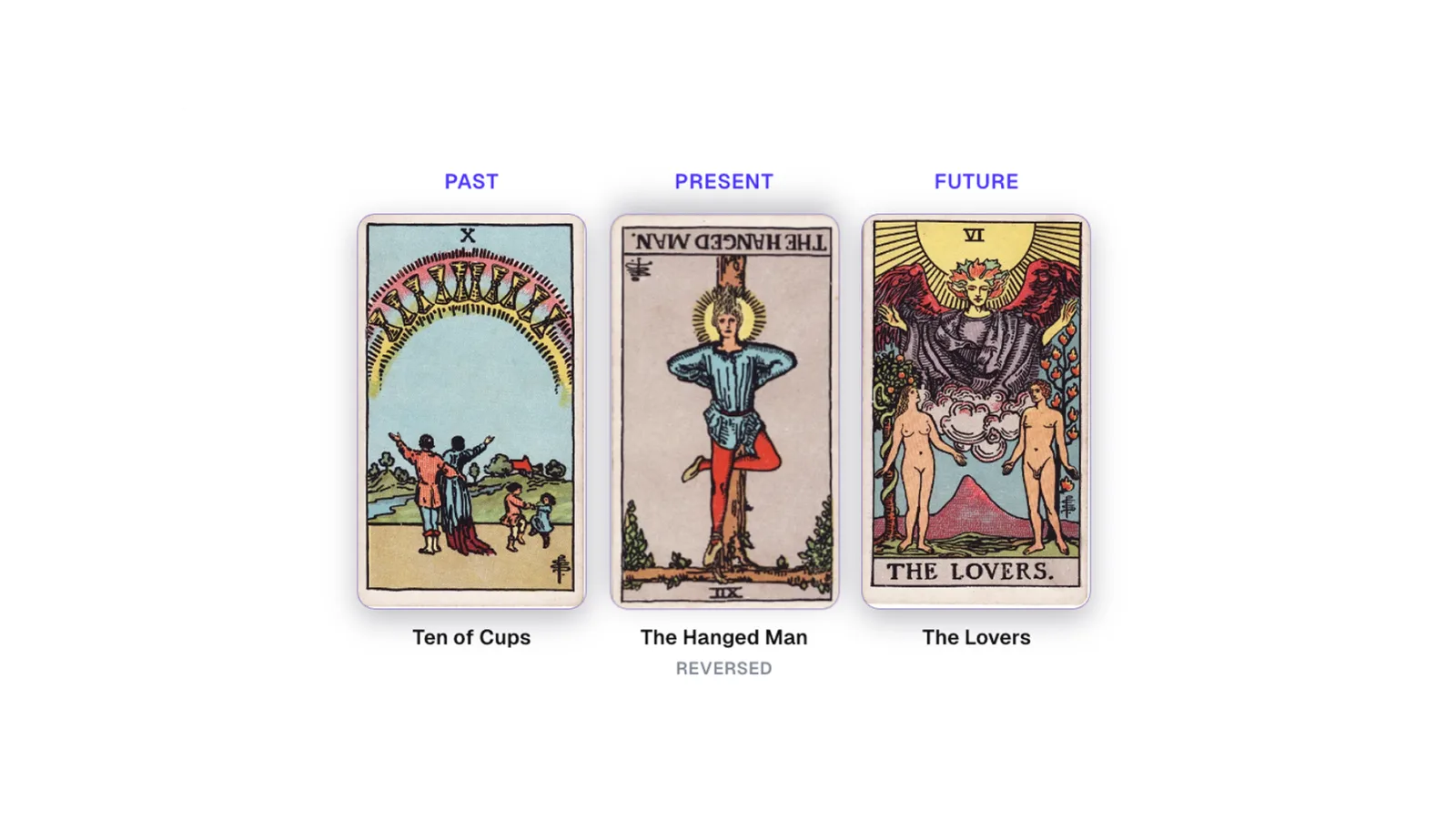
AI tarot reading is when a language model (like ChatGPT) has you draw real, but digital tarot cards from an interactive deck and explain the meaning of your draw as it relates to the question you've asked, or the thing you want to know.
When we're talking about AI tarot, we usually mean an online, AI-powered tool that uses an artificial intelligence chatbot that was taught specifically to interpret tarot cards.
AI tarot works very much like real tarot. Take a Rider-Waite deck with 78 cards split into 22 Major Arcana and 56 Minor Arcana across four suits, pick three from a shuffle and let the AI interpret your draw, including reversed and upside down variants.
You can use AI tarot in place of a human tarot reader, and it's not less accurate — with one caveat.
Let's walk through an example reading based on the Overchat AI tarot card reader to understand how it works.
1. Ask the cards a question to get started. You start by typing what you want guidance on into the question box.
In this example we'll type "When will I meet the love of my life?"
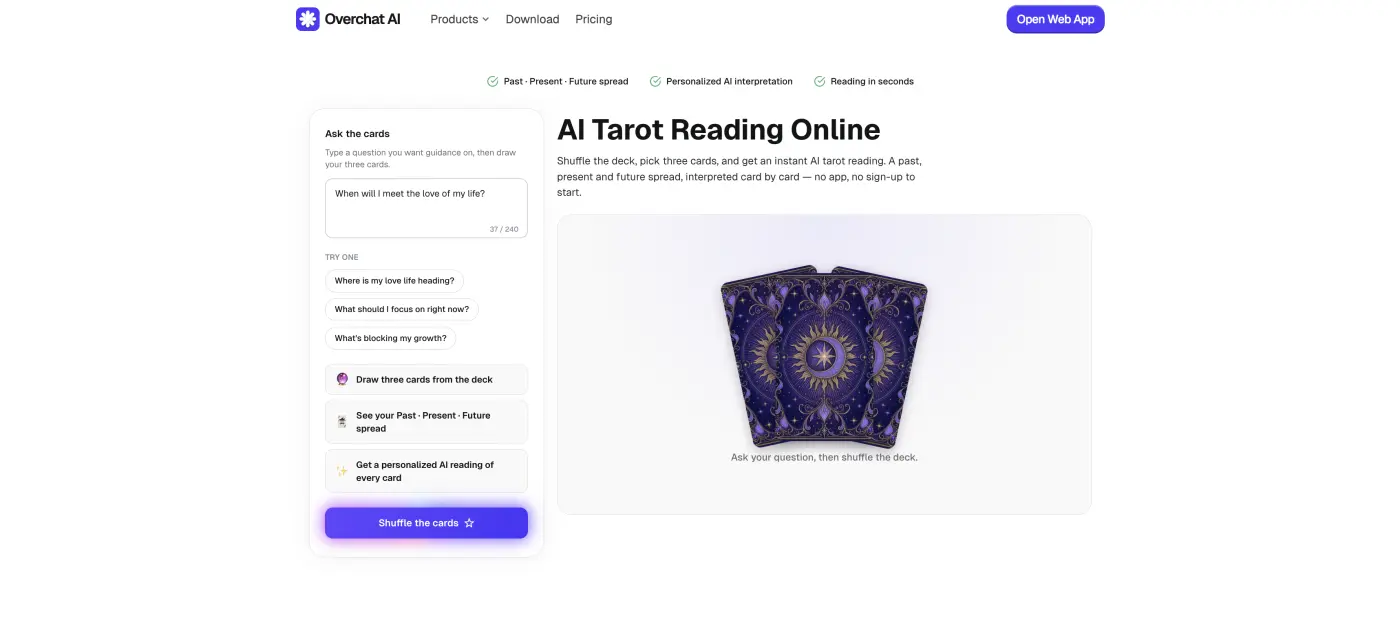
2. Shuffle and draw. Press Shuffle the cards and you see a fan of a digital 78-card Rider-Waite deck. Pick three.
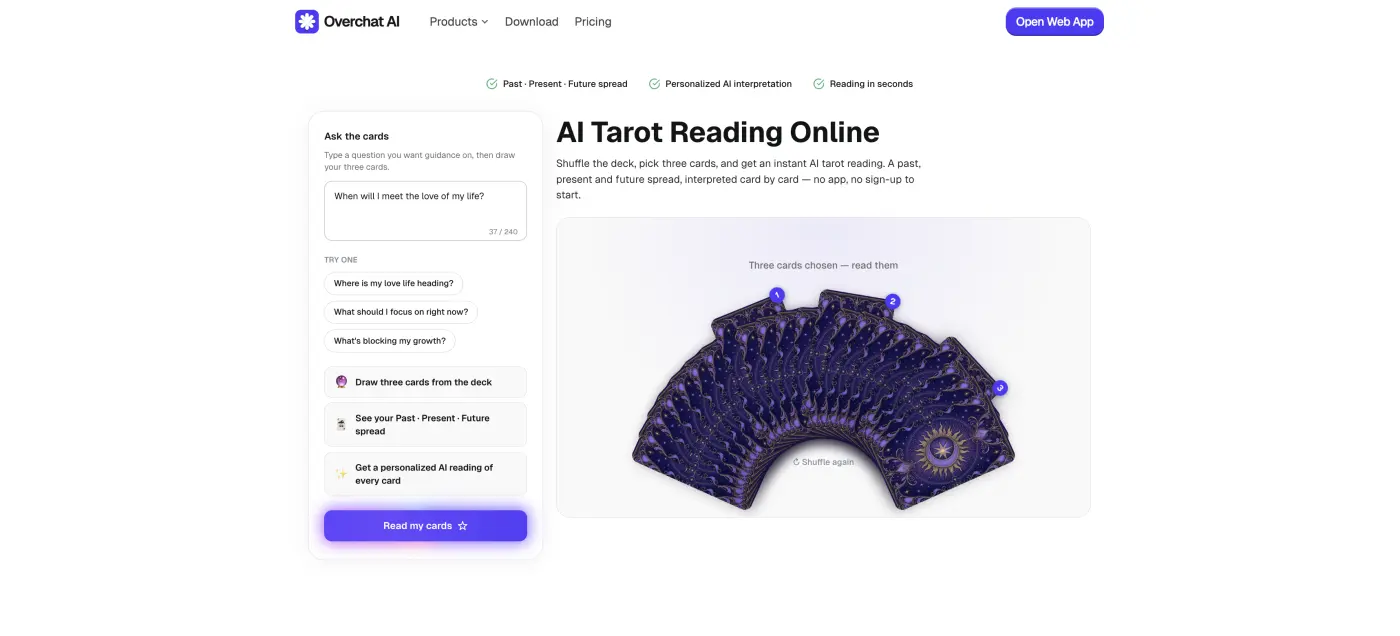
3. See the spread. The three cards flip into a Past · Present · Future layout — in this reading, the Ten of Cups, the Hanged Man (reversed), and the Lovers.
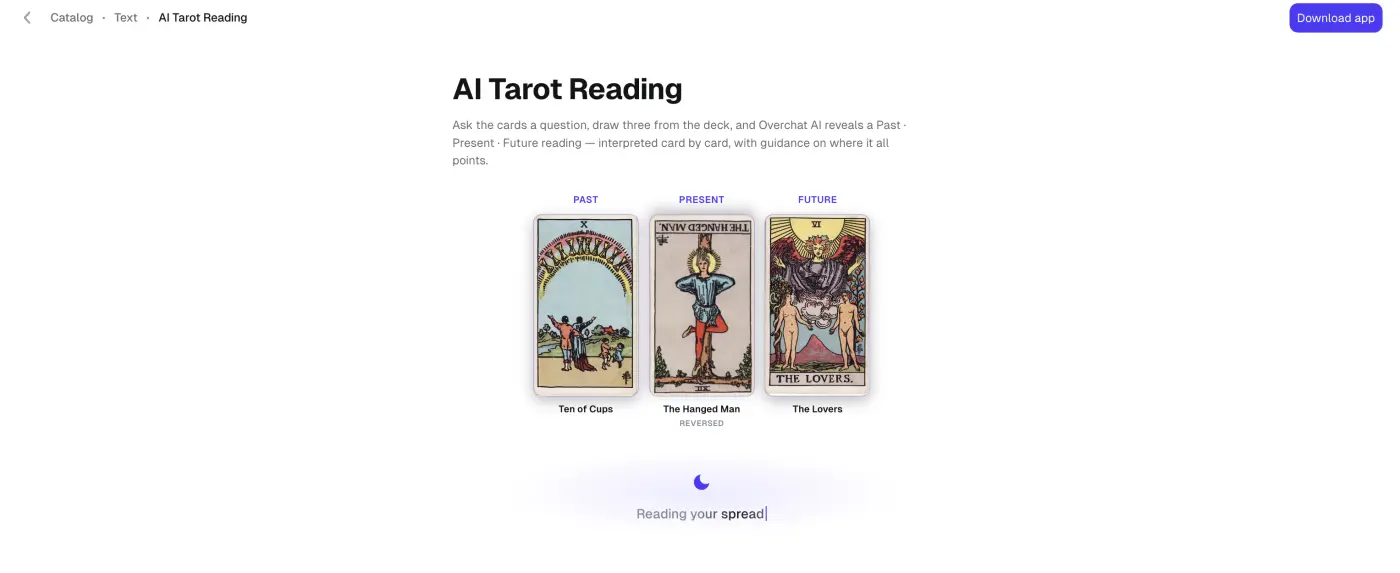
4. Get your AI tarot reading. At this point the AI takes the three cards and writes an interpretation card by card, then a Guidance section that ties the spread into one arc with a concrete next step.
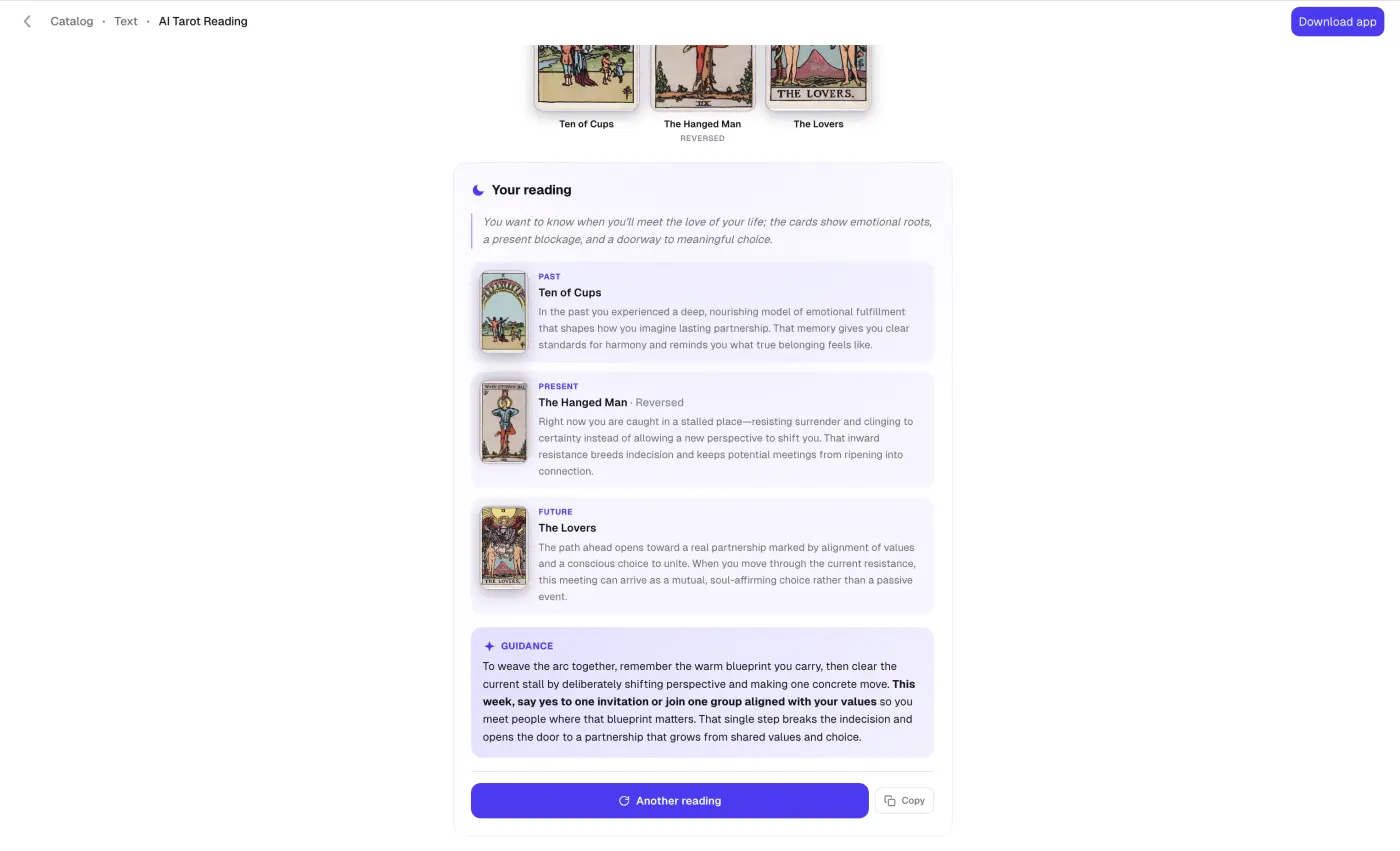
As you can see, the reading is highly personalized. In the example above the Hanged Man reversed in the "present" position gets read against your question about love.
Yes, absolutely — AI can read tarot cards. It has full knowledge about how to interpret every card in every position, and we'd argue that purely interpretively it's more accurate than most humans.
AI does have one limitation in tarot reading, though, and that's the fact that it doesn't read tarot intuitively.
When you join a session with a human reader, they don't just look at the cards but also at you — your reactions, voice, and so on.
Tarot readers call this intuition, and that's a big part of Tarot that the AI can't quite grasp.
Does it mean that the AI tarot is inaccurate? No — there's a counter argument to be made that human readers are, in fact, less consistent exactly because they may let their emotions influence the reading.
For tarot, when we say "accurate," we mean one of two things: did the AI read the cards correctly, and does the reading resonate with your situation?
Card interpretation. AI has full knowledge about how to read the cards and it won't misremember any of the meanings.
Resonance. This is a little bit more nuanced. One of the big things that makes tarot work is the fact that the human reader reads your reaction to the cards, allowing the practice to become a sort of self-reflection journey or almost therapeutic.
Of course, we won't claim that AI can predict the future based on tarot cards — but if you believe that the practice has that power, there's no reason why it works differently when AI does the shuffle.
There are a few reasons why you might choose an AI reader over a human reader and, conversely, some reasons why you'd do the opposite.
The case for an AI tarot reader:
AI tarot reading is also private, which matters when the question is something you'd rather not say out loud to a stranger.
The case for a human tarot reader:
Here's a table comparing both:
| AI tarot reading | Human tarot reader | |
|---|---|---|
| Availability | Any time, instant | By appointment |
| Cost | Free tools or a low monthly plan | $30–$150+ per session |
| Card knowledge | Every card and combination | Varies by reader |
| Consistency | Same quality every time | Depends on the reader's day |
| Privacy | Fully private | Shared with a person |
| Intuition | None | Core strength |
| Emotional attunement | None | Reads tone and body language |
| Reading a spread as a whole | Improving, still card-by-card | A skilled reader's strength |
Ask AI tarot:
What to avoid asking an AI tarot reader:
The Overchat AI tarot card reader is a web-based tarot reader that draws from a full 78-card Rider-Waite deck — all 22 Major Arcana and 56 Minor Arcana, with upright and reversed meanings respected, and gives the reading based on your question. It's part of the Overchat AI Pro subscription, alongside the rest of the platform's tools.
If you want to see how it compares to the other tools out there, we put it up against five more in our roundup of the best AI tarot reading apps.
Overchat AI Tarot is also part of an all-in-one AI platform. Overchat AI has hundreds of other tools — palm reading, text analysis, chat, image generation, writing tools, and more, all part of the same Overchat AI Pro subscription.
Common questions about AI tarot reading, answered.
Some AI tarot tools are free, and others are paid. Many free readers limit you to a basic single-card or three-card draw and put longer spreads behind a plan. The Overchat AI tarot reader is part of the paid Overchat AI Pro subscription, which also covers the rest of the platform's tools.
An AI reading is more private than sitting across from a person, since no one hears your question. The safety caveat is over-reliance, not privacy: treat it as a reflection tool, not an infallible predictor, and don't feed a real-time crisis into an app. Check any tool's data policy if you're typing something sensitive.
No. AI tarot doesn't predict the future, and neither does traditional tarot — most readers describe tarot as a tool for reflection, not fortune-telling. AI can help you spot patterns and think through a situation, but it has no ability to name a specific future event beyond chance.
It depends on what you want. AI is better on availability, cost, privacy, and consistency, and it knows every card cold. A human reader is better on intuition, emotional attunement, and reading a full spread as one story. For a quick private reading AI wins; for a reading that's really a conversation, a person does.
The strongest readings come from tools built on frontier language models, because interpretation quality tracks the model underneath. The Overchat AI tarot reader runs on models like GPT-5.5 and Claude Opus 4.8 and works from a full 78-card Rider-Waite deck, which makes it one of the best options to start with. For a side-by-side look at the alternatives, see our roundup of the best AI tarot reading apps.


