
GPT-5.6

Chat with GPT-5.6, OpenAI's newest frontier family — Sol, Terra, and Luna. It handles text and images, ships a 1.5M-token context window, and is tuned hard for agentic coding, cybersecurity, and long-horizon reasoning.

GPT-5.6 at a Glance

GPT-5.6 is OpenAI's newest model family, released July 9, 2026. It comes in three tiers — Sol, the frontier flagship for the hardest agentic and reasoning work; Terra, the everyday model that matches GPT-5.5 quality at roughly half the price; and Luna, the fast, lowest-cost option for high-volume tasks. All three take text and image input, share a 1.5M-token context window, and post gains in coding, cybersecurity, and science over GPT-5.5.

Access GPT-5.6 on Overchat AI

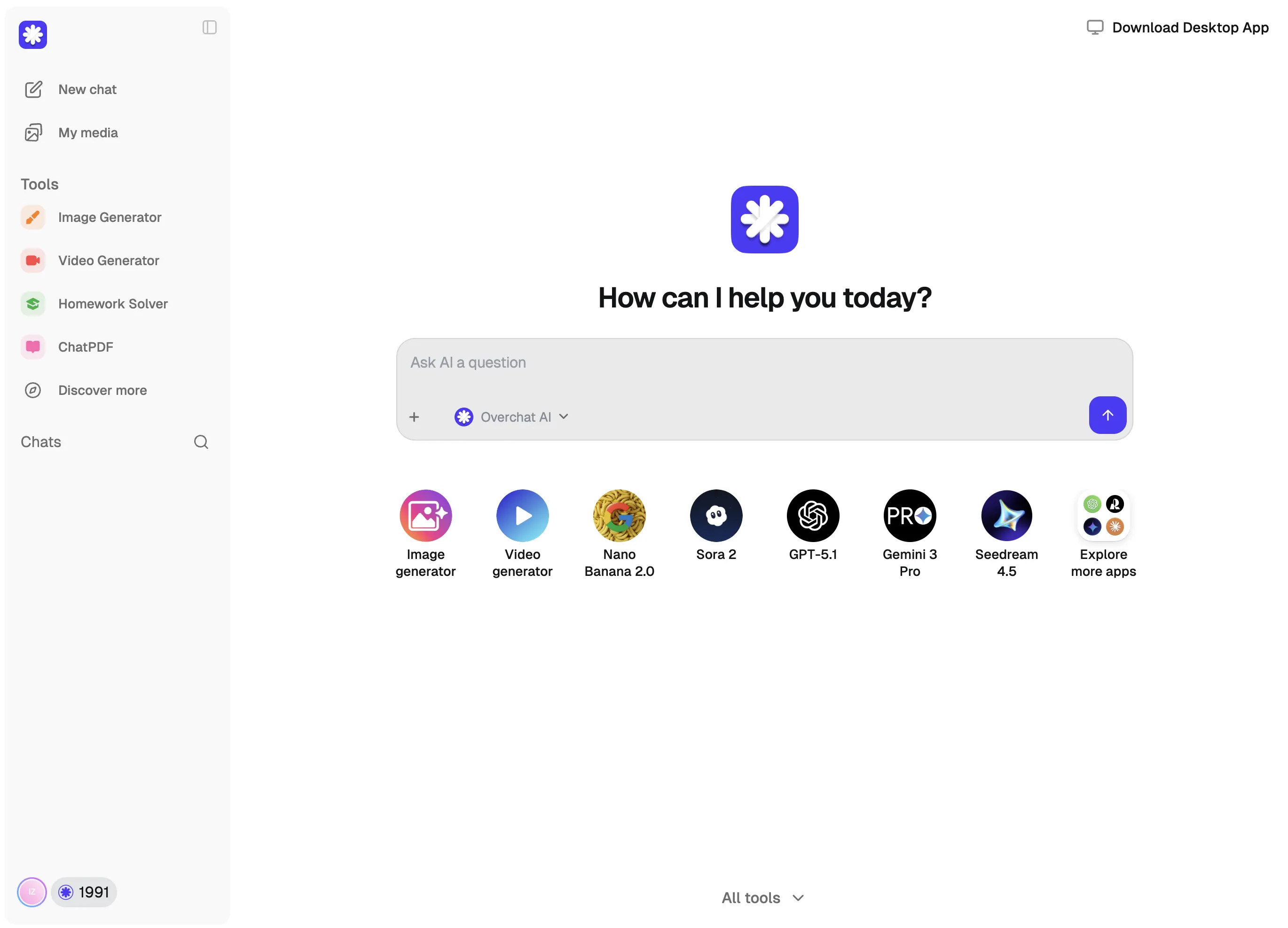
Access GPT-5.6 on Overchat AI alongside Claude, Gemini, DeepSeek, and other top models. Pick GPT-5.6 from the model selector and start chatting right away.

Minimalist UI illustration showing Overchat AI chat and document interface, with layered cards, message bubbles, and simplified icons in blue and white, representing AI-powered communication and content generation.
⭐️

Three tiers: Sol, Terra, Luna

GPT-5.6 ships as three models instead of one. Sol is the flagship for the hardest agentic and coding work, Terra is the balanced everyday pick at about half the cost of GPT-5.5, and Luna is the fastest, cheapest option. The tier names carry forward across generations, so you pick by the job, not the version number.

🔺

Best-in-class agentic coding

On TerminalBench 2.1, the benchmark for command-line agentic coding, Sol scores 88.8% and Sol Ultra hits 91.9% — ahead of Claude Mythos 5 (88.0%) and well past GPT-5.5's 83.4%. In Ultra Mode, Sol breaks a task into parts, spawns parallel subagents to work each one, then synthesizes the results.

🔻

1.5M-token context window

GPT-5.6 extends the context window to 1.5 million tokens, up from 1 million in GPT-5.5. In practice you can feed it entire codebases, long legal contracts, or book-length documents in a single conversation and it keeps track of the details from start to finish.

What Is GPT-5.6?

GPT-5.6 is a family of large language models made by OpenAI and the direct successor to GPT-5.5. It ships in three tiers — Sol, Terra, and Luna — that share the same generation but target different jobs. OpenAI released it as a limited preview in June 2026 under government oversight, then opened it to the public on July 9, 2026.

OpenAI was founded in 2015 by Sam Altman, Elon Musk, and others. The company is best known for ChatGPT, which became the fastest-growing consumer app in history after launching in late 2022. GPT-5.6 continues the line of models that started with GPT-1 in 2018 and has evolved through GPT-2, GPT-3, GPT-4, GPT-5, and GPT-5.5.

The headline change in GPT-5.6 is the tiered lineup. Instead of a single model, OpenAI split the generation into Sol for frontier work, Terra for balanced everyday use at roughly half of GPT-5.5's cost, and Luna for the cheapest, fastest responses. The tier names are meant to persist across future generations, so Sol, Terra, and Luna become durable labels for capability rather than one-off releases.

GPT-5.6 Technical Details

The context window grows to 1.5 million tokens, up from 1 million in GPT-5.5. For practical use, that means entire codebases, long legal contracts, or book-length documents fit in a single conversation without truncation. All three tiers accept text and image input and return text output, tuned specifically for agentic coding, cybersecurity, and biology.

GPT-5.6 is a proprietary family distributed by OpenAI through its API and ChatGPT. Like other GPT models, it is not open-source and cannot be self-hosted. Third-party platforms like Overchat AI provide access to it alongside competing models such as Claude Opus 4.8, Gemini 3 Pro, and DeepSeek V3.2.

On coding benchmarks the gains are clear. On TerminalBench 2.1, Sol scores 88.8% and Sol Ultra reaches 91.9%, both ahead of Claude Mythos 5 at 88.0%; Terra ties Claude Fable 5 at 84.3%, and Luna posts 82.5% — while GPT-5.5 sat at 83.4%. In Ultra Mode, Sol decomposes a request and spawns parallel subagents that each handle a component before the results are merged.

OpenAI positions the GPT-5.6 tiers as one lineup covering everything from cheap high-volume calls to frontier agentic work, all on the same generation. For developers, that means you can move between Luna, Terra, and Sol on a single API without switching model families — pick the tier that fits the task and the budget.
How to Use GPT-5.6 on Overchat AI

1.

Open Overchat AI

Visit the Overchat AI web app, or install the mobile app, and select GPT-5.6 from the model selector.

2.

Ask GPT-5.6 anything

Type your question or attach files — PDFs, DOCX, or images. GPT-5.6 reads text and images natively, so you can mix text and visuals in the same conversation and put its 1.5M-token context to work on long inputs.

3.

Keep chatting

Continue the conversation as long as you need. GPT-5.6 keeps track of context across long sessions, so it works well for extended coding sessions, research, legal review, or any task that takes multiple rounds of back-and-forth.

Get Started
Use GPT-5.4 on Overchat AI

FAQ

What is GPT-5.6?

GPT-5.6 is OpenAI's newest model family, released to the public on July 9, 2026. It comes in three tiers — Sol (frontier flagship), Terra (everyday, about half the cost of GPT-5.5), and Luna (fastest and cheapest) — all with a 1.5M-token context window and text-plus-image input tuned for agentic coding, cybersecurity, and science. You can use it on Overchat AI by selecting GPT-5.6 from the model picker.

How to use GPT-5.6?

Go to Overchat AI and pick GPT-5.6 from the model selector. Type your question, attach files or images if needed, and press Send. You can ask follow-up questions, upload documents, and have long multi-turn conversations just like you would in ChatGPT.

Who made GPT-5.6?

GPT-5.6 was created by OpenAI, a San Francisco-based AI company founded in 2015 by Sam Altman, Elon Musk, and others. OpenAI is best known as the maker of ChatGPT. GPT-5.6 launched as a limited preview in June 2026 and rolled out to the public on July 9, 2026, as the Sol, Terra, and Luna tiers.

More AI Models

Chat GPT Logo

GPT-5.5

OpenAI's latest frontier model with native multimodality, extended context, and stronger agentic tool use.

Ask GPT-5.5 ↗
DeepSeek logo

DeepSeek V3.2

Advanced reasoning model designed for complex problem solving, mathematical reasoning, and programming.

Ask DeepSeek ↗
Claude logo

Claude Opus 4.6

Anthropic's flagship model excelling at reasoning, knowledge, math, and coding tasks.

Ask Claude ↗
Gemini Logo

Gemini 3 Pro

Google's most capable model with advanced multimodal understanding and generation.

Ask Gemini ↗
Grok logo

Grok 4.1

xAI's powerful model with real-time knowledge and witty, direct responses.

Ask Grok ↗
Qwen logo

Qwen 3.5

Alibaba's advanced model with strong multilingual capabilities and reasoning skills.

Ask Qwen ↗

About Overchat AI

Overchat AI brings you the power of the world's top AI models: ChatGPT, Claude, Gemini, Mistral, and more.

Overchat AI Interface

From The Blog

Overchat AI For All Platforms

Available on Web, iOS, and Android. Access your AI assistant anywhere, anytime.

Google Play Store badgeApp Store badge
Overchat AI Desktop and mobile interfaces