What Is DeepSeek AI — And How Does It Compare To ChatGPT?
Last Updated:
2026-09-26
What Is DeepSeek AI — And How Does It Compare To ChatGPT?
If you're wondering: what is DeepSeek AI, the answer is quite simple. DeepSeek AI is a Chinese AI research lab that builds large language models. The company released several models in late 2024 and early 2025 that compete directly with OpenAI's GPT-4 and Anthropic's Claude, but at a fraction of the operating cost.
The deepseek ai model lineup includes DeepSeek V3.2 (their main conversational model) and DeepSeek R1 (their reasoning-focused model that shows its thinking process). They've gained attention because their models perform comparably to much more expensive alternatives in benchmarks.
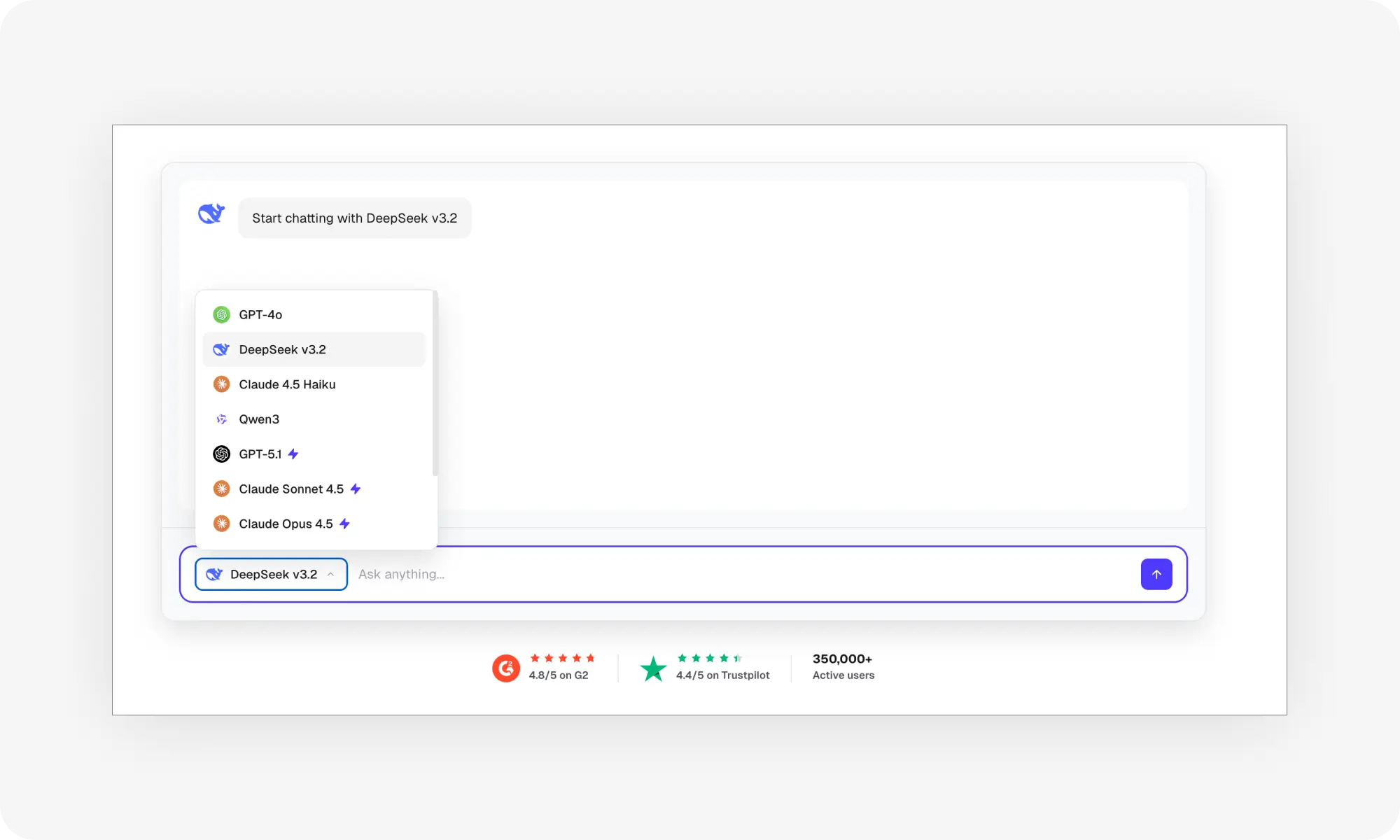
DeepSeek makes its models available through DeepSeek chat on their website, through API access, and via third-party platforms that integrate their technology. You can also chat with DeepSeek on Overchat AI.
DeepSeek is owned by High-Flyer Capital Management, a Chinese quantitative hedge fund based in Hangzhou.
Unlike most Chinese tech giants, DeepSeek releases open-weight models that researchers can download and run locally, available on Hugging Face.
DeepSeek R1 is a reasoning model that shows its full thinking process before answering — especially useful for math, coding, and logic tasks where you need to verify the AI's work.
DeepSeek V4 (released April 2026) is the current flagship — a Mixture-of-Experts model with a 1M-token context window and configurable reasoning depth. Available in V4-Pro (1.6T parameters, 49B active) and V4-Flash (284B parameters, 13B active).
DeepSeek V3.2 remains the main everyday model in most integrations (including Overchat AI) — fast, cheap, with a 128K context window.
Access options: free through Overchat AI with no signup, via the DeepSeek API (OpenAI-compatible format), or locally if you have the hardware (80GB+ VRAM for the full model).
vs GPT-5.2: GPT-5.2 wins on multimodal input/output (DeepSeek is text-only), writing polish, and ecosystem integrations. DeepSeek wins on cost, open weights, local deployment, and (with V4) context window length.
Model lineup: V4 as the new flagship, V3.2 for everyday use with Sparse Attention for long-context efficiency, R1 for visible step-by-step reasoning, plus specialised variants like DeepSeek-Prover for formal math.
Bigger picture: DeepSeek trained V3 for around $6M in compute — a fraction of OpenAI's hundreds of millions — proving competitive AI doesn't require massive budgets.
Who Owns DeepSeek AI
DeepSeek is owned by High-Flyer Capital Management, a quantitative hedge fund based in Hangzhou, China. The fund's founder, Liang Wenfeng, started DeepSeek as an AI research division.
The company operates somewhat independently from typical chinese ai companies. They release their models with open weights, meaning researchers and developers can download and run them locally. Most Chinese tech giants like Baidu or Alibaba keep their models proprietary.
This open approach has made DeepSeek popular with the developer community. You can find their models on Hugging Face and run them on your own hardware if you have the resources.
DeepSeek AI Features
Deep Reasoning
DeepSeek R1 — and the latest V4 in “thinking” mode — show you the model’s thinking process before giving an answer. When you ask a question, the model generates a "reasoning trace" where you see it working through the problem step by step.
For example, if you ask it to solve a math problem, you'll see it set up equations, check its work, catch mistakes, and revise its approach—all visible in the output before it gives you the final answer. This chain-of-thought reasoning makes it easier to spot where the model might be wrong and helps with debugging complex problems.
This feature is particularly useful for coding, mathematics, and logical reasoning tasks where you need to verify the AI's work.
Code Generation
DeepSeek V3.2 and the newer V4 both handle multiple programming languages including Python, JavaScript, C++, and Java. They can write complete functions, debug existing code, and refactor messy implementations.
The models were trained on a large corpus of code and can understand context across files. If you're working on a project, you can give them multiple files and they will maintain consistency with your existing codebase. V4 in particular benefits from its 1M-token context window — large enough to fit an entire mid-sized codebase in a single prompt.
Long Context Window
DeepSeek V3.2 processes up to 128,000 tokens in a single conversation — roughly 90,000 words or about 300 pages of text. DeepSeek V4 extends this dramatically to a full 1 million tokens, on par with the longest context windows from frontier closed models. You can upload entire codebases, long documents, or multiple research papers and ask questions about all of them at once.
Multilingual Processing
The model handles Chinese and English particularly well since it was trained heavily on both languages. It also supports Japanese, Korean, Spanish, French, German, and other major languages.
How to Use DeepSeek AI
You can access DeepSeek through several methods depending on what you need.
If you’re a developer, you can also use the DeepSeek API by generating API keys from their dashboard. The API follows OpenAI's format, so if you've integrated ChatGPT before, you can swap in DeepSeek endpoints with minimal code changes.
For advanced users, you can download the model weights and run DeepSeek locally. This requires significant hardware (multiple GPUs with at least 80GB of VRAM for the full model), but gives you complete control and privacy.
DeepSeek AI Pricing
DeepSeek undercuts most competitors. The free tier gives you full access to both deepseek chat models through their website.
There are rate limits, but for casual use you won't hit them. Most people can use DeepSeek without paying anything, unless you’re planning to use the API, which costs money.
That being said, DeepSeek API also costs significantly less compared to ChatGPT or Claude. The table below compares API pricing between popular models:
Model
Input (per 1M tokens)
Output (per 1M tokens)
DeepSeek V3.2
$0.28
$0.39
DeepSeek R1
$0.55
$2.19
GPT-5.2
$1.75
$14.00
Gemini 3 Pro
$2.00
$12.00
Claude Opus 4.5
$5.00
$25.00
DeepSeek V3.2 is dramatically cheaper than competing models. It costs 6x less than GPT-5.2, 7x less than Gemini 3 Pro, and 18x less than Claude Opus 4.5 for input tokens. Output tokens show similar savings.
Even DeepSeek R1 (the reasoning model) costs 3x less than GPT-5.2 and 6x less than Gemini 3 Pro. A million tokens is about 750,000 words. Unless you're processing massive amounts of text daily, costs stay low.
DeepSeek vs ChatGPT
The table below shows how DeepSeek V3.2 and R1 compare to ChatGPT on current benchmarks. DeepSeek V4 was released in April 2026 and broadly closes the gap with GPT-5 family on reasoning benchmarks — third-party numbers are still being published as of mid-2026, so we show the V3.2/R1 figures here and discuss V4 qualitatively.
Benchmark
DeepSeek V3.2
DeepSeek R1
GPT-5.2 Thinking
AIME 2025 (Math)
96.0%
87.5%
100%
GPQA Diamond (Science)
59.1%
81.0%
92.4%
SWE-bench Verified (Coding)
73.1%
57.6%
80.0%
ARC-AGI-2 (Abstract Reasoning)
—
—
52.9%
Key Differences:
Context window depends on the DeepSeek model. GPT-5.2 has a 400,000 token context window. DeepSeek V3.2 sits at 128,000 tokens (smaller than GPT-5.2), but DeepSeek V4 jumps to 1 million tokens — more than double GPT-5.2 and on par with the longest closed-model windows.
GPT-5.2 supports multimodal inputs and outputs (images, vision tasks). DeepSeek V3.2 and R1 are text-only. If you need image analysis, GPT-5.2 is required.
DeepSeek's open weights mean you can run it locally if data privacy matters or if you want to fine-tune the model. GPT-5.2 only runs on OpenAI's servers.
GPT-5.2’s writing style tends to feel more natural. It's been heavily optimized for consumer chat experiences.
ChatGPT has more third-party integrations, better brand recognition, and a larger ecosystem. DeepSeek is growing fast among developers who prioritize cost efficiency and open-source flexibility.
DeepSeek Models Explained
DeepSeek V4 (V4-Pro and V4-Flash)
Released in April 2026, V4 is DeepSeek’s current flagship and the biggest leap since V3. It comes in two sizes: V4-Pro (1.6 trillion total parameters, 49B active) and V4-Flash (284B total, 13B active). Both are Mixture-of-Experts models with a 1-million-token context window.
The headline architectural change is a new Hybrid Attention Architecture combining Compressed Sparse Attention and Heavily Compressed Attention, which lets V4-Pro use only about 27% of the compute and 10% of the memory that V3.2 needed for the same 1M-token workload. V4 also introduces configurable reasoning depth — developers can dial the amount of thinking effort per request.
Both V4 models are open-weight and available on Hugging Face. Use V4-Pro when you want maximum quality on hard tasks or need to process huge documents; V4-Flash when speed and cost matter more than raw performance.
DeepSeek V3.2
This is still the workhorse model in many integrations (including Overchat AI). It’s optimized for chats, writing simple code, and analyzing text. This version includes DeepSeek Sparse Attention (DSA), which dramatically reduces costs for long-context processing. Use this for everyday tasks where you need reliable performance without showing the thinking process — and where V4’s larger footprint isn’t necessary.
DeepSeek R1
This is the original reasoning model, released in early 2025. It shows its chain of thought and specializes in complex problem-solving. When you ask it a question, you see the model working through the problem step-by-step before it gives you the final answer. Use this when you need to verify the AI's logic or work through difficult technical problems like mathematics, competitive programming, or complex debugging.
DeepSeek V3.2-Speciale (historical)
A limited-time, high-compute variant of V3.2 optimized for maximum performance on elite benchmarks. It achieved gold-medal-level results on IMO, IOI, and ICPC competitions and was available through December 15, 2025. It’s no longer a live endpoint, but its results were what proved V3.2’s underlying architecture could match frontier closed models on hard reasoning tasks — paving the way for V4.
Bottom Line
Key takeaways:
DeepSeek is an open-weights AI model similar to OpenAI's GPT.
The company is owned by High-Flyer Capital Management, a Chinese quantitative hedge fund.
DeepSeek V3.2 costs roughly 6-36x cheaper than GPT-5.2 to use through their API, depending on variant.
DeepSeek V3.2 scored 96.0% on AIME 2025 math benchmarks, matching GPT-5.2's performance at a fraction of the cost.
The main models are V4 (the new flagship with a 1M-token context), V3.2 for cheap everyday use, and R1 for reasoning tasks that show the model's thinking process.
DeepSeek proved that competitive AI models don't require massive budgets. They built V3 for roughly $6 million in compute costs — all the while, OpenAI spends hundreds of millions to train their models.
This efficiency comes from better training techniques and smart architectural improvements.
For users, it means more options. You're not locked into expensive API providers if you need powerful AI capabilities. Open weights mean you can modify and customize the model for specific needs.