
Face Symmetry Test — Check Your Face Symmetry Online
How symmetrical is your face? Upload a photo and AI measures your facial symmetry — a symmetry score plus a feature-by-feature breakdown.
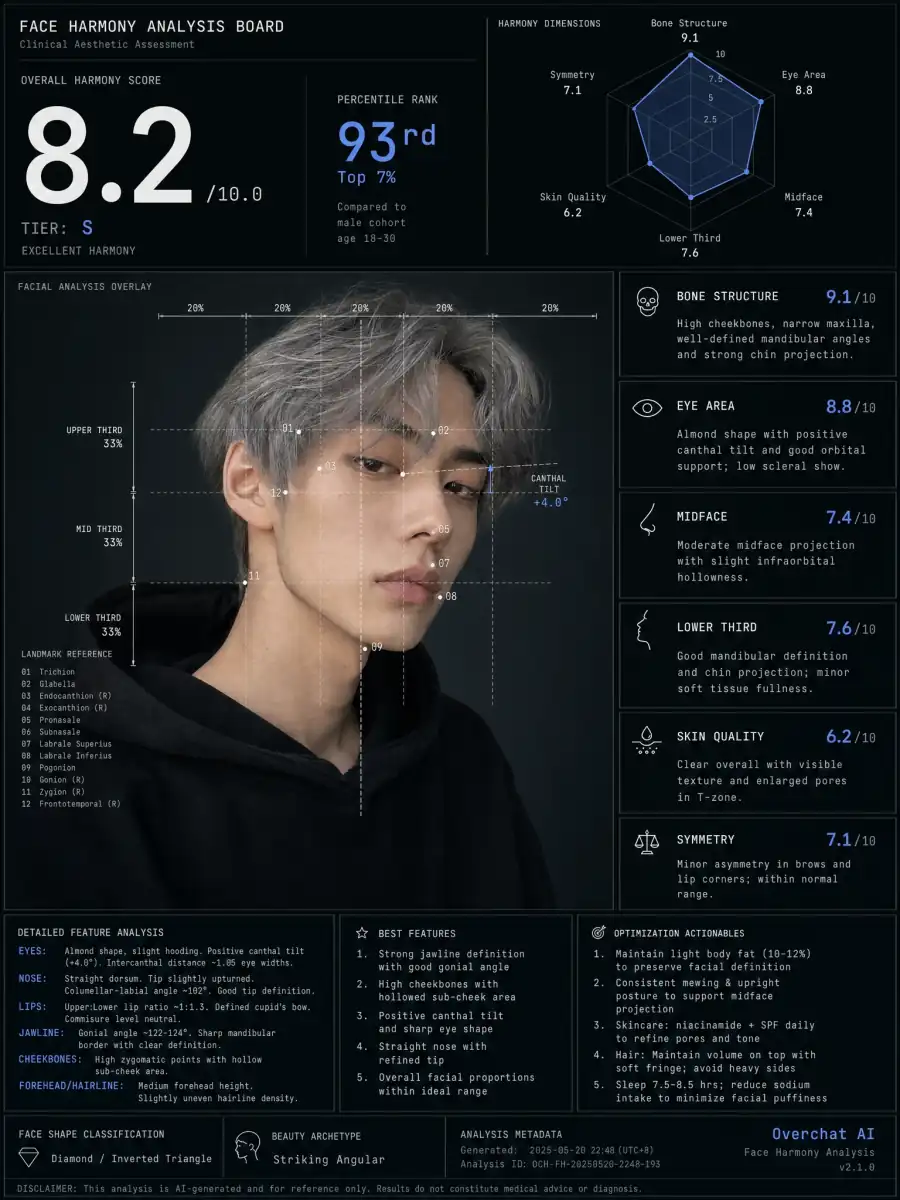
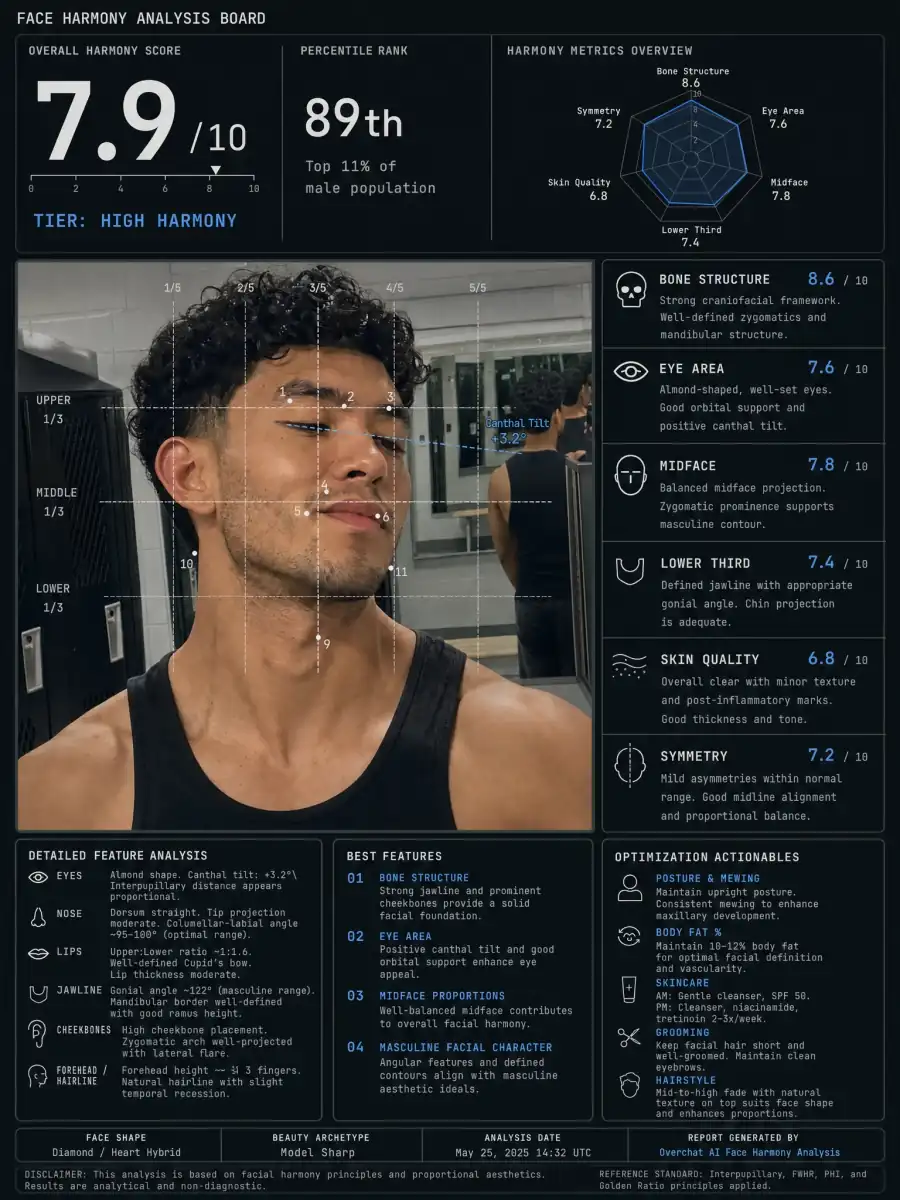
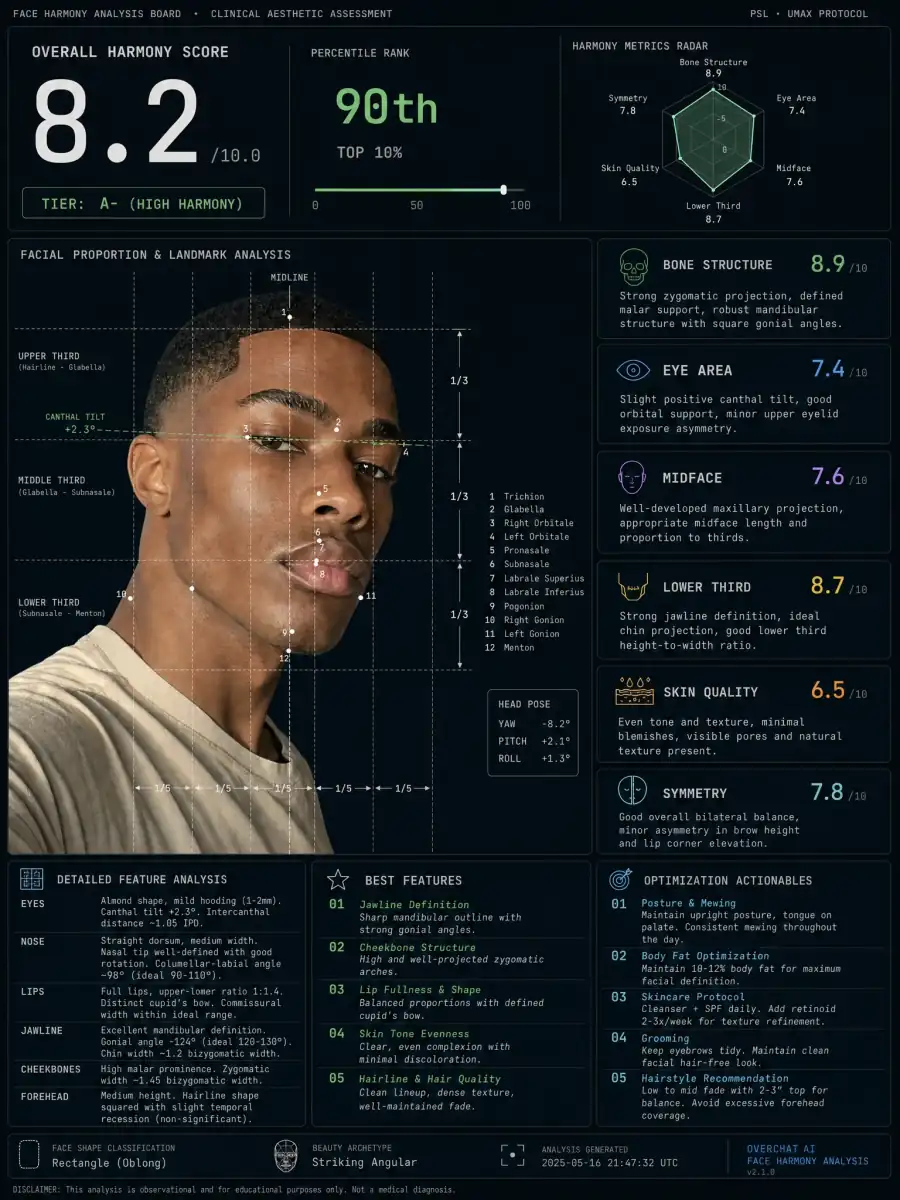
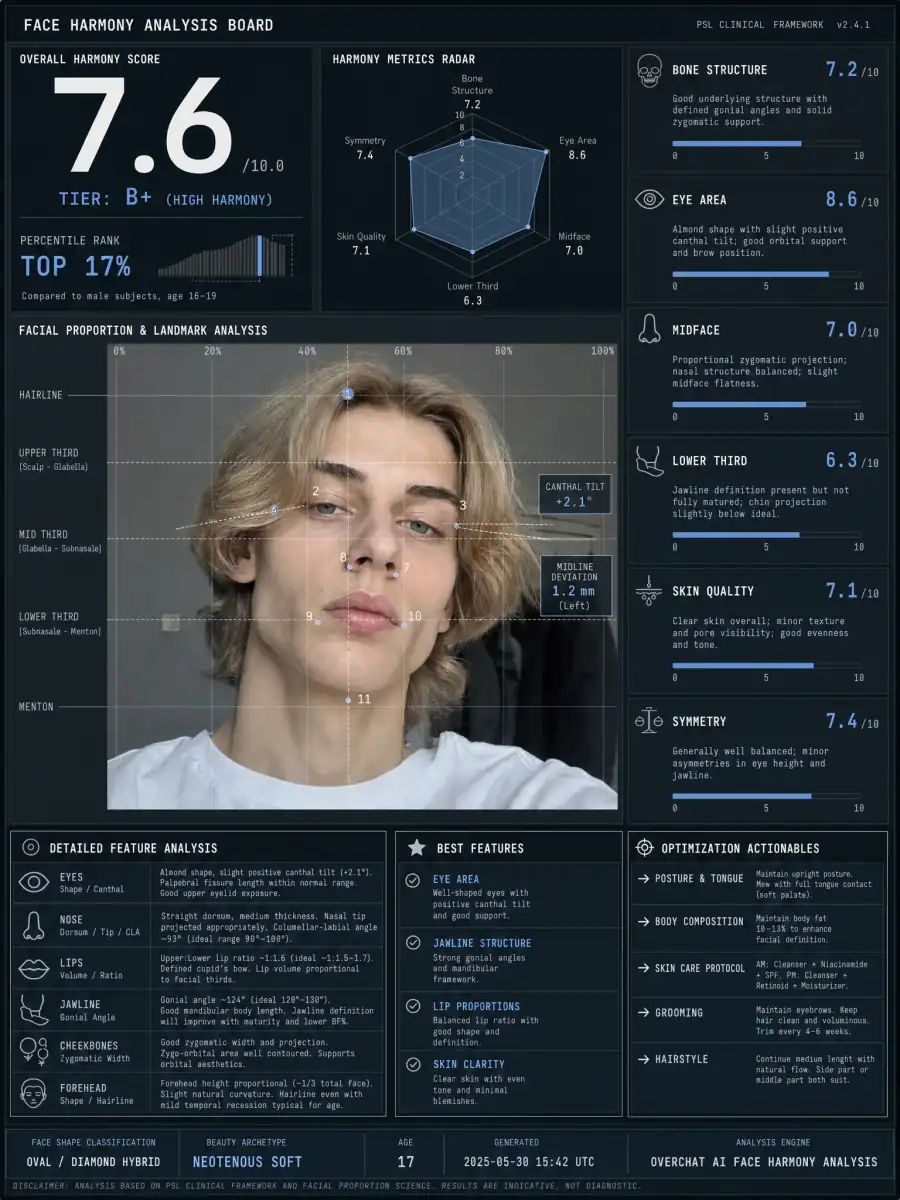
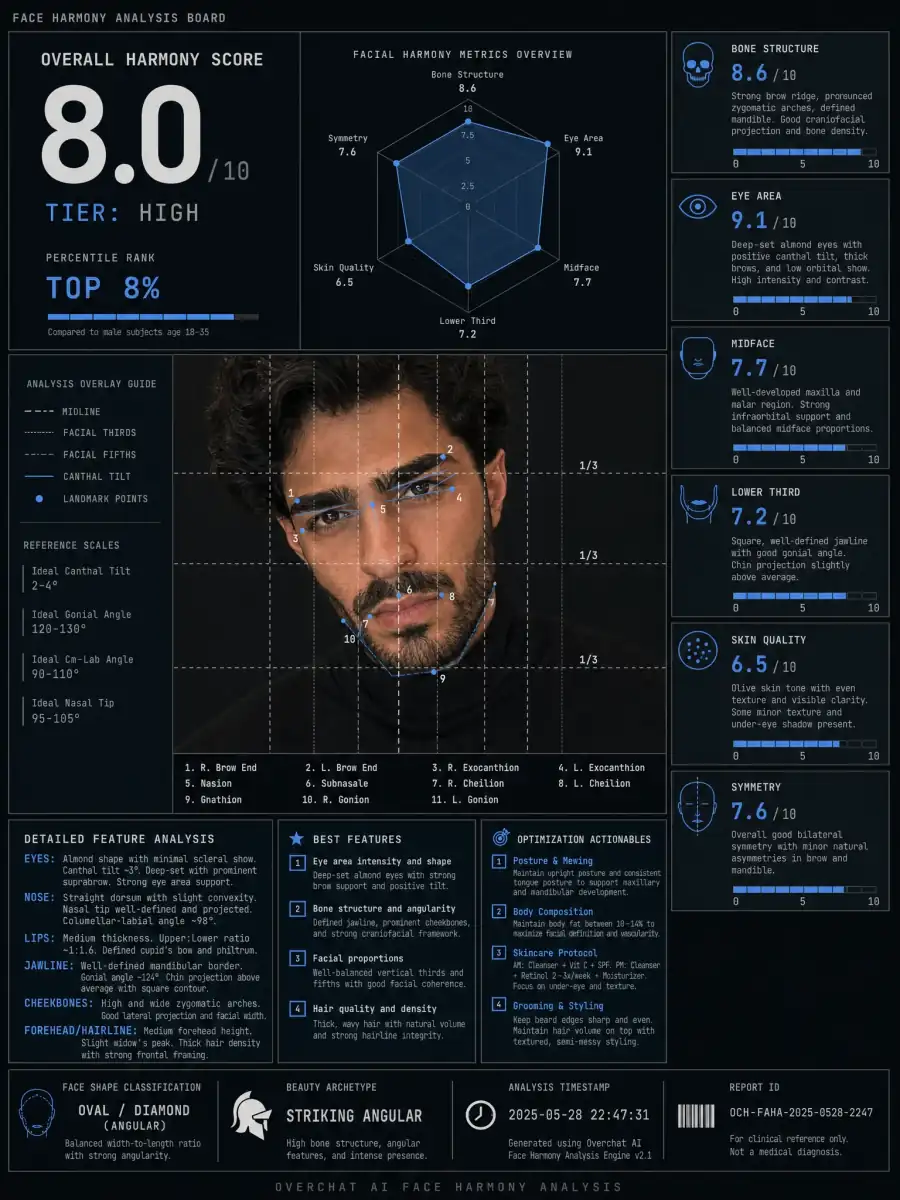
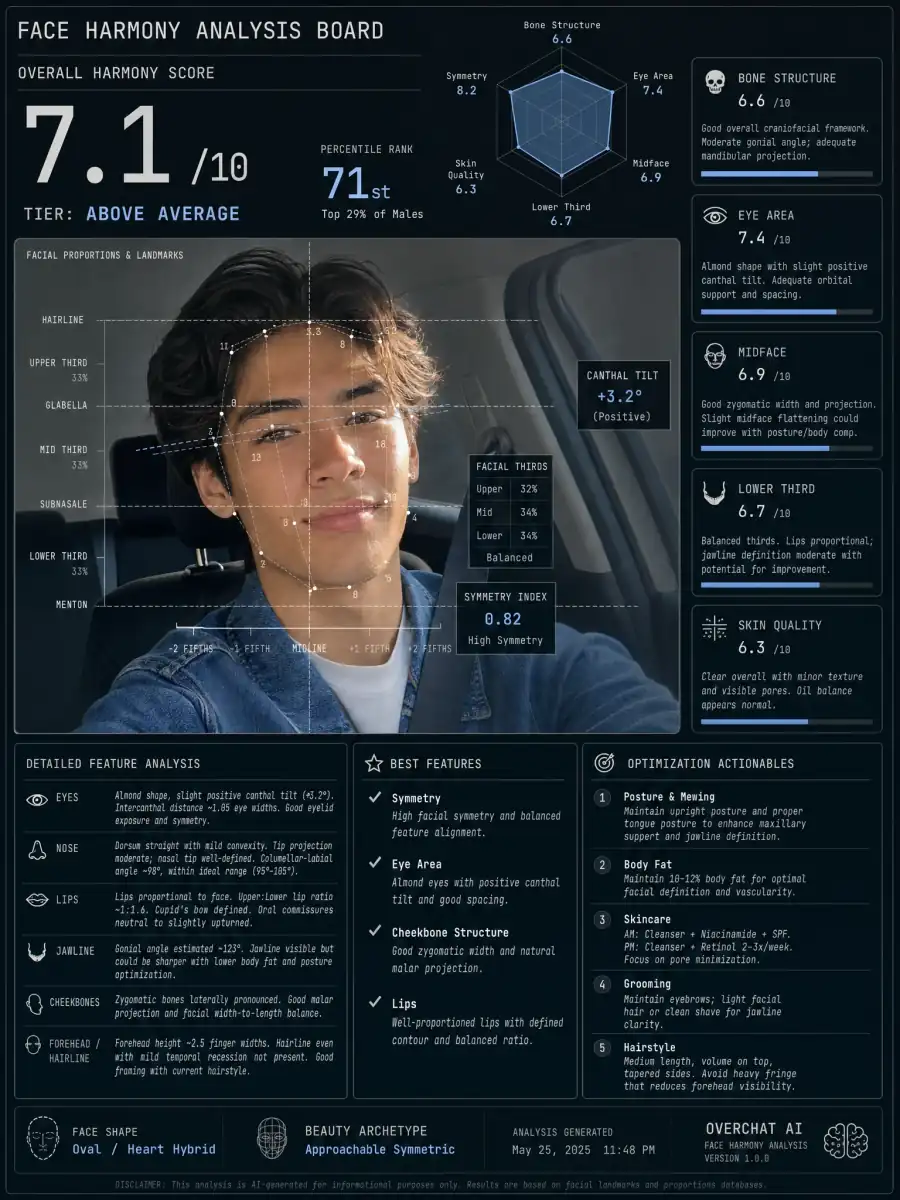
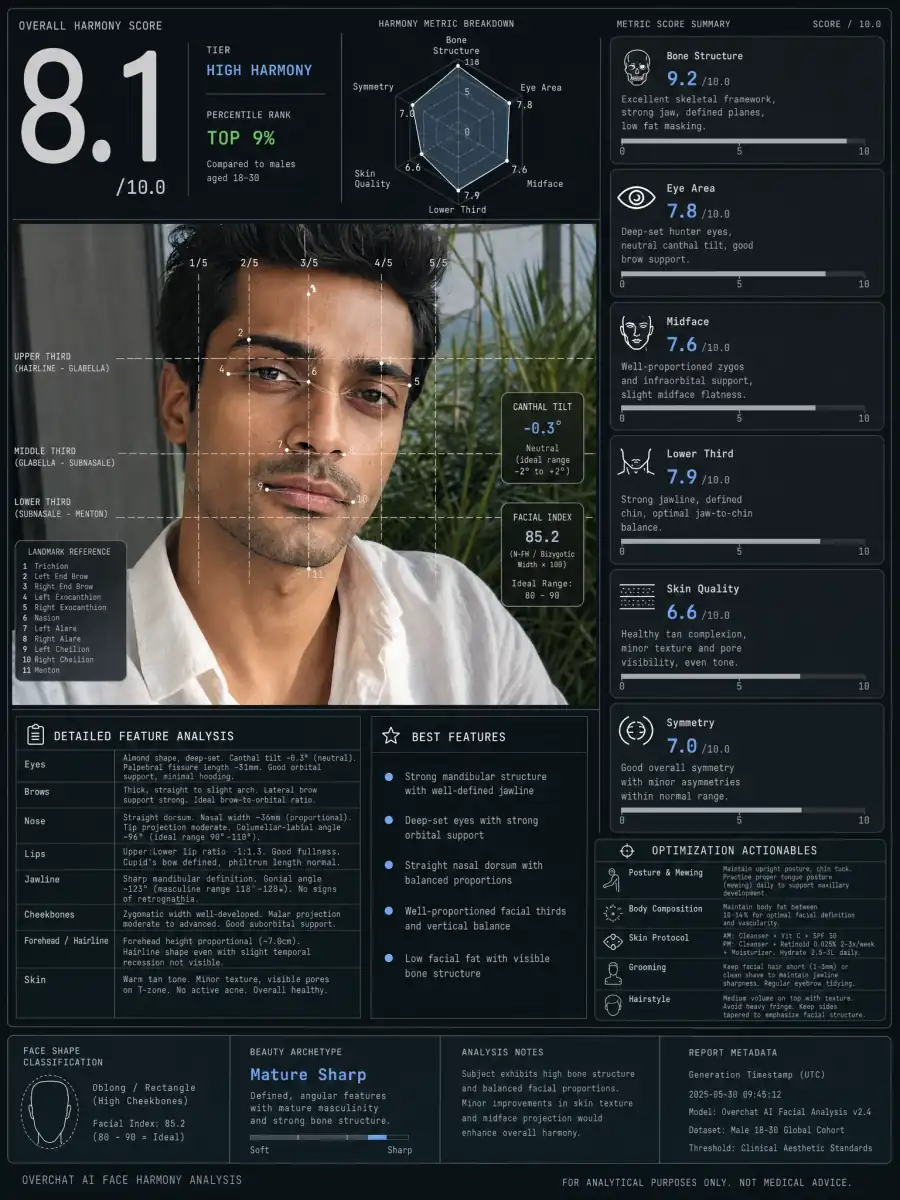
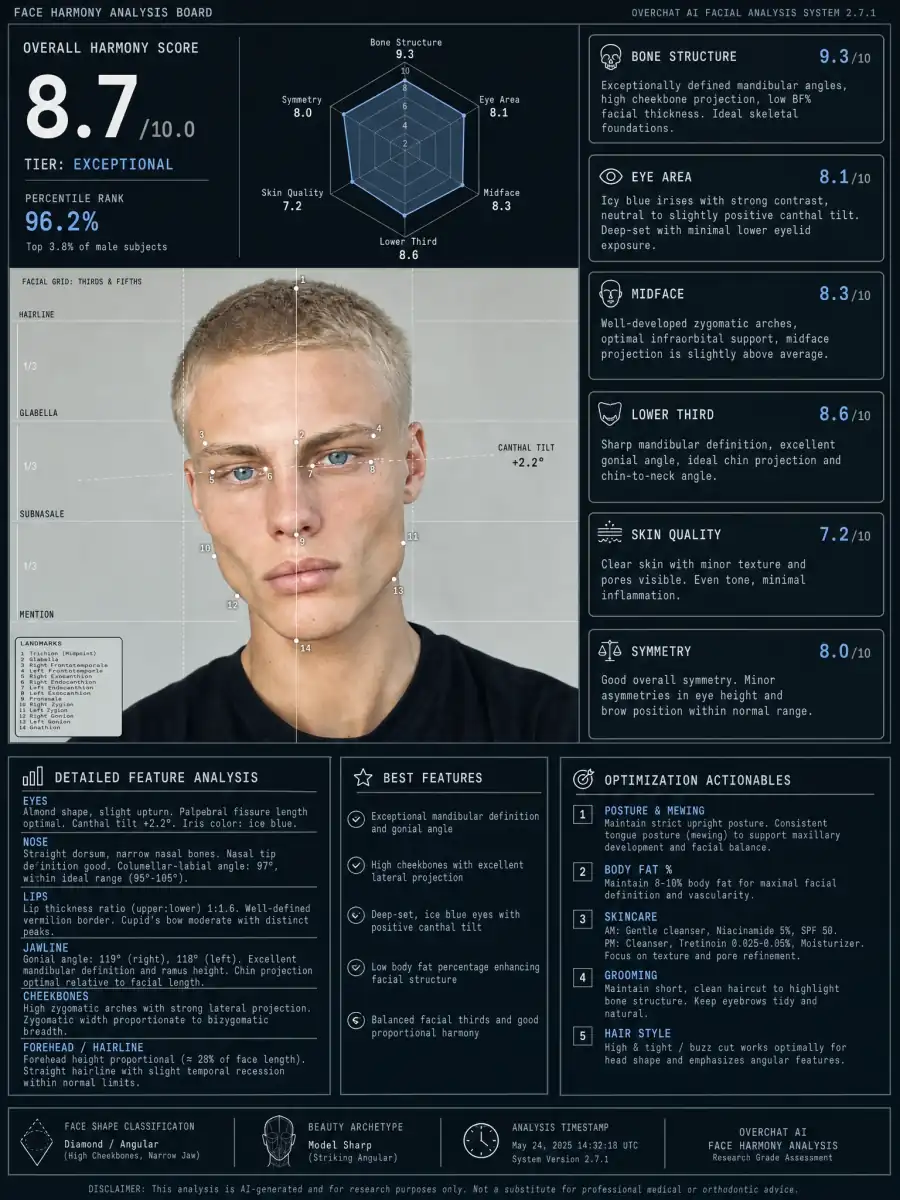
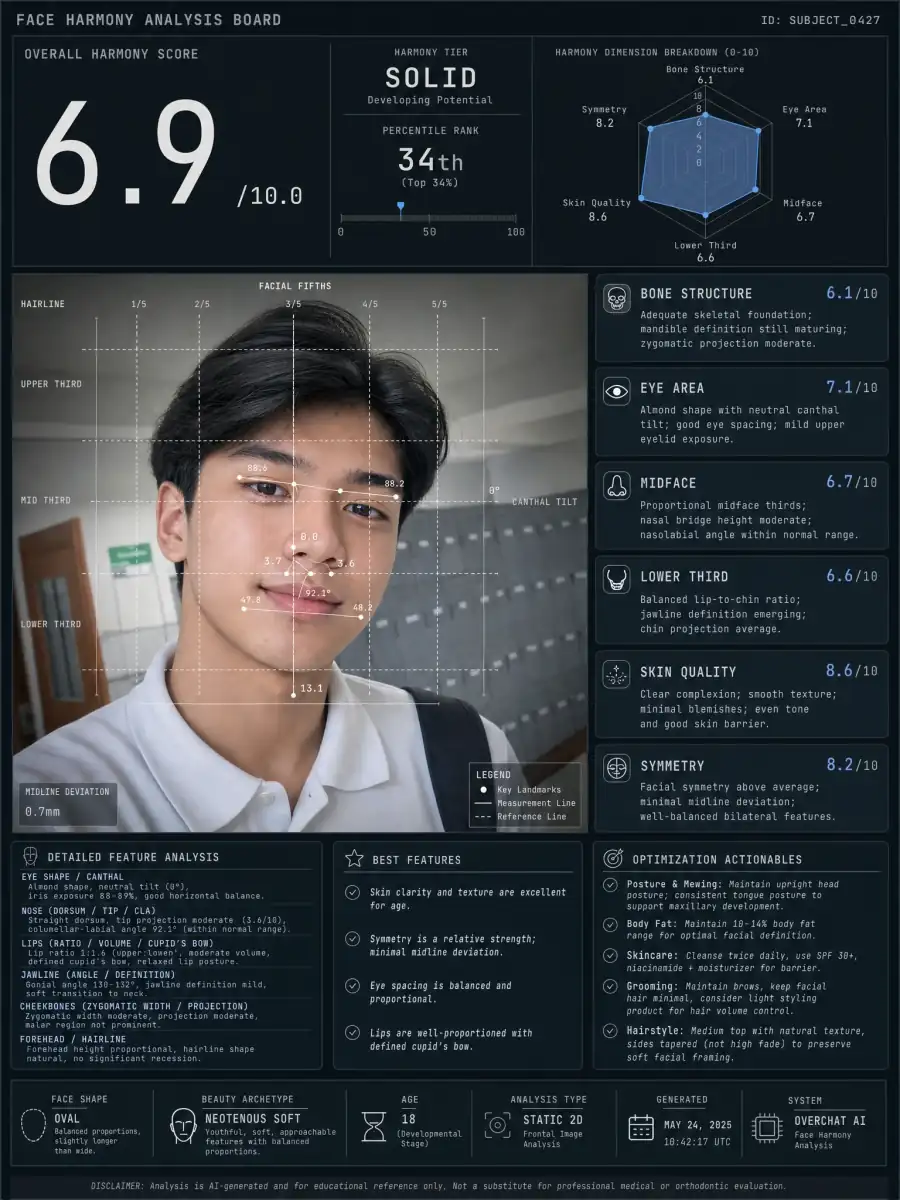
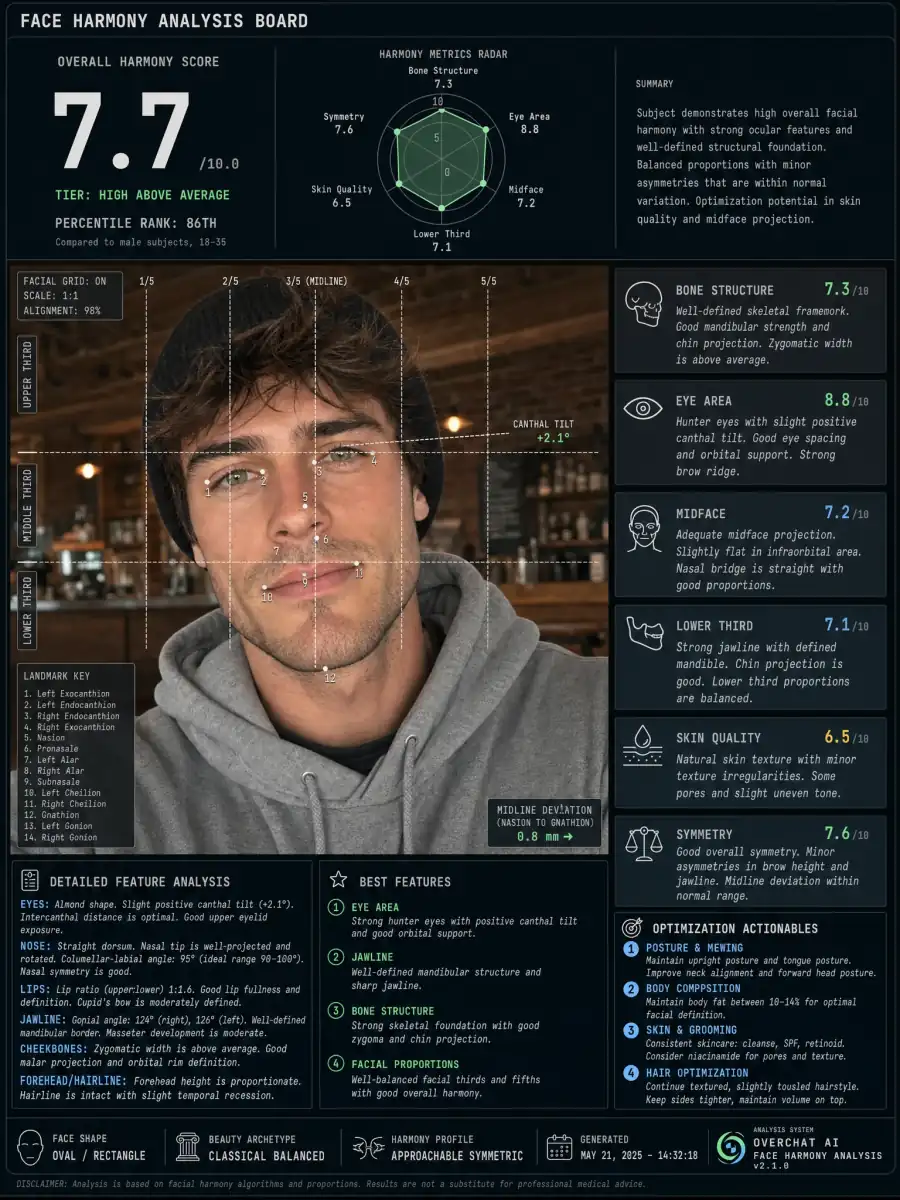
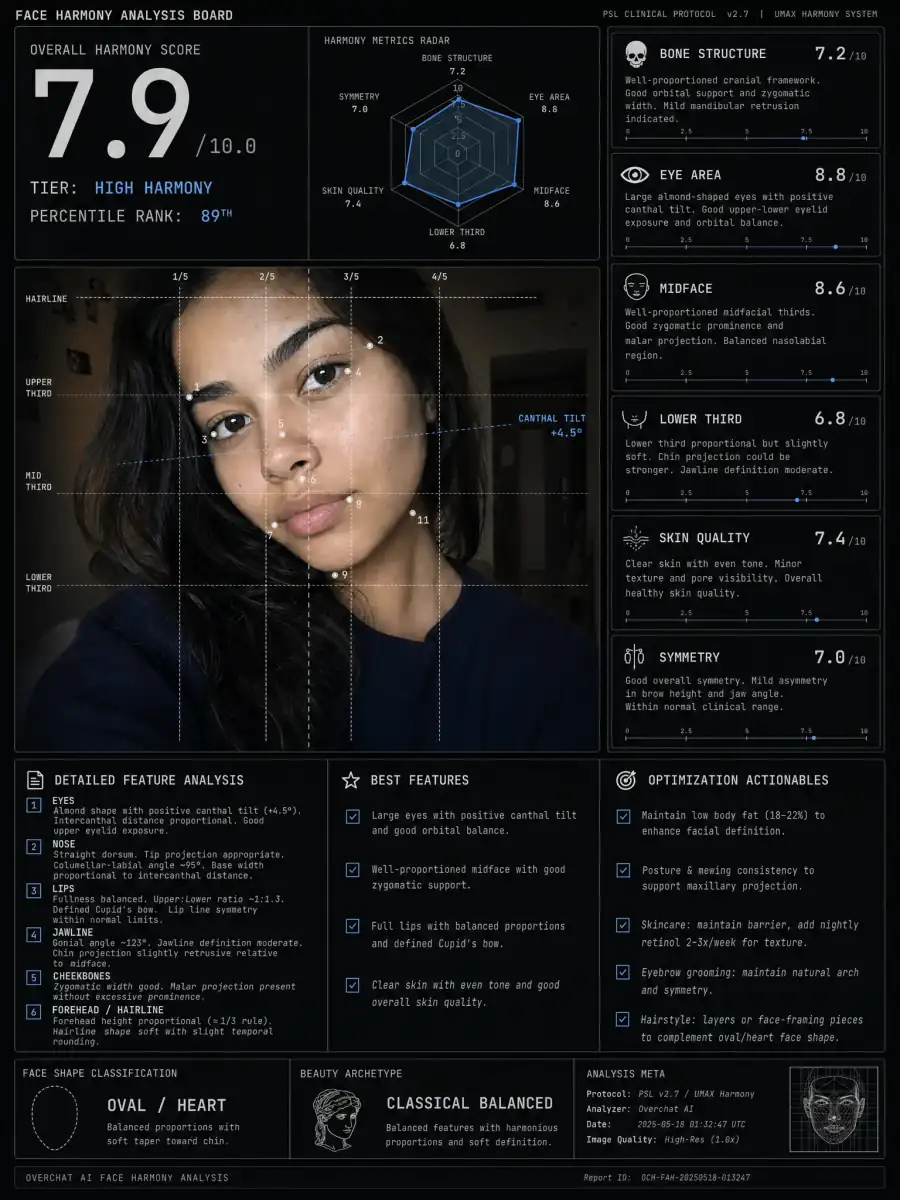
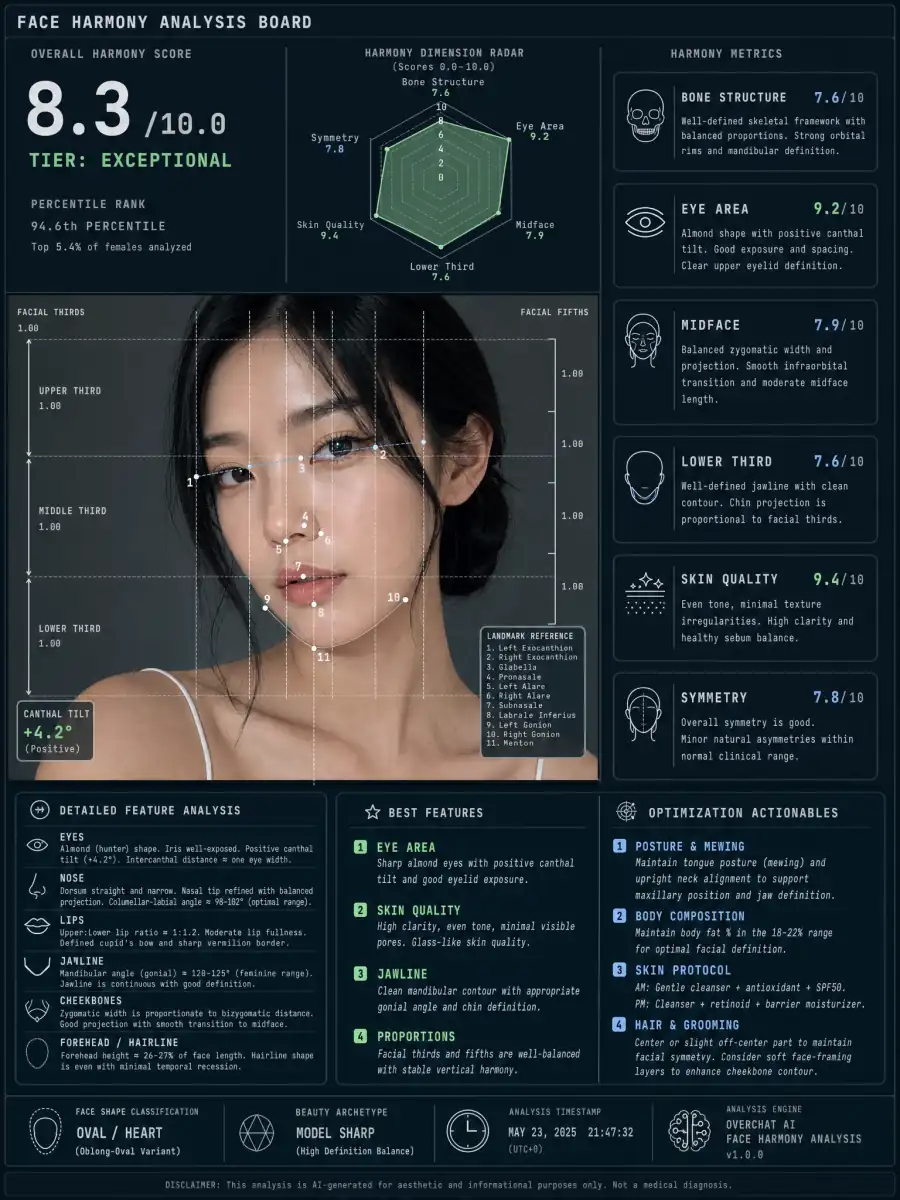
How symmetrical is your face? Upload a photo and AI measures your facial symmetry — a symmetry score plus a feature-by-feature breakdown.
Want your own symmetry score? Upload your photo and take the test.
Take the Overchat AI Face Symmetry Test to see how symmetrical your face is. Upload a photo and our AI will map over 40 prominent facial landmarks on the left and right sides of your face. It will then return a symmetry score with a breakdown.
With Overchat AI, you will receive a detailed symmetry test based on the mapping of over 40 facial features. You will also see where you fall based on anonymized community scores.
See how your face compares to the global average and to everyone else who took the test, as reflected in our anonymized database of facial symmetry ratings.
The AI maps your eyes, brows, nose, lips, and jawline, as well as 40 total facial landmarks, to calculate your face symmetry score. This ensures an accurate analysis that takes into account the distances between these features, as well as eye alignment, nose centering, mouth balance, and jaw angles.
Get your official facial symmetry test results in 30 seconds on Overchat AI.
USE CASES
Measure how closely the left and right sides of your face match. You’ll get an overall symmetry score based on over 40 facial landmarks.
A slight head tilt, uneven lighting, or an off-kilter camera angle can make asymmetry appear more pronounced than it actually is. Overchat AI will reveal whether the asymmetry you're seeing is real or caused by photo distortion.
From eye and brow height to mouth position and jaw width, see where the two sides differ most.
Upload a photo and get a direct answer based on the visible differences between both sides of your face.
Facial asymmetry can result from a person's natural bone structure, muscle habits, expressions, posture, or how a photo was taken. Take the Overchat AI facial asymmetry test to find out which it is for you.
From canthal tilt and brow angle to the jaw and cheekbone lines. See which angles differ between the left and right sides, and by how much.
Upload a photo and get your symmetry score in seconds — the test is free.
Overchat AI maps more than 40 paired landmarks on your face, measures the gaps between them, and calculates your symmetry score.
| Criterion | What it measures | What the AI analyzes |
|---|---|---|
| ✓Landmarks | Where each paired feature sits on the left and right side | Eyes, brows, nose, lips and jaw mapped as matched point pairs |
| ✓Midline | How far features drift off the centre line of your face | Nose centering, chin alignment, vertical midline deviation |
| ✓Feature pairs | Left–right differences between matching features | Eye height, brow arch, mouth-corner tilt, jaw angles |
| ✓Halves & whole | How the two halves read together as one face | Combined left–right deltas rolled into your final symmetry score |
Overchat AI brings you the power of the world's top AI models: GPT, Claude, Gemini, Mistral, and more.
The Overchat AI face symmetry test maps 40+ key facial landmarks and compares their position on the left and right sides of your face. It measures differences around the eyes, brows, nose, lips, cheekbones and jawline to produce a facial symmetry score and show where asymmetry is strongest.
A face symmetry score of 7/10 or higher is good. Scores of 8–9/10 indicate high symmetry, while 10/10 would mean almost perfect left–right alignment.
Almost no one has a perfectly symmetrical face. Small differences in eye height, brows, jaw width, cheekbones and mouth position are normal.
Usually, higher facial symmetry is perceived as more attractive, but symmetry is only one factor alongside facial proportions, eye area, jawline and other features.
Facial asymmetry can come from genetics, bone structure, jaw development, dental alignment, muscle use, ageing or injury.
Yes, the Overchat AI Face Symmetry feature uses an advanced artificial intelligence model that measures over 40 facial landmarks to consistently evaluate differences between the left and right sides of your face. These differences are evaluated across the eyes, brows, nose, lips, cheekbones, and jawline. The feature then gives you a detailed symmetry score out of 10.
Yes, Overchat AI automatically deletes your photo after processing, and nobody but you sees the photo you uploaded.
While grooming, posture, and dental correction can improve some asymmetries, differences caused by facial bone structure usually require medical or surgical treatment for significant change. Take the test to learn more.
Chinese company Baidu has quietly released a model that's just as good as DeepSeek and ChatGPT — ERNIE 4.5 delivers exceptional performance at a fraction of the cost — and most people outside China have never even heard of it.
If you're wondering: what is DeepSeek AI, the answer is quite simple. DeepSeek AI is a Chinese AI research lab that builds large language models. The company released several models in late 2024 and early 2025 that compete directly with OpenAI's GPT-4 and Anthropic's Claude, but at a fraction of the operating cost.
ChatGPT Plus costs $20 per month plus tax, while the Pro plan costs $200 per month plus tax. Understandably, not everyone is willing to pay that much for a chatbot, especially if the premium features aren’t worth it to them. This raises an obvious question: how can I use ChatGPT for free?
Available on Web, iOS, and Android. Access your AI assistant anywhere, anytime.


.svg)
