The Overchat AI compatibility test is designed for couples to take together. It only takes a few minutes and provides a compatibility score, a breakdown of your compatibility across nine metrics, your couple archetype and a green flag/red flag count for each of you.
The Overchat AI compatibility test is designed for couples — you both answer questions on one phone. She types her answers in her form and he types his in his. Overchat AI then analyses and compares your answers, revealing insights about your relationship.
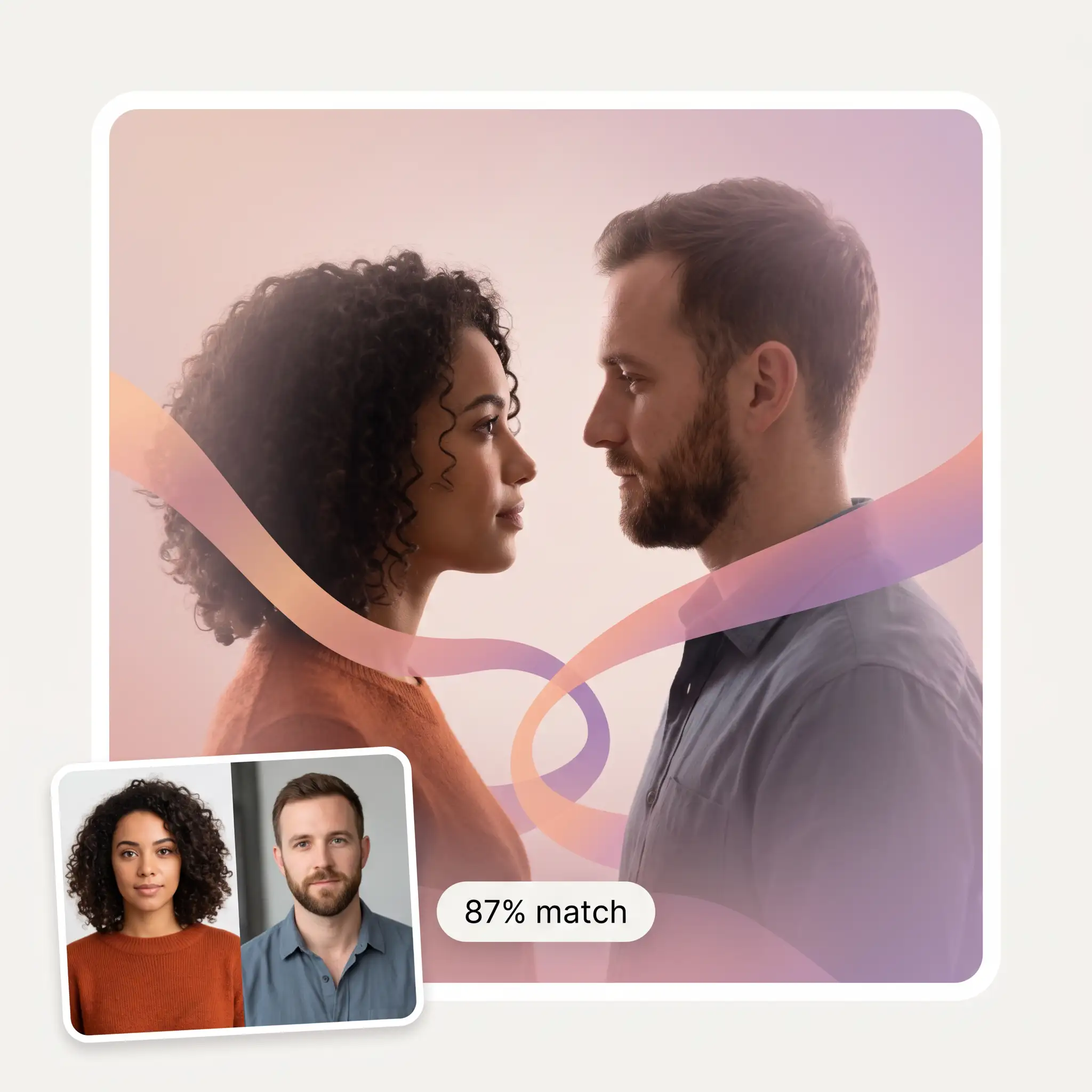
Pass the phone back and forth through the eleven questions, typing your answer to each one as you go.
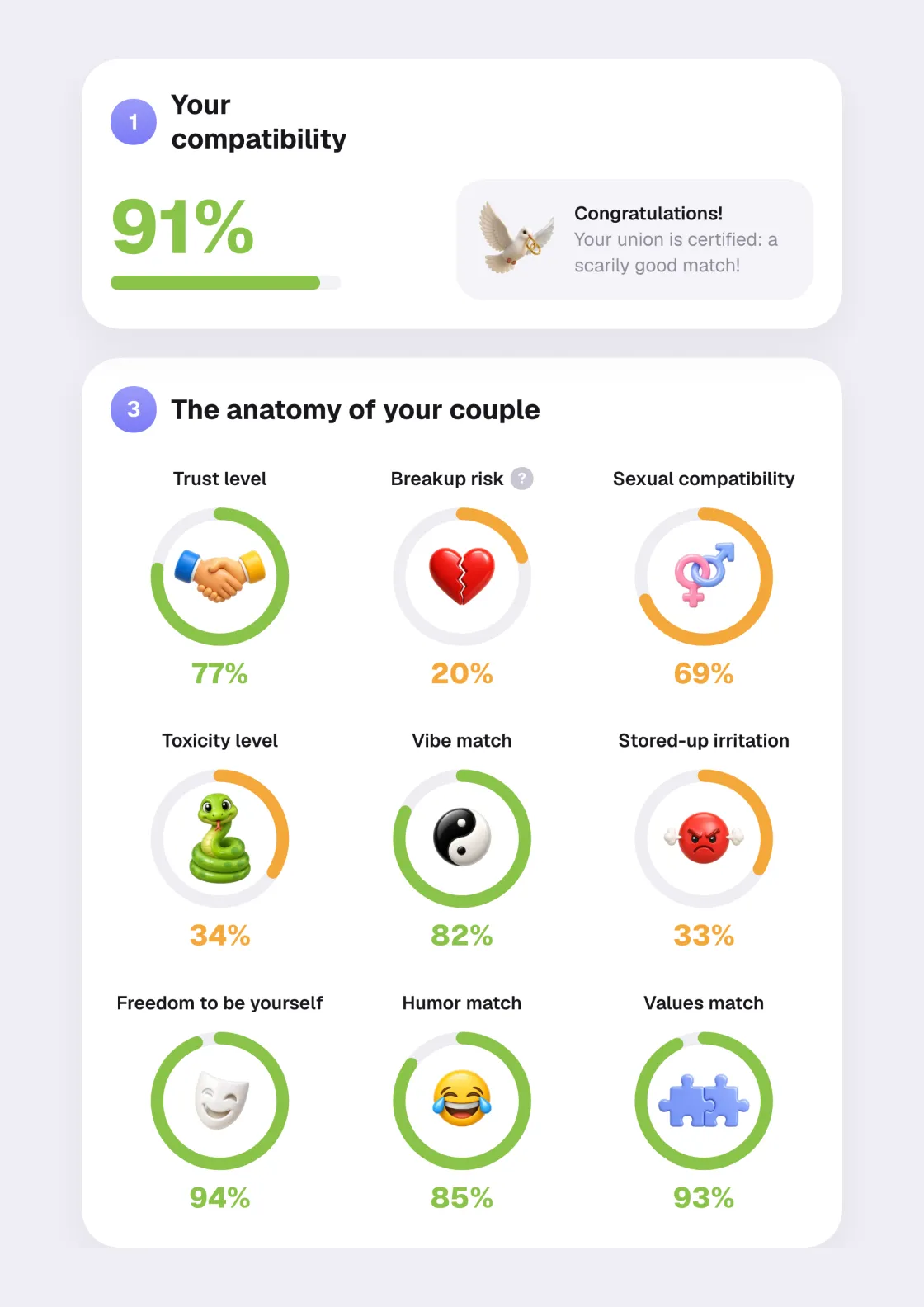
Our specially trained AI will analyse your answers across nine metrics: trust level, values match, humour match, vibe match, intimate compatibility, freedom to be yourself, pent-up irritation, toxicity level, and break-up risk.
Receive a comparability score, along with a detailed breakdown of how it was determined, and advice on how to strengthen your relationship further.
Finally get a real answer to the age-old “are we compatible?” question. Here's what you'll get if you complete the Overchat AI compatibility test.
After completing the compatibility quiz, get your overall compatibility score and a detailed breakdown of how it was calculated. This is based on trust level, physical chemistry, values match, humour match, toxicity level, stored-up irritation, freedom to be yourself, overall vibe and breakup risk.
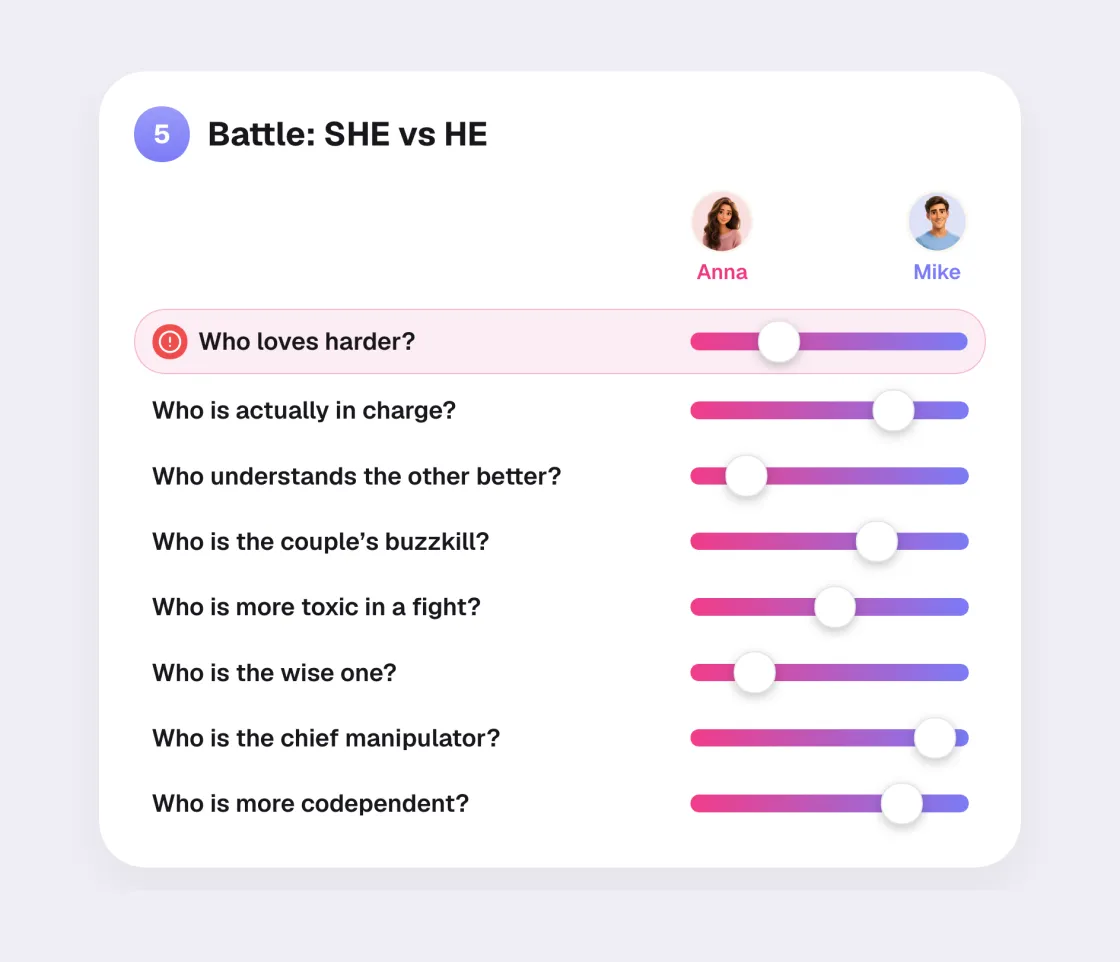
The SHE vs. HE battle settles typical arguments between couples, such as who loves whom more, who is in charge, and who understands the other better. The flag-o-meter counts green and red flags separately for each of you, based on how each partner describes the other.
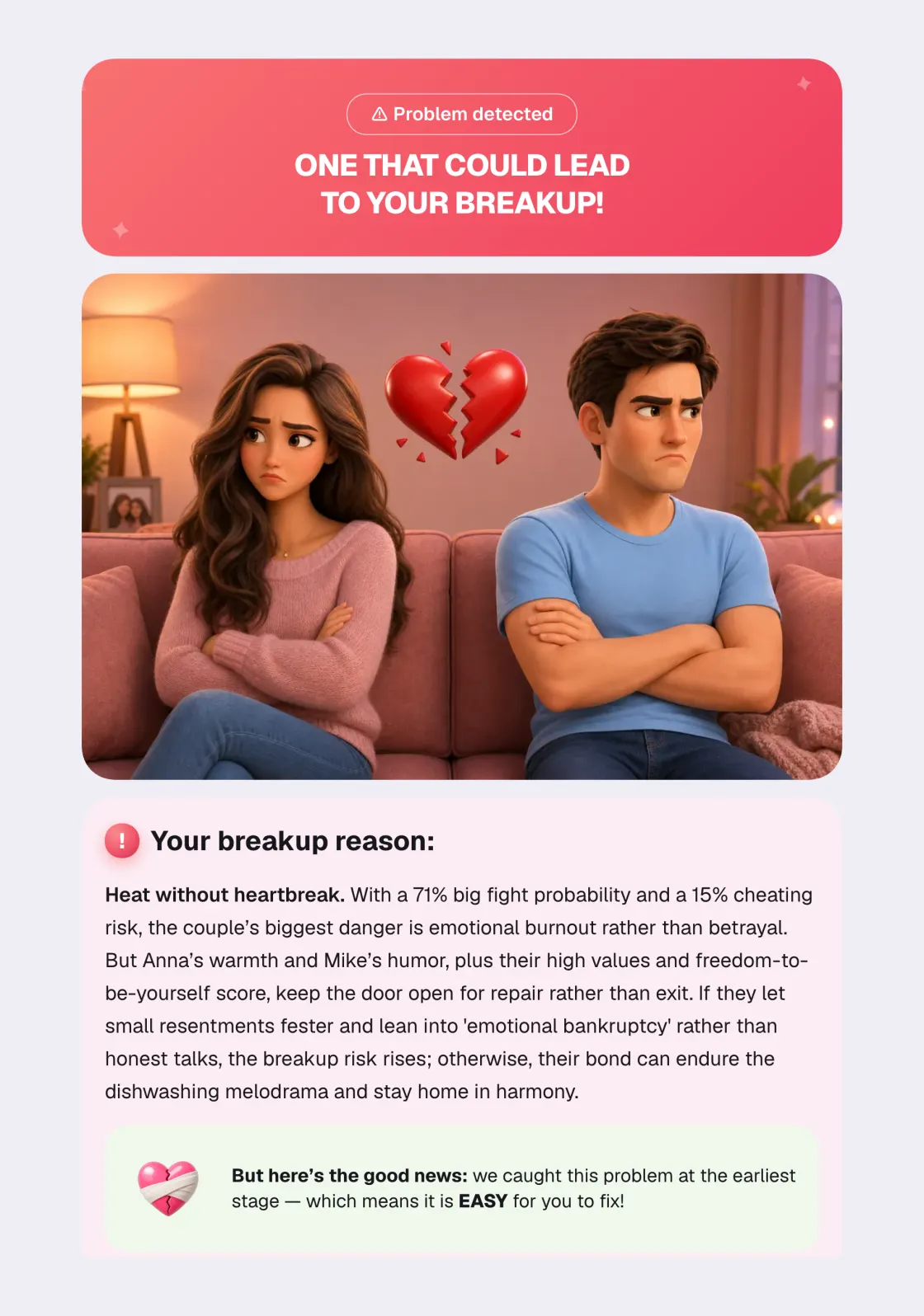
See the biggest dangers to your relationship before they happen — so you can avoid them by taking the necessary steps to break the habits that may lead you to those situations. The Overchat AI compatibility report reveals the thing most likely to end your relationship, showing you the probability of a big fight, cheating and a breakup. You will also receive a forecast of how much longer the relationship will continue on its current trajectory.
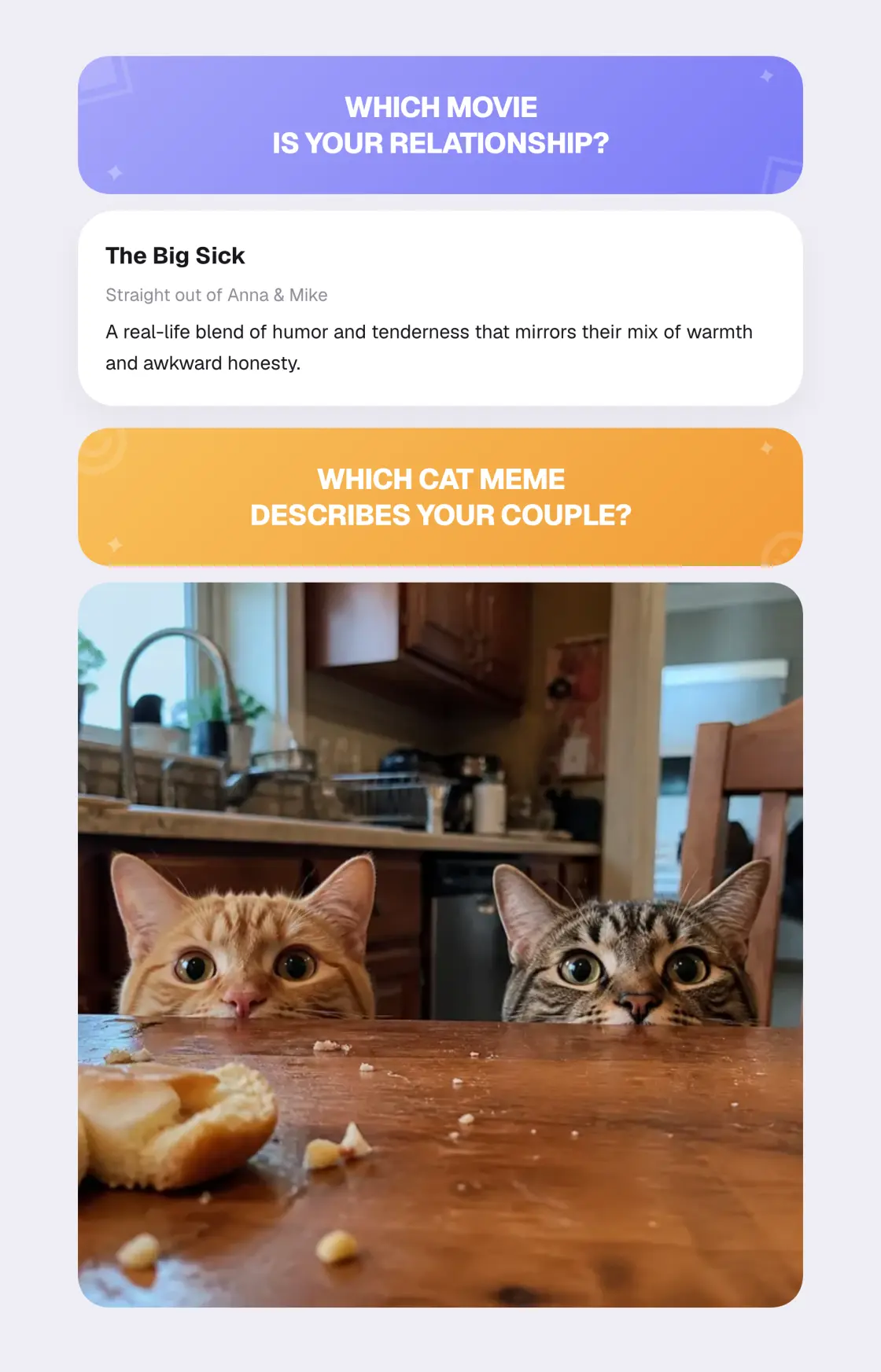
The Overchat AI compatibility test is a great way to bond with your partner. Serious questions are interspersed with light-hearted jokes. See which cartoon duo you and your partner are, and which cat meme best describes your relationship.
USE CASES
On a scale of 0 to 100, how well do the two of you suit each other?
What kind of couple are you, and what could potentially derail your relationship?
Take a look at the green and red flags in your relationship to see what's going well and what could be improved.
Find out who the leader is, who the vibe killer is, and much more besides.
Run through seven stressful scenarios and see how you would cope with them together.
Find out how to strengthen your relationship — and get an idea for a perfect date designed just for you by our AI.
Grab your partner and one phone. The compatibility test takes about seven minutes and your score is free.
The score is a weighted comparison of the two sets of answers that you provide when completing the Overchat AI compatibility test. These answers are analysed and assigned a score by our specially trained AI.
| Criterion | What it measures | What the score uses |
|---|---|---|
| ✓Values match | Will the two of you pick the same option when faced with a tough decision? | Would-you-rather round, |
| ✓Boundaries | Where each of you draws the line on the same situation | FINE-or-WEIRD blitz |
| ✓Shared traits | How far apart your two descriptions of this couple are | The traits she picked vs the traits he picked |
| ✓Flags & tone | How each of you behaves in a fight, and how you write about each other | Green-to-red flag ratio |
Overchat AI brings you the power of the world's top AI models: GPT, Claude, Gemini, Mistral, and more.
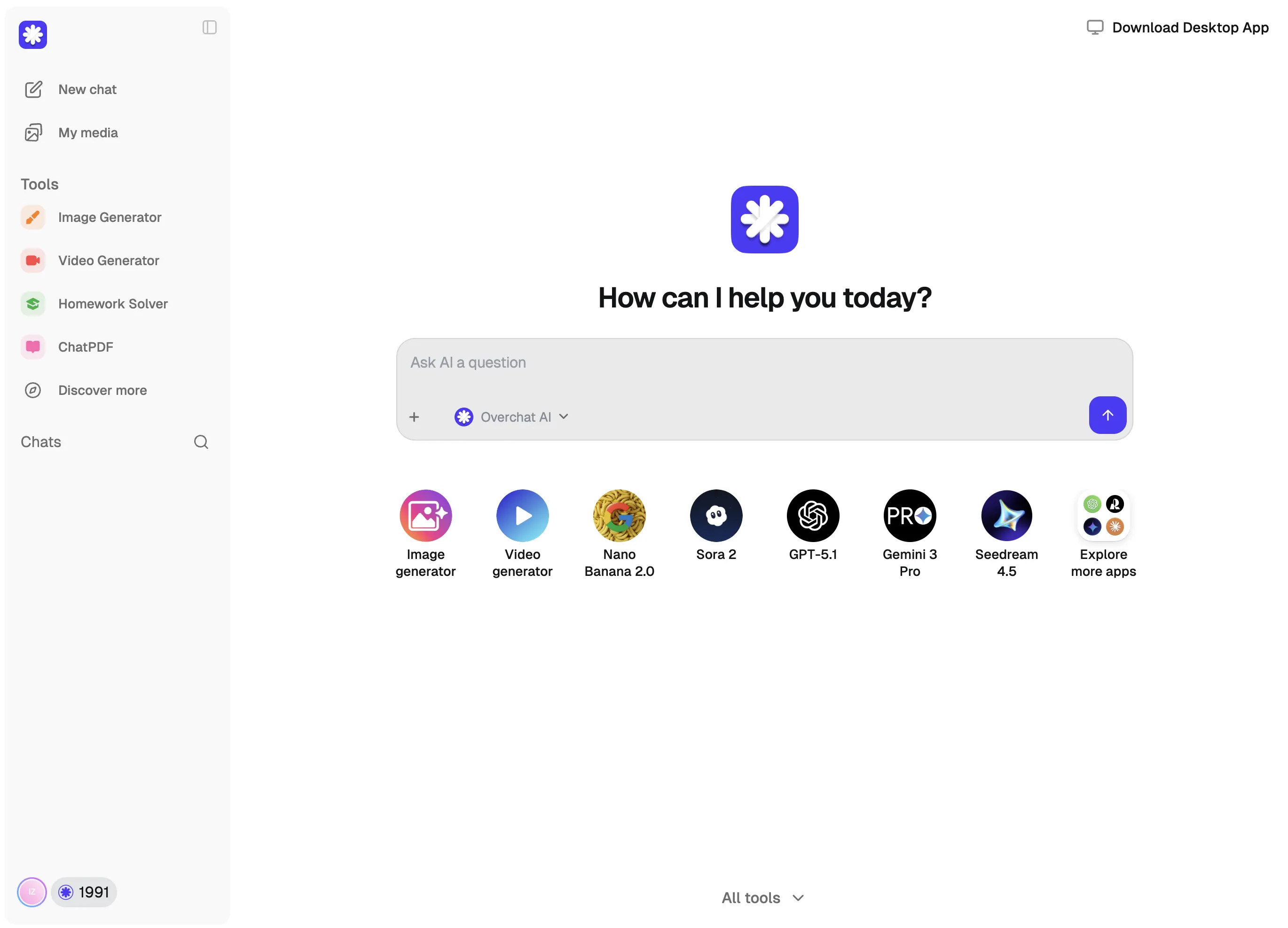
In the Overchat AI compatibility test, you and your partner enter your names and dates of birth and then answer 11 questions on the same phone or laptop. Overchat AI then compares your answers and converts the differences into a compatibility score, providing a full report on your relationship.
Yes, the Overchat AI compatibility score is accurate. Our specially trained AI measures how closely your two answers line up across nine relationship metrics right now, producing an accurate score.
The 7-7-7 rule is a scheduling habit for long-term couples, involving a date night every seven days, a night away together every seven weeks, and a longer trip every seven months. The idea is to set aside time together before the calendar fills up with other commitments. If your relationship is lacking in passion or you have built up a lot of resentment towards each other, this is the kind of routine that can improve things.
Another version of this is the '2-2-2' rule: a date every two weeks, a weekend away every two months, and a week-long holiday every two years.
The 3-6-9 rule identifies three key stages in a new relationship. After around three months, the initial infatuation fades and real habits start to emerge. After around six months, you will have seen how the other person handles stress and conflict. After nine months, you have enough evidence to decide whether the relationship is long-term. The Overchat AI compatibility test will tell you the most after the three-month mark, once there is something substantial to base answers on.
Yes. Overchat AI doesn't use your answers; they're only used to create your couple report. We'll never publish or share them, and it's up to you whether you show the result to anyone.
Chinese company Baidu has quietly released a model that's just as good as DeepSeek and ChatGPT — ERNIE 4.5 delivers exceptional performance at a fraction of the cost — and most people outside China have never even heard of it.
If you're wondering: what is DeepSeek AI, the answer is quite simple. DeepSeek AI is a Chinese AI research lab that builds large language models. The company released several models in late 2024 and early 2025 that compete directly with OpenAI's GPT-4 and Anthropic's Claude, but at a fraction of the operating cost.
ChatGPT Plus costs $20 per month plus tax, while the Pro plan costs $200 per month plus tax. Understandably, not everyone is willing to pay that much for a chatbot, especially if the premium features aren’t worth it to them. This raises an obvious question: how can I use ChatGPT for free?
Available on Web, iOS, and Android. Access your AI assistant anywhere, anytime.



.svg)
