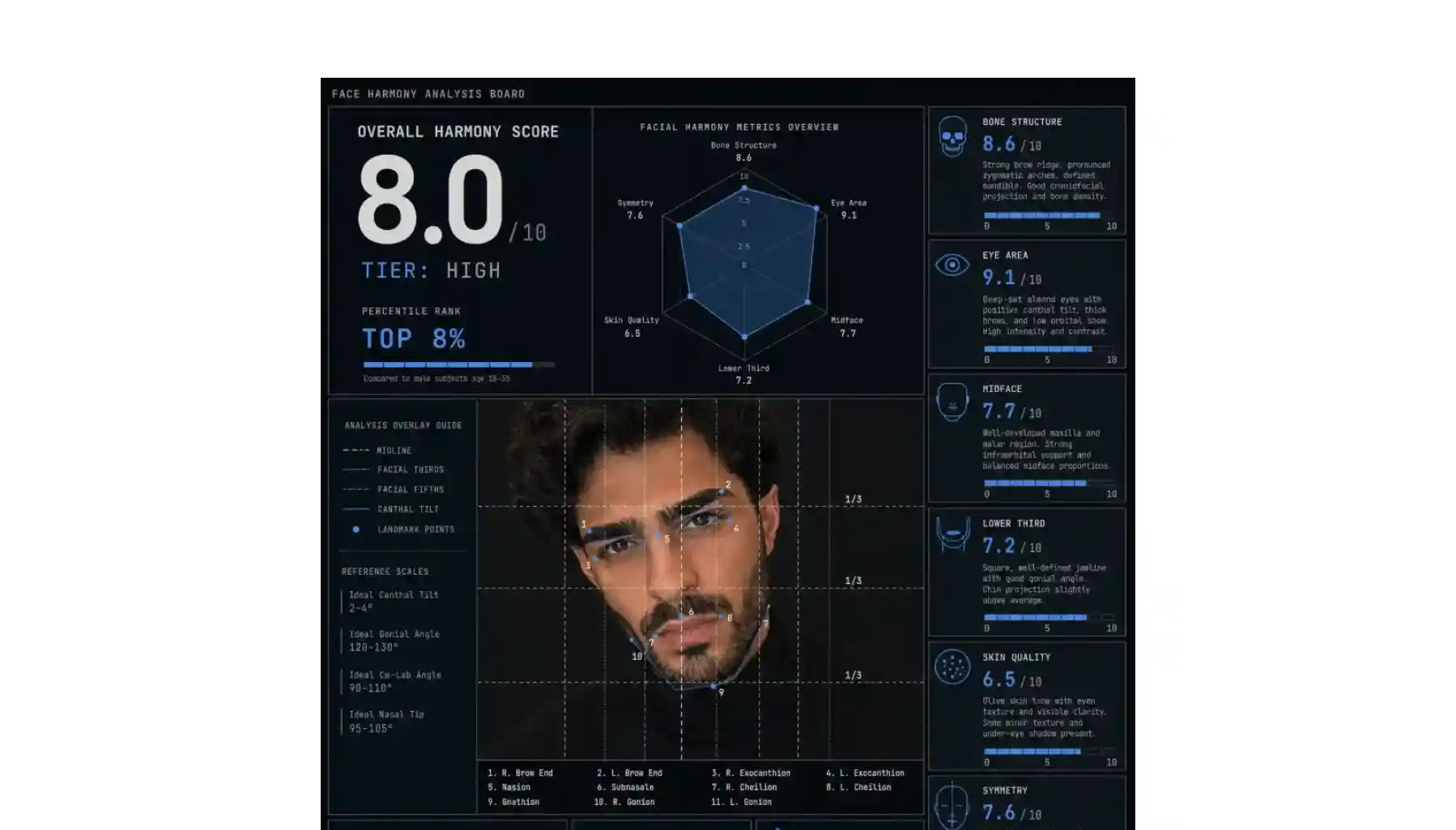
The PSL scale is a system for scoring facial attractiveness on a numerical curve that runs from roughly 0 to 8. It originated on a set of early-2010s online forums, spread through the looksmaxxing community, and entered mainstream internet vocabulary through TikTok.
In this article, we’re going to break down what the PSL scale is, how it’s calculated, and how a new wave of AI tools helps people measure it online. Let’s get started.
A PSL score is a measure of facial attractiveness. It’s built from four categories:
Harmony
Dimorphism
Angularity,
Miscellaneous individual features
It assigns a numbered score to each person which places them into a tier ranging from Sub3 to GigaChad. Most people fall between 3.5 and 5 on the PSL scale.
TL;DR
What is a PSL scale? It’s a facial-attractiveness rating on a roughly 0–8 scale, deliberately calibrated to be stricter than the casual 1–10 rating.
What does it measure? Facialbone structure and proportion.
How it scores: PSL scales use four weighted categories — harmony (~30%), dimorphism (~30%), angularity (~25%), and miscellaneous features (~15%).
What are PSL tiers? Depending on the rating, PSL scale assignseight tiers. These include Sub3, normie, Chadlite, Chad, and GigaChad. For females tiers go from Becky to Stacy.
Where did the PSL scale originate from? PSL ratings were created in incel forums PUAHate, Sluthate, and Lookism, which gives the acronym its name.
Is the PSL scale scientific? It is to some extent. For example, doctors do measure facial structure, and that part of the scale is based on real science. However, the numbers are assigned by different AI tools, groups of people and methodologies, so they can vary.
Remember that attraction is subjective — how attracted people are to you can depend on mannerisms, smell, and confidence. So a PSL scale alone can’t answer the question, 'How attractive am I?'
And now, for the long version:
What Is the PSL Scale?
The PSL scale (the letters stand for the forums PUAHate, Sluthate, and Lookism) is a rating system used within online appearance-focused subcultures, particularly among looksmaxxers, to assign a numerical score to how attractive a face is.
A score sits on a curve that runs from about 0 to 8, and the defining feature of that curve is where it places the average person.
On the casual 1-to-10 scale most people use in conversation, the midpoint is around 5, and politeness tends to push real-world ratings higher still.
On the PSL scale, the true average is 4, and the figures above it are spaced so that each step represents a visible difference. A score of 5 on the PSL scale corresponds to roughly a 7 in everyday terms.
Also, PSL scale looks only at the underlying architecture of the face, and doesn’t take into account the overall impression.
For example, PSL must be measured on a neutral photograph — you may have the most charming smile, captivating gaze and immaculate grooming, but if your bone structure and proportions are not ideal, the scale will objectively judge that.
Casual rating
Approximate PSL score
5–6
~4 (average)
7
~5
8
~6
9
~7
10
~8
How a PSL Score Is Calculated
A PSL score is assembled from four categories:
Harmony — how cohesive and balanced the features are
Dimorphism — how clearly the face reads as male or female
Angularity — the sharpness and definition of the bone structure
Miscellaneous — individual features such as the eyes, skin, hair, and nose
What’s more, different categories have varying levels of importance.
Harmony and dimorphism — roughly 30 percent of the score
Angularity — about 25 percent
Miscellaneous — the remaining 15 percent or so.
The sections below explain what each one measures and why it carries the weight it does.
1. Harmony
Harmony measures whether the features of a face look as though they belong together. It’s judged on:
Symmetry between the left and right sides of the face
Facial thirds — whether the face divides into roughly equal vertical sections, from hairline to brow, brow to nose, and nose to chin
Proportion — how closely the spacing of the features tracks classical ratios such as the golden ratio
Faces that sit close to the population average across many measurements at once tend to score highest here.
This is why composite images — faces built by digitally blending many individuals together — are consistently rated as attractive in psychological research. Harmony rewards cohesion.
2. Dimorphism
Dimorphism measures how clearly a face reads as male or female. In men, the features that raise the score are:
A prominent brow ridge
A wide, square jaw
A projecting chin
A sharp gonial angle — the angle where the jaw turns upward toward the ear, ideally around 115 to 122 degrees
In women, the score moves in the opposite direction, toward softer and more tapered proportions.
These traits are shaped largely by hormone exposure during development, which is why dimorphism is treated as a fixed structural quality rather than something easily changed.
3. Angularity
Angularity measures the sharpness of the face — the definition of the bone beneath the skin:
Pronounced cheekbones
A clean jawline
A straight nasal bridge
A crisp jaw-to-neck transition
Because much of this definition is a matter of how much fat sits over the bone, angularity correlates closely with body fat.
That relationship makes it the category most open to change without surgery: reducing body fat reveals structure, which is why getting into shape is the community's first recommendation for raising a score.
4. Miscellaneous
The miscellaneous category collects the individual features:
The shape and tilt of the eyes — measured as the angle of the outer corner relative to the inner, and called canthal tilt
The quality and clarity of the skin
The density and position of the hair
The form of the nose, lips, and teeth
5. Halos and failos
To understand how these categories are measured we need to also discuss two more concepts: halos and failos.
A "halo" is a single feature so strong that it lifts the perception of the entire face, like a striking pair of eyes.
A "failo" is the reverse: a single weak feature that drags down a face which would otherwise score well.
These two effects explain why two people with nearly identical measurements can be placed in different tiers, and why the community treats targeted improvement of one standout feature as worthwhile.
Why the PSL Scale Uses a Bell Curve
The reason the average score is set at 4 rather than 5 follows from how the scale models the population.
PSL treats facial attractiveness as a normal distribution — a bell curve — with most people clustered near the middle and progressively fewer toward either extreme.
Community estimates place roughly two-thirds of people between PSL 4 and 6, which leaves only a narrow band at the top for genuinely exceptional faces.
This is why the scale feels stricter than the casual 1-to-10: in the community's view, there are not many truly distinct levels of above-average attractiveness.
Whether real-world attractiveness follows a clean bell curve is contested.
A widely cited analysis of dating-site behavior, published by Christian Rudder in Dataclysm, found that men rated women along a roughly symmetrical curve, while women rated around 80 percent of men as below average. A separate dataset drawn from several thousand first dates reported a similar pattern, with a majority of men falling below the median.
These figures circulate often in looksmaxxing discussions, but they are also heavily criticized, as the populations are self-selected, and the behavior of a dating platform is not a neutral measure of attractiveness, so take all of this with a pinch of salt.
What are the PSL Tiers?
In addition to the numerical score, PSL scales also have tiers. So what are these?
The number you’re given maps onto a ladder of named tiers. You might have already seen them: "Sub3," "normie," "Chad," "GigaChad." The female versions are "Becky" for the normie tiers and "Stacy" for Chad. Here’s how the scores correspond to the numbers:
Tier
PSL range
Approx. % of people
Casual equivalent
Sub3
0–1.5
~1%
1–2
LTN (low-tier normie)
1.5–3.5
~25%
3–4
MTN (mid-tier normie)
3.5–5.0
~50%
5–6
HTN (high-tier normie)
5.0–6.0
~15%
7
Chadlite
6.0–7.0
~5%
8
Chad
7.0–8.5
~3%
9
GigaChad
8.5+
~0.1%
10
There are also "True Adam" and "True Eve," tiers — an almost mythical, most attractive man and woman among billions.
PSL vs. SMV
If you have read about PSL before or visited the Looksmaxxing community on Reddit, you may have come across another abbreviation: SMV. PSL and SMV are often confused, so it’s worth taking a minute to clear this up.
SMV, or sexual market value, is also an attractiveness score, but it measures different things.
While PSL grades the face alone, SMV is a broader figure that folds in the qualities a face cannot capture: height, build and fitness, age, and social factors such as status and wealth.
The relationship between them is hierarchical — PSL is one component of SMV.
Where the PSL Scale Came From
The acronym PSL is drawn from the names of three online forums where the rating system was developed during the early 2010s: PUAHate, Sluthate, and Lookism.
These were communities organized around a belief, sometimes called lookism, that a person's appearance determines not only their romantic prospects but their wider fortunes in life.
Out of that premise came looksmaxxing, a term that encompasses practices aimed at improving one's appearance by any available means, and the PSL scale served as the tool for measuring a face and tracking changes to it over time.
The history of these forums is closely tied to a violent event, and is best read as a short timeline:
2009 — PUAHate is founded, initially to criticize pickup-artist culture before shifting toward "looks theory."
May 2014 — Shutdown. PUAHate closes around the time one of its users carries out a mass killing in Isla Vista, California; the perpetrator references the community's ideas in a manifesto.
2014 — Sluthate. The userbase relaunches under a new name following the attention.
2015 — Lookism.net. The community migrates to its most stable home, where the four-category framework is formalized.
2023–2026 — TikTok. Looksmaxxing creators bring the vocabulary into mainstream circulation.
The vocabulary reached a far larger audience through TikTok between 2023 and 2026, as looksmaxxing creators brought its terms into mainstream circulation.
Is the PSL Scale Scientifically Valid?
Yes, at least partially. The PSL scale has a genuine foundation.
Particularly, Its four categories do correspond to properties that have been studied by scientists trying to understand how attractiveness works. For example:
Symmetryhas been documented as a real facial attractiveness factor
People do tend to prefer faces that show sexual dimorphism more clearly — we’re attracted to men who look more like men, masculine, and vice versa.
That being said, when we get into specific angle measurements, named tiers, and precise numeric ranges — it’s hard to say how much this can be mapped to real attractiveness, or, at least, how precisely.
That being said, a face rated 8 is almost certainly going to be more attractive than a face rated 2 — that much is objective.
This brings us to the question: how do I get a PSL score? Not everyone is eager to jump on Reddit and be criticised and scrutinised by tens of thousands of people in a community known for its toxicity.
For this reason, many people have turned to AI PSL rating tools, which analyse a photograph of your face and assign a PSL score.
Best AI PSL Rating Tools
If you want to get a PSL score, but don’t want to talk to strangers on a forum, you can use an AI tool instead. Below, we made a list of some of the best ones on the market.
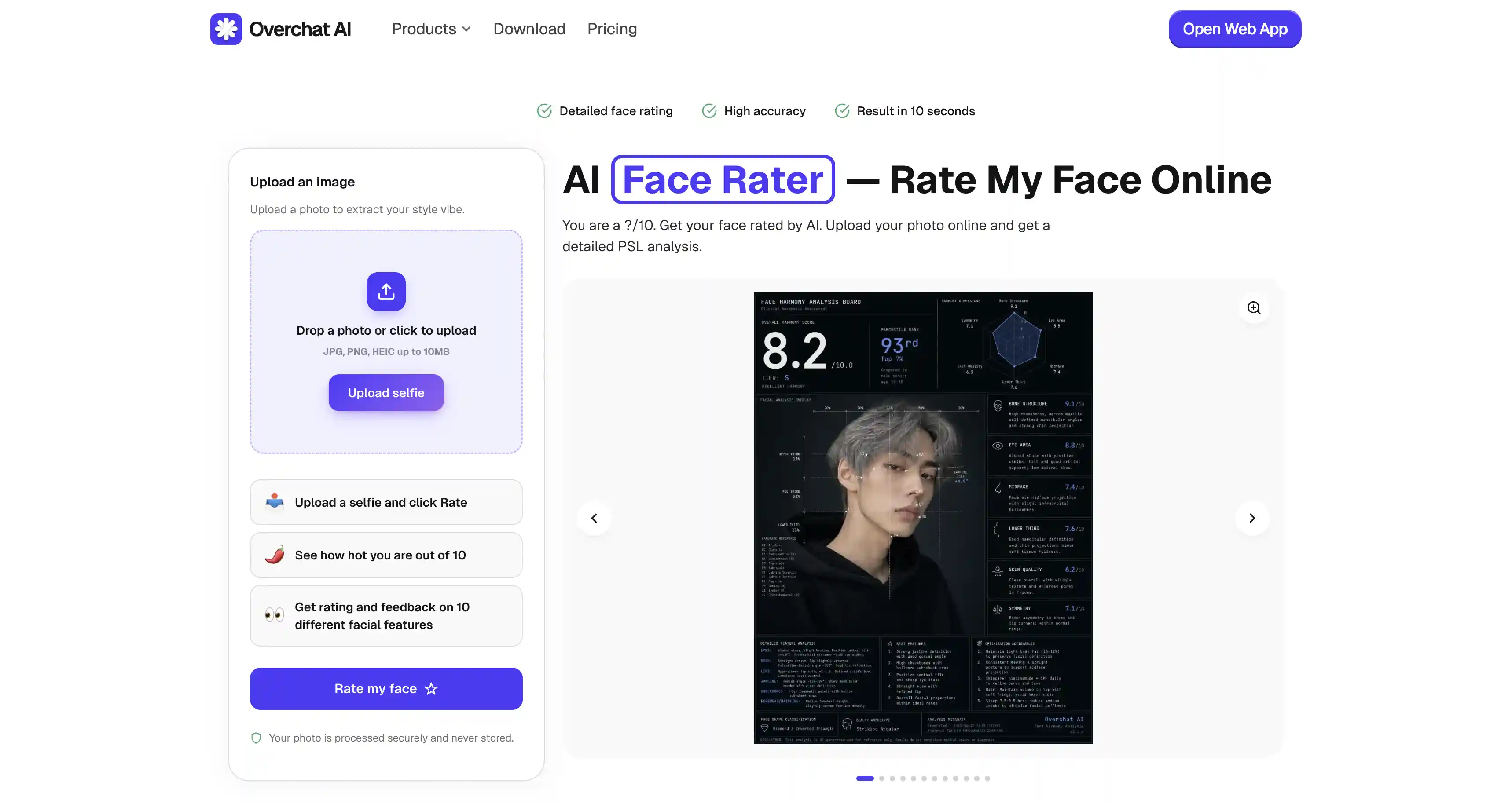
1. Overchat AI Face Rater
Overchat AI Face Rater is, we like to think, one of the most accurate face raters. We might be biased because we’ve built the tool, but it returns a detailed PSL-style analysis of your face as an infographic, which, we believe, is one of the best PSL analysis formats.
Here’s how to use it:
Upload a selfie (JPG, PNG, or HEIC, up to 10MB)
Click Rate
Get your score out of 10 with feedback on 10 facial features
You get a rating out of 10 plus a breakdown across symmetry, proportions, jawline, skin quality, and more, without paying or creating an account. Photos are processed securely and not stored, and you can test different pictures to see how lighting and angle change the result.
Overchat AI also offers a looksmaxxing app, which you can switch to in order to get detailed advice on how to improve your overall attractiveness — and the PSL score.
Pros:
✅ Detailed breakdown across 10 features
✅ Results in about 10 seconds
✅ Photos are auto deleted
✅ Works in the browser on any device
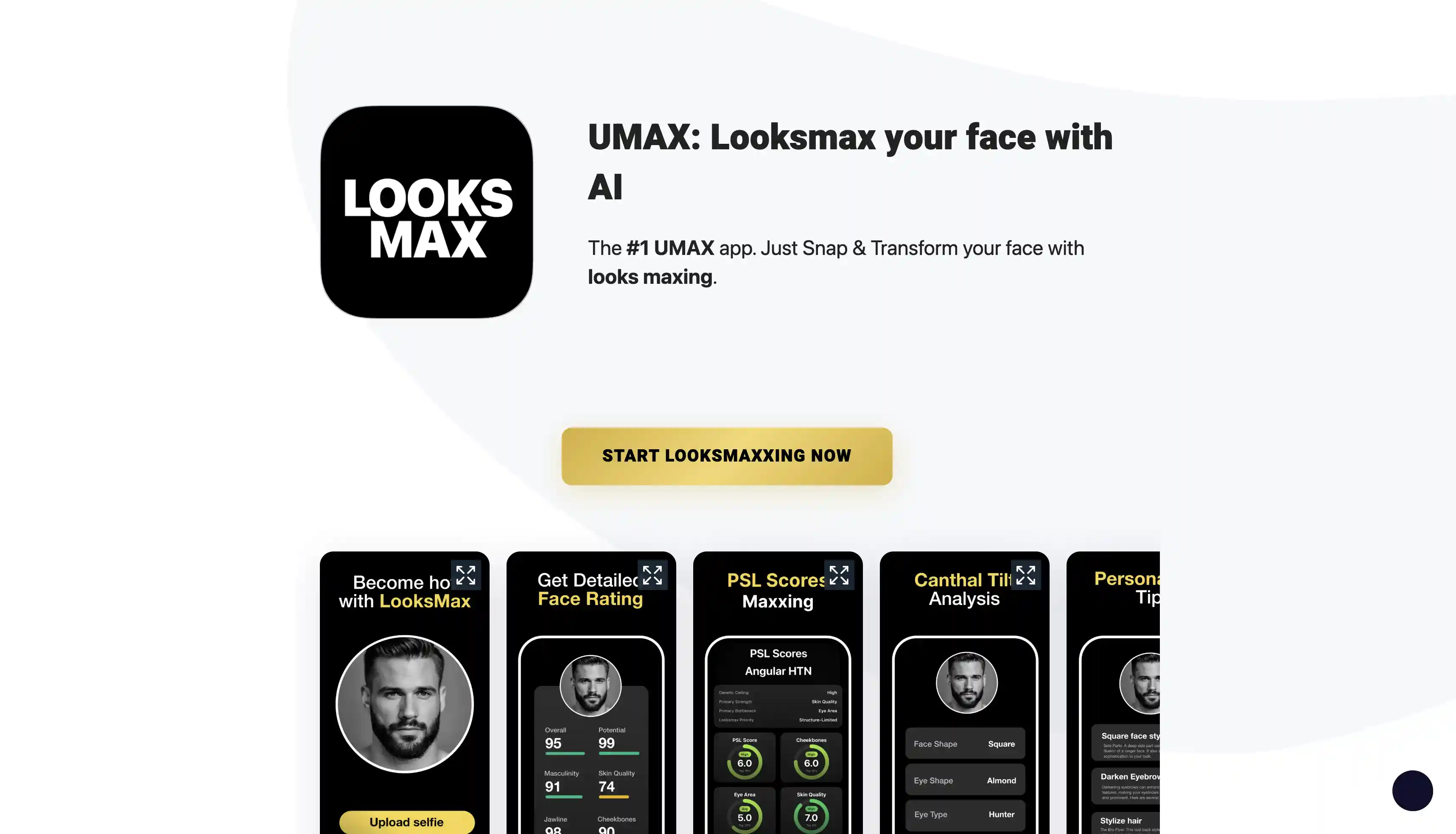
2. Umax
Umax is the most established name in the space, with the largest user base and a polished mobile app. It scores your face on the PSL scale, analyzes your golden ratio, and breaks down features like canthal tilt, cheekbones, and jawline.
Beyond the score, Umax is built as a full looksmaxxing coach. It includes hairstyle recommendations, a skincare and glow-up tracker, mewing and jaw exercises, and a step-by-step improvement plan. That makes it a good fit for someone who wants ongoing guidance rather than a one-off rating.
The main drawbacks are transparency and price. Umax does not always make clear which measurements feed the final score, and its feedback is broader than the measurement-focused tools. The subscription has also drawn complaints for being steep relative to the free tier.
Pros:
✅ Largest user base and a well-designed app
✅ PSL score plus golden-ratio analysis
✅ Full improvement plan with hair, skin, and mewing
✅ Easy to share results
Cons:
❌ Scoring method is not fully transparent
❌ Subscription is on the expensive side
❌ Feedback is less granular than measurement-first tools
3. Qoves Studio
Qoves Studio analyzes a portrait for facial proportions, symmetry, and feature relationships, drawing on a large image dataset and many parameters, and accounts for different ethnic profiles.
For roughly $150 a year, you get a human-reviewed assessment with before-and-after visualizations and a multi-month improvement protocol. It's used by some clinics and researchers, which reflects the depth on offer.
This depth is overkill for anyone who just wants a quick number, and the price is the highest here. There's a free basic analysis, but the value is in the paid report.
Pros:
✅ Research-backed, detailed analysis
✅ Human-reviewed report with an improvement protocol
✅ Accounts for different ethnic profiles
✅ Before-and-after visualizations
Cons:
❌ The full report costs around $150/year
❌ Overkill for a casual rating
❌ Slower than instant tools
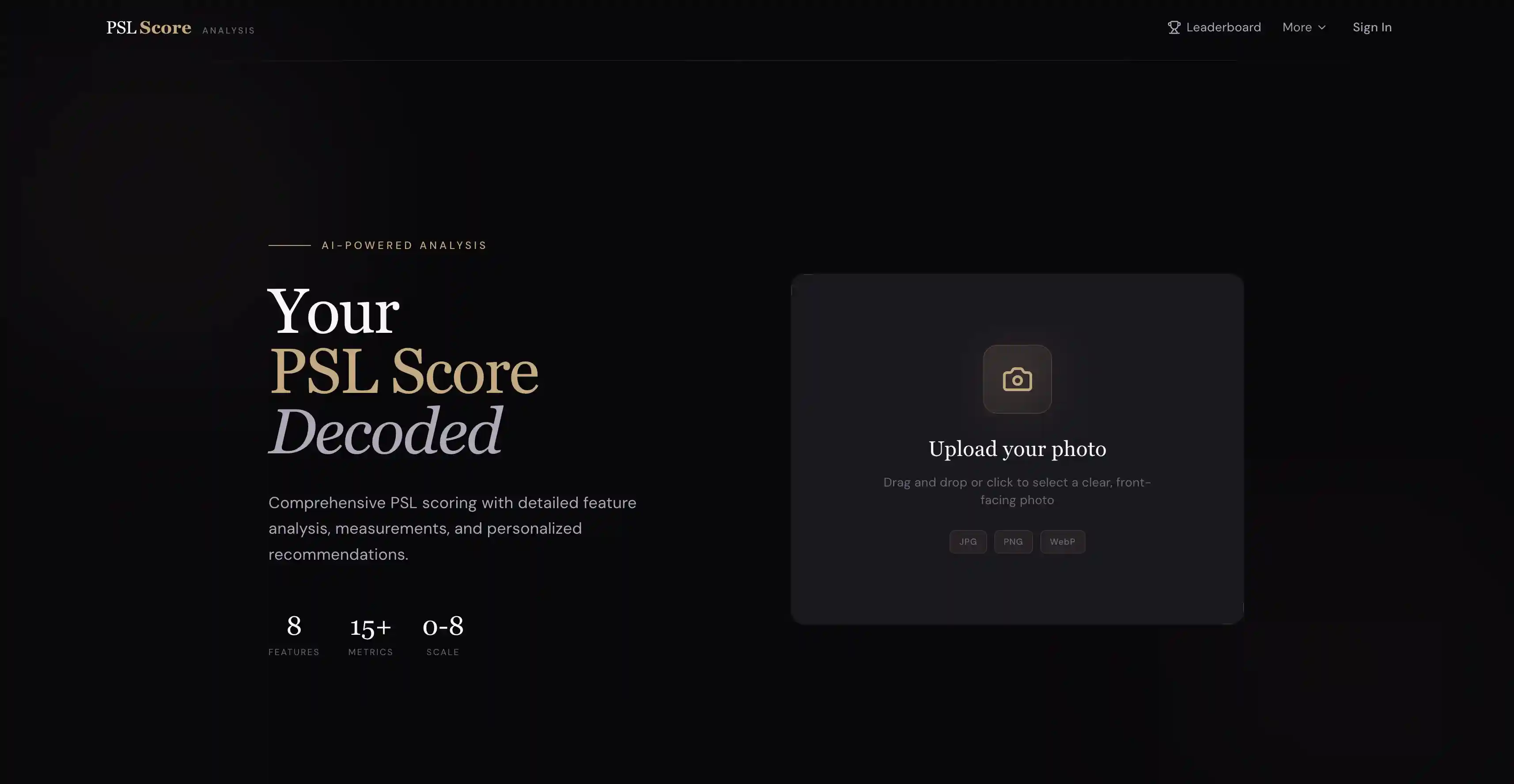
4. PSLScore
PSLScore focuses on granular, quantitative analysis. It leans into specific measurements and the ratios behind them, then pairs the score with personalized looksmaxxing recommendations.
It sits between the casual apps and the premium reports on both depth and price. For someone who wants more detail than Umax gives but isn't ready to pay Qoves money, it's a sensible middle option.
Pros:
✅ Detailed, measurement-focused scoring
✅ Personalized recommendations
✅ More affordable than premium reports
Cons:
❌ Less polished than the biggest apps
❌ Smaller user base and community
Bottom Line
The LooksMaxing community is known to be strict and rather extreme. So, if there’s one thing to take away from all this, it's that the PSL scale is merely a vocabulary for discussing facial structure. Don’t treat it like a verdict, and don’t become discouraged for being below average. For people who are not actively working on themselves, that's normal and can be improved.
Also, PSL doesn’t take into account charisma, style, fitness, presence, and context — any of which can outweigh a difference of a point or two in facial structure. Then again, it doesn’t have too — it’s one of many tools modern men and women have developed to measure attractiveness.
FAQ
What does PSL stand for?
PSL stands for PUAHate, Sluthate, and Lookism — three online forums where the rating system was developed in the early 2010s. The letters are the initials of those communities. Some newer sources reinterpret it as "Proportion, Size, Lineation," but the original meaning is the three forums.
What is a good PSL score?
Anything above 5 is good, and anything above 6 is rare. Since the scale puts the average at 4, a 5 already sits comfortably above most people, roughly matching a 7 on the casual 1-to-10 scale. Scores above 6 represent something like the top 5 percent, and 7 and above is model territory.
What is the average PSL score?
The average is about 4 to 4.5. This is the single most misunderstood part of the scale, because the average on a casual scale feels closer to 5 or 6. PSL deliberately sets the midpoint lower so that each half-point marks a visible difference. Most people fall between 3.5 and 5.
How do I calculate my PSL score?
The easiest way is to use an AI face-rating tool like the ones above — you upload a photo and get a score in seconds. Doing it manually means scoring a face across the four categories (harmony, dimorphism, angularity, and miscellaneous features), which is slow and inconsistent even for experienced raters. For a quick read, an AI tool is the practical option.
What is a halo in PSL?
A halo is a single feature so strong that it lifts the perceived attractiveness of the whole face. A striking eye area, a positive canthal tilt, or a sharp jawline can each make the rest of the face read better than it would alone. The opposite is a "failo," a single weak feature that drags the whole face down.
Is the PSL scale only for men?
No, but it started that way. The same four-category framework applies to women, with gender-specific weighting and different tier names — "Becky" replaces the normie tiers and "Stacy" replaces Chad. Most of the early tools and forums were built around male faces, so results for women were historically less reliable, though modern AI tools are trained on more balanced data.
What is the difference between PSL and SMV?
PSL grades the face only. SMV (sexual market value) is broader, folding in height, build, age, status, and wealth. PSL is one component of SMV rather than a synonym for it. The common rule of thumb is to add up to two points to a PSL score to estimate a "real-life" rating out of 10.
Can your PSL score change?
Partly. The bone structure underneath is largely fixed after puberty, but a meaningful share of a score comes from things you can change — body fat, skin quality, hair, and grooming. Reducing body fat in particular sharpens the angularity category, which is why most realistic improvement advice focuses there. Expect a shift of around half a point to a point, not a jump between tiers.
Are AI PSL rating tools accurate?
Yes, if you believe the PSL scale is accurate as a concept, then AI PSL measurement apps are quite accurate.
Is the PSL scale scientifically valid?
PSL is partially based on real science. Symmetry, sexual dimorphism, and averageness are all documented attractiveness signals in research. However, the community has added a framework with numbers and tiers on top of that, and how precisely it corresponds to real attractiveness is up for debate.