The AI labs have been shipping flagships at a relentless pace. As of June 2026, the four models worth comparing are OpenAI's GPT-5.5, xAI's Grok 4.3, Google's Gemini 3.1 Pro, and Anthropic's Claude Opus 4.8 — so if you're looking for the best AI model for coding or writing, this is the lineup that matters.
We'll explain what each of these models is, what they're best at, and compare all four based on benchmarks, features, and pricing.
By the end, you'll know which AI model is best for your specific use case.
Updated June 2026: refreshed for the current frontier lineup — GPT-5.5, Grok 4.3, Gemini 3.1 Pro, and Claude Opus 4.8, now the #1 overall AI model and the best model for coding.
Introduction
The pace of AI releases hasn’t slowed. After the packed November 2025 wave (GPT-5.1, Grok 4.1, Gemini 3 Pro, Claude Opus 4.5), each lab has shipped a new flagship: GPT-5.5 (OpenAI, April 2026), Grok 4.3 (xAI, April 2026), Gemini 3.1 Pro (Google, February 2026), and Claude Opus 4.8 (Anthropic, May 2026).
Here’s the short version. As of June 2026, Claude Opus 4.8 is the best overall AI model — it leads the Artificial Analysis Intelligence Index at 61.4, just ahead of GPT-5.5 (60.2), Gemini 3.1 Pro (57), and Grok 4.3 (53). For specific jobs: Opus 4.8 and GPT-5.5 are neck-and-neck at the top for coding, Gemini 3.1 Pro leads on reasoning and data analysis, GPT-5.5 leads on creative writing, and Grok 4.3 is the cheapest of the four with strong agentic and tool-use scores.
Below we explain what each model is, what it’s best at, and how they compare on benchmarks, features, and pricing — so you’ll know which one is best for your specific use case.
What is GPT-5.5?
GPT-5.5 is OpenAI's current flagship, released in April 2026. It's built for agentic and professional work — coding, tool use, research, and long-horizon tasks — keeping the previous generation's response speed while being noticeably more capable and more token-efficient.
GPT-5.5 comes in several variants:
Instant, the free-tier default for everyday tasks with a balance of speed and intelligence.
Thinking, for complex reasoning tasks.
Pro, which uses parallel test-time compute for the hardest problems (paid tiers).
ChatGPT can switch between these based on the context and type of question, so you don't have to choose which one to use.
GPT-5.5 powers ChatGPT — the most popular AI chatbot by far, and one of the fastest-growing products in history. It succeeds GPT-5.1 (November 2025) and GPT-5.2 (December 2025).
Grok 4.3 is xAI's current flagship, released at the end of April 2026. It's a reasoning-first model with always-on ("continuous") reasoning, a 1 million-token context window, and the most aggressive pricing of the four flagships. It's a solid top-five frontier model that's especially strong at agentic tool use, instruction-following, and high-factual-accuracy work — it currently ranks #1 on Artificial Analysis's CaseLaw legal-reasoning benchmark.
Rather than separate variants, Grok 4.3 exposes configurable reasoning-effort levels (none, low, medium, high), so you can dial up how much the model "thinks" depending on the task. xAI also shipped a separate Custom Voices voice-cloning suite alongside it.
Released in February 2026, Gemini 3.1 Pro is Google's most advanced reasoning model in the Gemini 3 series. It's built for complex multi-step problem-solving and agentic coding, and it's massively multimodal — it can reason over text, audio, images, video, PDFs, and entire code repositories within a 1 million-token context window. Its predecessor, Gemini 3 Pro, was the first Google model to claim the #1 spot on Artificial Analysis.
Gemini 3.1 Pro ships as a single "Pro" model with an optional Deep Think mode for extended reasoning on the hardest problems. (Google has also shipped a faster Gemini 3.5 Flash and teased a "3.5 Pro coming soon," but those are separate models.)
Gemini integrates directly into Google's ecosystem, including Search, Workspace, and developer platforms like Vertex AI.
What is Claude Opus 4.8?
Claude Opus 4.8, released on May 28, 2026, is Anthropic's most capable model and currently the #1 overall AI model. It's built for complex reasoning, long-horizon agentic coding, and high-autonomy agentic work — computer use, browser agents, and financial analysis — and it leads the Artificial Analysis Intelligence Index. It's the direct successor to Opus 4.5 (November 2025), Opus 4.6, and Opus 4.7.
It's the most capable model Anthropic has released, excelling at everything from deep research to working with slides and spreadsheets. It runs with adaptive thinking and a configurable effort level (defaulting to "high"), plus an optional Fast mode that roughly 2.5×'s output speed at a premium price.
Opus 4.8 is also a notably more reliable coder than its predecessors: Anthropic reports it is about 4× less likely than Opus 4.7 to let flaws in its own code slip through, while using roughly 35% fewer tokens to complete a task. Anthropic says it's a better coding model than most humans — when its team tested an earlier Opus on an internal performance engineering exam, it scored higher than any human candidate ever had.
Benchmark Comparison
Benchmarks give us concrete data to compare raw performance across models. Here's how GPT-5.5, Grok 4.3, Gemini 3.1 Pro, and Claude Opus 4.8 compare on coding and reasoning. (Grok 4.3 is shown as "–" where xAI hasn't published a comparable score for that specific benchmark — we don't fill those cells with numbers from the older Grok 4.)
What is the Best AI Model? Benchmark Comparison
Coding Benchmarks
Benchmark
GPT-5.5
Grok 4.3
Gemini 3.1 Pro
Opus 4.8
What It Measures
SWE-bench Verified
88.7%
-
80.6%
88.6%
Real-world GitHub issue resolution
SWE-bench Pro
58.6%
-
54.2%
69.2%
Harder, multi-file software tasks
Terminal-Bench
82.7%
-
68.5%
74.6%
Command-line task execution
Pay close attention to SWE-bench Verified — it measures how well models resolve real GitHub issues, and it's the best benchmark for real-world performance. Here GPT-5.5 (88.7%, a figure reported by OpenAI) and Claude Opus 4.8 (88.6%) are effectively tied at the top, with Gemini 3.1 Pro a step behind at 80.6%. The gap opens up on the harder SWE-bench Pro, where Opus 4.8 leads clearly at 69.2% versus GPT-5.5's 58.6% and Gemini's 54.2% — which is why Opus 4.8 is our pick for serious coding work.
One caveat on the Terminal-Bench row: Opus 4.8's 74.6% is measured on the newer Terminal-Bench 2.1 (Terminus-2), while the GPT-5.5 and Gemini figures are on version 2.0, so that column isn't strictly apples-to-apples. xAI hasn't published comparable SWE-bench or Terminal-Bench numbers for Grok 4.3, so we leave those cells blank rather than borrow scores from the older Grok 4.
Reasoning Benchmarks
Benchmark
GPT-5.5
Grok 4.3
Gemini 3.1 Pro
Opus 4.8
What It Measures
GPQA Diamond
93.5%
-
94.3%
93.6%
PhD-level science questions
ARC-AGI-2
85.0%
-
77.1%
-
Novel abstract-reasoning puzzles
Humanity's Last Exam (no tools)
-
-
44.4%
49.8%
Expert-level questions across fields
On GPQA Diamond — PhD-level science questions — the three models with published scores are essentially tied: Gemini 3.1 Pro (94.3%), Opus 4.8 (93.6%), and GPT-5.5 (93.5%). This benchmark is close to saturated, so those tiny gaps are noise rather than a real ranking. ARC-AGI-2, which tests novel abstract-reasoning puzzles that are hard to brute-force, separates the field more: GPT-5.5 leads at 85.0%, ahead of Gemini 3.1 Pro at 77.1%. On Humanity's Last Exam, Opus 4.8 (49.8%) edges out Gemini 3.1 Pro (44.4%) in the no-tools setting. As with coding, xAI hasn't published these specific scores for Grok 4.3.
Best AI Model For Coding
Claude Opus 4.8
Opus 4.8 leads the industry on real-world coding. It scores 88.6% on SWE-bench Verified — effectively tied with GPT-5.5's reported 88.7% — and pulls clearly ahead on the harder SWE-bench Pro at 69.2%, versus GPT-5.5's 58.6% and Gemini 3.1 Pro's 54.2%. SWE-bench is the most important benchmark to track here, as it measures performance on real GitHub issues.
According to Anthropic, Opus 4.8 is excellent at writing and debugging code, is proficient in multiple languages, and can understand large codebases. Much of this comes down to smart context-window optimization — instead of loading the entire codebase at once, Claude reasons about where to look and pulls specific sections into context. Just as important for production work, it's about 4× less likely than Opus 4.7 to let flaws in its own code slip through, while finishing tasks in roughly 35% fewer tokens.
Which AI is in second place for coding? GPT-5.5 — it's neck-and-neck with Opus 4.8 on SWE-bench Verified and is especially strong in terminal and command-line workflows. If you live in agentic coding tools, it's an excellent default.
If you enjoy vibe-coding, Gemini 3.1 Pro is also worth a look — Google built Antigravity, an IDE designed around vibe coding, where you can create complete AI-powered applications from simple prompts.
Gemini 3.1 Pro leads on PhD-level science reasoning, topping GPQA Diamond at 94.3% — just ahead of Opus 4.8 (93.6%) and GPT-5.5 (93.5%) in what is now a near-saturated benchmark. Its multimodal architecture also makes it especially good at problems that mix text, charts, and data.
When Deep Think mode is enabled, Gemini spends more time reasoning through complex problems, which improves accuracy on the hardest mathematical and logical tasks.
For pure abstract reasoning, though, GPT-5.5 is the standout: it scores 85.0% on ARC-AGI-2 — a test of novel puzzles that are hard to brute-force — well ahead of Gemini 3.1 Pro's 77.1%. So if your work is heavy on math and step-by-step logic, GPT-5.5 and Gemini 3.1 Pro are both excellent picks.
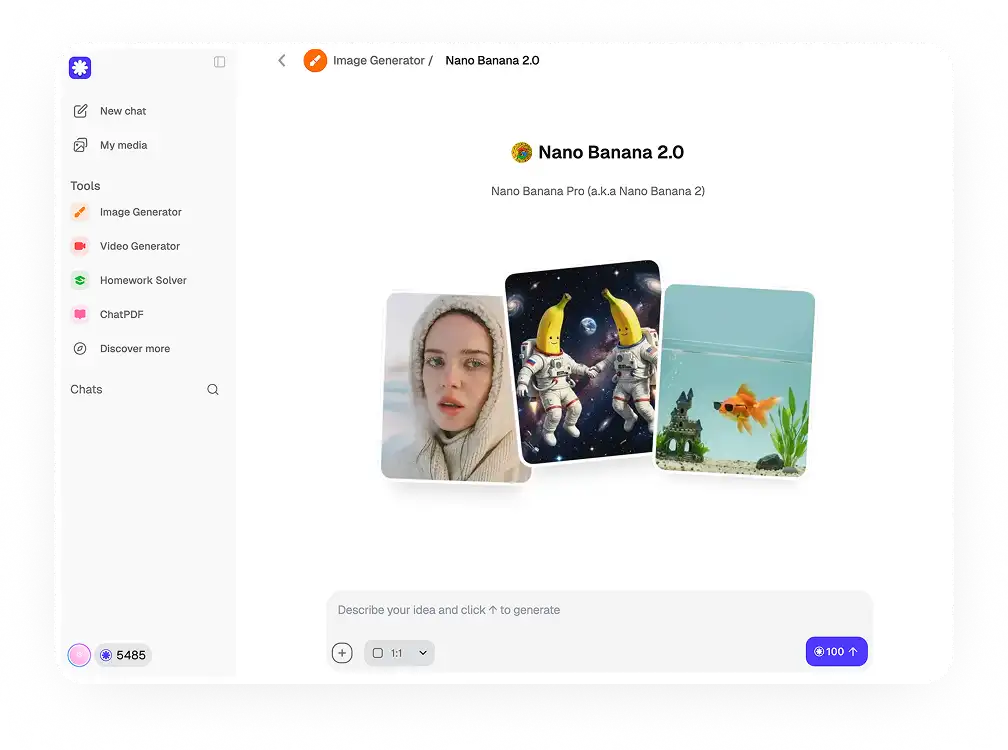
Nano Banana 2 is the best AI image generation model right now. Many say it's the best AI image generator in the world — and it’s probably true. Nano Banana 2 (technically Gemini 3.1 Flash Image) is Google's image-generation component that works alongside the Gemini line.
You can blend up to 14 images at a time
You can edit images through prompts
You can create infographics with accurate real-world data
You can generate highly realistic images up to 4K resolution
What are the disadvantages? It costs more and is slower than other models. That's why Nano Banana 2 is also called Nano Banana Pro. It wasn't a replacement for the original model. Instead, it was released as a more advanced, premium version.
Other notable image generators include:
Flux 2
Reve
Seedream 4
What about ChatGPT? GPT-Image is OpenAI's image generation model that creates images through ChatGPT. At one point this was the best choice for image generation, but now it’s not as good as competitors.
Grok also offers image generation, but it’s not as good as that of Nano Banana 2. That said, Grok permits explicit content, so you can potentially create images that other models won’t let you make because of safety filtering.
Best AI Model For Video
Sora 2 and Kling o1
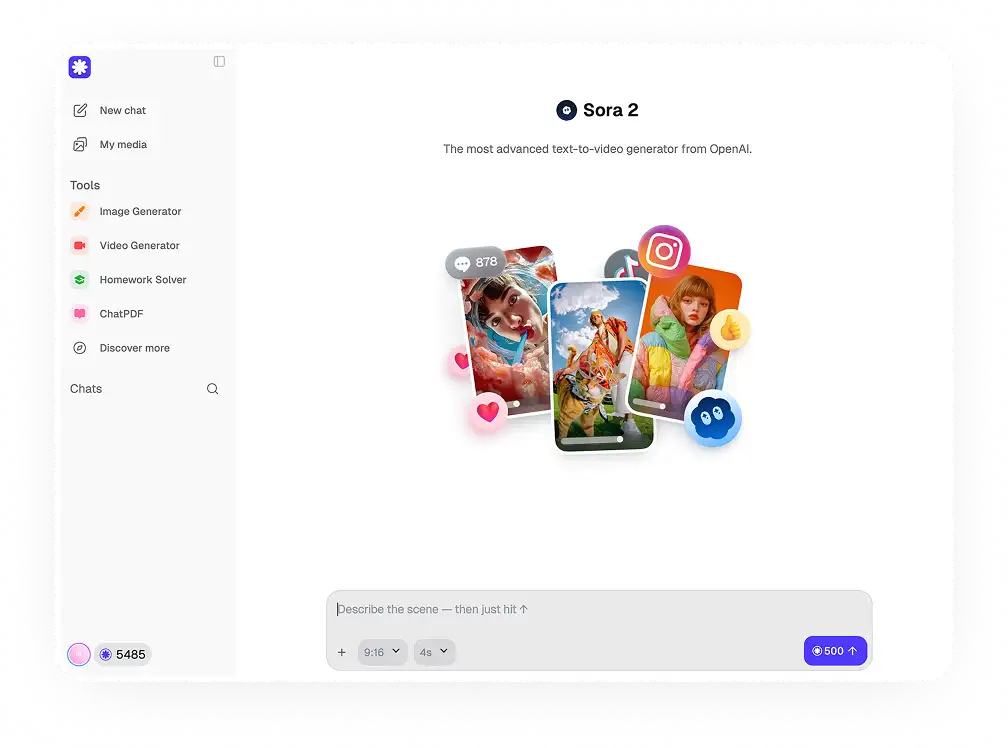
Sora 2 and Kling o1 are the best AI video models right now. Sora is OpenAI's video generation model that offers exceptional quality and realistic physics compared to competitors. It can also generate videos with sound.
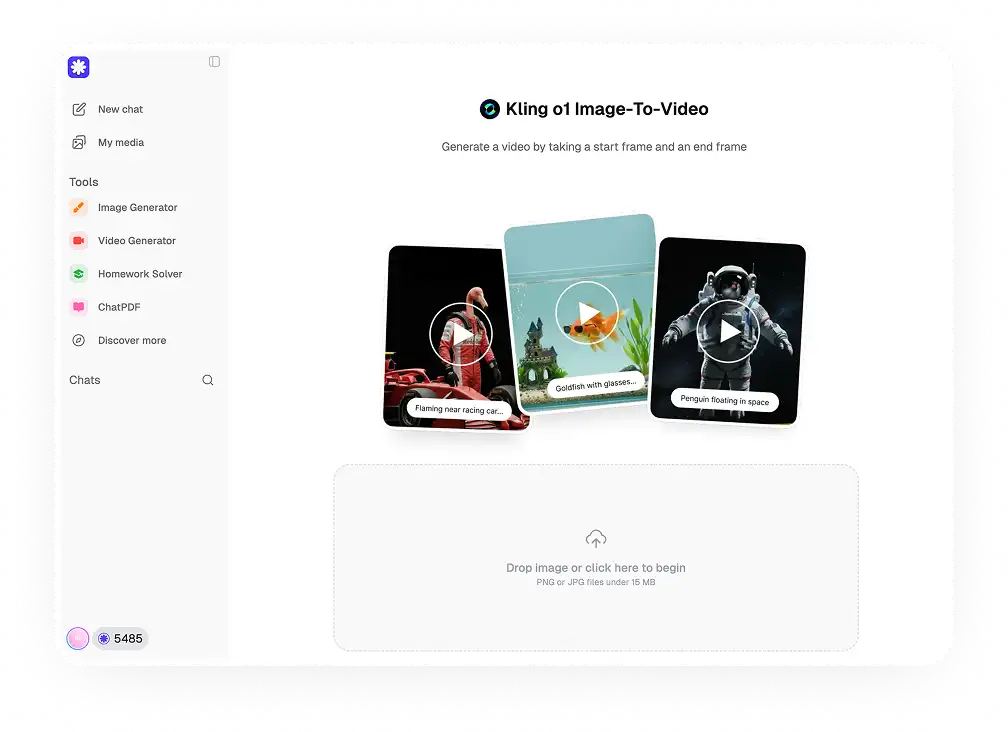
Kling o1 is the world’s first unified multi-modal AI model, meaning you can throw any content and attachments at it and create ultra-complex prompts, giving you more control over the end-result than anything else on the market.
What else is worth considering? Veo 3.1 — this is Google's video generation model that works alongside Gemini. It is almost as good as Sora 2, but the videos aren’t quite as realistic.
Best AI Model For Data Analysis
Gemini 3.1 Pro
Gemini 3.1 Pro has a 1 million-token context window, which allows it to digest and reason about very long documents, large spreadsheets, CSV files, or databases.
It has another advantage —strong multimodal processing. This means that the model can read images, scans, and visual content very accurately, making it ideal for analyzing and chatting with PDF documents.
Google workspace users will also find it convenient that Gemini 3.1 Pro integrates directly with Google Sheets, Google Analytics, and other Google Workspace tools
Why is Gemini 3.1 Pro so good at data analysis? It’s built different (no pun intended).
Unlike other models that process different media types sequentially, Gemini understands text, images, tables, and charts simultaneously within its architecture. This makes it particularly strong at analyzing documents that combine multiple data formats — like quarterly reports with embedded charts or research papers with tables and graphs.
Pricing Comparison
All four flagships offer free tiers and multiple paid options. Here's how the pricing structures compare:
Consumer Pricing
Tier
ChatGPT
Grok
Gemini
Claude
Free
GPT-5.5 Instant (default) with limits, web search, voice mode, file uploads
Grok 4.3 with limits, DeepSearch, reasoning
Gemini 3.1 Pro with limits (Gemini app / AI Studio)
~$30/month - SuperGrok: full Grok 4.3 access, DeepSearch, enhanced reasoning
$19.99/month - Google AI Pro: Gemini 3.1 Pro with 1M-token context
$20/month - Claude Pro
Premium
$200/month - ChatGPT Pro: unlimited GPT-5.5, GPT-5.5 Pro mode, Deep Research, Sora
~$300/month - SuperGrok Heavy: fullest Grok 4.3 access, early features
From $100/month - Google AI Ultra (top tier $200/month)
From $100/month - Claude Max
At the basic tier, ChatGPT Plus, Google AI Pro, and Claude Pro all sit around $20/month, while xAI's SuperGrok is a bit higher at roughly $30/month. Plus and Pro bundle extras like Canvas, Custom GPTs, and Projects.
Google AI Pro is similar to ChatGPT Plus at about $20/month and works with Google Workspace apps like Gmail, Docs, and Sheets — handy if you already live in Google's ecosystem. (Note: consumer tiers shift often, so check each provider's current pricing page.)
API Pricing
For developers building applications, here's how the API costs compare across the four current flagships (per million tokens; check each provider for live numbers):
Grok 4.3: $1.25 input / $2.50 output — the cheapest of the four
Gemini 3.1 Pro: $2.00 input / $12.00 output (rises to $4.00 / $18.00 for prompts over 200k tokens)
GPT-5.5: $5.00 input / $30.00 output (cached input $0.50; long prompts over ~272k tokens are billed at a premium)
Claude Opus 4.8: $5.00 input / $25.00 output (an optional Fast mode runs $10 / $50; prompt caching can cut input cost by up to 90%)
Grok 4.3 is by far the most affordable, and Gemini 3.1 Pro is the cheapest of the closed frontier models for short prompts. GPT-5.5 and Opus 4.8 sit at the premium end — you're paying for top-tier coding and agentic performance. Gemini's pricing roughly doubles for very large contexts above 200,000 tokens, so factor that in for long-document work.
Bottom Line
The four labs keep leapfrogging each other. As of June 2026 the current flagships are GPT-5.5 (April 2026), Grok 4.3 (April 2026), Gemini 3.1 Pro (February 2026), and Claude Opus 4.8 (May 28, 2026) — and Opus 4.8 is the one to beat, leading the Artificial Analysis Intelligence Index and topping the coding benchmarks. But there's no single winner for everything: Opus 4.8 and GPT-5.5 own coding, Gemini 3.1 Pro leads reasoning and data analysis, GPT-5.5 leads creative writing, and Grok 4.3 is the budget pick.
The only problem is that subscribing to all of them is expensive — easily $100+/month across the four. Thankfully, there's a better option.
With a single subscription starting at $5.99 per week, you can access all four models on Overchat AI.
Frequently Asked Questions (FAQ)
What is an AI model?
An AI model is a large language model trained on massive amounts of text data using transformer-based neural networks. These models learn patterns in language and can generate human-like text, analyze data, write code, and perform various other tasks.
What is the best AI model right now?
As of June 2026, Claude Opus 4.8 is the best overall AI model — it leads the Artificial Analysis Intelligence Index at 61.4, just ahead of GPT-5.5 at 60.2. For specific tasks: Opus 4.8 also leads on coding, Gemini 3.1 Pro leads on reasoning and data analysis, and GPT-5.5 leads on creative writing and terminal/CLI workflows.
Which AI model is best for coding?
Claude Opus 4.8 (the successor to Opus 4.5 covered in this article) is the best AI model for coding as of mid-2026. Opus 4.5 already topped SWE-bench Verified at 80.9% in November 2025, and Opus 4.8 has extended that lead further still — SWE-bench Verified 88.6% and SWE-bench Pro 69.2%, ahead of GPT-5.5 (58.6%) and Gemini 3.1 Pro (54.2%).
Which AI model is best for writing?
GPT-5.5 is the best AI model for creative writing. OpenAI's GPT line has led this category since GPT-5.1 topped the Creative Writing v3 benchmark in late 2025, and GPT-5.5 continues that lead with a warm, natural tone.
Which AI model is best for math and reasoning?
Gemini 3.1 Pro and GPT-5.5 are the strongest picks for math and reasoning. Gemini 3.1 Pro narrowly leads on GPQA Diamond (94.3%, just ahead of Opus 4.8 and GPT-5.5), while GPT-5.5 is the clear leader on the ARC-AGI-2 abstract-reasoning test at 85.0%.
Which AI model is best for image generation?
Nano Banana 2 is the best AI image generation model. Many people say that its release was as big a breakthrough for image generation as the release of GPT-3 for text generation. This is because it makes it possible to do things that were simply not possible before, like merging 14 images into one, or creating detailed infographics with perfect text and accurate facts.
What is the best OpenAI model?
As of June 2026, GPT-5.5 is OpenAI's most capable model and the one covered in this article. It comes in Instant (the free-tier default), Thinking, and Pro variants for everyday versus complex tasks, and it succeeds GPT-5.1 and GPT-5.2.