
AI Tarot Reading Online
Shuffle the deck, pick three cards, and get an instant AI tarot reading. A past, present and future spread, interpreted card by card — no app, no sign-up to start.
Ask the cards a real question and get a personalized tarot reading in seconds. Yes/No tarot, 3-card Past-Present-Future, or the full 10-card Celtic Cross — all 78 Major and Minor Arcana, upright and reversed, with an AI interpretation written around your situation.
Tarot is a deck of 78 cards — 22 Major Arcana (life themes: The Lovers, Death, The Tower, The Star…) and 56 Minor Arcana (everyday matters across Cups, Pentacles, Swords, Wands). A reader draws cards, lays them in a spread, and reads the meaning of each card by its position. The AI tarot reader does the same thing online: it shuffles a real 78-card Rider–Waite deck, draws the cards, respects upright and reversed orientations, then writes an interpretation tailored to the exact question you asked.
Every card in the deck — all 22 Major Arcana plus the full Cups, Pentacles, Swords and Wands — with proper upright and reversed meanings. No watered-down 20-card mobile-app deck.
Type your real question — love, career, a decision, a person — and the AI weaves the cards together into a reading that actually answers it, instead of pasting generic card meanings side by side.
Pull a card or a full spread in under a minute. No appointment, no $40 reader on the phone, no email gate before the first reading.
USE CASES
One card, one answer. "Should I text them?", "Will I get the job?", "Is this the right move?" — the AI pulls a card, reads its orientation, and gives you a clear yes, no or "not yet" with the reasoning.
The most-asked tarot question. Drop the name and the situation — the AI draws a spread to map their feelings, your feelings, where it's heading, and what's actually blocking it.
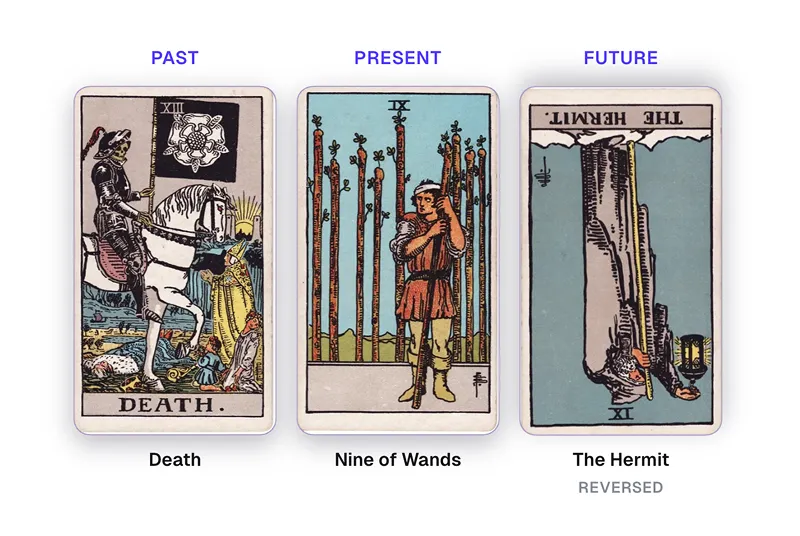
The classic 3-card spread. Card 1 — what brought you here. Card 2 — where you stand right now. Card 3 — the most likely path if nothing changes. Quick, focused, great for beginners.
Job offer on the table? Side-project worth pursuing? Boss situation getting worse? The AI reads the cards specifically for work, money, ambition and timing — not generic life advice.
The full reading: present, challenge, root, past, crown, near future, your stance, environment, hopes and fears, and outcome. The AI walks you through each position so the 10 cards read as one coherent story, not a card-meaning checklist.
Open the page, draw one card, get a short read for the day ahead. A 30-second journaling prompt that's more interesting than a horoscope.
Join thousands of people already using Overchat AI for tarot, astrology, palm reading and other AI tools — free to start.
Overchat AI brings you the power of the world's top AI models: ChatGPT, Claude, Gemini, Mistral, and more.
Three categories to avoid. First, anything tied to life safety, serious medical diagnoses, legal disputes or specific financial decisions — those need a doctor, lawyer or advisor, not a card spread. Second, hard yes/no questions about someone else's behaviour ("Are they cheating?", "Does she love him?") — readers consider them invasive, and the cards read your energy, not somebody else's. Third, the same question asked five times hoping for a different answer. Re-ask only when the situation actually changes.
Major Arcana = 22 trump cards (The Fool, The Magician, The Lovers, Death, The Tower, The Star…) covering big life themes — turning points, soul lessons, archetypes. Minor Arcana = 56 cards split into four suits (Cups for emotion, Pentacles for money/body, Swords for thought/conflict, Wands for action/passion) plus court cards (Page, Knight, Queen, King). When a Major shows up the reading is about something significant; mostly Minors means the situation is everyday. The AI reader weighs both correctly.
Tarot — AI or human — isn't a science and doesn't predict the future. Treat it as a structured reflection tool: the cards give you language and angles to think about a situation you're already chewing on. In a 2022 study (Psychology & Psychotherapy), people rated chatbot-delivered tarot readings about as accurate in content as readings from certified human readers (78% vs 79%). What human readers add is emotional resonance; what AI adds is speed, consistency, and no judgement.
Match the spread to the question. One quick yes/no decision → Yes/No tarot (1 card). Something unfolding over time, like a relationship or a job change → 3-card Past-Present-Future. A messy, multi-layered situation where you want context, blockers, hopes and outcome → Celtic Cross (10 cards). Beginners usually start with 3-card and move to Celtic Cross once they want depth.
Yes — you can do a single-card Yes/No or a 3-card reading for free with an Overchat AI account. Longer spreads and unlimited readings are on the paid plans, since each reading runs on real AI compute. Overchat AI also bundles ChatGPT, Claude, Gemini, image and video generation, palm reading and astrology in the same account.
No. Tarot — AI or human — does not predict specific future events with verifiable accuracy. What a good reading does is reflect your current situation, surface options you hadn't named, and suggest what to watch for. Use it as a mirror, not as a fortune teller. If a reading nudges you to act on something important, talk to someone you trust before you make the move.
Roughly, but with nuance. A reversed card usually softens, blocks, delays or internalises the upright meaning rather than flipping it 180°. Reversed Three of Cups isn't "no friendship" — it's "strained or one-sided celebration." The AI reader handles upright and reversed meanings separately for every card in the spread.
Open-ended beats yes/no for deeper readings. Instead of "Will I marry them?" ask "What is the current dynamic between us, and what does it need from me?". Be specific (name, timeframe, situation), be honest, and ask one question at a time. The clearer your question, the more useful the cards — that's true for human tarot too.
Chinese company Baidu has quietly released a model that's just as good as DeepSeek and ChatGPT — ERNIE 4.5 delivers exceptional performance at a fraction of the cost — and most people outside China have never even heard of it.
If you're wondering: what is DeepSeek AI, the answer is quite simple. DeepSeek AI is a Chinese AI research lab that builds large language models. The company released several models in late 2024 and early 2025 that compete directly with OpenAI's GPT-4 and Anthropic's Claude, but at a fraction of the operating cost.
ChatGPT Plus costs $20 per month plus tax, while the Pro plan costs $200 per month plus tax. Understandably, not everyone is willing to pay that much for a chatbot, especially if the premium features aren’t worth it to them. This raises an obvious question: how can I use ChatGPT for free?
Available on Web, iOS, and Android. Access your AI assistant anywhere, anytime.

.svg)
