About Muse Wonder
Muse Wonder is Meta's most capable Muse model, built for agents, knowledge work and coding. It reads text, images, video, audio and PDFs, holds up to 1 million tokens in one conversation, and keeps working on a hard task by trying other approaches before it gives up
Muse Wonder scores 68.1% on AutomationBench, ahead of GPT-6.1 Terra at 60.2%, and 30.6% on GDP.pdf, one of the ten best results of any model on questions about long professional PDFs. When it doesn't know the answer to a knowledge question, it says so instead of making one up in 79.1% of cases
On Overchat AI, Muse Wonder is in the same chat as Muse Spark, Claude and GPT-6, so you can ask it, attach a file and switch models without starting over
- Modalities
- Intelligence Index?
- 44
- Context window?
- 1M tokens
- Released
- Oct 12, 2026
Muse Wonder vs other models
Muse Wonder ranks #11 on the Artificial Analysis Intelligence Index out of 54 models
- 65
 Claude Fable 5.2
- 60
 Gemini 4 Carbon
- 59Claude Opus 5.5
- 55
 GPT-6.1 Sol
- 51GPT-6.1 Terra
- 50Gemini 4 Argon
- 46
 Kimi K3.1 Pro
- 44
 Muse Wonder
- 37Muse Spark
- 35
 Grok 4.7
- #9of 148 modelsGDP.pdfQuestions about long professional PDFs with tables, charts and fine print
- #11of 142 modelsSciCodePython code for scientific computing
- #13of 111 modelsNot making facts upHow often the model says it doesn't know instead of making up an answer
- #15of 150 modelsAutomationBenchBusiness workflows an agent runs across many apps
Source: Artificial Analysis
Compare Muse Wonder
Muse Wonder vs Kimi K3.1 Pro
Muse Wonder scores higher than Kimi K3.1 Pro in 3 of 7 benchmarks. The widest lead is in FrontierCode 2.0: 27.9% against 25.5%. Kimi K3.1 Pro is ahead in Terminal-Bench 4.0: 67.2% against 52.0%. Muse Wonder writes 980 tokens per second, Kimi K3.1 Pro writes 340
- Benchmarks won
- Muse Wonder: 3
- Kimi K3.1 Pro: 4
- Average score
- Muse Wonder: 42.0%
- Kimi K3.1 Pro: 45.5%
- Output speed, tokens/s
- Muse Wonder: 980
- Kimi K3.1 Pro: 340
- Time to first token, s (log scale)
- Muse Wonder: 8.7
- Kimi K3.1 Pro: 7.4
- FrontierCode 2.0+2.4
- HLE-Diamond+1.7
- CritPt v2 Hard+1.0
- GDP.pdf−0.8
- AutomationBench−5.2
- Terminal-Bench-Science−8.6
- Terminal-Bench 4.0−15.2
Muse Wonder vs GPT-6.1 Terra
Muse Wonder scores higher than GPT-6.1 Terra in 2 of 7 benchmarks. The widest lead is in AutomationBench: 68.1% against 60.2%. GPT-6.1 Terra is ahead in Terminal-Bench-Science: 57.6% against 25.7%. Muse Wonder writes 980 tokens per second, GPT-6.1 Terra writes 75
- Benchmarks won
- Muse Wonder: 2
- GPT-6.1 Terra: 5
- Average score
- Muse Wonder: 42.0%
- GPT-6.1 Terra: 51.4%
- Output speed, tokens/s
- Muse Wonder: 980
- GPT-6.1 Terra: 75
- Time to first token, s (log scale)
- Muse Wonder: 8.7
- GPT-6.1 Terra: 4.3
- AutomationBench+7.9
- GDP.pdf+2.0
- Terminal-Bench 4.0−3.6
- HLE-Diamond−8.3
- FrontierCode 2.0−14.4
- CritPt v2 Hard−17.5
- Terminal-Bench-Science−31.9
Muse Wonder vs Grok 4.7
Muse Wonder scores higher than Grok 4.7 in 6 of 7 benchmarks. The widest lead is in Terminal-Bench 4.0: 52.0% against 25.8%. Grok 4.7 is ahead in FrontierCode 2.0: 28.7% against 27.9%. Muse Wonder writes 980 tokens per second, Grok 4.7 writes 81
- Benchmarks won
- Muse Wonder: 6
- Grok 4.7: 1
- Average score
- Muse Wonder: 42.0%
- Grok 4.7: 29.7%
- Output speed, tokens/s
- Muse Wonder: 980
- Grok 4.7: 81
- Time to first token, s (log scale)
- Muse Wonder: 8.7
- Grok 4.7: 8.9
- Terminal-Bench 4.0+26.2
- CritPt v2 Hard+17.0
- HLE-Diamond+15.8
- Terminal-Bench-Science+14.3
- GDP.pdf+10.6
- AutomationBench+2.5
- FrontierCode 2.0−0.8
Muse Wonder vs Muse Spark
Muse Wonder scores higher than Muse Spark in 7 of 7 benchmarks. The widest lead is in Terminal-Bench 4.0: 52.0% against 33.3%. Muse Wonder writes 980 tokens per second, Muse Spark writes 1129
- Benchmarks won
- Muse Wonder: 7
- Muse Spark: 0
- Average score
- Muse Wonder: 42.0%
- Muse Spark: 33.4%
- Output speed, tokens/s
- Muse Wonder: 980
- Muse Spark: 1129
- Time to first token, s (log scale)
- Muse Wonder: 8.7
- Muse Spark: 6.2
- Terminal-Bench 4.0+18.7
- Terminal-Bench-Science+14.7
- AutomationBench+10.2
- HLE-Diamond+5.3
- FrontierCode 2.0+4.8
- GDP.pdf+4.0
- CritPt v2 Hard+2.5
Best model by use case
Average benchmark scores of Muse Wonder and 4 other models by use case
Coding
?Average of 3 tests- 1GPT-6.1 Terra51.8%
- 2Kimi K3.1 Pro42.3%
- 3Muse Wonder35.2%
- 4Muse Spark22.5%
- 5Grok 4.722.0%
Knowledge work
?Average of 2 tests- 1Kimi K3.1 Pro52.3%
- 2Muse Wonder49.3%
- 3GPT-6.1 Terra44.4%
- 4Grok 4.742.8%
- 5Muse Spark42.3%
Reasoning
?Average of 2 tests- 1GPT-6.1 Terra57.6%
- 2Muse Wonder44.8%
- 3Kimi K3.1 Pro43.4%
- 4Muse Spark40.9%
- 5Grok 4.728.4%
Muse Wonder benchmarks
Compare Muse Wonder with 4 other models in 7 benchmarks measuring coding, knowledge work and reasoning
Coding
- Terminal-Bench 4.0?Muse Wonder52.0%Kimi K3.1 Pro67.2%GPT-6.1 Terra55.6%Grok 4.725.8%Muse Spark33.3%52.0%−15.2
- FrontierCode 2.0?Muse Wonder27.9%Kimi K3.1 Pro25.5%GPT-6.1 Terra42.3%Grok 4.728.7%Muse Spark23.1%27.9%−14.4
- Terminal-Bench-Science?Muse Wonder25.7%Kimi K3.1 Pro34.3%GPT-6.1 Terra57.6%Grok 4.711.4%Muse Spark11.0%25.7%−31.9
Knowledge work
- AutomationBench?Muse Wonder68.1%Kimi K3.1 Pro73.3%GPT-6.1 Terra60.2%Grok 4.765.6%Muse Spark57.9%68.1%−5.2
- GDP.pdf?Muse Wonder30.6%Kimi K3.1 Pro31.4%GPT-6.1 Terra28.6%Grok 4.720.0%Muse Spark26.6%30.6%−0.8
Reasoning
- HLE-Diamond?Muse Wonder39.0%Kimi K3.1 Pro37.3%GPT-6.1 Terra47.3%Grok 4.723.2%Muse Spark33.7%39.0%−8.3
- CritPt v2 Hard?Muse Wonder50.5%Kimi K3.1 Pro49.5%GPT-6.1 Terra68.0%Grok 4.733.5%Muse Spark48.0%50.5%−17.5
Sources: Meta, Introducing Muse Wonder (Oct 12, 2026), Artificial Analysis, Muse Wonder and Muse Wonder Full
Muse Wonder speed
Output speed is how fast the model writes (tokens per second, higher is better). Time to first token is how long you wait before the answer starts (lower is better)
Output speed and time to first token of 35 models
?Percentile| Models | Output speed, tokens/s (log scale) | Time to first token, s (log scale) |
|---|---|---|
| GPT-6 Luna | 143 | 2.4 |
| GPT-6.1 Terra | 75 | 4.3 |
| GPT-6.1 Sol | 58 | 2.9 |
| GPT-6 Astra | 48 | 3.2 |
| Claude Opus 5.5 | 88 | 1.9 |
| Claude Opus 5 | 54 | 2.6 |
| Claude Opus 4.8 | 59 | 1.3 |
| Claude Fable 5.2 | 84 | 2.3 |
| Claude Sonnet 5.5 | 102 | 1 |
| Claude 5 Sonnet | 215 | 10.5 |
| Claude Sonnet 4.6 | 220 | 10.8 |
| Claude Haiku 5.5 | 167 | 2.1 |
| Gemini 4 Carbon | 169 | 29.5 |
| Gemini 4 Argon | 91 | 6 |
| Gemini 3.8 Flash | 203 | 7.5 |
| Gemini 3 Pro | 270 | 11.2 |
| Grok 4.7 | 81 | 8.9 |
| Grok 4.6 | 290 | 32 |
| Qwen 3.8 Max | 81 | 30.6 |
| DeepSeek V4 Pro | 144 | 1.1 |
| DeepSeek V4.1 Flash | 422 | 2.2 |
| Mistral Large 4 | 226 | 8.6 |
| Hy4 | 214 | 37.7 |
| ERNIE 5.5 Flash | 405 | 2.7 |
| Muse Wonder | 980 | 8.7 |
| Muse Spark | 1129 | 6.2 |
| Kimi K3.1 Pro | 340 | 7.4 |
| Kimi K3 | 338 | 5.9 |
| GLM 5.3 | 197 | 1.2 |
| Flint | 194 | 12.3 |
| Llama 4 | 81 | 0.7 |
| Claude 4.5 Haiku | 162 | 0.9 |
| MiniMax M3 | 169 | 4.5 |
| MiniMax M3.1 Flash | 656 | 7.2 |
| Kimi K2.7 Code | 455 | 3.6 |
Typing test
Every model writes the same answer. The test waits the model's time to first token, then prints the text at the model's output speed and shows the total time
- Muse Wonder980 tokens/s8.7 s to first token
- Kimi K3.1 Pro340 tokens/s7.4 s to first token
- GPT-6.1 Terra75 tokens/s4.3 s to first token
- Grok 4.781 tokens/s8.9 s to first token
Source: Overchat AI, 2026-11-11
See how Muse Wonder answers
Examples of Muse Wonder answers to 3 prompts: Find what's wrong, Simulate a pendulum and Check a fact. Each answer is the unedited output of the model
My online store's last six months: visits 42k, 45k, 47k, 51k, 50k, 53k; orders 1,260, 1,280, 1,240, 1,230, 1,150, 1,140; refunds 38, 41, 52, 66, 71, 80. Find the two biggest problems and suggest one fix for each, in a short table.
Muse Wonder| Problem | Evidence (Month 1 → 6) | Fix |
|---|---|---|
| 1. Falling conversion rate | Visits up 42k → 53k (+26%), but orders down 1,260 → 1,140. Conversion fell 3.0% → 2.15%. | Audit the new traffic source and align its landing page to the ad/search intent. |
| 2. Rising refund rate | Refunds up 38 → 80; refund rate more than doubled, 3.0% → 7.0% of orders. | Identify the #1 refund reason for the top product and fix it (e.g., sizing/description or quality). |
Write a Python function that simulates a damped pendulum with the RK4 method and returns the angle over time. Keep it under 40 lines and explain your choice of time step in one sentence.
Muse Wonderimport numpy as np
def simulate_damped_pendulum(theta0=1.0, omega0=0.0, t_max=10.0,
dt=0.01, g=9.81, L=1.0, damping=0.1):
n = int(t_max / dt) + 1
t = np.linspace(0, t_max, n)
theta = np.empty(n)
omega = np.empty(n)
theta[0], omega[0] = theta0, omega0
def deriv(th, om):
return om, -(g / L) * np.sin(th) - damping * om
for i in range(n - 1):
th, om = theta[i], omega[i]
k1_th, k1_om = deriv(th, om)
k2_th, k2_om = deriv(th + 0.5 * dt * k1_th, om + 0.5 * dt * k1_om)
k3_th, k3_om = deriv(th + 0.5 * dt * k2_th, om + 0.5 * dt * k2_om)
k4_th, k4_om = deriv(th + dt * k3_th, om + dt * k3_om)
theta[i + 1] = th + (dt / 6) * (k1_th + 2 * k2_th + 2 * k3_th + k4_th)
omega[i + 1] = om + (dt / 6) * (k1_om + 2 * k2_om + 2 * k3_om + k4_om)
return t, thetaI chose dt=0.01 s because it is far smaller than the pendulum's ~2 s natural period, so RK4 remains accurate and stable without unnecessary computation.
Who was the first person to walk on the Moon, and who was the 13th? If any part of the question has no real answer, say so instead of guessing.
Muse WonderThe first person to walk on the Moon was Neil Armstrong of Apollo 11, on July 20, 1969 (EDT).
There is no 13th person — only 12 people in total have walked on the Moon, all Apollo astronauts between 1969 and 1972.
More prompts to try with Muse Wonder
What Muse Wonder is best for
Agents and business workflows
Muse Wonder runs workflows across sales, support and finance apps, with 68.1% on AutomationBench, ahead of GPT-6.1 Terra and Grok 4.7
Reports and long PDFs
Muse Wonder answers questions about long professional PDFs with tables, charts and fine print, with 30.6% on GDP.pdf, one of the ten best results of any model
Answers you can trust
Muse Wonder says when it doesn't know: in 79.1% of the knowledge questions it can't answer, it admits it instead of making up a fact
Coding and science
Muse Wonder writes scientific code, with 60.3% on SciCode, and completes hard terminal tasks, with 52.0% on Terminal-Bench 4.0
How to use Muse Wonder on Overchat AI
Start in the chat at the top of this page or in the Overchat AI app on the web, iOS or Android
- 01
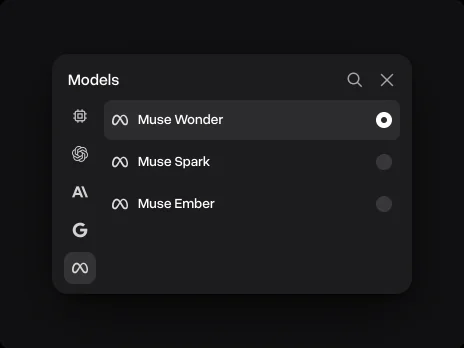
Pick Muse Wonder
It is already picked in the chat on this page. In the Overchat AI app, open the model list next to the message field and pick Muse Wonder
- 02
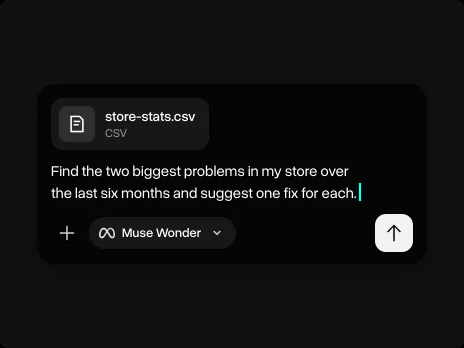
Attach your code or a file
Add code, a document, a spreadsheet or a screenshot, and write what you need: the result, the format and what must stay the same
- 03
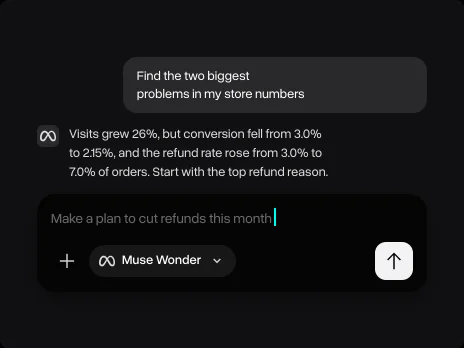
Keep going in the same chat
Ask a follow-up, ask for tests or a shorter version, or switch to another model without losing the conversation
Why use Muse Wonder on Overchat AI
One account for chat, images and video, on every device
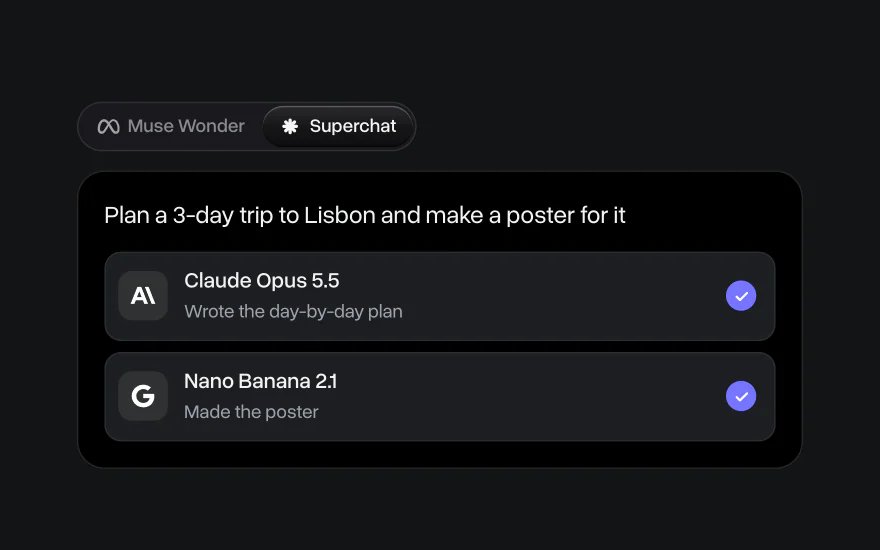
Superchat AI agent
Superchat Agent automatically routes your message to the model best suited for the task. It can generate images and videos, use the AI tools built into Overchat AI, and learn from your interactions to get better over time
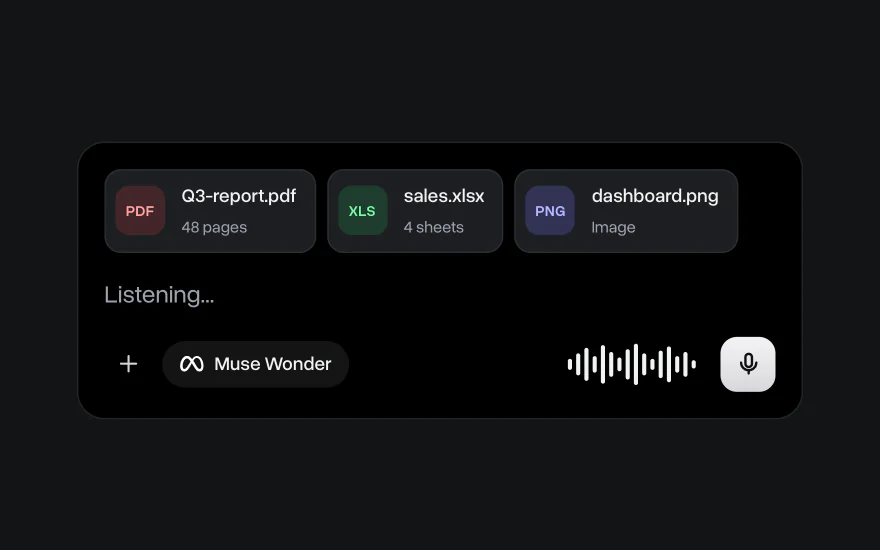
Chat with images and files
Upload PDFs, spreadsheets, code and screenshots and ask Muse Wonder about them. You can also dictate a message instead of typing it
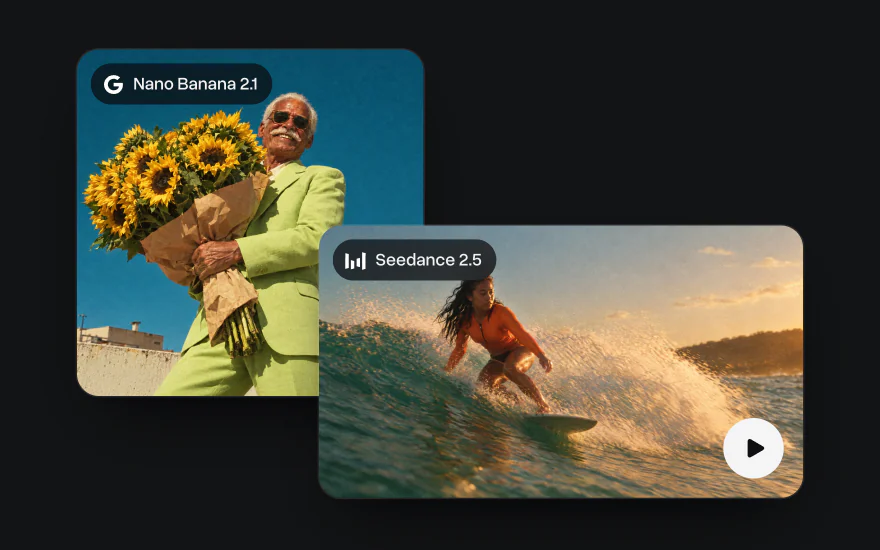
Go beyond text
Generate images with Nano Banana and GPT Image and videos with Seedance and Kling in the same account, with the same credits as chat
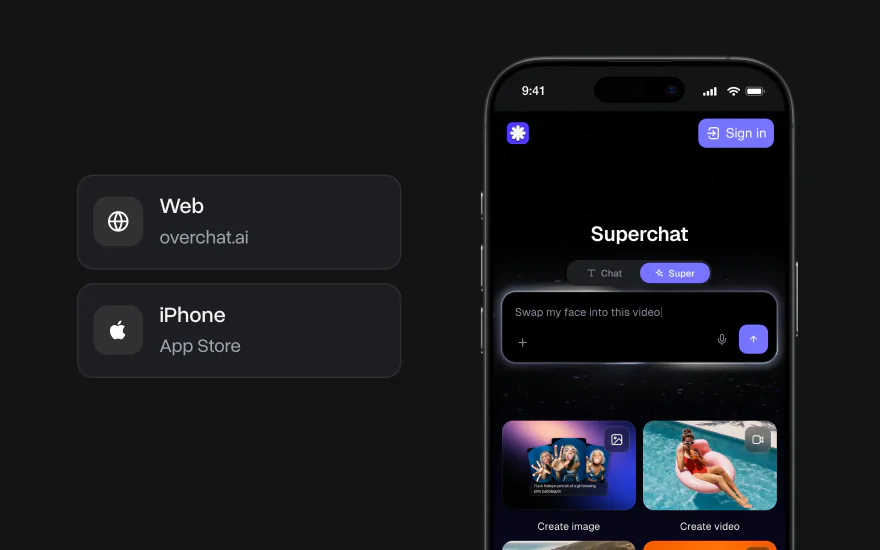
On the web and iPhone
Start a chat on your laptop and finish it on your phone. The Overchat AI app has the same models, and your chats stay in one account on every device

Meta models on Overchat AI
Compare 4 Meta models on Overchat AI by output speed, time to first token and the price of one message
Muse WonderThis pageLlama 4Source: Overchat AI, 2026-11-11
Explore other models
Models marked Soon are coming to Overchat AI; the rest are available now


Learn more about AI models

We tested Gemini 4 Argon against Claude Opus 5.5, GPT-6 Astra and Muse Wonder
We tested Gemini 4 Argon against Claude Opus 5.5, GPT-6 Astra and Muse Wonder on three coding tasks. See benchmarks, speed and how to use it
Muse Wonder vs Muse Spark: Meta's New Model Tested
We tested Muse Wonder against Muse Spark 1.3 on logic, writing and coding tasks. See benchmarks and which Meta model is better
10 Best All-in-One AI Platforms in 2026: Why One AI Subscription Beats Many
Compare the 10 best all-in-one AI platforms in 2026, from Overchat AI to Poe and Magai, with prices, free plans and the newest GPT and Claude models