We tested Gemini 4 Argon against Claude Opus 5.5, GPT-6 Astra and Muse Wonder
Last Updated:
2026-10-14
We tested Gemini 4 Argon against Claude Opus 5.5, GPT-6 Astra and Muse Wonder
Gemini 4 Argon is Google's flagship model which was publicly released on October 13, 2026. Google says this model is built for complex software engineering and multi-step agents, and positions it to compete against Claude Opus 5.5 and GPT-6 Astra, outperforming them on multiple benchmarks.
To test what the new model can do, we've pitted it against Opus 5.5, GPT-6 Astra and Muse Wonder, and the results were interesting.
Gemini 4 Argon is a frontier LLM from Google DeepMind. Originally announced on September 30, 2026, it was first given for closed testing to a group of cyber defenders through its Fairwind Program, and became generally available on October 13, 2026. Argon is a sparse mixture-of-experts transformer trained as a new model, and Google positions it for software engineering, math and science problems and autonomous agents. The model accepts text, images, video, audio and PDF files. It has a massively upgraded output limit of 1 million tokens, up from 64,000 tokens in earlier Gemini models — that's an almost 16-fold increase.
Gemini 4 Argon benchmarks
According to Google's measurements, Argon beats Opus 5.5 and GPT-6 Astra on several benchmarks, including DeepSWE, a benchmark of long software engineering tasks, and Vibe Code Bench.
Benchmark
Gemini 4 Argon
Claude Opus 5.5
GPT-6 Astra
DeepSWE v1.1
77.9%
74.2%
74.1%
Vibe Code Bench
91.9%
90.3%
—
Terminal-Bench 4.0
57.4%
66.4%
58.2%
FrontierSWE v2
55.0%
62.3%
65.5%
First-party benchmarks tend to highlight the best of each model because they're often run in ideal conditions, so it's useful to also include Artificial Analysis benchmarks — as an independent company that runs the same set of tests on every model, they're often more objective, and here Gemini 4 Argon ends up five points behind Claude Opus 5.5 on its Intelligence Index and level with GPT-6 Astra.
Argon's main strength in these tests is accuracy: its hallucination rate is 15%, the lowest among models that score 45 or more on the index.
Model
Intelligence Index
AA-Omniscience
Cost per index task
Claude Opus 5.5
58
46
$5.98
Gemini 4 Argon
53
42
$1.99
GPT-6 Astra
53
43
$3.26
Muse Wonder
52
25
$4.52
Gemini 4 Argon vs Claude Opus 5.5 vs GPT-6 Astra vs Muse Wonder: coding test
We gave Gemini 4 Argon, Claude Opus 5.5, GPT-6 Astra and Muse Wonder three challenging tasks and ran them in Overchat AI.
In every run the models were asked to provide a single HTML file which we could open directly in Chrome and run. The tasks were as follows:
Task
Gemini 4 Argon
Claude Opus 5.5
GPT-6 Astra
Muse Wonder
Black hole flyby
Lensed disk and Einstein ring, banding on the disk
Correct shape, grey shadow up close
Correct lensing and a black shadow
Brown shadow, stray bright spots
Animated path tracer
Clean image, smear behind the moving sphere
Moving caustic and camera orbit
Moving caustic, bright noise specks
Small box, noisy image
Racing game
Cars stuck at the start
Race runs
Race runs, most detailed interface
Race runs
The results are below. Gemini 4 Argon is top left, Claude Opus 5.5 top right, GPT-6 Astra bottom left and Muse Wonder bottom right.
Black hole shader
This challenging render not only tests the visual output but also math.
The prompt:
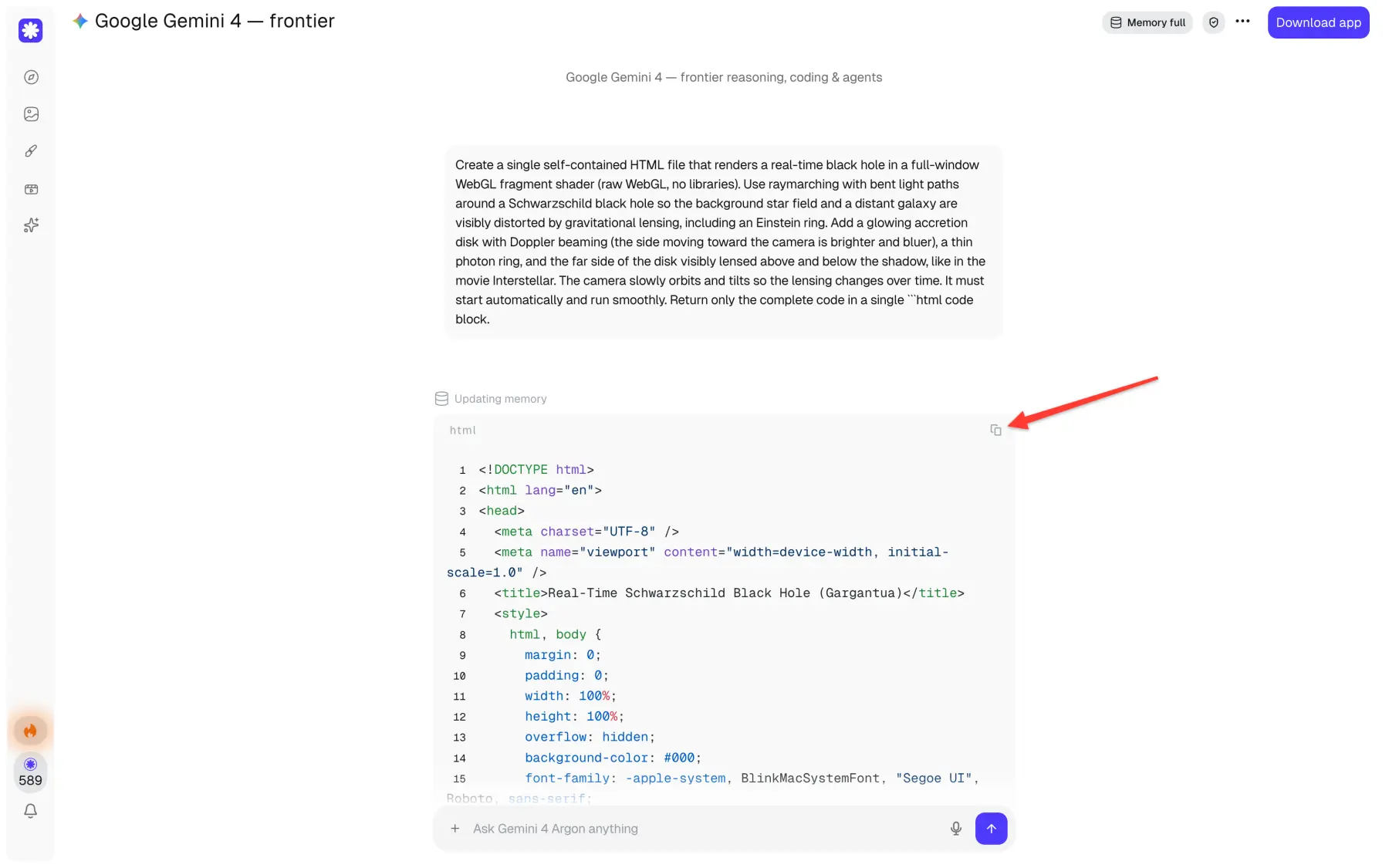
Create a single self-contained HTML file that renders a real-time black hole in a full-window WebGL fragment shader (raw WebGL, no libraries). Use raymarching with bent light paths around a Schwarzschild black hole so the background star field and a distant galaxy are visibly distorted by gravitational lensing, including an Einstein ring. Add a glowing accretion disk with Doppler beaming (the side moving toward the camera is brighter and bluer), a thin photon ring, and the far side of the disk visibly lensed above and below the shadow, like in the movie Interstellar. The camera flies a cinematic path: it starts far away, slowly approaches the black hole and passes through the plane of the disk, so the view changes from edge-on to looking down at the disk and the lensing becomes more extreme as it gets closer; one full approach takes about 15 seconds, then it pulls back and repeats. It must start automatically and run smoothly. Return only the complete code in a single ```html code block.
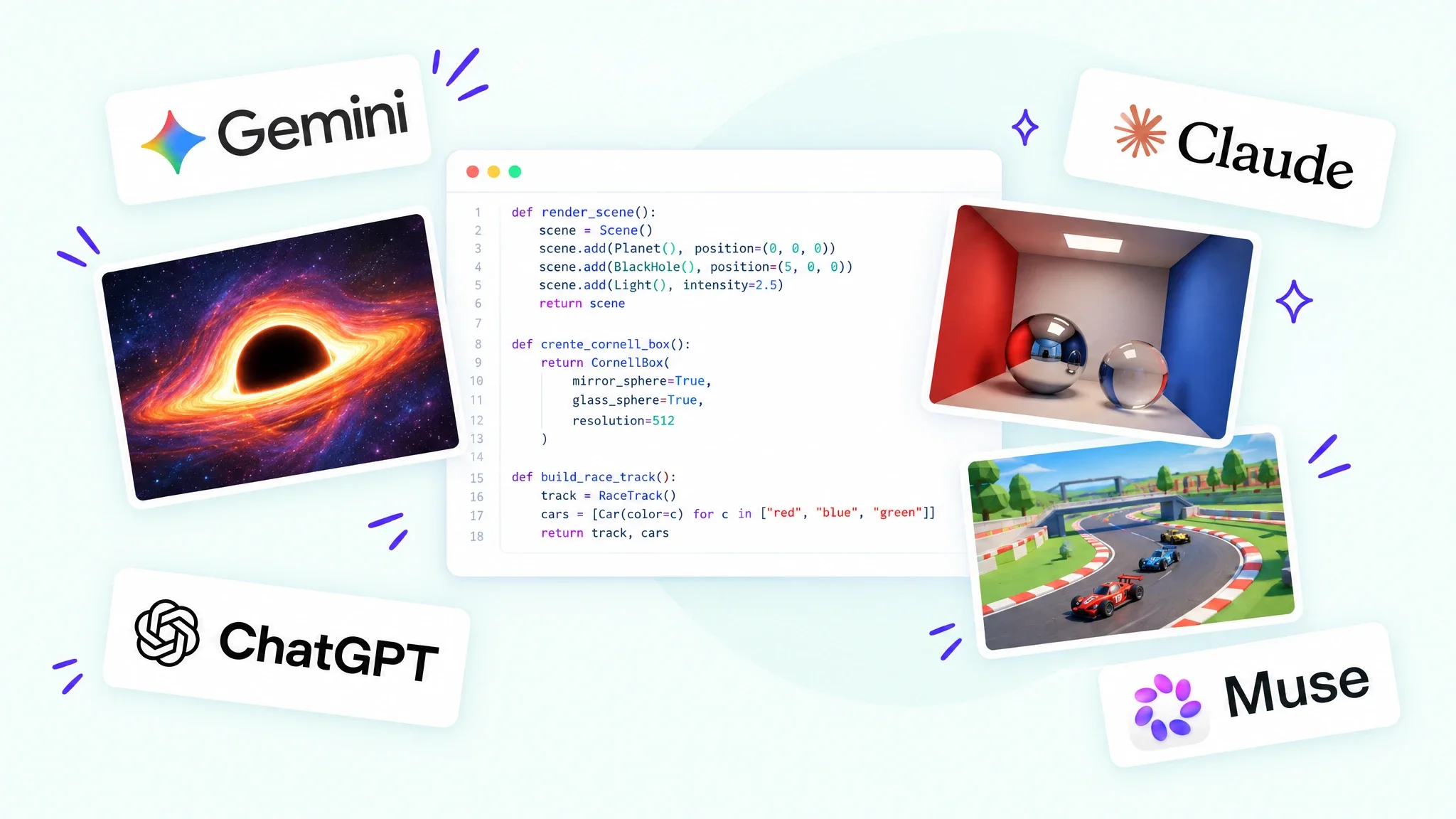
The models had to create a real-time black hole rendered by a WebGL shader, with gravitational lensing and a camera that flies toward it.
Right away the speed difference. Gemini 4 Argon wrote the code in 47 seconds. GPT-6 Astra took 222 seconds, for comparison.
In terms of accuracy, Argon arguably made the most dramatic scene: the disk bends around the shadow and a bright Einstein ring surrounds it. However, GPT-6 Astra probably has the most physically accurate rendition with the far side of the disk lensed above and below a black shadow — just like in Interstellar.
Animated path tracer
Path tracing is the rendering method behind photorealistic CGI: it simulates real behaviour of light as rays are "shot" from a light source and bounce around the scene and against objects, carrying lighting and color information. You've probably heard about ray tracing in games, and path tracing is an even more accurate version of that. It's computationally very heavy, so we usually only see it in movies and rendered CGI.
The prompt:
Create a single self-contained HTML file (no libraries) with a real-time GPU path tracer written in WebGL2 fragment shaders that renders an animated Cornell box on a full-window canvas. The scene: red and green side walls, white floor, ceiling and back wall, one mirror sphere and one glass sphere with refraction. Everything moves: the area light slowly travels across the ceiling and its color shifts from warm orange to cool blue and back every few seconds, so the soft shadows, the color bleeding and the caustic under the glass sphere visibly move; the glass sphere slowly bounces; the camera slowly orbits a little around the box. Render several samples per pixel per frame and use a temporal blend so the image stays clean while the scene moves. It must start automatically and run smoothly. Return only the complete code in a single ```html code block.
In this task the models create a Cornell box, the classic test scene of computer graphics, with a moving light, a bouncing glass sphere and a moving camera, which makes the shadows and the caustic, the bright spot that the glass sphere focuses onto the floor, move as well.
While all four models wrote a working path tracer, they handle motion differently.
Claude Opus 5.5 shows the clearest caustic, which slides across the floor as the sphere bounces. Gemini 4 Argon keeps the image the cleanest and the light visibly changes color, but the glass sphere leaves a smear behind it, a side effect of the temporal blend that mixes previous frames into the current one.
GPT-6 Astra added a small interface with the frame rate and sample count, and its caustic moves correctly, but bright white specks of noise stay on the ceiling and the spheres.
Muse Wonder rendered the box small in the middle of the screen with the widest camera orbit, and its image is the noisiest of the four.
Racing game
Last but not least, we asked the models to create a playable racing game in one shot — because modern AI models are so powerful that they can very well do this, and it makes for a great test.
The prompt:
Create a single HTML file with a 3D racing game in Three.js. Load it with an import map from https://cdn.jsdelivr.net/npm/three@0.160.0/build/three.module.js (addons, if you need them, from https://cdn.jsdelivr.net/npm/three@0.160.0/examples/jsm/); no other libraries. A closed race track with curves, barriers and a start line runs through a simple landscape. Four cars race each other, all driven by an AI that follows the racing line, brakes before turns, overtakes and avoids collisions; the player can take over the red car with the arrow keys at any time. Show a lap counter, race positions and a minimap. The camera follows the leading car from behind with a smooth chase cam. The race starts immediately in this autopilot mode. Return only the complete code in a single ```html code block.
This is a 3D racing track with four cars driven by AI, a lap counter, race positions and a minimap.
This is the only task where Gemini 4 Argon failed, unfortunately.
The car drives into a fence immediately and the code bugs out, as the game pauses and the cars freeze in place while the speedometer shows 15 km/h.
The other games all work, but being strict, only GPT-6 Astra and Opus 5.5 succeeded in one-shotting a whole racing game.
Opus 5.5 seems to have the most realistic result: position of the camera and style of driving are akin to a real player playing a real game.
GPT-6 Astra made a more detailed interface and the visuals look more polished, in our opinion, although the action looks like an end-game cinematic due to the camera being positioned quite high.
Muse Wonder's game works, but the visuals are the most simplistic and the cars are teleporting around to move forward in steps instead of a smooth motion.
Speed
Gemini 4 Argon consistently started writing code within 2–4 seconds and finished each task in under two minutes, whereas Claude Opus 5.5 and GPT-6 Astra spent between one and a half and five minutes on reasoning even before the first line of code appeared.
Task
Gemini 4 Argon
Claude Opus 5.5
GPT-6 Astra
Muse Wonder
Black hole shader
47 s
140 s
222 s
93 s
Animated path tracer
51 s
156 s
270 s
95 s
Racing game
119 s
431 s
247 s
104 s
This is a massive difference and in real-world usage completely transforms the experience.
While the tests above were all about one-shotting a task, in reality, you could have iterated on the code 2-3 times before getting a single result from Astra, which sort of negates the fact that the model is worse at one-shotting.
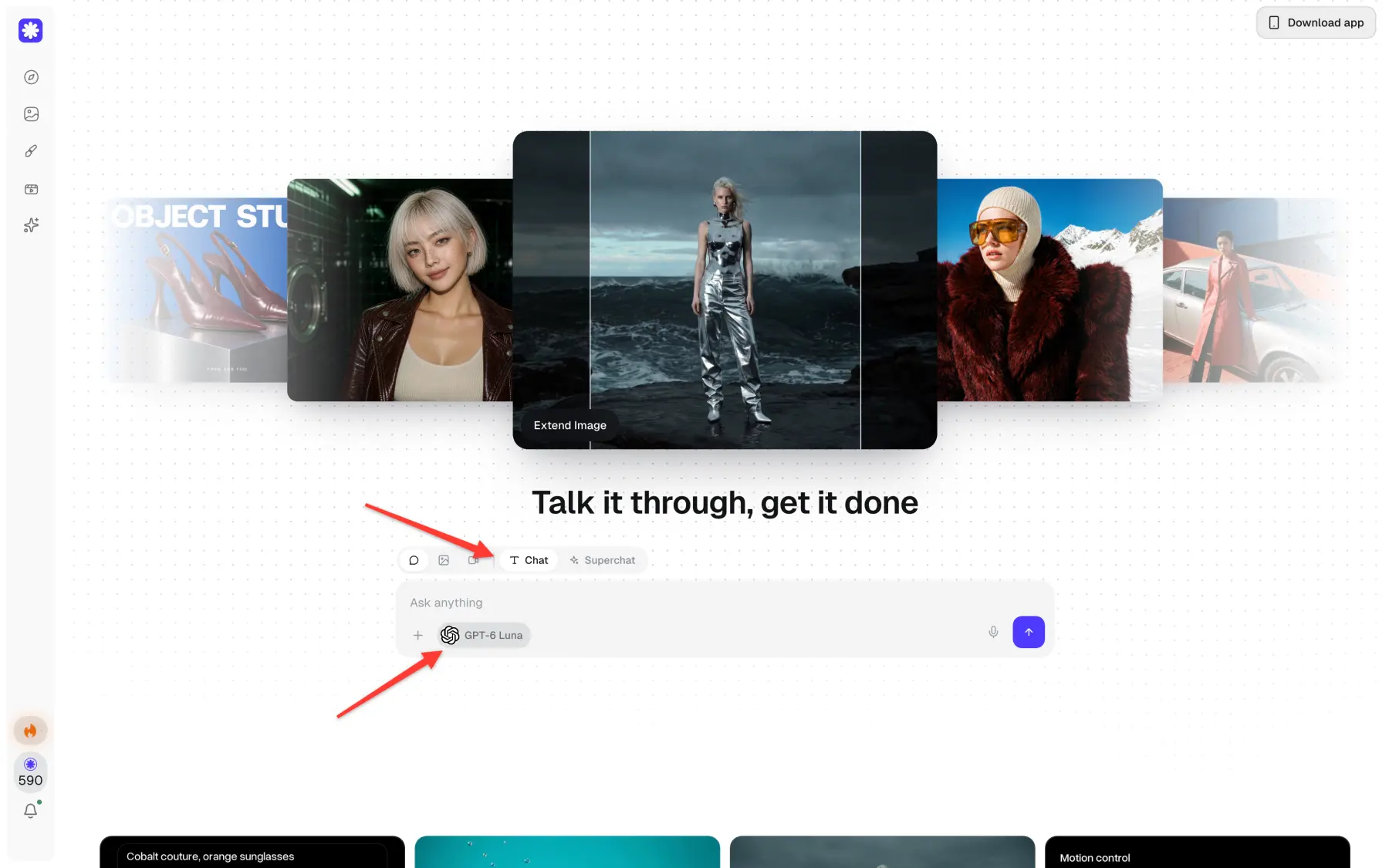
In the message box, switch to Chat mode and click the name of the current model.
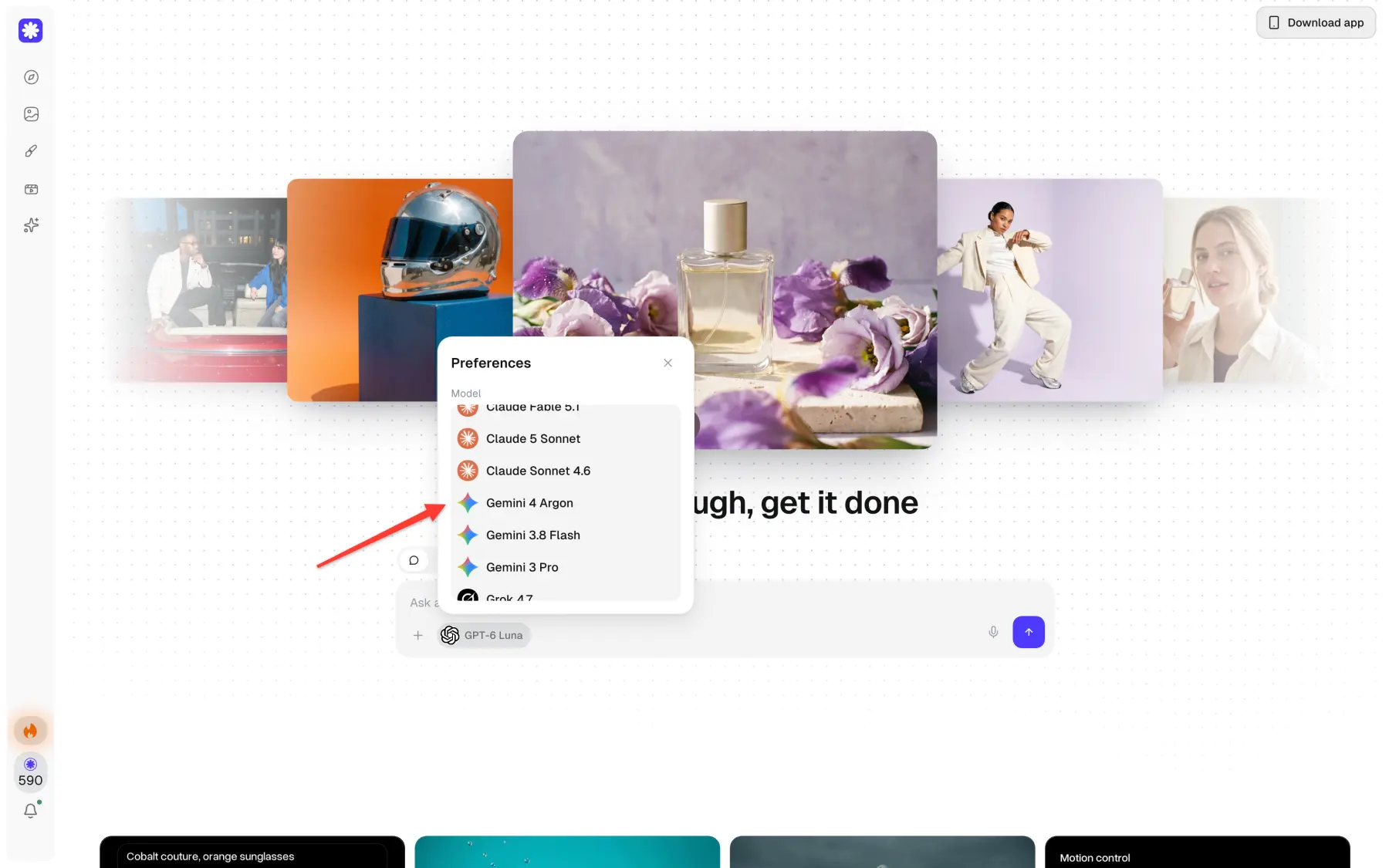
Choose Gemini 4 Argon in the Model list.
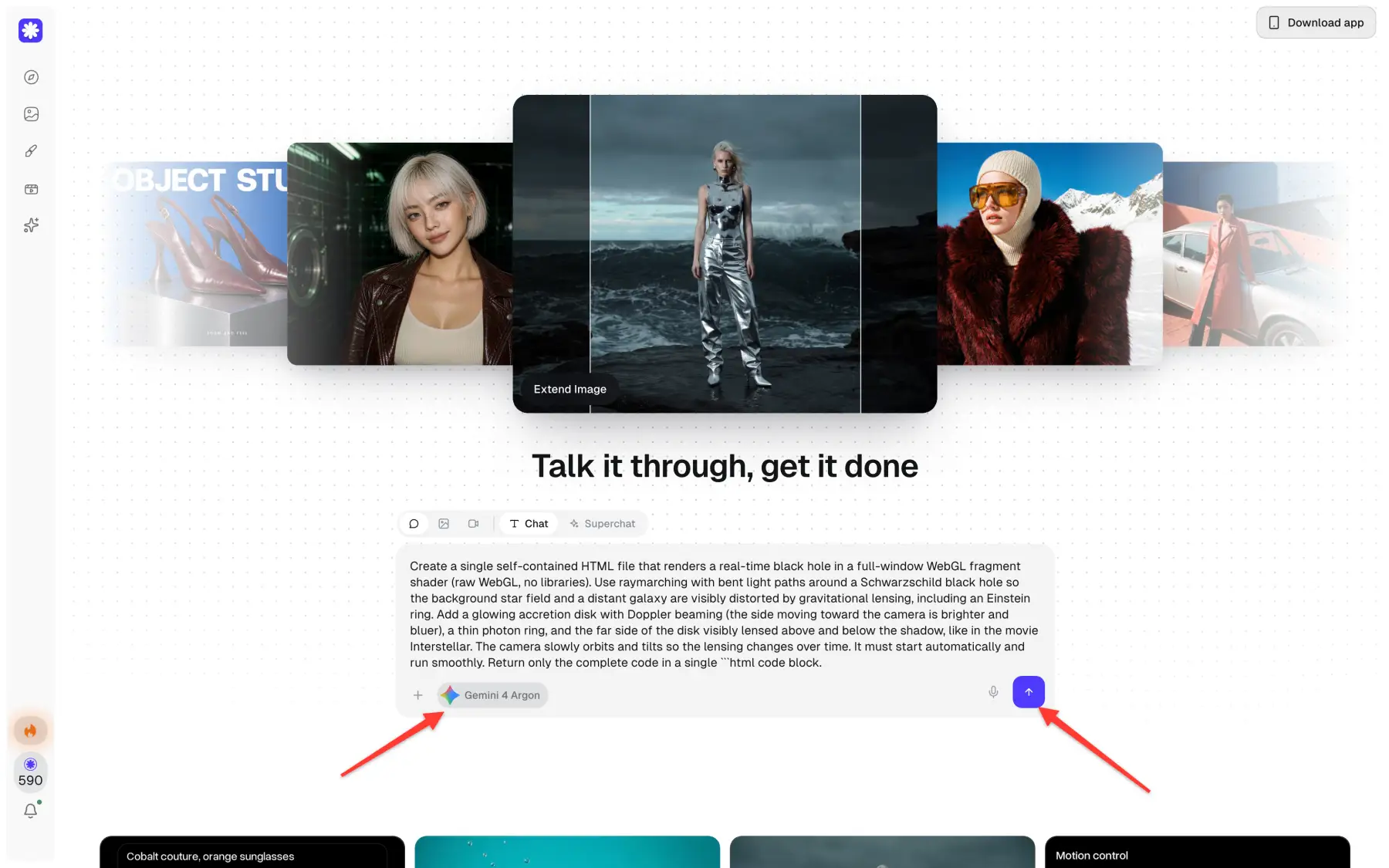
Type your prompt and press the send button.
Start chatting with Gemini 4 Argon.
FAQ
What is Gemini 4 Argon?
Gemini 4 Argon is Google's flagship large language model, built for software engineering, math and science problems and autonomous agents. It accepts text, images, video, audio and PDF files and can return up to 1 million tokens in one answer.
When was Gemini 4 Argon released?
Google announced Gemini 4 Argon on September 30, 2026, and first gave access to cyber defenders in its Fairwind Program. The model became generally available to developers and Gemini app subscribers on October 13, 2026.
How much does Gemini 4 Argon cost?
In the Gemini API, Gemini 4 Argon costs $2 per million input tokens and $10 per million output tokens at the introductory price, and $4 and $20 after it. In Overchat AI, a message to Gemini 4 Argon costs 1 credit on a paid plan.
Is Gemini 4 Argon better than Claude Opus 5.5 for coding?
Gemini 4 Argon beats Claude Opus 5.5 on DeepSWE and Vibe Code Bench, while Opus 5.5 leads on Terminal-Bench and FrontierSWE. In our test, Argon wrote code about three times faster and made more striking graphics, but its racing game did not run, while all three of Opus 5.5's programs worked.
Where can I use Gemini 4 Argon?
Gemini 4 Argon is available in the Gemini app for Google AI Pro and Ultra subscribers, in the Gemini API, Google AI Studio and Google Cloud, in Antigravity and in third-party apps such as Overchat AI.