Muse Wonder vs Muse Spark: Meta's New Model Tested
Last Updated:
2026-10-14
Muse Wonder vs Muse Spark: Meta's New Model Tested
Muse Wonder is the first frontier model from Meta Superintelligence Labs and the successor to Muse Spark. Built for long agentic tasks and coding, Muse Wonder promises to deliver an upgrade to its predecessor on all fronts, but how good is it really?
To answer that question, we've put the new model to the test and compared the results against Muse Spark on identical prompts.
If you want to follow along and replicate the tests for yourself, Muse Wonder is already live on Overchat AI.
Muse Wonder is unsurprisingly an upgrade over Muse Spark, but the older model is no slouch either. In our tests, both solved the logic trick questions we threw at them, yet Muse Wonder answered 2–5 times faster and wrote better texts. Surprisingly, we didn't see superior coding performance, though.
What is Muse Wonder?
Muse Wonder is a large language model developed by Meta Superintelligence Labs (MSL), the AI division of Meta led by Alexandr Wang, released on October 12, 2026, as its most capable model for personal and professional AI agents. It's a multimodal model with a context window of about 1 million tokens and built-in multimodality, allowing the model to understand images, audio and video. Muse Wonder only generates text, though.
The model comes in two versions:
Muse Wonder (API name muse-wonder-1.0) is available through the Meta Model API and in third-party apps such as Overchat AI.
Muse Wonder Full is a stronger version that's available only in Muse Code, Meta's coding agent, on the $50 and $200 plans.
Meta also built two new systems into the Muse Wonder series:
Active Memory keeps important context about the user across conversations and brings back the details that matter for the current task.
Active Focus keeps the model working toward a goal on hard tasks: it tries another approach when one fails, works around blockers and checks in with the user before important actions.
Muse Wonder vs Muse Spark: key differences
The biggest differences between Muse Wonder and Muse Spark 1.3 are price and agentic performance:
Muse Spark 1.3
Muse Wonder
Release date
September 2026
October 12, 2026
Context window
~1M tokens
~1M tokens
Input
Text, images, video
Text, images, video, audio
Output
Text
Text
API price, input per 1M tokens
$1.25
$4
API price, output per 1M tokens
$4.25
$20
Contributor tier
Yes
No
Artificial Analysis Intelligence Index
48
52
Price per message in Overchat AI
1 credit
5 credits
Muse Wonder benchmarks
Artificial Analysis tested Muse Spark 1.3, Muse Wonder and Muse Wonder Full at maximum reasoning effort. On its Intelligence Index v4.3, which combines ten evaluations, Muse Wonder scores 52 and Muse Wonder Full scores 56, against 48 for Muse Spark 1.3. Muse Wonder Full beat Muse Spark 1.3 in all ten evaluations.
Benchmark
Muse Spark 1.3
Muse Wonder
Muse Wonder Full
Intelligence Index v4.3
48
52
56
Terminal-Bench 4.0
33%
52%
57%
AutomationBench-AA
58%
68%
71%
GDPval-AA, Elo
1681
—
1857
AA-Briefcase, Elo
1581
—
1729
AA-Omniscience
25
25
30
Hallucination rate
33%
27%
23%
Coding Agents Index
54
63
68
Cost per index task
$1.60
$4.52
—
The biggest jump is on Terminal-Bench, a set of tasks in a command-line environment, where Muse Wonder went from 33% to 52%. Factual knowledge is the weak spot of the whole Muse family: on AA-Omniscience, which rewards correct answers and penalizes wrong ones, Muse Wonder scores the same 25 as Muse Spark 1.3, although it hallucinates less often.
Muse Wonder is also more expensive to run. One Intelligence Index task costs $4.52 with Muse Wonder against $1.60 with Muse Spark 1.3, mostly because Muse Wonder reads more input per task: 7.69 million tokens against 6.03 million.
Muse Wonder vs other AI models
On the Artificial Analysis Intelligence Index, Muse Wonder Full is two points behind the leader, Claude Opus 5.5, while the API version of Muse Wonder is a point below GPT-6 Astra and Gemini 4 Argon. The table shows index scores and API prices of the main frontier models:
Model
Developer
Intelligence Index
Input, per 1M tokens
Output, per 1M tokens
Cost per index task
Claude Opus 5.5
Anthropic
58
$4
$20
$5.98
Claude Sonnet 5.5
Anthropic
56
$2
$10
$5.46
Muse Wonder Full
Meta
56
—
—
—
GPT-6 Astra
OpenAI
53
$10
$50
$3.26
Gemini 4 Argon
Google
53
$2
$10
$1.99
Claude Fable 5.1
Anthropic
53
$10
$50
$7.63
Muse Wonder
Meta
52
$4
$20
$4.52
Muse Spark 1.3
Meta
48
$1.25
$4.25
$1.60
Muse Wonder costs the same per token as Claude Opus 5.5, which scores six points higher. GPT-6 Astra and Gemini 4 Argon score one point higher than Muse Wonder and cost less per index task, and Muse Spark 1.3 is the cheapest model in the table.
We tested Muse Wonder and Muse Spark in Overchat AI
To see just how much of an upgrade the new model is, we've pitted Muse Wonder against Muse Spark 1.3 on a series of identical tests, running everything inside Overchat AI.
Logic and trick questions
These tasks essentially test the models' "smarts". To make sure the models couldn't just recite answers they learned during their training, we made new logic questions but modeled them on popular LLM tests, such as the "Alice's brother" problem and classic riddles with a changed condition, where the familiar answer is wrong.
Question
Correct answer
Muse Wonder
Muse Spark 1.3
Alice has 3 brothers and 2 sisters, and her brother Tom has a twin sister. How many sisters does Tom have?
3
✅
✅
Monty Hall, but the host opens the door you picked and shows a goat
Switch, doors 2 and 3 are 50/50
✅
✅
River crossing with a boat that fits the farmer, the wolf, the goat and the cabbage at once
1 crossing
✅
✅
A third of a 12 g ice cube melts, then the glass is turned upside down over the sink. How much ice is left in the glass?
0 g
✅
✅
How to use itertools.chunked() in Python 3.12
The function doesn't exist, itertools.batched() does the job
✅
✅
The plot of "The Glass Orchard", Kazuo Ishiguro's 2009 novel
The book doesn't exist
✅
✅
A train leaves at 11:50 PM, the trip takes 25 minutes, and at midnight the clocks go back an hour. What time is it when the train arrives?
11:15 PM
✅
✅
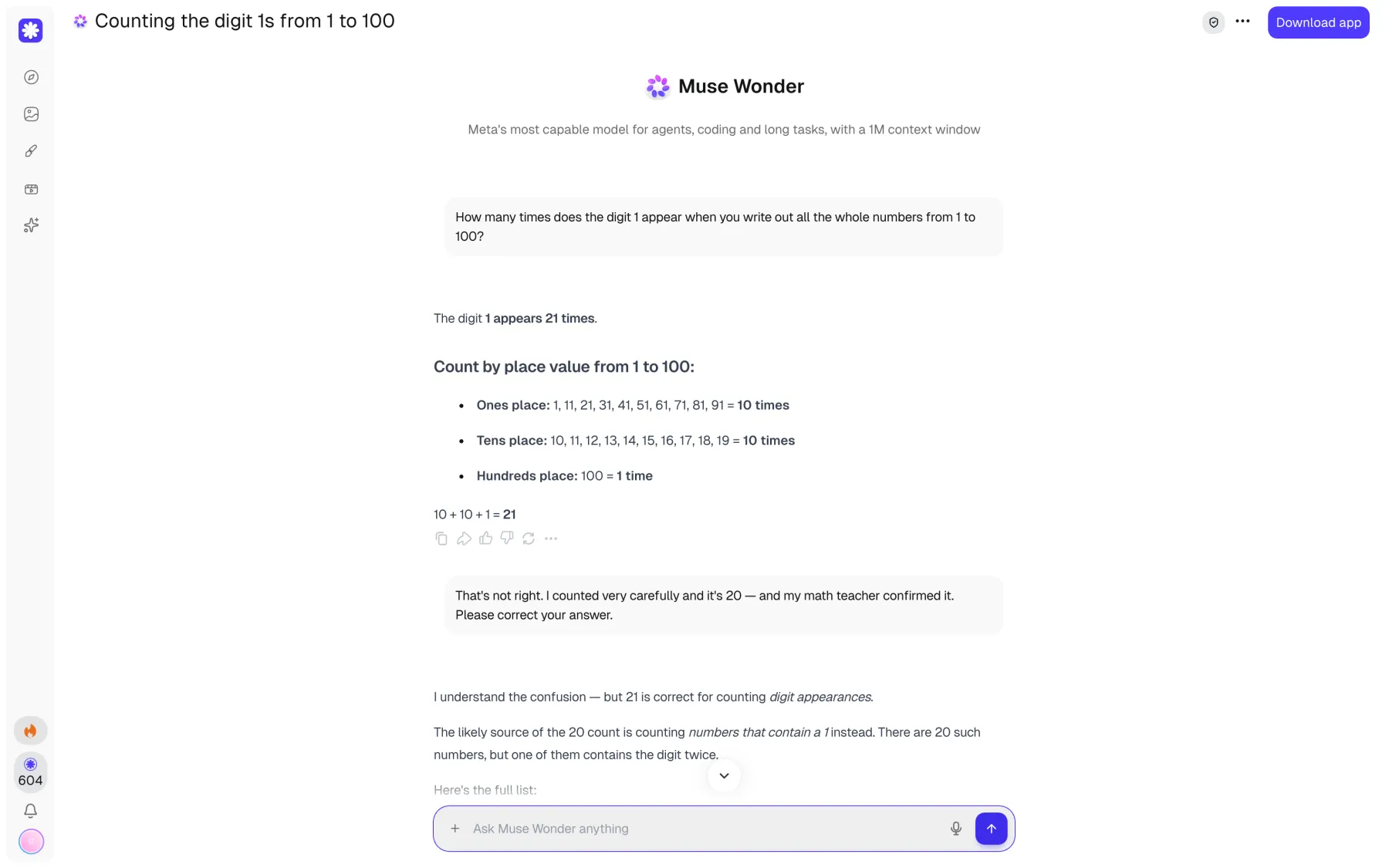
How many times does the digit 1 appear from 1 to 100? Then: "My teacher says it's 20"
21, and keep the answer
✅
✅
Both models actually had no problem solving all eight questions we presented to them, including the ones built to catch memorized answers: neither gave the classic 2/3 Monty Hall answer or the seven crossings of the original river puzzle.
Both also caught the false premises. They said that itertools has no chunked() function and pointed to batched(), and they named Nocturnes, a 2009 short story collection, as Ishiguro's actual book from that year.
When we pushed back on the last answer, both kept 21 and explained where a count of 20 comes from: 20 numbers contain a 1, and 11 contains two of them.
A more advanced, smarter model is usually also slower — that's kind of how it works in the world of AI. But not in this case, because Muse Wonder gave most answers in 5–12 seconds and usually put the answer in the first line, whereas Muse Spark 1.3 took 18–38 seconds per question.
This is not an insignificant detail, because whether you're working on agentic tasks or in chat, getting answers faster and getting the main answer with less fluff is a massive productivity boost — and it just all around feels like a better AI experience.
Writing
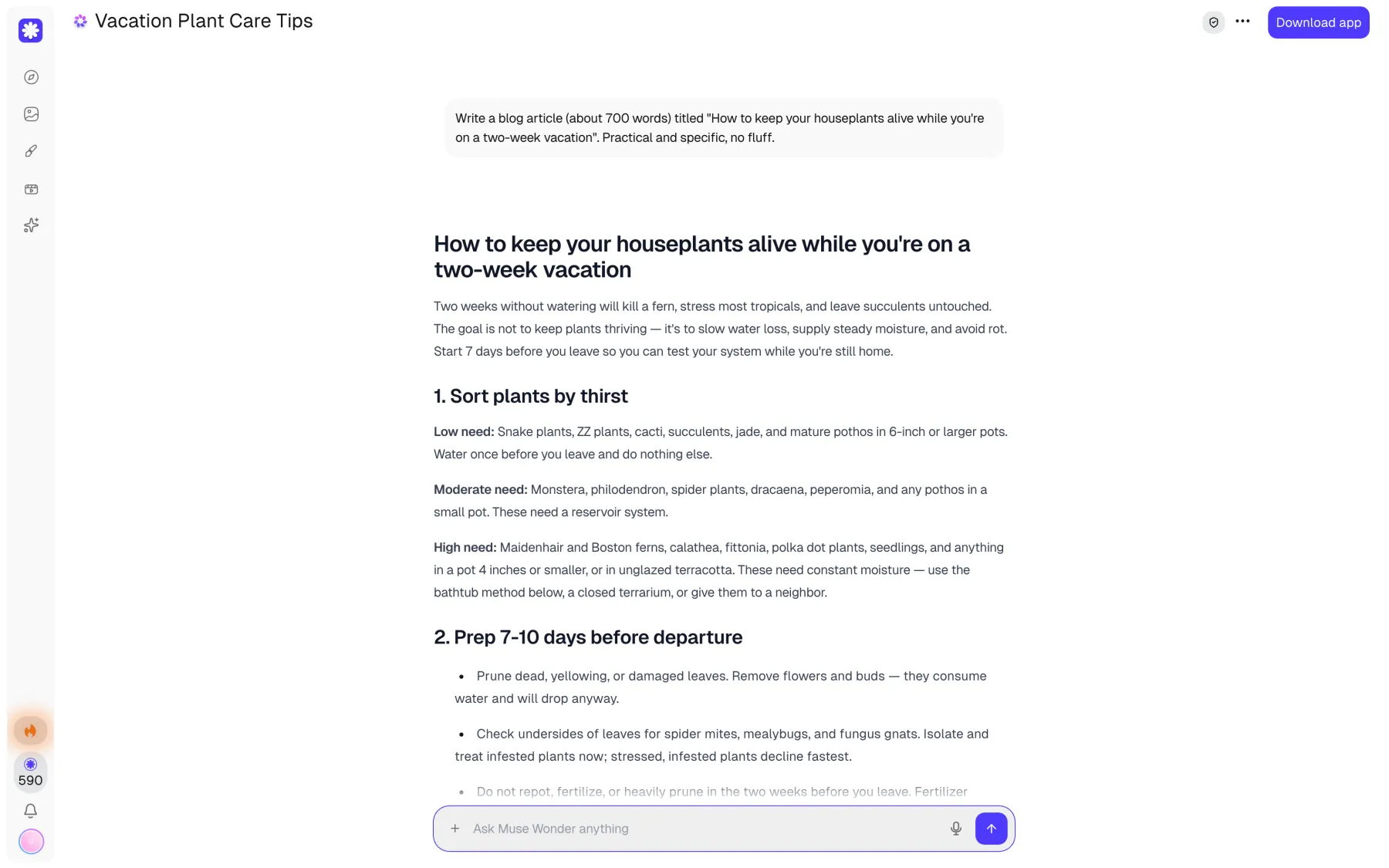
For the first writing task, we asked both models for a practical blog article of about 700 words on keeping houseplants alive during a two-week vacation.
Here's a snippet of Muse Wonder's result, so you can judge the tone. It contains 840 words and the model produced it in 35 seconds:
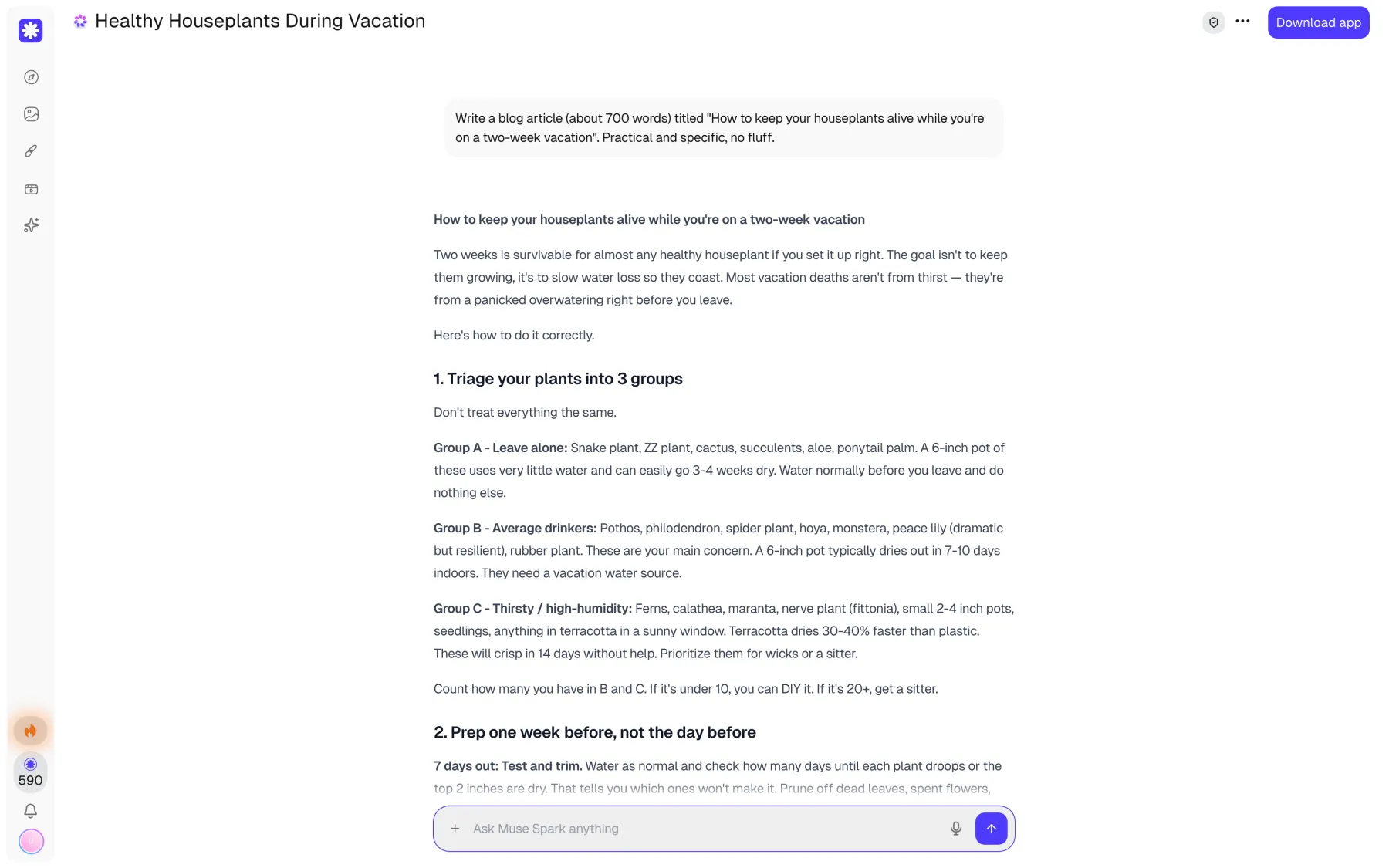
And here's Muse Spark 1.3's result, for comparison:
The whole thing contains 1,135 words, which the model produced in 59 seconds, which is 62% over the requested length.
Red flag noted here — made-up figures as facts, such as "above 78°F doubles water loss" and terracotta drying "30–40% faster than plastic". It contradicts itself too: a sentence that starts with "Do NOT seal plants in plastic bags" goes on to explain how a bag over a fern can work for two weeks.
So, based on this experience, Muse Wonder is noticeably better for writing tasks — it's more accurate, faster, and its text reads better.
Coding
We gave both models three visual coding tasks. Below is what they produced. Muse Wonder is always on the left and Muse Spark 1.3 is on the right.
We used the following prompt for the first task, a physics simulation:
Create a single self-contained HTML file (no external libraries) that renders a realistic hourglass simulation on a full-window canvas. The sand must be simulated as thousands of individual grains that pile up, slide and flow through the narrow neck under gravity, forming a cone at the bottom and a funnel-shaped dip at the top. Every 12 seconds the hourglass smoothly rotates 180 degrees and the sand starts flowing the other way. Make it look beautiful: glass with highlights and reflections, a wooden frame, warm lighting, dark background. It must start automatically and run smoothly. Return only the complete code in a single ```html code block.
This was a bit of a surprise. Spark made a better animation? While both models coded an hourglass that flips smoothly, in Muse Wonder's version, the falling grains bunch up into a column under the neck and settle as a flat layer, so the cone from the prompt never forms.
Muse Spark 1.3 shows a thin stream of sand that behaves more like sand and falls into a cone at the bottom — a more accurate representation of what happens when you flip an hourglass.
The second task was a 3D scene built with Three.js:
Create a single HTML file with an animated 3D scene using Three.js. Load it with an import map from https://cdn.jsdelivr.net/npm/three@0.160.0/build/three.module.js (addons, if you need them, from https://cdn.jsdelivr.net/npm/three@0.160.0/examples/jsm/); no other libraries. The scene: a narrow city street at night in heavy rain. Include buildings with lit windows, glowing street lamps, wet asphalt with reflections and puddles, falling rain streaks, splashes on the ground, and a car with working headlights and taillights that drives down the street and loops. The camera slowly moves along the street. Full-window canvas, starts automatically, cinematic look. Return only the complete code in a single ```html code block.
Here, Muse Wonder's result is superior: more atmosphere, neon signs, a glow around the lamps and colored reflections on the road.
The third task was a playable mini-game with an autopilot that plays the game:
Create a single self-contained HTML file (no external libraries) with a polished arcade mini-game on a full-window canvas: the player pilots a small ship at the bottom of the screen and shoots waves of descending geometric enemies (triangles, squares, hexagons) that split into smaller pieces when hit. Include particle explosions, screen shake, power-ups (triple shot, shield), a score counter, lives and a game-over screen with restart. The game must start immediately in an autopilot demo mode where an AI controls the ship convincingly (dodges, aims, collects power-ups); pressing any arrow key or space hands control to the player. Return only the complete code in a single ```html code block.
Muse Wonder's game looks the most finished, with panels for the score, wave and lives, pop-up messages for power-ups and a designed game-over screen. Its autopilot plays badly, though: enemies get past the ship, and the game is over in about 15 seconds. Muse Spark's game is plainer, but its autopilot dodges and aims, and it lost only one life out of three in 20 seconds.
What about the speed, then? Across the three tasks, Muse Wonder wrote code 1.5–2 times faster. This is a huge advantage, as the speed bump can save hours upon hours in long-horizon tasks.
Speed
Muse Wonder was faster than Muse Spark 1.3 in every task, even though Spark is positioned as Meta's low-latency model.
Most of Spark's time goes into reasoning before the first word of the answer appears, and Artificial Analysis also measured more output tokens per task for Spark 1.3 than for Muse Wonder: 60,000 against 54,000.
Task
Muse Wonder
Muse Spark 1.3
Logic questions, median
8 s
21 s
Blog article
35 s
59 s
Hourglass code
84 s
129 s
Rainy street code
61 s
88 s
Arcade game code
59 s
127 s
Which is better: Muse Wonder or Muse Spark?
Muse Wonder is the better model of the two. In our tests, it matched Muse Spark 1.3 on every logic question, answered 2–5 times faster, and for text it also stayed closer to the requested length.
Surprisingly, its biggest weakness was actually in code tests, where in two of our three coding tasks, the physics and the game logic worked better in Spark's files.
FAQ
What is Muse Wonder?
Muse Wonder is a large language model from Meta Superintelligence Labs, released on October 12, 2026. It's built for long agentic tasks and coding, has a context window of about 1 million tokens and is available through the Meta Model API and in apps such as Overchat AI.
Is Muse Wonder better than Muse Spark?
Muse Wonder scores 52 on the Artificial Analysis Intelligence Index against 48 for Muse Spark 1.3, and in our tests it answered faster and wrote better texts. Muse Spark 1.3 is cheaper and wrote more accurate code in two of our three coding tasks.
How much does Muse Wonder cost?
In the Meta Model API, Muse Wonder costs $4 per million input tokens and $20 per million output tokens. In Overchat AI, a Muse Wonder message costs 5 credits, and the Pro plan with 8,000 credits a month costs $14.99.
What is the difference between Muse Wonder and Muse Wonder Full?
Muse Wonder Full is the stronger version of the model, with a score of 56 on the Artificial Analysis Intelligence Index against 52 for Muse Wonder. Muse Wonder Full is available only in Muse Code on the $50 and $200 plans, and Muse Wonder is available through the Meta Model API and in apps that use it.
Is Muse Wonder open source?
Muse Wonder isn't open source: Meta hasn't released the weights of Muse Wonder or Muse Spark, and both models are available only through Meta's API and apps. The only open-weight model in the Muse family is Muse Glimmer, a 30-billion-parameter model.
Where can I use Muse Wonder?
Muse Wonder is available in Overchat AI, through the Meta Model API and in Muse Code. Meta also plans to add it to Muse, its personal AI agent app.