About Grok 4.7
Grok 4.7 is xAI's model for coding and knowledge work, with about 2.1 trillion parameters. It reads text, images and files, takes up to 500,000 tokens in one conversation and keeps working on hard tasks for hours, checking its own work before it answers
Grok 4.7 scores 64.0% on EEBench, an electrical engineering test, ahead of Claude Fable 5.1 at 56.4% and GPT-5.6 Sol at 39.4%, and 19.6% on Harvey's Legal Agent Benchmark, three times Fable 5.1's 6.7%. In coding it reaches 46.3% on CursorBench 4.0 and 71.0% on DeepSWE v1.1, up from 40.4% and 65.2% for Grok 4.6
On Overchat AI, Grok 4.7 works in one chat with Claude, GPT-6 and Gemini, so you can hand the same task to another model mid-conversation
- Modalities
- Intelligence Index?
- 35
- Context window?
- 500K tokens
- Released
- Sep 21, 2026
Grok 4.7 vs other models
Grok 4.7 ranks #41 on the Artificial Analysis Intelligence Index out of 54 models
- 65
 Claude Fable 5.2
- 60
 Gemini 4 Carbon
- 59Claude Opus 5.5
- 57
 GPT-6 Astra
- 55GPT-6.1 Sol
- 50
 Muse Wonder Full
- 46
 Kimi K3.1 Pro
- 44Muse Wonder
- 35
 Grok 4.7
- 33
 DeepSeek V4.1 Flash
- #5of 63 modelsAA-Omniscience Non-Hallucination RateHow often the model says it doesn't know instead of making up an answer
- #9of 166 modelsGDPval-AATasks from real jobs, graded against experts' work
- #19of 63 modelsAA-Omniscience AccuracyKnowledge questions answered correctly
- #20of 136 modelsSciCodePython code for scientific computing
Source: Artificial Analysis
Compare Grok 4.7
Grok 4.7 vs Grok 4.6
Grok 4.7 scores higher than Grok 4.6 in 6 of 6 benchmarks. The widest lead is in Terminal-Bench 4.0: 37.6% against 20.3%. Grok 4.7 writes 81 tokens per second, Grok 4.6 writes 290
- Benchmarks won
- Grok 4.7: 6
- Grok 4.6: 0
- Average score
- Grok 4.7: 49.2%
- Grok 4.6: 40.5%
- Output speed, tokens/s
- Grok 4.7: 81
- Grok 4.6: 290
- Time to first token, s (log scale)
- Grok 4.7: 8.9
- Grok 4.6: 32.0
- Terminal-Bench 4.0+17.3
- EEBench+11.0
- HealthBench Professional+8.2
- CursorBench 4.0+5.9
- DeepSWE v1.1+5.8
- Harvey's Legal Agent Benchmark+3.8
Grok 4.7 vs GPT-5.6 Sol
Grok 4.7 scores higher than GPT-5.6 Sol in 4 of 6 benchmarks. The widest lead is in EEBench: 64.0% against 39.4%. GPT-5.6 Sol is ahead in HealthBench Professional: 60.5% against 56.7%
- Benchmarks won
- Grok 4.7: 4
- GPT-5.6 Sol: 2
- Average score
- Grok 4.7: 49.2%
- GPT-5.6 Sol: 42.4%
- EEBench+24.6
- Harvey's Legal Agent Benchmark+17.1
- CursorBench 4.0+4.6
- Terminal-Bench 4.0+0.3
- DeepSWE v1.1−1.7
- HealthBench Professional−3.8
Grok 4.7 vs Claude Fable 5.1
Grok 4.7 scores higher than Claude Fable 5.1 in 3 of 6 benchmarks. The widest lead is in Harvey's Legal Agent Benchmark: 19.6% against 6.7%. Claude Fable 5.1 is ahead in Terminal-Bench 4.0: 57.9% against 37.6%
- Benchmarks won
- Grok 4.7: 3
- Claude Fable 5.1: 3
- Average score
- Grok 4.7: 49.2%
- Claude Fable 5.1: 50.8%
- Harvey's Legal Agent Benchmark+12.9
- EEBench+7.6
- DeepSWE v1.1+1.0
- HealthBench Professional−5.4
- CursorBench 4.0−5.5
- Terminal-Bench 4.0−20.3
Best model by use case
Average benchmark scores of Grok 4.7 and 3 other models by use case
Coding
?Average of 3 tests- 1Claude Fable 5.159.9%
- 2Grok 4.751.6%
- 3GPT-5.6 Sol50.6%
- 4Grok 4.642.0%
Knowledge work
?Average of 3 tests- 1Grok 4.746.8%
- 2Claude Fable 5.141.7%
- 3Grok 4.639.1%
- 4GPT-5.6 Sol34.1%
Grok 4.7 benchmarks
Compare Grok 4.7 with Grok 4.6, GPT-5.6 Sol and Claude Fable 5.1 in 6 benchmarks measuring coding and knowledge work
Coding
- CursorBench 4.0?Grok 4.746.3%Grok 4.640.4%GPT-5.6 Sol41.7%Claude Fable 5.151.8%46.3%−5.5
- DeepSWE v1.1?Grok 4.771.0%Grok 4.665.2%GPT-5.6 Sol72.7%Claude Fable 5.170.0%71.0%−1.7
- Terminal-Bench 4.0?Grok 4.737.6%Grok 4.620.3%GPT-5.6 Sol37.3%Claude Fable 5.157.9%37.6%−20.3
Knowledge work
- EEBench?Grok 4.764.0%Grok 4.653.0%GPT-5.6 Sol39.4%Claude Fable 5.156.4%64.0%+7.6
- Harvey's Legal Agent Benchmark?Grok 4.719.6%Grok 4.615.8%GPT-5.6 Sol2.5%Claude Fable 5.16.7%19.6%+3.8
- HealthBench Professional?Grok 4.756.7%Grok 4.648.5%GPT-5.6 Sol60.5%Claude Fable 5.162.1%56.7%−5.4
Grok 4.7 speed
Output speed is how fast the model writes (tokens per second, higher is better). Time to first token is how long you wait before the answer starts (lower is better)
Output speed and time to first token of 35 models
?Percentile| Models | Output speed, tokens/s (log scale) | Time to first token, s (log scale) |
|---|---|---|
| GPT-6 Luna | 143 | 2.4 |
| GPT-6.1 Terra | 75 | 4.3 |
| GPT-6.1 Sol | 58 | 2.9 |
| GPT-6 Astra | 48 | 3.2 |
| Claude Opus 5.5 | 88 | 1.9 |
| Claude Opus 5 | 54 | 2.6 |
| Claude Opus 4.8 | 59 | 1.3 |
| Claude Fable 5.2 | 84 | 2.3 |
| Claude Sonnet 5.5 | 102 | 1 |
| Claude 5 Sonnet | 215 | 10.5 |
| Claude Sonnet 4.6 | 220 | 10.8 |
| Claude Haiku 5.5 | 167 | 2.1 |
| Gemini 4 Carbon | 169 | 29.5 |
| Gemini 4 Argon | 91 | 6 |
| Gemini 3.8 Flash | 203 | 7.5 |
| Gemini 3 Pro | 270 | 11.2 |
| Grok 4.7 | 81 | 8.9 |
| Grok 4.6 | 290 | 32 |
| Qwen 3.8 Max | 81 | 30.6 |
| DeepSeek V4 Pro | 144 | 1.1 |
| DeepSeek V4.1 Flash | 422 | 2.2 |
| Mistral Large 4 | 226 | 8.6 |
| Hy4 | 214 | 37.7 |
| ERNIE 5.5 Flash | 405 | 2.7 |
| Muse Wonder | 980 | 8.7 |
| Muse Spark | 1129 | 6.2 |
| Kimi K3.1 Pro | 340 | 7.4 |
| Kimi K3 | 338 | 5.9 |
| GLM 5.3 | 197 | 1.2 |
| Flint | 194 | 12.3 |
| Llama 4 | 81 | 0.7 |
| Claude 4.5 Haiku | 162 | 0.9 |
| MiniMax M3 | 169 | 4.5 |
| MiniMax M3.1 Flash | 656 | 7.2 |
| Kimi K2.7 Code | 455 | 3.6 |
Typing test
Every model writes the same answer. The test waits the model's time to first token, then prints the text at the model's output speed and shows the total time
- Grok 4.781 tokens/s8.9 s to first token
- Grok 4.6290 tokens/s32.0 s to first token
Source: Overchat AI, 2026-11-11
See how Grok 4.7 answers
Examples of Grok 4.7 answers to 3 prompts: Pick a power circuit, Write a backup script and Outline a pitch deck. Each answer is the unedited output of the model
I want to power a 12 V LED strip that draws 2 A from a 24 V supply. Should I use a resistor, a linear regulator or a buck converter? Explain with the numbers.
Grok 4.7Use a buck converter. A resistor or linear regulator will each waste 24 W as heat (50% efficiency); a buck converter wastes only a few watts.
The load
- LED strip: 12 V × 2 A = 24 W.
- Supply: 24 V. You must drop 12 V while supplying 2 A.
Resistor
- Drop 12 V at 2 A → R = 12/2 = 6 Ω.
- Dissipation: 12 V × 2 A = 24 W (or I²R = 24 W).
- Supply delivers 24 V × 2 A = 48 W; efficiency = 50%.
- A 24 W resistor is large, runs very hot, and gives poor regulation if the strip current changes with temperature or brightness.
Linear regulator (e.g. a 12 V LDO or 7812-style part rated for ≥2 A)
- Same electrical result: it drops (24-12) V × 2 A = 24 W as heat.
- Input power still 48 W, efficiency 50%.
- You need a substantial heatsink; the regulator will be hot and the supply is loaded at 2 A continuously.
Buck converter
- A typical synchronous buck is ~90% efficient (often 85–95% depending on the module).
- Input power ≈ 24 W/0.9 ≈ 27 W.
- Input current ≈ 27 W/24 V ≈ 1.1 A.
- Waste heat ≈ 2–4 W instead of 24 W — small heatsinking or none, far less stress on the 24 V supply, and stable 12 V output.
Bottom line: At 2 A the resistor and linear regulator each throw away as much power as the LEDs use. A buck converter is the only practical choice.
Write a bash script that backs up a folder to a dated .tar.gz file, keeps only the last 7 backups and logs each run. Then show how to run it every night at 2 am with cron.
Grok 4.7#!/usr/bin/env bash
# backup-folder.sh — archive a folder to a dated .tar.gz, keep the last 7, log each run.
set -euo pipefail
# --- config ---
SOURCE="${1:-/path/to/folder}" # folder to back up (no trailing slash needed)
DEST="${2:-/path/to/backups}" # directory that holds the archives
KEEP=7
LOG="${DEST}/backup.log"
# --- prep ---
if [[ ! -d "$SOURCE" ]]; then
echo "Source is not a directory: $SOURCE" >&2
exit 1
fi
mkdir -p "$DEST"
STAMP="$(date +%Y-%m-%d_%H%M%S)"
NAME="$(basename "$SOURCE")"
ARCHIVE="${DEST}/${NAME}_${STAMP}.tar.gz"
log() {
# timestamped line to the log and to stdout
printf '%s %s\n' "$(date '+%Y-%m-%d %H:%M:%S')" "$*" | tee -a "$LOG"
}
log "START backup of ${SOURCE} -> ${ARCHIVE}"
if tar -czf "$ARCHIVE" -C "$(dirname "$SOURCE")" "$NAME"; then
log "OK wrote $(du -h "$ARCHIVE" | awk '{print $1}') ${ARCHIVE}"
else
log "FAIL tar exited $?"
exit 1
fi
# Keep only the newest KEEP archives for this folder name; delete the rest.
# shellcheck disable=SC2012
mapfile -t OLD < <(ls -1t "${DEST}/${NAME}_"*.tar.gz 2>/dev/null | tail -n +"$((KEEP + 1))" || true)
if ((${#OLD[@]})); then
for f in "${OLD[@]}"; do
rm -f -- "$f"
log "PRUNE removed ${f}"
done
else
log "PRUNE nothing to remove (keeping up to ${KEEP})"
fi
log "DONE"Make it executable and try a run:
chmod +x backup-folder.sh
./backup-folder.sh /path/to/folder /path/to/backups
Nightly at 2:00 am with cron (use absolute paths; cron’s environment is minimal):
crontab -eAdd:
0 2 * * * /path/to/backup-folder.sh /path/to/folder /path/to/backupsThat runs every day at 02:00. Output is also appended to /path/to/backups/backup.log. If you want cron’s own mail/stderr captured as well, you can append >> /path/to/backups/cron.log 2>&1 to the crontab line.
Outline a 6-slide pitch deck for a mobile app that helps roommates split rent and bills: a title and three short bullet points for each slide.
Grok 4.7Slide 1: Title
- SplitRent: fair bills, fewer roommate fights
- One app for rent, utilities, and shared expenses
- Built for households that want clarity without spreadsheets
Slide 2: The problem
- Rent and bills are split unevenly or late
- Venmo threads and spreadsheets get messy fast
- Disputes over who owes what strain relationships
Slide 3: The solution
- Create a household and add roommates in minutes
- Log rent, utilities, groceries, and one-off costs
- See who owes what and settle up in one tap
Slide 4: How it works
- Set rent shares by room, percentage, or custom split
- Auto-divide recurring bills and track due dates
- Send payment requests and mark balances paid
Slide 5: Why it wins
- Fairness rules that handle unequal rooms and incomes
- Shared ledger everyone can trust
- Reminders that reduce awkward money conversations
Slide 6: Ask
- Seeking seed funding to launch iOS and Android
- Use of funds: product, payments, and early growth
- Goal: 50,000 active households in 18 months
More prompts to try with Grok 4.7
What Grok 4.7 is best for
Coding in your codebase
Grok 4.7 fixes bugs and builds features in real codebases, and it runs in Cursor and Grok Build. It scores 71.0% on DeepSWE v1.1 and 46.3% on CursorBench 4.0
Electrical engineering
Grok 4.7 sizes circuits, picks parts and checks power budgets, with the numbers shown. It scores 64.0% on EEBench, ahead of Claude Fable 5.1 and GPT-5.6 Sol
Legal and office work
Grok 4.7 drafts documents, slide decks and contract reviews. It scores 19.6% on Harvey's Legal Agent Benchmark, against 6.7% for Claude Fable 5.1 and 2.5% for GPT-5.6 Sol
Long multi-step tasks
Grok 4.7 keeps working on a hard task for hours and checks its own work before it answers. It nearly doubles Grok 4.6's score on Terminal-Bench 4.0, from 20.3% to 37.6%
How to use Grok 4.7 on Overchat AI
Start in the chat at the top of this page or in the Overchat AI app on the web, iOS or Android
- 01
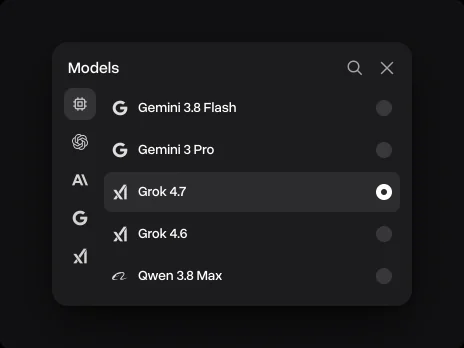
Pick Grok 4.7
It is already picked in the chat on this page. In the Overchat AI app, open the model list next to the message field and pick Grok 4.7
- 02
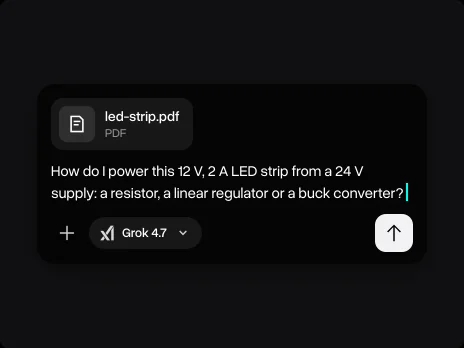
Attach your code or a file
Add code, a document, a spreadsheet or a screenshot, and write what you need: the result, the format and what must stay the same
- 03
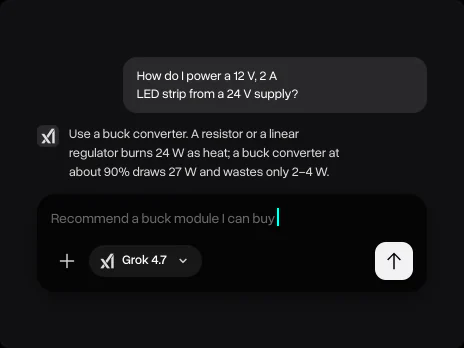
Keep going in the same chat
Ask a follow-up, ask for tests or a shorter version, or switch to another model without losing the conversation
Why use Grok 4.7 on Overchat AI
One account for chat, images and video, on every device
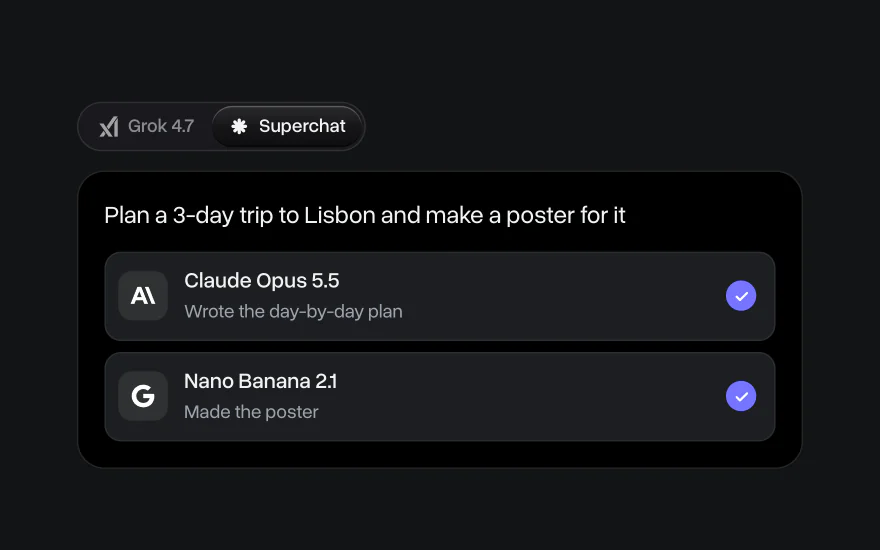
Superchat AI agent
Superchat Agent automatically routes your message to the model best suited for the task. It can generate images and videos, use the AI tools built into Overchat AI, and learn from your interactions to get better over time
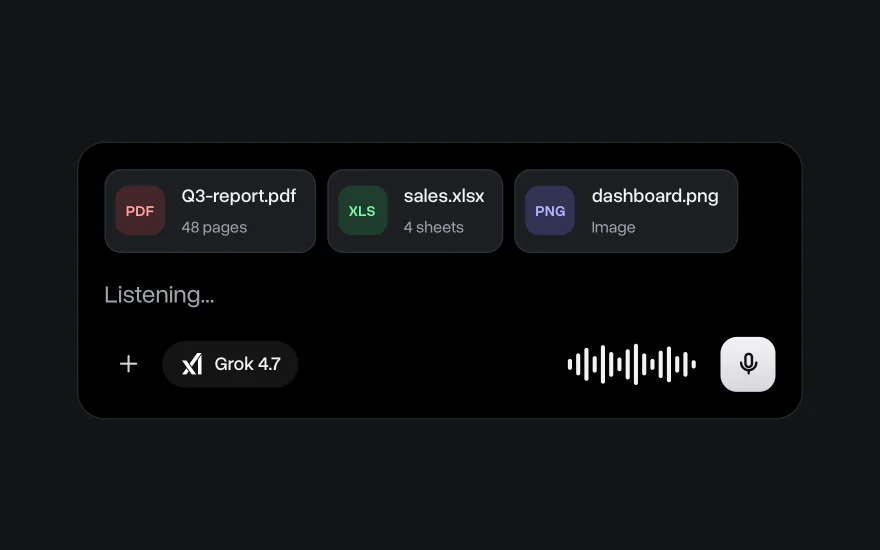
Chat with images and files
Upload PDFs, spreadsheets, code and screenshots and ask Grok 4.7 about them. You can also dictate a message instead of typing it
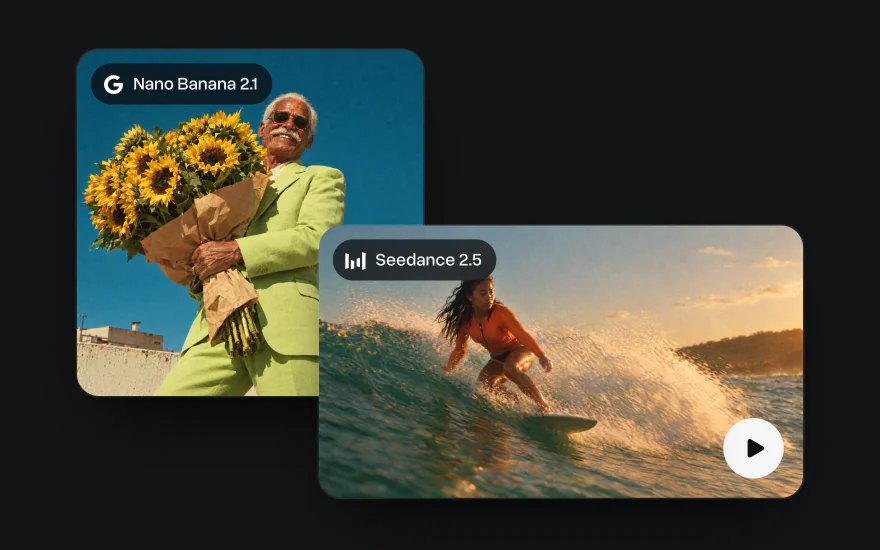
Go beyond text
Generate images with Nano Banana and GPT Image and videos with Seedance and Kling in the same account, with the same credits as chat
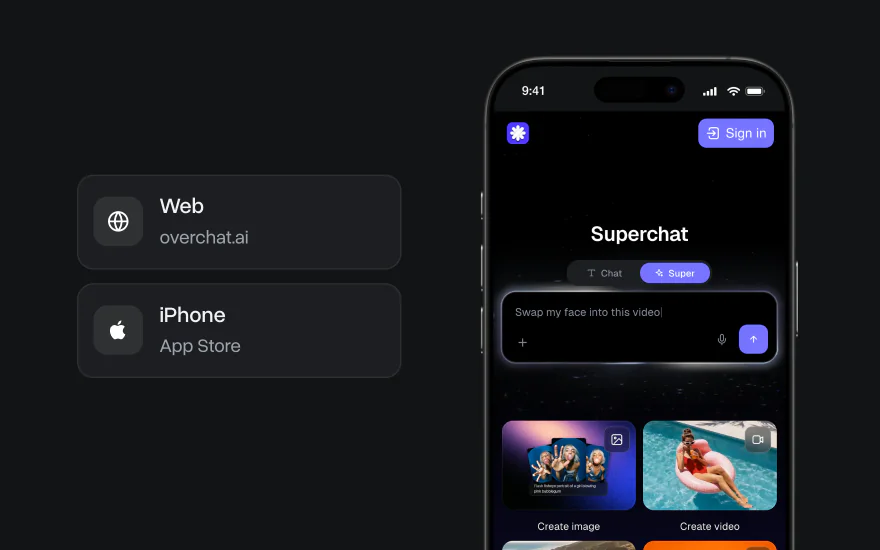
On the web and iPhone
Start a chat on your laptop and finish it on your phone. The Overchat AI app has the same models, and your chats stay in one account on every device

Grok models on Overchat AI
Compare 2 Grok models on Overchat AI by output speed, time to first token and the price of one message
Grok 4.7This pageGrok 4.6Source: Overchat AI, 2026-11-11
Explore other models
Models marked Soon are coming to Overchat AI; the rest are available now


Learn more about AI models

We tested Gemini 4 Argon against Claude Opus 5.5, GPT-6 Astra and Muse Wonder
We tested Gemini 4 Argon against Claude Opus 5.5, GPT-6 Astra and Muse Wonder on three coding tasks. See benchmarks, speed and how to use it

Muse Wonder vs Muse Spark: Meta's New Model Tested
We tested Muse Wonder against Muse Spark 1.3 on logic, writing and coding tasks. See benchmarks and which Meta model is better

10 Best All-in-One AI Platforms in 2026: Why One AI Subscription Beats Many
Compare the 10 best all-in-one AI platforms in 2026, from Overchat AI to Poe and Magai, with prices, free plans and the newest GPT and Claude models