About GLM 5.3
GLM 5.3 is Z.ai's flagship open-weights model for coding agents, security work and long tasks. It has 753 billion parameters, of which 40 billion work on each token, reads up to 1 million tokens in one conversation and always reasons before it answers
GLM 5.3 scores 84.5% on CyberGym, the best result in its comparison, and 28.3% on Terminal-Bench 3.0, ahead of Claude Opus 4.8 at 21.1% and Kimi K3 at 17.4%. It also leads AutomationBench with 48.2% and GDPval-AA with 1,769 points, a test of real work from dozens of professions
On Overchat AI, GLM 5.3 is in the same chat as Claude Opus 5.5, GPT-6 and DeepSeek, so you can compare answers and switch models without starting over
- Modalities
- Intelligence Index?
- 31.7
- Context window?
- 1M tokens
- Released
- Aug 14, 2026
GLM 5.3 vs other models
GLM 5.3 ranks #21 on the Artificial Analysis Intelligence Index out of 54 models
- 59.1
 Claude Opus 5.5
- 54.6
 GPT-6.1 Sol
- 54.5Claude Sonnet 5.5
- 50.4
 Gemini 4 Argon
- 46.5
 Kimi K3.1 Pro
- 35.5
 Grok 4.7
- 34.6
 Hy4
- 33.7
 Qwen 3.8 Max
- 32.6
 DeepSeek V4.1 Flash
- 31.7
 GLM 5.3
- #3of 131 modelsτ-Bench BankingCustomer requests an agent handles with a bank's tools and rules
- #13of 136 modelsSciCodePython code for scientific computing
- #13of 166 modelsGDPval-AATasks from real jobs, graded against experts' work
- #14of 130 modelsTerminal-Bench 4.0Multi-step coding tasks an agent completes in a terminal
Source: Artificial Analysis
Compare GLM 5.3
GLM 5.3 vs Kimi K3
GLM 5.3 scores higher than Kimi K3 in 8 of 13 benchmarks. The widest lead is in ExploitBench: 54.4% against 32.2%. Kimi K3 is ahead in SWE-Marathon v1.1: 48.1% against 42.5%. GLM 5.3 writes 197 tokens per second, Kimi K3 writes 338
- Benchmarks won
- GLM 5.3: 8
- Kimi K3: 5
- Average score
- GLM 5.3: 53.4%
- Kimi K3: 50.1%
- Output speed, tokens/s
- GLM 5.3: 197
- Kimi K3: 338
- Time to first token, s (log scale)
- GLM 5.3: 1.2
- Kimi K3: 5.9
- ExploitBench+22.2
- Terminal-Bench 3.0+10.9
- PostTrainBench+7.8
- CyberGym+4.5
- HLE with tools+2.7
- ProgramBench+1.5
- AutomationBench+1.5
- Agents' Last Exam+0.9
- NL2Repo0.0
- Terminal-Bench 2.1−0.1
- DeepSWE v1.1−0.6
- Toolathlon Verified−3.5
- SWE-Marathon v1.1−5.6
- FrontierSWE—
GLM 5.3 vs DeepSeek V4 Pro
GLM 5.3 scores higher than DeepSeek V4 Pro in 6 of 8 benchmarks. The widest lead is in AutomationBench: 48.2% against 43.2%. DeepSeek V4 Pro is ahead in NL2Repo: 61.1% against 58.0%. GLM 5.3 writes 197 tokens per second, DeepSeek V4 Pro writes 144
- Benchmarks won
- GLM 5.3: 6
- DeepSeek V4 Pro: 2
- Average score
- GLM 5.3: 63.7%
- DeepSeek V4 Pro: 62.3%
- Output speed, tokens/s
- GLM 5.3: 197
- DeepSeek V4 Pro: 144
- Time to first token, s (log scale)
- GLM 5.3: 1.2
- DeepSeek V4 Pro: 1.1
- AutomationBench+5.0
- DeepSWE v1.1+4.2
- Agents' Last Exam+2.8
- HLE with tools+2.5
- CyberGym+1.2
- Terminal-Bench 2.1+0.3
- Toolathlon Verified−1.1
- NL2Repo−3.1
- Terminal-Bench 3.0—
- ProgramBench—
- FrontierSWE—
- SWE-Marathon v1.1—
- PostTrainBench—
- ExploitBench—
GLM 5.3 vs Qwen 3.8 Max
GLM 5.3 scores higher than Qwen 3.8 Max in 10 of 10 benchmarks. The widest lead is in ExploitBench: 54.4% against 28.8%. GLM 5.3 writes 197 tokens per second, Qwen 3.8 Max writes 81
- Benchmarks won
- GLM 5.3: 10
- Qwen 3.8 Max: 0
- Average score
- GLM 5.3: 58.3%
- Qwen 3.8 Max: 51.2%
- Output speed, tokens/s
- GLM 5.3: 197
- Qwen 3.8 Max: 81
- Time to first token, s (log scale)
- GLM 5.3: 1.2
- Qwen 3.8 Max: 30.6
- ExploitBench+25.6
- DeepSWE v1.1+10.3
- ProgramBench+8.5
- AutomationBench+8.4
- HLE with tools+6.3
- CyberGym+6.0
- NL2Repo+2.1
- Terminal-Bench 2.1+1.6
- Agents' Last Exam+1.5
- Toolathlon Verified+0.5
- Terminal-Bench 3.0—
- FrontierSWE—
- SWE-Marathon v1.1—
- PostTrainBench—
GLM 5.3 vs Claude Opus 4.8
GLM 5.3 scores higher than Claude Opus 4.8 in 11 of 14 benchmarks. The widest lead is in ExploitBench: 54.4% against 40.0%. Claude Opus 4.8 is ahead in NL2Repo: 69.7% against 58.0%. GLM 5.3 writes 197 tokens per second, Claude Opus 4.8 writes 59
- Benchmarks won
- GLM 5.3: 11
- Claude Opus 4.8: 3
- Average score
- GLM 5.3: 55.1%
- Claude Opus 4.8: 51.2%
- Output speed, tokens/s
- GLM 5.3: 197
- Claude Opus 4.8: 59
- Time to first token, s (log scale)
- GLM 5.3: 1.2
- Claude Opus 4.8: 1.3
- ExploitBench+14.4
- FrontierSWE+11.6
- DeepSWE v1.1+8.9
- Terminal-Bench 3.0+7.2
- AutomationBench+7.2
- PostTrainBench+6.9
- CyberGym+6.4
- HLE with tools+4.6
- ProgramBench+3.5
- Terminal-Bench 2.1+3.2
- Agents' Last Exam+2.8
- Toolathlon Verified−3.2
- SWE-Marathon v1.1−6.3
- NL2Repo−11.7
Best model by use case
Average benchmark scores of GLM 5.3 and 4 other models by use case
Coding
?Average of 4 tests- 1GLM 5.374.4%
- 2DeepSeek V4 Pro73.8%
- 3Kimi K373.5%
- 4Claude Opus 4.872.7%
- 5Qwen 3.8 Max69.4%
Agents
?Average of 2 tests- 1Kimi K352.0%
- 2Claude Opus 4.851.0%
- 3GLM 5.350.8%
- 4DeepSeek V4 Pro49.9%
- 5Qwen 3.8 Max49.8%
Knowledge work
?AutomationBench- 1GLM 5.348.2%
- 2Kimi K346.7%
- 3DeepSeek V4 Pro43.2%
- 4Claude Opus 4.841.0%
- 5Qwen 3.8 Max39.8%
Reasoning
?HLE with tools- 1GLM 5.362.5%
- 2DeepSeek V4 Pro60.0%
- 3Kimi K359.8%
- 4Claude Opus 4.857.9%
- 5Qwen 3.8 Max56.2%
GLM 5.3 benchmarks
Compare GLM 5.3 with 4 other models in 14 benchmarks measuring coding, agents, knowledge work and reasoning
Coding
- Terminal-Bench 2.1?GLM 5.388.2%Kimi K388.3%DeepSeek V4 Pro87.9%Qwen 3.8 Max86.6%Claude Opus 4.885.0%88.2%−0.1
- Terminal-Bench 3.0?GLM 5.328.3%Kimi K317.4%DeepSeek V4 Pro—Qwen 3.8 Max—Claude Opus 4.821.1%28.3%+7.2
- DeepSWE v1.1?GLM 5.366.9%Kimi K367.5%DeepSeek V4 Pro62.7%Qwen 3.8 Max56.6%Claude Opus 4.858.0%66.9%−0.6
- NL2Repo?GLM 5.358.0%Kimi K358.0%DeepSeek V4 Pro61.1%Qwen 3.8 Max55.9%Claude Opus 4.869.7%58.0%−11.7
- ProgramBench?GLM 5.319.0%Kimi K317.5%DeepSeek V4 Pro—Qwen 3.8 Max10.5%Claude Opus 4.815.5%19.0%+1.5
- FrontierSWE?GLM 5.378.1%Kimi K3—DeepSeek V4 Pro—Qwen 3.8 Max—Claude Opus 4.866.5%78.1%+11.6
- SWE-Marathon v1.1?GLM 5.342.5%Kimi K348.1%DeepSeek V4 Pro—Qwen 3.8 Max—Claude Opus 4.848.8%42.5%−6.3
- PostTrainBench?GLM 5.339.8%Kimi K332.0%DeepSeek V4 Pro—Qwen 3.8 Max—Claude Opus 4.832.9%39.8%+6.9
- CyberGym?GLM 5.384.5%Kimi K380.0%DeepSeek V4 Pro83.3%Qwen 3.8 Max78.5%Claude Opus 4.878.1%84.5%+1.2
- ExploitBench?GLM 5.354.4%Kimi K332.2%DeepSeek V4 Pro—Qwen 3.8 Max28.8%Claude Opus 4.840.0%54.4%+14.4
Agents
- Toolathlon Verified?GLM 5.373.0%Kimi K376.5%DeepSeek V4 Pro74.1%Qwen 3.8 Max72.5%Claude Opus 4.876.2%73.0%−3.5
- Agents' Last Exam?GLM 5.328.5%Kimi K327.6%DeepSeek V4 Pro25.7%Qwen 3.8 Max27.0%Claude Opus 4.825.7%28.5%+0.9
Knowledge work
- AutomationBench?GLM 5.348.2%Kimi K346.7%DeepSeek V4 Pro43.2%Qwen 3.8 Max39.8%Claude Opus 4.841.0%48.2%+1.5
Reasoning
- HLE with tools?GLM 5.362.5%Kimi K359.8%DeepSeek V4 Pro60.0%Qwen 3.8 Max56.2%Claude Opus 4.857.9%62.5%+2.5
Sources: Z.ai, GLM-5.3: Frontier Coding with Emergent Cyber Capabilities (Aug 14, 2026), Z.ai, GLM-5.3 model card on Hugging Face, Artificial Analysis, GLM-5.3
GLM 5.3 speed
Output speed is how fast the model writes (tokens per second, higher is better). Time to first token is how long you wait before the answer starts (lower is better)
Output speed and time to first token of 35 models
?Percentile| Models | Output speed, tokens/s (log scale) | Time to first token, s (log scale) |
|---|---|---|
| GPT-6 Luna | 143 | 2.4 |
| GPT-6.1 Terra | 75 | 4.3 |
| GPT-6.1 Sol | 58 | 2.9 |
| GPT-6 Astra | 48 | 3.2 |
| Claude Opus 5.5 | 88 | 1.9 |
| Claude Opus 5 | 54 | 2.6 |
| Claude Opus 4.8 | 59 | 1.3 |
| Claude Fable 5.2 | 84 | 2.3 |
| Claude Sonnet 5.5 | 102 | 1 |
| Claude 5 Sonnet | 215 | 10.5 |
| Claude Sonnet 4.6 | 220 | 10.8 |
| Claude Haiku 5.5 | 167 | 2.1 |
| Gemini 4 Carbon | 169 | 29.5 |
| Gemini 4 Argon | 91 | 6 |
| Gemini 3.8 Flash | 203 | 7.5 |
| Gemini 3 Pro | 270 | 11.2 |
| Grok 4.7 | 81 | 8.9 |
| Grok 4.6 | 290 | 32 |
| Qwen 3.8 Max | 81 | 30.6 |
| DeepSeek V4 Pro | 144 | 1.1 |
| DeepSeek V4.1 Flash | 422 | 2.2 |
| Mistral Large 4 | 226 | 8.6 |
| Hy4 | 214 | 37.7 |
| ERNIE 5.5 Flash | 405 | 2.7 |
| Muse Wonder | 980 | 8.7 |
| Muse Spark | 1129 | 6.2 |
| Kimi K3.1 Pro | 340 | 7.4 |
| Kimi K3 | 338 | 5.9 |
| GLM 5.3 | 197 | 1.2 |
| Flint | 194 | 12.3 |
| Llama 4 | 81 | 0.7 |
| Claude 4.5 Haiku | 162 | 0.9 |
| MiniMax M3 | 169 | 4.5 |
| MiniMax M3.1 Flash | 656 | 7.2 |
| Kimi K2.7 Code | 455 | 3.6 |
Typing test
Every model writes the same answer. The test waits the model's time to first token, then prints the text at the model's output speed and shows the total time
- GLM 5.3197 tokens/s1.2 s to first token
- Kimi K3338 tokens/s5.9 s to first token
- DeepSeek V4 Pro144 tokens/s1.1 s to first token
- Qwen 3.8 Max81 tokens/s30.6 s to first token
Source: Overchat AI, 2026-11-11
See how GLM 5.3 answers
Examples of GLM 5.3 answers to 3 prompts: Find security bugs, Write a shell script and Write a postmortem. Each answer is the unedited output of the model
Review this Flask login route for security problems. List each problem in one line, then give me the fixed route. ```python @app.route("/login", methods=["POST"]) def login(): user = request.form["user"] pw = request.form["password"] row = db.execute(f"SELECT id, password FROM users WHERE name = '{user}'").fetchone() if row and row[1] == pw: session["uid"] = row[0] return redirect(request.args.get("next", "/")) return "Wrong user or password: " + user, 401 ```
GLM 5.3Security Problems
- SQL injection — user input is interpolated directly into the SQL query string.
- Passwords stored/compared in plaintext — needs a real hash (bcrypt/argon2) checked via a constant-time comparison.
- Open redirect —
nextis taken from user-controlledrequest.argswithout validation. - Username reflected in response body — enables reflected XSS on error.
- No rate limiting / brute-force protection — unlimited login attempts allowed.
- Error message leaks account existence — "Wrong user or password: user" lets attackers enumerate valid usernames (combined with #4).
- Missing CSRF protection — no CSRF token check on the POST form.
- No constant-time comparison — timing differences can leak which check failed.
Fixed Route
import secrets
from flask import Flask, request, session, redirect, url_for, abort
from werkzeug.security import check_password_hash
from flask_limiter import Limiter
from flask_limiter.util import get_remote_address
from flask_wtf.csrf import CSRFProtect  # or validate_csrf from flask_wtf

limiter = Limiter(get_remote_address, app=app, default_limits=[])
csrf = CSRFProtect(app)  # protects all POSTs automatically with Flask-WTF forms

@app.route("/login", methods=["POST"])
@limiter.limit("10 per minute; 5 per 10 minutes", key_func=lambda: request.form.get("user", "") or get_remote_address())
def login():
    user = request.form.get("user", "")
    pw = request.form.get("password", "")

    # Parameterized query — no SQL injection possible
    row = db.execute(
        "SELECT id, password_hash FROM users WHERE name = %s", (user,)
    ).fetchone()

    # Constant-time password check against stored hash
    login_ok = row is not None and check_password_hash(row[1], pw)

    # Uniform delay & generic error — no username enumeration or reflection
    if not login_ok:
        time.sleep(random.uniform(0.1, 0.25))
        return "Invalid username or password", 401

    # Regenerate session on login (prevents session fixation)
    session.clear()
    session["uid"] = row[0]

    # Only allow relative, safe redirects (blocks open redirect)
    nxt = request.form.get("next") or "/"
    if not nxt.startswith("/") or nxt.startswith("//"):
        nxt = "/"

    return redirect(nxt)
Key changes:
- Parameterized SQL query (
%splaceholder, params passed separately) — #1 check_password_hash(bcrypt/argon2/PBKDF2) — #2, #8- Redirect target validated to be a safe relative path, moved to the form body — #3
- Generic error message with no user input reflected — #4, #6
- Rate limiting via
flask-limiterkeyed by IP + username — #5 CSRFProtectfor CSRF tokens — #7session.clear()before setting the new uid to prevent session fixation
You'd also need to add import time, random and, in production, run behind HTTPS with SESSION_COOKIE_SECURE = True and SESSION_COOKIE_HTTPONLY = True.
Write a bash script that prints the 10 largest files under a folder I pass as an argument, skipping node_modules and .git, with sizes in human-readable form. Keep it short, then explain each command in one line.
GLM 5.3#!/usr/bin/env bash
set -euo pipefail
dir="${1:-.}"
find "$dir" \
-type d \( -name node_modules -o -name .git \) -prune \
-o -type f -printf '%s\t%p\n' \
| sort -rn | head -n 10 \
| numfmt --to=iec --field=1 \
| column -t -s$'\t'Usage: ./largest.sh /path/to/folder
What each line does:
#!/usr/bin/env bash— shebang: runs the script with Bash found via PATH.set -euo pipefail— exit on errors, fail on undefined variables, and propagate pipe failures.dir="${1:-.}"— take the first argument as target folder, defaulting to the current directory if omitted.find "$dir" -type d \( -name node_modules -o -name .git \) -prune— recursively find directories namednode_modulesor.gitand prune (skip descending into) them.-o -type f -printf '%s\t%p\n'— for everything not pruned, print each file's size in bytes, a tab, and its path.sort -rn | head -n 10— sort numerically descending and keep only the 10 largest.numfmt --to=iec --field=1— convert the byte counts in the first field to human-readable units (K, M, G).column -t -s$'\t'— align the output into neat columns split on the tab.
Turn these notes into a short incident postmortem with a summary, timeline, root cause and three action items: checkout down 14:02-14:41 UTC; deploy at 13:58 changed the payment client timeout from 10s to 1s; payment provider p95 latency is 1.8s; errors spiked to 62%; rollback at 14:37; about 1,900 orders failed.
GLM 5.3Incident Postmortem: Checkout Service Outage
Date: [Incident date] Severity: SEV-1 — Customer-facing checkout failure Duration: 14:02–14:41 UTC (39 minutes) Impact: ~1,900 failed orders; checkout error rate peaked at 62%
Summary
At 13:58 UTC, a deployment reduced the payment client timeout from 10 seconds to 1 second. Our payment provider's p95 latency is 1.8 seconds, meaning a large fraction of payment requests legitimately take longer than the new timeout allows. Checkout began failing at 14:02 UTC, with errors spiking to 62%. The change was rolled back at 14:37 UTC, and the service recovered by 14:41 UTC. Approximately 1,900 customer orders failed during the incident.
Timeline (UTC)
| Time | Event |
|---|---|
| 13:58 | Deployment ships payment client timeout change (10s → 1s) |
| 14:02 | Checkout errors begin; error rate climbs sharply |
| ~14:0x | Error rate peaks at 62% |
| 14:37 | Rollback of the timeout change |
| 14:41 | Checkout fully recovered |
Root Cause
The deployment set the payment client timeout (1s) below the payment provider's observed p95 latency (1.8s). As a result, the majority of requests that would have succeeded were aborted client-side before the provider could respond, causing a systemic failure of the checkout path. The change was not validated against real production latency characteristics of the third-party provider before release.
Action Items
- Alert on config/timeout changes that conflict with dependency SLOs — Add a pre-deploy check that blocks or flags timeout values below the p95 latency of the upstream service they govern.
- Add staged rollout and automated rollback triggers — Deploy payment-path changes gradually with automatic rollback when error rates exceed a threshold, reducing detection-to-recovery time well below the 34 minutes seen here.
- Document dependency latency baselines — Maintain an up-to-date dashboard of third-party provider latency (p50/p95/p99) so timeout decisions are grounded in current data, and review the existing 10s timeout against these figures.
If you'd like, I can also draft the customer-facing communication or expand any section with more detail.
More prompts to try with GLM 5.3
What GLM 5.3 is best for
Coding agents and long tasks
GLM 5.3 takes on coding work that runs for hours, from a fix across a whole codebase to a new feature with tests. It scores 66.9% on DeepSWE and 28.3% on Terminal-Bench 3.0, ahead of Kimi K3 and Claude Opus 4.8
Security reviews
GLM 5.3 finds vulnerabilities in real code and explains how to fix them. It scores 84.5% on CyberGym and has found 2,436 vulnerabilities in 269 real projects, some of them decades old
Workflows across apps
GLM 5.3 plans and runs business workflows that move data between apps, with 48.2% on AutomationBench, the top score among the models it is compared with
Reports and documents
Give GLM 5.3 notes, numbers and documents, and it returns a report, a plan or a review. It has 1,769 points on GDPval-AA, a test of real work from dozens of professions, the highest in its comparison
How to use GLM 5.3 on Overchat AI
Start in the chat at the top of this page or in the Overchat AI app on the web, iOS or Android
- 01
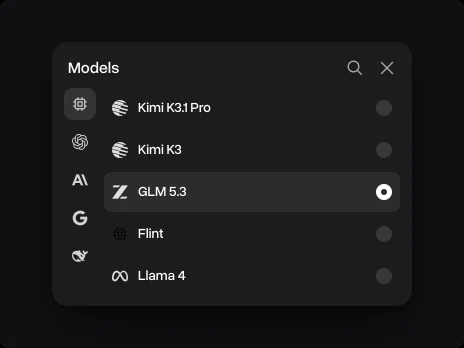
Pick GLM 5.3
It is already picked in the chat on this page. In the Overchat AI app, open the model list next to the message field and pick GLM 5.3
- 02
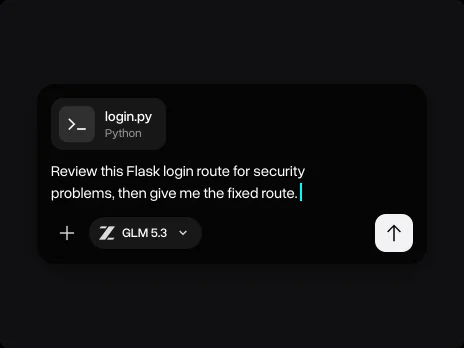
Attach your code or a file
Add code, a document, a spreadsheet or a screenshot, and write what you need: the result, the format and what must stay the same
- 03
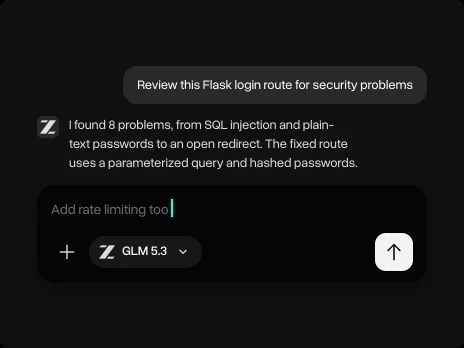
Keep going in the same chat
Ask a follow-up, ask for tests or a shorter version, or switch to another model without losing the conversation
Why use GLM 5.3 on Overchat AI
One account for chat, images and video, on every device
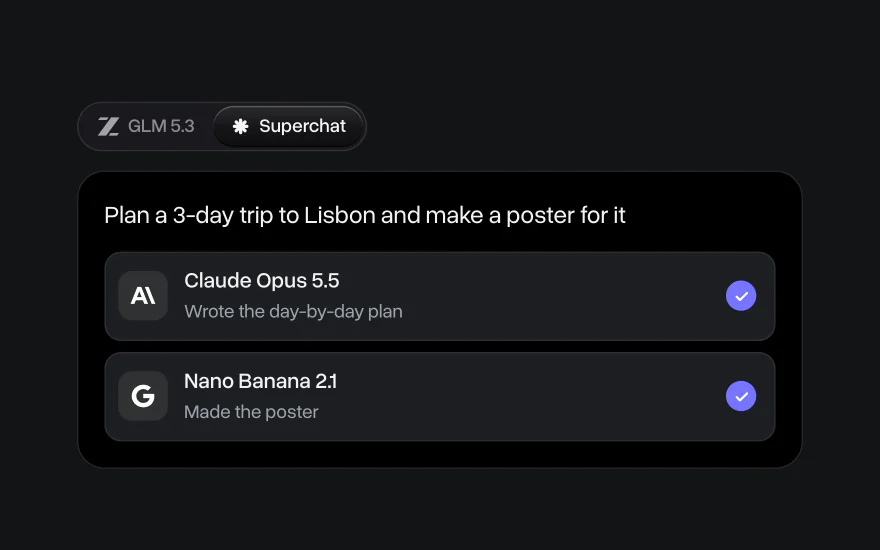
Superchat AI agent
Superchat Agent automatically routes your message to the model best suited for the task. It can generate images and videos, use the AI tools built into Overchat AI, and learn from your interactions to get better over time
Chat with images and files
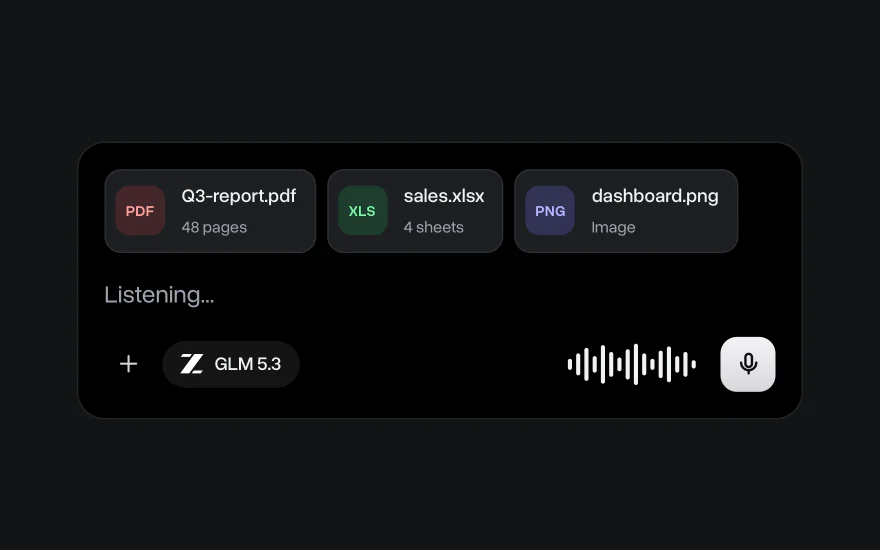
Upload PDFs, spreadsheets, code and screenshots and ask GLM 5.3 about them. You can also dictate a message instead of typing it

Go beyond text
Generate images with Nano Banana and GPT Image and videos with Seedance and Kling in the same account, with the same credits as chat
On the web and iPhone
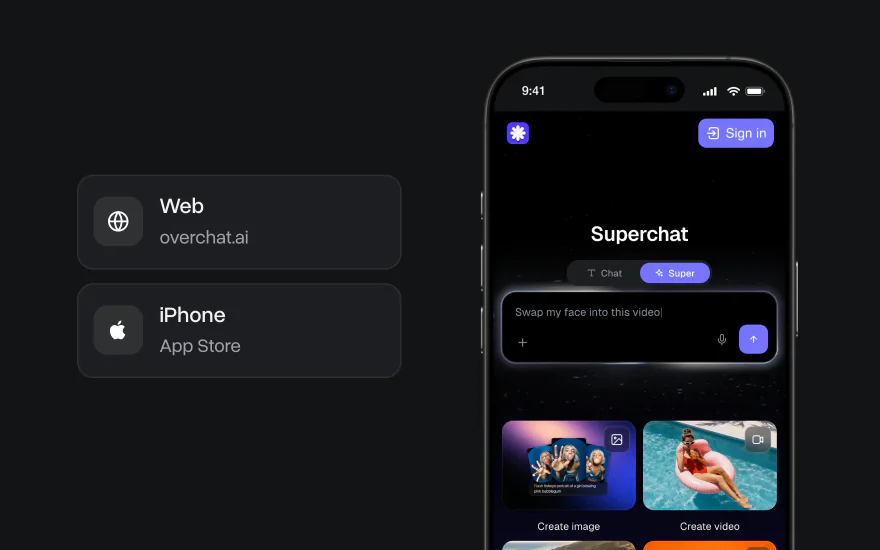
Start a chat on your laptop and finish it on your phone. The Overchat AI app has the same models, and your chats stay in one account on every device

Explore other models
Models marked Soon are coming to Overchat AI; the rest are available now


Learn more about AI models

We tested Gemini 4 Argon against Claude Opus 5.5, GPT-6 Astra and Muse Wonder
We tested Gemini 4 Argon against Claude Opus 5.5, GPT-6 Astra and Muse Wonder on three coding tasks. See benchmarks, speed and how to use it

Muse Wonder vs Muse Spark: Meta's New Model Tested
We tested Muse Wonder against Muse Spark 1.3 on logic, writing and coding tasks. See benchmarks and which Meta model is better

10 Best All-in-One AI Platforms in 2026: Why One AI Subscription Beats Many
Compare the 10 best all-in-one AI platforms in 2026, from Overchat AI to Poe and Magai, with prices, free plans and the newest GPT and Claude models