About Muse Spark
Muse Spark 1.3 is the September version of Meta's Muse Spark, the model for agentic coding, long documents and everyday tasks. It reads text, images, video and files and holds up to 1 million tokens in one conversation
Muse Spark 1.3 scores 57.9% on AutomationBench against 35.4% for Claude Haiku 5.5, and 48.0% on the hard set of the CritPt physics test against 29.5% for Qwen 3.8 Max. It is the fourth Muse Spark release in five months, and each one has raised its scores in coding and agent tasks
On Overchat AI, Muse Spark is in the same chat as Muse Wonder, Claude and GPT-6, so you can ask it, attach a file and switch models without starting over
- Modalities
- Intelligence Index?
- 37
- Context window?
- 1M tokens
- Released
- Sep 2, 2026
Muse Spark vs other models
Muse Spark ranks #12 on the Artificial Analysis Intelligence Index out of 55 models
- 59
 Claude Opus 5.5
- 55
 GPT-6.1 Sol
- 46
 Kimi K3.1 Pro
- 44
 Muse Wonder
- 37Muse Spark
- 36Claude Haiku 5.5
- 36Muse Ember
- 35
 Grok 4.7
- 34
 Qwen 3.8 Max
- 33
 DeepSeek V4.1 Flash
- #23of 149 modelsGDP.pdfQuestions about long professional PDFs with tables, charts and fine print
- #35of 134 modelsHLE-Diamond1,000 expert-level questions from Humanity's Last Exam, half on reasoning and half on knowledge
- #36of 111 modelsCritPt v2 HardThe hardest research-level physics problems of CritPt
- #43of 148 modelsTerminal-Bench 4.0Hard tasks an agent completes in a terminal
Source: Artificial Analysis
Compare Muse Spark
Muse Spark vs Claude Haiku 5.5
Muse Spark scores higher than Claude Haiku 5.5 in 5 of 7 benchmarks. The widest lead is in AutomationBench: 57.9% against 35.4%. Claude Haiku 5.5 is ahead in FrontierCode 2.0: 34.9% against 23.1%. Muse Spark writes 1129 tokens per second, Claude Haiku 5.5 writes 167
- Benchmarks won
- Muse Spark: 5
- Claude Haiku 5.5: 2
- Average score
- Muse Spark: 33.4%
- Claude Haiku 5.5: 31.0%
- Output speed, tokens/s
- Muse Spark: 1129
- Claude Haiku 5.5: 167
- Time to first token, s (log scale)
- Muse Spark: 6.2
- Claude Haiku 5.5: 2.1
- AutomationBench+22.5
- GDP.pdf+5.8
- CritPt v2 Hard+4.5
- HLE-Diamond+4.1
- Terminal-Bench 4.0+0.5
- Terminal-Bench-Science−9.0
- FrontierCode 2.0−11.8
Muse Spark vs Grok 4.7
Muse Spark scores higher than Grok 4.7 in 4 of 7 benchmarks. The widest lead is in CritPt v2 Hard: 48.0% against 33.5%. Grok 4.7 is ahead in AutomationBench: 65.6% against 57.9%. Muse Spark writes 1129 tokens per second, Grok 4.7 writes 81
- Benchmarks won
- Muse Spark: 4
- Grok 4.7: 3
- Average score
- Muse Spark: 33.4%
- Grok 4.7: 29.7%
- Output speed, tokens/s
- Muse Spark: 1129
- Grok 4.7: 81
- Time to first token, s (log scale)
- Muse Spark: 6.2
- Grok 4.7: 8.9
- CritPt v2 Hard+14.5
- HLE-Diamond+10.5
- Terminal-Bench 4.0+7.5
- GDP.pdf+6.6
- Terminal-Bench-Science−0.4
- FrontierCode 2.0−5.6
- AutomationBench−7.7
Muse Spark vs Qwen 3.8 Max
Muse Spark scores higher than Qwen 3.8 Max in 4 of 7 benchmarks. The widest lead is in CritPt v2 Hard: 48.0% against 29.5%. Qwen 3.8 Max is ahead in Terminal-Bench 4.0: 38.9% against 33.3%. Muse Spark writes 1129 tokens per second, Qwen 3.8 Max writes 81
- Benchmarks won
- Muse Spark: 4
- Qwen 3.8 Max: 3
- Average score
- Muse Spark: 33.4%
- Qwen 3.8 Max: 29.5%
- Output speed, tokens/s
- Muse Spark: 1129
- Qwen 3.8 Max: 81
- Time to first token, s (log scale)
- Muse Spark: 6.2
- Qwen 3.8 Max: 30.6
- CritPt v2 Hard+18.5
- HLE-Diamond+9.7
- GDP.pdf+3.8
- AutomationBench+1.7
- FrontierCode 2.0−0.3
- Terminal-Bench-Science−0.9
- Terminal-Bench 4.0−5.6
Muse Spark vs DeepSeek V4.1 Flash
Muse Spark scores higher than DeepSeek V4.1 Flash in 3 of 7 benchmarks. The widest lead is in CritPt v2 Hard: 48.0% against 25.0%. DeepSeek V4.1 Flash is ahead in AutomationBench: 66.6% against 57.9%. Muse Spark writes 1129 tokens per second, DeepSeek V4.1 Flash writes 422
- Benchmarks won
- Muse Spark: 3
- DeepSeek V4.1 Flash: 4
- Average score
- Muse Spark: 33.4%
- DeepSeek V4.1 Flash: 29.9%
- Output speed, tokens/s
- Muse Spark: 1129
- DeepSeek V4.1 Flash: 422
- Time to first token, s (log scale)
- Muse Spark: 6.2
- DeepSeek V4.1 Flash: 2.2
- CritPt v2 Hard+23.0
- GDP.pdf+9.4
- HLE-Diamond+8.4
- Terminal-Bench 4.0−0.5
- Terminal-Bench-Science−1.9
- FrontierCode 2.0−5.4
- AutomationBench−8.7
Best model by use case
Average benchmark scores of Muse Spark and 4 other models by use case
Coding
?Average of 3 tests- 1Claude Haiku 5.529.2%
- 2DeepSeek V4.1 Flash25.1%
- 3Qwen 3.8 Max24.7%
- 4Muse Spark22.5%
- 5Grok 4.722.0%
Knowledge work
?Average of 2 tests- 1Grok 4.742.8%
- 2Muse Spark42.3%
- 3DeepSeek V4.1 Flash41.9%
- 4Qwen 3.8 Max39.5%
- 5Claude Haiku 5.528.1%
Reasoning
?Average of 2 tests- 1Muse Spark40.9%
- 2Claude Haiku 5.536.5%
- 3Grok 4.728.4%
- 4Qwen 3.8 Max26.8%
- 5DeepSeek V4.1 Flash25.1%
Muse Spark benchmarks
Compare Muse Spark with 4 other models in 7 benchmarks measuring coding, knowledge work and reasoning
Coding
- Terminal-Bench 4.0?Muse Spark33.3%Claude Haiku 5.532.8%Grok 4.725.8%Qwen 3.8 Max38.9%DeepSeek V4.1 Flash33.8%33.3%−5.6
- FrontierCode 2.0?Muse Spark23.1%Claude Haiku 5.534.9%Grok 4.728.7%Qwen 3.8 Max23.4%DeepSeek V4.1 Flash28.5%23.1%−11.8
- Terminal-Bench-Science?Muse Spark11.0%Claude Haiku 5.520.0%Grok 4.711.4%Qwen 3.8 Max11.9%DeepSeek V4.1 Flash12.9%11.0%−9.0
Knowledge work
- AutomationBench?Muse Spark57.9%Claude Haiku 5.535.4%Grok 4.765.6%Qwen 3.8 Max56.2%DeepSeek V4.1 Flash66.6%57.9%−8.7
- GDP.pdf?Muse Spark26.6%Claude Haiku 5.520.8%Grok 4.720.0%Qwen 3.8 Max22.8%DeepSeek V4.1 Flash17.2%26.6%+3.8
Reasoning
- HLE-Diamond?Muse Spark33.7%Claude Haiku 5.529.6%Grok 4.723.2%Qwen 3.8 Max24.0%DeepSeek V4.1 Flash25.3%33.7%+4.1
- CritPt v2 Hard?Muse Spark48.0%Claude Haiku 5.543.5%Grok 4.733.5%Qwen 3.8 Max29.5%DeepSeek V4.1 Flash25.0%48.0%+4.5
Sources: Artificial Analysis, Muse Spark 1.3 (Sep 2, 2026), OpenRouter, Meta: Muse Spark 1.3
Muse Spark speed
Output speed is how fast the model writes (tokens per second, higher is better). Time to first token is how long you wait before the answer starts (lower is better)
Output speed and time to first token of 35 models
?Percentile| Models | Output speed, tokens/s (log scale) | Time to first token, s (log scale) |
|---|---|---|
| GPT-6 Luna | 143 | 2.4 |
| GPT-6.1 Terra | 75 | 4.3 |
| GPT-6.1 Sol | 58 | 2.9 |
| GPT-6 Astra | 48 | 3.2 |
| Claude Opus 5.5 | 88 | 1.9 |
| Claude Opus 5 | 54 | 2.6 |
| Claude Opus 4.8 | 59 | 1.3 |
| Claude Fable 5.2 | 84 | 2.3 |
| Claude Sonnet 5.5 | 102 | 1 |
| Claude 5 Sonnet | 215 | 10.5 |
| Claude Sonnet 4.6 | 220 | 10.8 |
| Claude Haiku 5.5 | 167 | 2.1 |
| Gemini 4 Carbon | 169 | 29.5 |
| Gemini 4 Argon | 91 | 6 |
| Gemini 3.8 Flash | 203 | 7.5 |
| Gemini 3 Pro | 270 | 11.2 |
| Grok 4.7 | 81 | 8.9 |
| Grok 4.6 | 290 | 32 |
| Qwen 3.8 Max | 81 | 30.6 |
| DeepSeek V4 Pro | 144 | 1.1 |
| DeepSeek V4.1 Flash | 422 | 2.2 |
| Mistral Large 4 | 226 | 8.6 |
| Hy4 | 214 | 37.7 |
| ERNIE 5.5 Flash | 405 | 2.7 |
| Muse Wonder | 980 | 8.7 |
| Muse Spark | 1129 | 6.2 |
| Kimi K3.1 Pro | 340 | 7.4 |
| Kimi K3 | 338 | 5.9 |
| GLM 5.3 | 197 | 1.2 |
| Flint | 194 | 12.3 |
| Llama 4 | 81 | 0.7 |
| Claude 4.5 Haiku | 162 | 0.9 |
| MiniMax M3 | 169 | 4.5 |
| MiniMax M3.1 Flash | 656 | 7.2 |
| Kimi K2.7 Code | 455 | 3.6 |
Typing test
Every model writes the same answer. The test waits the model's time to first token, then prints the text at the model's output speed and shows the total time
- Muse Spark1129 tokens/s6.2 s to first token
- Claude Haiku 5.5167 tokens/s2.1 s to first token
- Grok 4.781 tokens/s8.9 s to first token
- Qwen 3.8 Max81 tokens/s30.6 s to first token
Source: Overchat AI, 2026-11-11
See how Muse Spark answers
Examples of Muse Spark answers to 3 prompts: Write a SQL query, Explain the science and Plan a trip. Each answer is the unedited output of the model
Write a SQL query that finds customers who ordered in at least three consecutive months, from a table orders(customer_id, ordered_at, amount). Then explain the trick behind it in two sentences.
Muse SparkQuery (PostgreSQL):
WITH monthly AS (
  SELECT DISTINCT
    customer_id,
    DATE_TRUNC('month', ordered_at)::date AS mon
  FROM orders
),
with_lags AS (
  SELECT
    customer_id,
    mon,
    LAG(mon) OVER (PARTITION BY customer_id ORDER BY mon) AS prev1,
    LAG(mon, 2) OVER (PARTITION BY customer_id ORDER BY mon) AS prev2
  FROM monthly
)
SELECT DISTINCT customer_id
FROM with_lags
WHERE mon = (prev1 + INTERVAL '1 month')::date
  AND prev1 = (prev2 + INTERVAL '1 month')::date;
How it works: The trick is to collapse orders to distinct customer-months and use LAG() to look back at the two previous months for each customer. If both gaps are exactly one month, then the current month completes a run of three consecutive months.
Explain why ice floats on water while most frozen liquids sink, in under 150 words, for a high school student. Plain text, no formulas.
Muse SparkMost liquids get denser when they freeze because their particles pack tighter together as they slow down, so the solid sinks. Water is weird because of how its molecules stick together. Water molecules form special links called hydrogen bonds. When water freezes, these bonds lock the molecules into a wide open honeycomb-like crystal with a lot of empty space inside. That means the same amount of water takes up more room as ice than as liquid. Since ice takes up more space for the same weight, it is less dense than liquid water. Less dense things float on denser things, so ice floats. This is actually great for life because floating ice insulates lakes in winter.
Plan a 4-day trip to Kyoto in April for two people on a mid-range budget: one line for each morning, afternoon and evening, and a rough daily budget in US dollars at the end.
Muse SparkPerfect time to go — early April is peak cherry blossom season in Kyoto! Here's a mid-range plan for two:
Day 1: Arrival & South Kyoto Morning: Arrive, check into hotel near Kyoto Station and walk to Nishi Hongan-ji and Shosei-en Garden for first blossoms. Afternoon: Hike through the 10,000 vermilion gates at Fushimi Inari Taisha and try street snacks like inari sushi and yakitori. Evening: Evening stroll through Gion and Pontocho Alley for traditional streets, then enjoy an izakaya dinner by the Kamo River. Daily Budget: ~$280 for two (hotel $150 + food $80 + local transport $50)
Day 2: East Kyoto & Sakura Spots Morning: Visit Kiyomizu-dera Temple early for views over the city, then walk down preserved Ninenzaka and Sannenzaka lanes. Afternoon: Picnic under cherry blossoms at Maruyama Park and visit Yasaka Shrine and Kodai-ji Temple. Evening: Experience a Yudofu (tofu hot pot) dinner in Higashiyama and see Kiyomizu illuminated for spring night viewing. Daily Budget: ~$300 for two (hotel $150 + food $100 + temples/transport $50)
Day 3: West Kyoto & Arashiyama Morning: Walk the Bamboo Grove early in Arashiyama, then visit Tenryu-ji Temple and its zen garden in full spring color. Afternoon: See UNESCO-listed Kinkaku-ji (Golden Pavilion) and nearby Ryoan-ji rock garden, then relax with matcha at Kitano Tenmangu. Evening: Return downtown for Nishiki Market tasting walk, then casual ramen dinner and craft beer in central Kyoto. Daily Budget: ~$290 for two (hotel $150 + food $90 + transport/entrance $50)
Day 4: Philosopher's Path & Farewell Morning: Cherry blossom walk along the Philosopher's Path to Ginkaku-ji (Silver Pavilion) and Honen-in Temple. Afternoon: Explore Demachi Masugata Shotengai and the Kyoto Imperial Palace Park for last sakura photos and souvenirs. Evening: Farewell kaiseki-style set dinner on Kawaramachi, then Shinkansen/bus out or final night hanami at Kamogawa riverside. Daily Budget: ~$270 for two (hotel $150 + food $90 + transport $30)
Tip: Book hotels 3-4 months ahead for April — prices double during sakura week.
More prompts to try with Muse Spark
What Muse Spark is best for
Agentic coding
Muse Spark 1.3 works through coding tasks in a terminal, with 33.3% on Terminal-Bench 4.0, ahead of Claude Haiku 5.5 and Grok 4.7
Business workflows
Muse Spark 1.3 runs workflows across sales, support and finance apps, with 57.9% on AutomationBench against 35.4% for Claude Haiku 5.5
Long documents and PDFs
Muse Spark 1.3 holds up to 1 million tokens and answers questions about long reports with tables and charts, with 26.6% on GDP.pdf, ahead of the other models it is compared with
Science and math
Muse Spark 1.3 solves research-level physics, with 48.0% on the hard set of CritPt, the top score among the models it is compared with
How to use Muse Spark on Overchat AI
Start in the chat at the top of this page or in the Overchat AI app on the web, iOS or Android
- 01
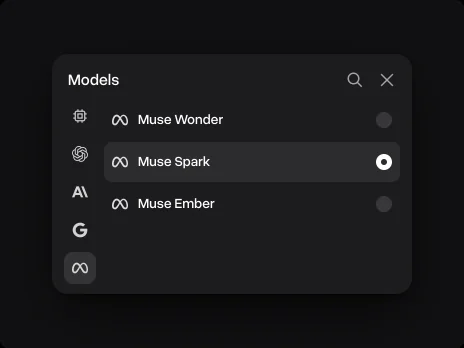
Pick Muse Spark
It is already picked in the chat on this page. In the Overchat AI app, open the model list next to the message field and pick Muse Spark
- 02
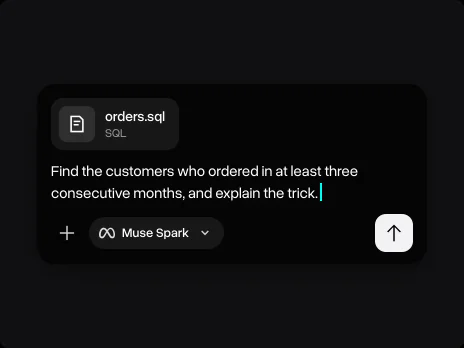
Attach your code or a file
Add code, a document, a spreadsheet or a screenshot, and write what you need: the result, the format and what must stay the same
- 03
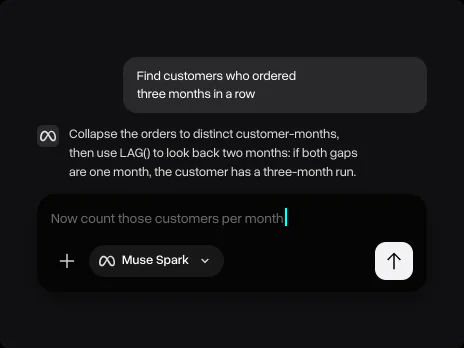
Keep going in the same chat
Ask a follow-up, ask for tests or a shorter version, or switch to another model without losing the conversation
Why use Muse Spark on Overchat AI
One account for chat, images and video, on every device
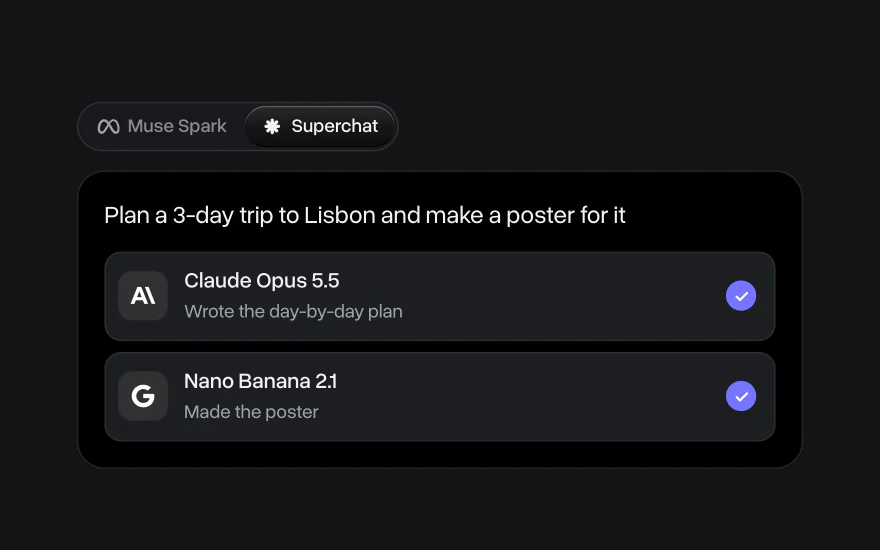
Superchat AI agent
Superchat Agent automatically routes your message to the model best suited for the task. It can generate images and videos, use the AI tools built into Overchat AI, and learn from your interactions to get better over time
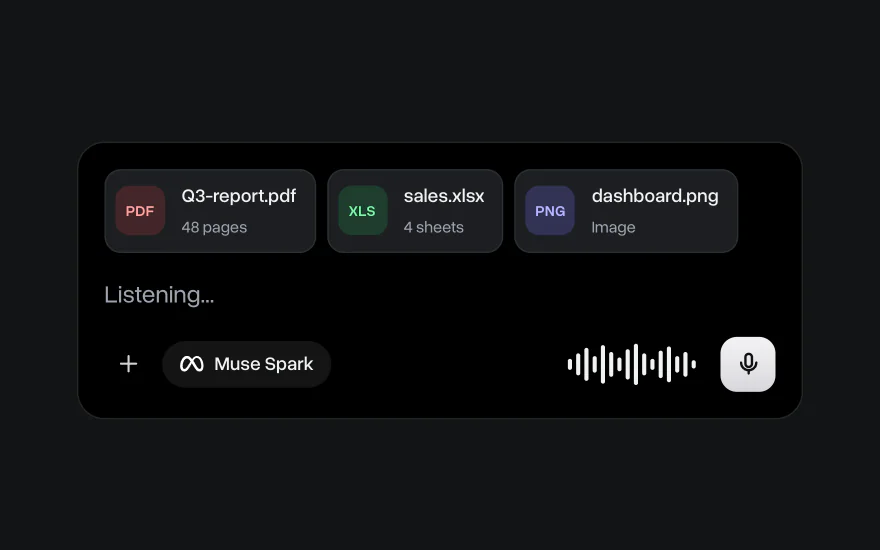
Chat with images and files
Upload PDFs, spreadsheets, code and screenshots and ask Muse Spark about them. You can also dictate a message instead of typing it
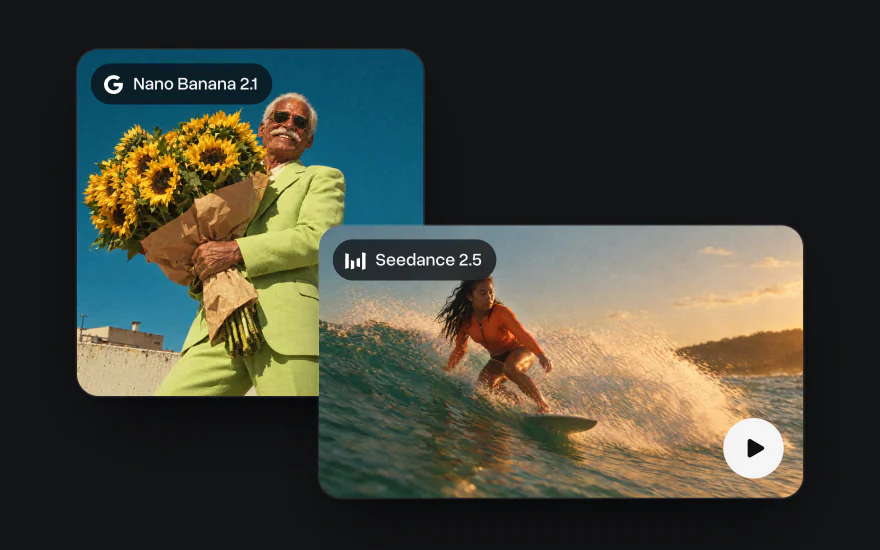
Go beyond text
Generate images with Nano Banana and GPT Image and videos with Seedance and Kling in the same account, with the same credits as chat
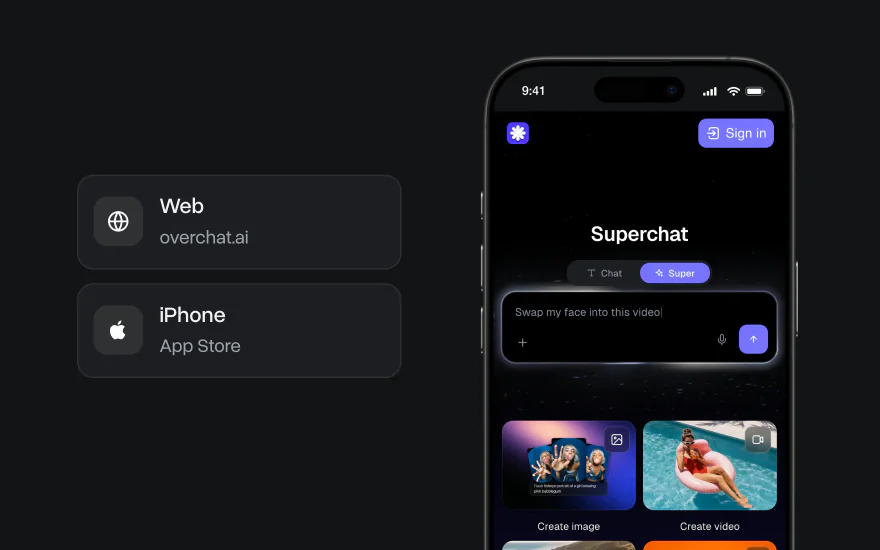
On the web and iPhone
Start a chat on your laptop and finish it on your phone. The Overchat AI app has the same models, and your chats stay in one account on every device

Meta models on Overchat AI
Compare 4 Meta models on Overchat AI by output speed, time to first token and the price of one message
Muse SparkThis pageLlama 4Source: Overchat AI, 2026-11-11
Explore other models
Models marked Soon are coming to Overchat AI; the rest are available now


Learn more about AI models

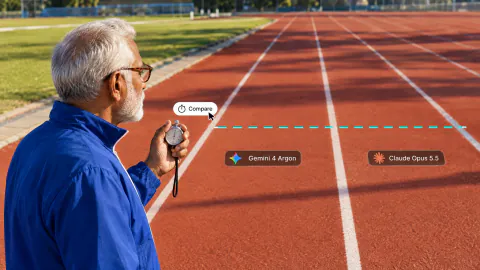
We tested Gemini 4 Argon against Claude Opus 5.5, GPT-6 Astra and Muse Wonder
We tested Gemini 4 Argon against Claude Opus 5.5, GPT-6 Astra and Muse Wonder on three coding tasks. See benchmarks, speed and how to use it
Muse Wonder vs Muse Spark: Meta's New Model Tested
We tested Muse Wonder against Muse Spark 1.3 on logic, writing and coding tasks. See benchmarks and which Meta model is better

10 Best All-in-One AI Platforms in 2026: Why One AI Subscription Beats Many
Compare the 10 best all-in-one AI platforms in 2026, from Overchat AI to Poe and Magai, with prices, free plans and the newest GPT and Claude models