About Gemini 4 Argon
Gemini 4 Argon is Google's flagship model for software engineering, legal and finance work, math and science. It reads text, images, video, audio and PDF files, takes up to 1 million tokens in one conversation and thinks before it answers
Gemini 4 Argon scores 77.9% on DeepSWE v1.1, ahead of Claude Opus 5.5 at 74.2% and GPT-6 Astra at 74.1%, and has the top results on AutomationBench, Vals Finance Agent v2 and Harvey's Legal Agent Benchmark among the models it is compared with. It also leads on LVBench, at 91.7%, for questions about long videos
On Overchat AI, Gemini 4 Argon shares one chat with Claude, GPT-6 and Grok, so you can send the same question to another model without leaving the conversation
- Modalities
- Intelligence Index?
- 50
- Context window?
- 1M tokens
- Released
- Sep 30, 2026
Gemini 4 Argon vs other models
Gemini 4 Argon ranks #20 on the Artificial Analysis Intelligence Index out of 54 models
- 65
 Claude Fable 5.2
- 60
 Gemini 4 Carbon
- 59Claude Opus 5.5
- 57
 GPT-6 Astra
- 55GPT-6.1 Sol
- 50Gemini 4 Argon
- 50
 Muse Wonder Full
- 46
 Kimi K3.1 Pro
- 44Muse Wonder
- 35
 Grok 4.7
- #1of 63 modelsAA-Omniscience Non-Hallucination RateHow often the model says it doesn't know instead of making up an answer
- #4of 344 modelsHumanity's Last ExamExpert-written questions across many subjects
- #4of 136 modelsSciCodePython code for scientific computing
- #6of 130 modelsTerminal-Bench 4.0Hard tasks an agent completes in a terminal
Source: Artificial Analysis
Compare Gemini 4 Argon
Gemini 4 Argon vs GPT-6 Astra
Gemini 4 Argon scores higher than GPT-6 Astra in 13 of 17 benchmarks. The widest lead is in Harvey's Legal Agent Benchmark: 19.6% against 5.4%. GPT-6 Astra is ahead in FrontierSWE v2: 65.5% against 55.0%. Gemini 4 Argon writes 91 tokens per second, GPT-6 Astra writes 48
- Benchmarks won
- Gemini 4 Argon: 13
- GPT-6 Astra: 4
- Average score
- Gemini 4 Argon: 68.8%
- GPT-6 Astra: 65.7%
- Output speed, tokens/s
- Gemini 4 Argon: 91
- GPT-6 Astra: 48
- Time to first token, s (log scale)
- Gemini 4 Argon: 6.0
- GPT-6 Astra: 3.2
- Harvey's Legal Agent Benchmark+14.2
- GraphWalks, 256K to 1M+12.4
- Vals Finance Agent v2+11.9
- AutomationBench+9.9
- Vals Index+5.8
- LVBench+4.2
- RiemannBench+4.0
- DeepSWE v1.1+3.8
- LABBench 2+3.4
- Vibe Code Bench+2.3
- PostTrainBench+1.0
- GraphWalks, up to 128K+1.0
- Chartography+0.6
- CWE-bench v10.0
- Terminal-Bench 4.0−0.8
- FrontierSWE v2−10.5
- Terminal-Bench Science−10.5
Gemini 4 Argon vs Claude Fable 5.1
Gemini 4 Argon scores higher than Claude Fable 5.1 in 15 of 17 benchmarks. The widest lead is in Chartography: 71.6% against 46.2%. Claude Fable 5.1 is ahead in FrontierSWE v2: 56.3% against 55.0%
- Benchmarks won
- Gemini 4 Argon: 15
- Claude Fable 5.1: 2
- Average score
- Gemini 4 Argon: 68.8%
- Claude Fable 5.1: 58.9%
- Chartography+25.4
- LABBench 2+20.2
- AutomationBench+19.9
- GraphWalks, 256K to 1M+19.2
- Harvey's Legal Agent Benchmark+12.9
- LVBench+12.0
- DeepSWE v1.1+10.5
- RiemannBench+10.4
- CWE-bench v1+10.0
- GraphWalks, up to 128K+8.3
- Vals Finance Agent v2+6.5
- PostTrainBench+5.1
- Terminal-Bench Science+5.0
- Vals Index+3.1
- Vibe Code Bench+1.6
- Terminal-Bench 4.0−0.5
- FrontierSWE v2−1.3
Gemini 4 Argon vs Claude Opus 5.5
Gemini 4 Argon scores higher than Claude Opus 5.5 in 13 of 17 benchmarks. The widest lead is in GraphWalks, 256K to 1M: 84.2% against 66.8%. Claude Opus 5.5 is ahead in Terminal-Bench 4.0: 66.4% against 57.4%. Gemini 4 Argon writes 91 tokens per second, Claude Opus 5.5 writes 88
- Benchmarks won
- Gemini 4 Argon: 13
- Claude Opus 5.5: 4
- Average score
- Gemini 4 Argon: 68.8%
- Claude Opus 5.5: 64.4%
- Output speed, tokens/s
- Gemini 4 Argon: 91
- Claude Opus 5.5: 88
- Time to first token, s (log scale)
- Gemini 4 Argon: 6.0
- Claude Opus 5.5: 1.9
- GraphWalks, 256K to 1M+17.4
- Harvey's Legal Agent Benchmark+15.8
- LABBench 2+15.7
- GraphWalks, up to 128K+9.1
- AutomationBench+8.8
- LVBench+8.0
- Vals Finance Agent v2+6.8
- RiemannBench+6.4
- Chartography+5.3
- DeepSWE v1.1+3.7
- Vals Index+1.9
- Vibe Code Bench+1.6
- CWE-bench v1+1.0
- PostTrainBench−4.0
- Terminal-Bench Science−5.7
- FrontierSWE v2−7.3
- Terminal-Bench 4.0−9.0
Best model by use case
Average benchmark scores of Gemini 4 Argon and 3 other models by use case
Knowledge work
?Average of 4 tests- 1Gemini 4 Argon51.3%
- 2Claude Opus 5.543.0%
- 3GPT-6 Astra40.9%
- 4Claude Fable 5.140.7%
Coding
?Average of 6 tests- 1Claude Opus 5.568.3%
- 2GPT-6 Astra66.6%
- 3Gemini 4 Argon65.9%
- 4Claude Fable 5.161.7%
Reasoning
?Average of 5 tests- 1Gemini 4 Argon81.3%
- 2GPT-6 Astra79.2%
- 3Claude Opus 5.572.7%
- 4Claude Fable 5.168.6%
Vision
?Average of 2 tests- 1Gemini 4 Argon81.7%
- 2GPT-6 Astra79.3%
- 3Claude Opus 5.575.0%
- 4Claude Fable 5.163.0%
Gemini 4 Argon benchmarks
Compare Gemini 4 Argon with GPT-6 Astra, Claude Fable 5.1 and Claude Opus 5.5 in 17 benchmarks measuring knowledge work, coding, reasoning and vision
Knowledge work
- Vals Index?Gemini 4 Argon68.9%GPT-6 Astra63.1%Claude Fable 5.165.8%Claude Opus 5.567.0%68.9%+1.9
- AutomationBench?Gemini 4 Argon51.3%GPT-6 Astra41.4%Claude Fable 5.131.4%Claude Opus 5.542.5%51.3%+8.8
- Vals Finance Agent v2?Gemini 4 Argon65.4%GPT-6 Astra53.5%Claude Fable 5.158.9%Claude Opus 5.558.6%65.4%+6.5
- Harvey's Legal Agent Benchmark?Gemini 4 Argon19.6%GPT-6 Astra5.4%Claude Fable 5.16.7%Claude Opus 5.53.8%19.6%+12.9
Coding
- DeepSWE v1.1?Gemini 4 Argon77.9%GPT-6 Astra74.1%Claude Fable 5.167.4%Claude Opus 5.574.2%77.9%+3.7
- FrontierSWE v2?Gemini 4 Argon55.0%GPT-6 Astra65.5%Claude Fable 5.156.3%Claude Opus 5.562.3%55.0%−10.5
- Vibe Code Bench?Gemini 4 Argon91.9%GPT-6 Astra89.6%Claude Fable 5.190.3%Claude Opus 5.590.3%91.9%+1.6
- Terminal-Bench 4.0?Gemini 4 Argon57.4%GPT-6 Astra58.2%Claude Fable 5.157.9%Claude Opus 5.566.4%57.4%−9.0
- PostTrainBench?Gemini 4 Argon45.3%GPT-6 Astra44.3%Claude Fable 5.140.2%Claude Opus 5.549.3%45.3%−4.0
- CWE-bench v1?Gemini 4 Argon68.0%GPT-6 Astra68.0%Claude Fable 5.158.0%Claude Opus 5.567.0%68.0%+0.0
Reasoning
- Terminal-Bench Science?Gemini 4 Argon57.6%GPT-6 Astra68.1%Claude Fable 5.152.6%Claude Opus 5.563.3%57.6%−10.5
- LABBench 2?Gemini 4 Argon88.8%GPT-6 Astra85.4%Claude Fable 5.168.6%Claude Opus 5.573.1%88.8%+3.4
- RiemannBench?Gemini 4 Argon76.0%GPT-6 Astra72.0%Claude Fable 5.165.6%Claude Opus 5.569.6%76.0%+4.0
- GraphWalks, up to 128K?Gemini 4 Argon99.7%GPT-6 Astra98.7%Claude Fable 5.191.4%Claude Opus 5.590.6%99.7%+1.0
- GraphWalks, 256K to 1M?Gemini 4 Argon84.2%GPT-6 Astra71.8%Claude Fable 5.165.0%Claude Opus 5.566.8%84.2%+12.4
Vision
- Chartography?Gemini 4 Argon71.6%GPT-6 Astra71.0%Claude Fable 5.146.2%Claude Opus 5.566.3%71.6%+0.6
- LVBench?Gemini 4 Argon91.7%GPT-6 Astra87.5%Claude Fable 5.179.7%Claude Opus 5.583.7%91.7%+4.2
Sources: Google, Gemini 4 Argon launch post (Sep 30, 2026), Google DeepMind, Gemini 4 Argon model evaluation
Gemini 4 Argon speed
Output speed is how fast the model writes (tokens per second, higher is better). Time to first token is how long you wait before the answer starts (lower is better)
Output speed and time to first token of 35 models
?Percentile| Models | Output speed, tokens/s (log scale) | Time to first token, s (log scale) |
|---|---|---|
| GPT-6 Luna | 143 | 2.4 |
| GPT-6.1 Terra | 75 | 4.3 |
| GPT-6.1 Sol | 58 | 2.9 |
| GPT-6 Astra | 48 | 3.2 |
| Claude Opus 5.5 | 88 | 1.9 |
| Claude Opus 5 | 54 | 2.6 |
| Claude Opus 4.8 | 59 | 1.3 |
| Claude Fable 5.2 | 84 | 2.3 |
| Claude Sonnet 5.5 | 102 | 1 |
| Claude 5 Sonnet | 215 | 10.5 |
| Claude Sonnet 4.6 | 220 | 10.8 |
| Claude Haiku 5.5 | 167 | 2.1 |
| Gemini 4 Carbon | 169 | 29.5 |
| Gemini 4 Argon | 91 | 6 |
| Gemini 3.8 Flash | 203 | 7.5 |
| Gemini 3 Pro | 270 | 11.2 |
| Grok 4.7 | 81 | 8.9 |
| Grok 4.6 | 290 | 32 |
| Qwen 3.8 Max | 81 | 30.6 |
| DeepSeek V4 Pro | 144 | 1.1 |
| DeepSeek V4.1 Flash | 422 | 2.2 |
| Mistral Large 4 | 226 | 8.6 |
| Hy4 | 214 | 37.7 |
| ERNIE 5.5 Flash | 405 | 2.7 |
| Muse Wonder | 980 | 8.7 |
| Muse Spark | 1129 | 6.2 |
| Kimi K3.1 Pro | 340 | 7.4 |
| Kimi K3 | 338 | 5.9 |
| GLM 5.3 | 197 | 1.2 |
| Flint | 194 | 12.3 |
| Llama 4 | 81 | 0.7 |
| Claude 4.5 Haiku | 162 | 0.9 |
| MiniMax M3 | 169 | 4.5 |
| MiniMax M3.1 Flash | 656 | 7.2 |
| Kimi K2.7 Code | 455 | 3.6 |
Typing test
Every model writes the same answer. The test waits the model's time to first token, then prints the text at the model's output speed and shows the total time
- Gemini 4 Argon91 tokens/s6.0 s to first token
- GPT-6 Astra48 tokens/s3.2 s to first token
- Claude Opus 5.588 tokens/s1.9 s to first token
Source: Overchat AI, 2026-11-11
See how Gemini 4 Argon answers
Examples of Gemini 4 Argon answers to 3 prompts: Analyze bank data, Review a contract and Solve a math problem. Each answer is the unedited output of the model
Write a Python script that reads a CSV of bank transactions (date, description, category, amount), groups spending by month and category and prints the top three categories for each month. Keep it under 40 lines.
Gemini 4 ArgonHere is a complete, dependency-free Python script that achieves this in under 30 lines using the built-in csv and collections modules.
It assumes dates are in YYYY-MM-DD format and uses abs() on the amount so it works regardless of whether spending is listed as positive or negative numbers.
from collections import Counter, defaultdict
import csv


def top_spending_categories(csv_file_path):
    # Dictionary mapping each 'YYYY-MM' to a Counter of categories
    monthly_spending = defaultdict(Counter)

    with open(csv_file_path, mode="r", newline="", encoding="utf-8") as file:
        reader = csv.DictReader(file)
        for row in reader:
            # Extract 'YYYY-MM' from 'YYYY-MM-DD'
            month = row["date"][:7]
            category = row["category"]
            amount = abs(float(row["amount"]))

            monthly_spending[month][category] += amount

    # Sort chronologically by month and print the top 3 categories
    for month in sorted(monthly_spending.keys()):
        print(f"--- {month} ---")
        for category, total in monthly_spending[month].most_common(3):
            print(f"  {category}: ${total:,.2f}")


if __name__ == "__main__":
    # Replace 'transactions.csv' with your actual file path
    top_spending_categories("transactions.csv")
Expected CSV Format (transactions.csv)
date,description,category,amount
2023-10-02,Grocery Store,Food,150.25
2023-10-05,Gas Station,Transport,45.00
2023-10-12,Apartment Rent,Housing,1200.00
2023-10-18,Restaurant,Food,85.50
2023-10-25,Electric Bill,Utilities,95.00
Example Output
--- 2023-10 ---
  Housing: $1,200.00
  Food: $235.75
Utilities: $95.00Review this clause from a freelance contract: "The Contractor shall indemnify and hold harmless the Client against any and all claims, losses and damages arising from the Services, without limitation." What are the risks for me as the contractor, and how would you rewrite it in a fairer way?
Gemini 4 ArgonThe clause you shared is what lawyers often call a "nuclear" indemnification clause. It is heavily one-sided and exposes you to massive financial risk.
Here is a breakdown of why this clause is dangerous for you as the contractor, followed by fairer ways to rewrite it.
The Risks for You (The Contractor)
- "Without limitation" (Uncapped Liability): This is the biggest red flag. If you are getting paid $2,000 for a project, and something goes wrong that costs the client $500,000, you are legally on the hook for the entire $500,000. Your financial risk is completely disproportionate to your reward.
- "Arising from the Services" (No Fault Required): Notice that the clause doesn't say "arising from the Contractor's negligence or breach of contract." It just says "arising from the Services." If you follow the client’s exact instructions, or use materials they provided, and a third party sues the client as a result, you could still be forced to pay for the client's legal defense and damages—even though you did nothing wrong.
- "Any and all losses and damages" (Includes Consequential Damages): This broad phrasing includes indirect damages, such as "lost profits" or "loss of business reputation." For example, if you are building a website, and a bug causes it to go down for three hours, the client could claim they lost $100,000 in potential sales during that window and demand you pay it.
- First-Party vs. Third-Party Claims: Indemnification is primarily meant to protect the client if a third party (like one of their customers, or a copyright troll) sues them because of something you did. Because this clause isn't restricted to "third-party claims," the client can use it to force you to pay for their internal losses and their own attorney's fees in a direct dispute with you.
- Uninsurable Risk: If you have Professional Liability (Errors & Omissions) insurance, your policy will generally only cover claims resulting from your actual negligence. By signing a contract where you agree to cover "any and all claims... without limitation," you are taking on liability that your insurance company will likely refuse to cover.
How to Rewrite It (From Most Fair to Compromise)
To make this fair, you need to narrow the trigger (only things that are actually your fault), limit the scope (third-party claims only), and cap the financial damage (usually to the amount they paid you).
Option 1: The Fair & Balanced Standard (Recommended)
This version limits your liability to third-party claims caused by your actual bad acts or IP infringement, makes the protection mutual (so they have to protect you if their materials get you sued), and adds a financial cap.
Indemnification: "The Contractor shall indemnify and hold harmless the Client against any third-party claims, losses, and direct damages to the extent directly caused by the Contractor’s gross negligence, willful misconduct, or infringement of third-party intellectual property rights in performing the Services. Conversely, the Client shall indemnify and hold harmless the Contractor against any third-party claims arising from materials, instructions, or intellectual property provided by the Client."
Limitation of Liability (Add as a separate sentence/clause): "Notwithstanding anything to the contrary, neither party shall be liable for any indirect, incidental, special, or consequential damages (including lost profits). The Contractor’s total aggregate liability under this Agreement, including its indemnification obligations, shall not exceed the total fees paid by the Client to the Contractor under this Agreement."
Option 2: The Short & Simple Revision (Minimal Redlines)
If the client dislikes heavy legal edits and you just want to tweak their exact sentence to make it safe, change it to this:
"The Contractor shall indemnify and hold harmless the Client against any third-party claims and direct damages solely to the extent caused by the Contractor's gross negligence or willful misconduct in performing the Services, up to a maximum amount equal to the total fees paid to the Contractor under this Agreement."
How to Explain the Change to Your Client
Clients often pull templates off the internet without realizing how aggressive the language is. When sending back your edits, you can keep the tone collaborative with a note like this:
“I reviewed the agreement and everything looks great, with the exception of the indemnification clause. As currently written, it carries uncapped liability even for things outside of my control, which my business insurance won't allow me to sign. I’ve updated the language to standard industry terms—making sure you are fully protected if I am negligent or infringe on anyone's IP, while capping the overall liability at the total value of the contract. Let me know if this works for you!”
A ball is dropped from 20 m and each bounce takes it back up to 60% of the height it fell from. What total distance does it travel before it comes to rest? Show the steps.
Gemini 4 ArgonTo find the total distance the ball travels before coming to rest, we need to calculate the initial drop distance and then add the distances of all the subsequent bounces (both going up and coming down).
Here is the step-by-step breakdown:
Step 1: Visualize the motion
- Initial Drop: The ball falls 20 m to hit the ground the first time.
- First Bounce: It rebounds to 60% of 20 m, which is 20 × 0.6 = 12 m going up, and then falls another 12 m going down.
- Second Bounce: It rebounds to 60% of 12 m, which is 12 × 0.6 = 7.2 m going up, and then falls 7.2 m going down.
- Subsequent Bounces: This pattern continues infinitely, with each bounce height being 0.6 times the previous height.
Step 2: Set up the mathematical series
We can separate the total distance (D) into the initial drop plus twice the height of each bounce (since the ball travels the same distance up and down on every bounce):
D = 20 + 2(20 × 0.6) + 2(20 × 0.6²) + 2(20 × 0.6³) + …
Let's simplify the terms inside the parentheses:
- 1st bounce height = 12 m
- 2nd bounce height = 7.2 m
- 3rd bounce height = 4.32 m
So the equation looks like this: D = 20 + 2(12 + 7.2 + 4.32 + …)
Step 3: Sum the infinite geometric series
The numbers inside the parentheses (12 + 7.2 + 4.32 + …) form an infinite geometric series, where:
- The first term (a) = 12
- The common ratio (r) = 0.6 (or 60%)
The formula for the sum (S) of an infinite geometric series (when |r| < 1) is: S = a / (1 − r)
Plug in our values for a and r:
S = 12 / (1 − 0.6)
S = 12 / 0.4
S = 30 m
(Note: 30 m is the total distance the ball travels strictly moving upward).
Step 4: Calculate the total distance
Since the ball travels 30 m going up, it must also travel 30 m coming down from those bounces. Now, substitute S = 30 back into our total distance equation from Step 2:
D = 20 + 2(S)
D = 20 + 2(30)
D = 20 + 60
D = 80 m
Answer:
The ball travels a total distance of 80 meters before coming to rest.
More prompts to try with Gemini 4 Argon
What Gemini 4 Argon is best for
Software engineering
Gemini 4 Argon fixes bugs and builds features across a real codebase. It scores 77.9% on DeepSWE v1.1 and 91.9% on Vibe Code Bench, the top results among the models it is compared with
Legal and finance work
Gemini 4 Argon reviews contracts, drafts legal documents and runs financial research. It scores 19.6% on Harvey's Legal Agent Benchmark, against 3.8% for Claude Opus 5.5, and 65.4% on Vals Finance Agent v2
Charts, scans and videos
Gemini 4 Argon reads charts, screenshots, scanned pages and long videos. It scores 71.6% on Chartography and 91.7% on LVBench, the best results among the models it is compared with
Math and science
Gemini 4 Argon solves research-level math and biology lab tasks, with 76.0% on RiemannBench and 88.8% on LABBench 2, ahead of GPT-6 Astra and Claude Opus 5.5
How to use Gemini 4 Argon on Overchat AI
Start in the chat at the top of this page or in the Overchat AI app on the web, iOS or Android
- 01
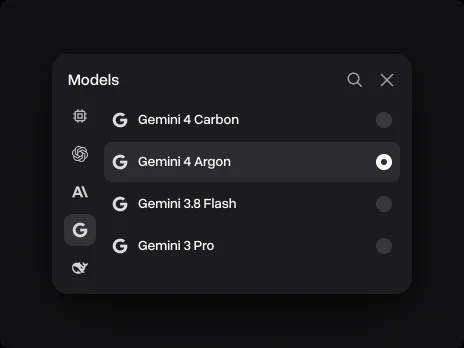
Pick Gemini 4 Argon
It is already picked in the chat on this page. In the Overchat AI app, open the model list next to the message field and pick Gemini 4 Argon
- 02
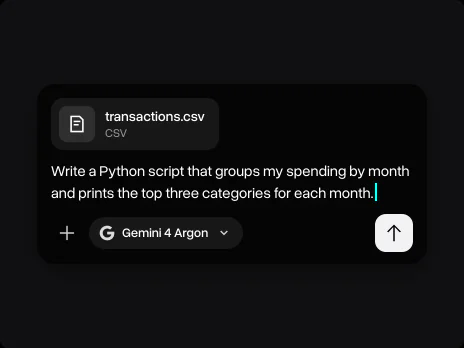
Attach your code or a file
Add code, a document, a spreadsheet or a screenshot, and write what you need: the result, the format and what must stay the same
- 03
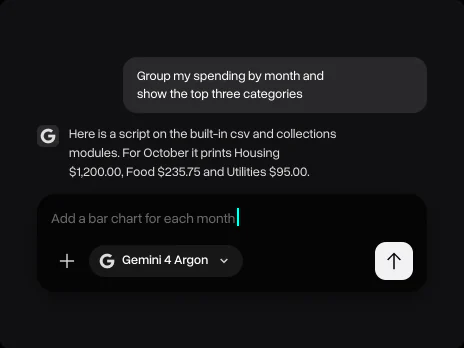
Keep going in the same chat
Ask a follow-up, ask for tests or a shorter version, or switch to another model without losing the conversation
Why use Gemini 4 Argon on Overchat AI
One account for chat, images and video, on every device
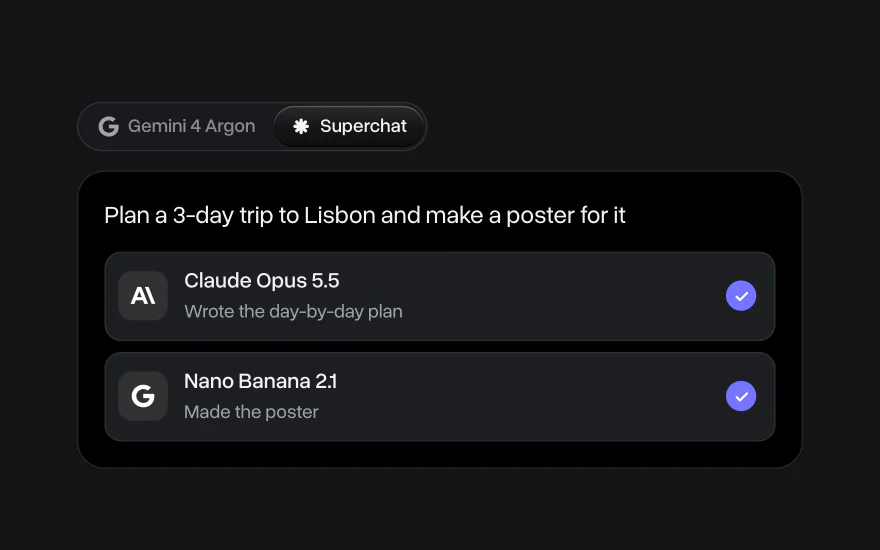
Superchat AI agent
Superchat Agent automatically routes your message to the model best suited for the task. It can generate images and videos, use the AI tools built into Overchat AI, and learn from your interactions to get better over time
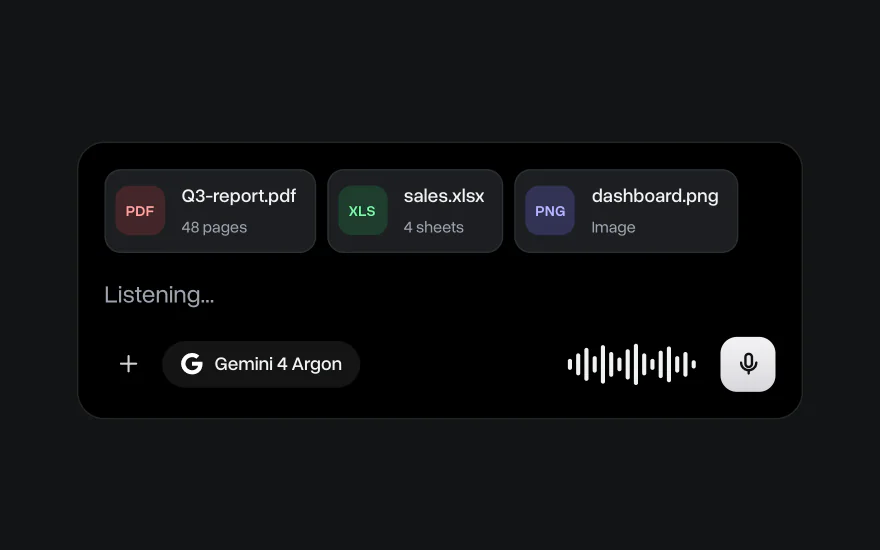
Chat with images and files
Upload PDFs, spreadsheets, code and screenshots and ask Gemini 4 Argon about them. You can also dictate a message instead of typing it
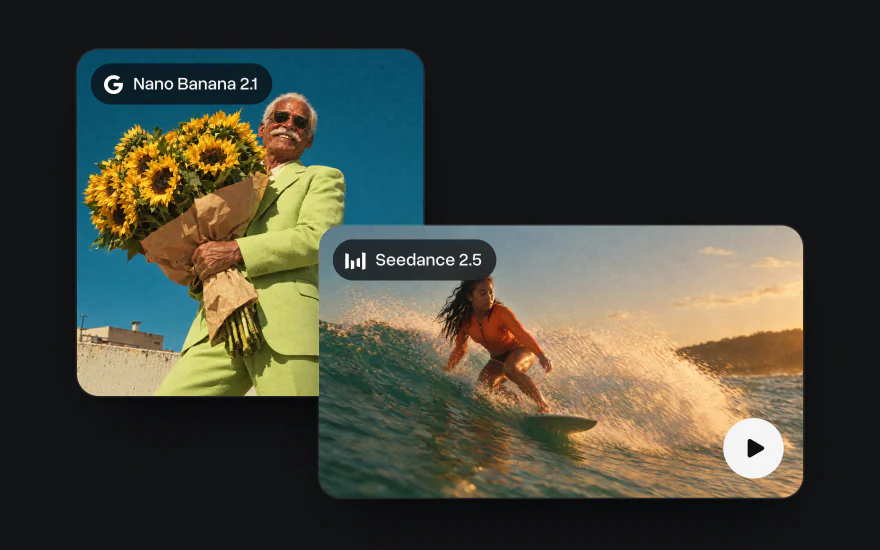
Go beyond text
Generate images with Nano Banana and GPT Image and videos with Seedance and Kling in the same account, with the same credits as chat
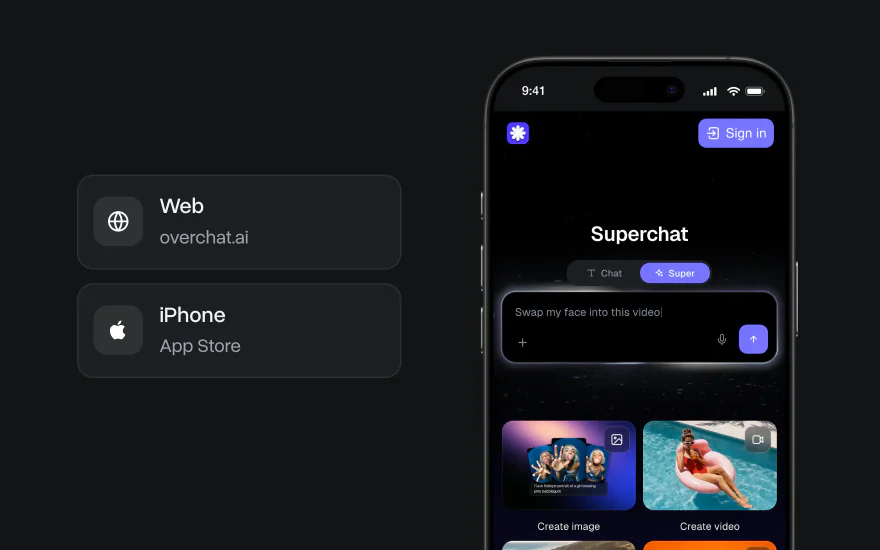
On the web and iPhone
Start a chat on your laptop and finish it on your phone. The Overchat AI app has the same models, and your chats stay in one account on every device

Gemini models on Overchat AI
Compare 4 Gemini models on Overchat AI by output speed, time to first token and the price of one message
Gemini 4 ArgonThis pageGemini 3.8 FlashGemini 3 ProSource: Overchat AI, 2026-11-11
Explore other models
Models marked Soon are coming to Overchat AI; the rest are available now


Learn more about AI models

We tested Gemini 4 Argon against Claude Opus 5.5, GPT-6 Astra and Muse Wonder
We tested Gemini 4 Argon against Claude Opus 5.5, GPT-6 Astra and Muse Wonder on three coding tasks. See benchmarks, speed and how to use it
Muse Wonder vs Muse Spark: Meta's New Model Tested
We tested Muse Wonder against Muse Spark 1.3 on logic, writing and coding tasks. See benchmarks and which Meta model is better
10 Best All-in-One AI Platforms in 2026: Why One AI Subscription Beats Many
Compare the 10 best all-in-one AI platforms in 2026, from Overchat AI to Poe and Magai, with prices, free plans and the newest GPT and Claude models