According to the State of Generative Media report, most companies now use 14 different models at the same time. Given that they need to interact with lots of different models, it's extremely important to get a provider that not only offers many models but is also very reliable — and ideally to get all that with a single connector.
In this guide, then, we're going to cover 10+ AI API services that offer all of the above, and rank them from best to worst for different use cases.
AI/ML API is the best multi-model gateway provider — it features 400+ models through one OpenAI-compatible endpoint at fastest inference speed.
Direct provider APIs (OpenAI, Anthropic, Google) are best for high-volume single-model use cases. If you only use one model then there’s no reason to use a third party provider, but then you lock yourself into that ecosystem.
fal.ai has the biggest share of generative models. It holds 50% market share for image APIs and 44% for video APIs, with 1,000+.
Groq offers the fastest AI API. The platform offers custom LPU hardware which delivers near-instantaneous inference for Llama, Mixtral, and Whisper. This is not something most users will notice, but it's useful in specific cases — live chat, support, etc.
Multi-model platforms offer the most flexibility. With how quickly the update cycle moves in the AI space, it's massively beneficial to have a unified API that lets you instantly switch from GPT infrastructure to Claude infrastructure by changing a single parameter when a specific provider refreshes its model line, so you can keep using the best or cheapest models — this is why for most people we recommend using a multi-model provider.
Quick Comparison
Provider
Models
Pricing model
Best for
AI/ML API
400+
Pay-as-you-go
Multi-model production stacks
OpenRouter
500+
Per token
Multi-provider with auto-failover
OpenAI
GPT-5.5, GPT Image 2
Per token
High-volume GPT workloads
Anthropic
Claude Opus 4.8, Sonnet 4.6, Haiku 4.5
Per token
Agentic workflows, long context
Google Gemini API
Gemini 3.2 Pro, Flash, Nano Banana 2
Per token, generous free tier
Long-context, vision, free prototyping
fal.ai
1,000+ image, video, audio, 3D
Per output (image, second of video)
Generative media production
Replicate
~200 open-source models
Per second of GPU compute
Custom model deployment, fine-tuning
kie.ai
Veo, Runway, Suno, Flux, Midjourney
Credit-based
Multi-modal media
Together AI
200+ open-source LLMs
Per token
Open-source LLM hosting at scale
Groq
Llama, Mixtral, Whisper, Qwen
Per token
Real-time, low-latency apps
Hugging Face
100,000+ open-source models
Per token
Research, prototyping
Pollo AI API
100+ video, image models
Credit-based
Cost-conscious video generation
How We Ranked AI API Services
We evaluated each service against the following criteria:
How many models does the service offer?
How predictable is the per-token or per-output billing?
Can theAPI be dropped in as a swap for OpenAI's SDK without rewriting integration code?
What’s the latency under typical load, documented uptime SLAs, region coverage?
Quality of docs, SDK availability, time-to-first-call.
Where the service is the obvious choice for a specific use case (speed, cost, model selection).
The ranking below favours services that perform well across multiple criteria. We've separately marked specialised platforms like fal.ai and Groq in their respective categories, but lower overall — they're the optimal choice for some use cases, but due to lower versatility, they're not the most optimal pick for most.
1. AI/ML API — Best Multi-Model AI API Service
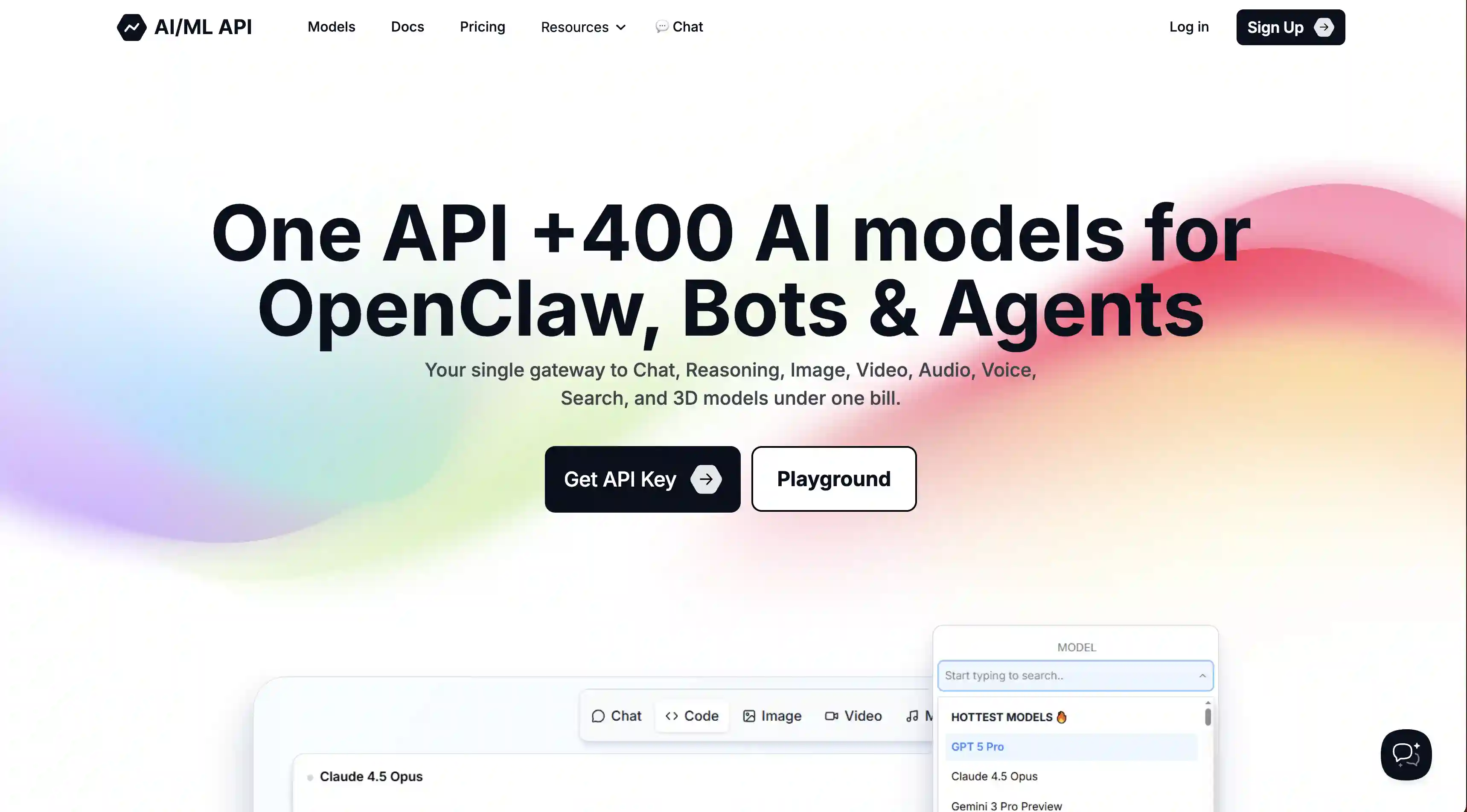
AI/ML API is a unified gateway to over 400 AI models from OpenAI, Anthropic, Google, Meta, DeepSeek, Stability AI, Black Forest Labs, ElevenLabs, and dozens of other providers.
It offers an OpenAI-compatible endpoint, providing access to text, image, video, and audio generation models through a single API.
What it offers:
400+ models across text (LLMs), image, video, audio, music, voice/TTS, 3D, embeddings, and OCR
OpenAI-compatible REST API, Anthropic compatible API
Fastest inference speed among AI API aggregators
Playground to test each model online
Pay-as-you-go starting at $20 minimum top-up
Volume discounts and enterprise plans with dedicated infrastructure
Why it ranks #1: AI/ML API solves the problem most teams face, which is the need to access many models across modalities without managing connectors and endpoints for multiple external platforms, and multiple billing accounts. Thanks to the OpenAI compatibility, users can switch from GPT-5.5 to Claude Opus 4.8 via a simple string replacement in their code — it's completely seamless. The free playground that lets you test models against live prompts is another big plus.
In addition, AI/ML API has incredibly responsive support — in our case they picked up our messages in under 5 minutes in live chat. This is something very few companies offer, and it's incredibly important when you need to debug an error log, or just have questions about model availability or release timelines.
Best for: Teams building products that use multiple models, agencies switching between providers based on client needs, and anyone who wants flexibility without vendor lock-in.
2. OpenRouter — Best for Provider Failover
OpenRouter is the closest direct competitor to AI/ML API in the multi-model gateway category. It aggregates 500+ models across 60+ providers. The best OpenRouter feature is automatic failover — if one provider goes down they route the request to another provider.
What it offers:
500+ LLMs from major providers and open-source projects
Automatic routing and failover between providers hosting the same model
OpenAI-compatible API
Where it makes sense: OpenRouter is focused mostly on text models, and has less coverage of image/video/audio/music. The most important advantage is the automatic failover, which together with the focus on LLM coverage makes it a good fit for when you need a text-based workflow with absolutely critical 100% uptime — perhaps building a custom coding or analytics agent that would perform long-running tasks.
Best for: Engineering teams that need high-availability LLM access.
3. OpenAI API — Best for High-Volume GPT Workloads
The OpenAI API is the highest-volume AI API in production. It offers access to GPT-5.5, GPT Image 2.0, and Sora 2 (which is being phased out), alongside embeddings, fine-tuning, audio, and the newer Responses API for multimodal workflows.
What it offers:
Access to the latest GPT models (currently GPT-5.5)
GPT Image 2.0 for image generation and editing
Whisper for speech-to-text, TTS for text-to-speech
Fine-tuning, batch processing, structured outputs, function calling
Enterprise compliance: SOC 2, GDPR, data residency options
A powerful backoffice
Detailed documentation
Where it makes sense: When you've already selected a specific OpenAI model and you know that you’ll stay in this ecosystem.
Where it doesn't: Single-vendor dependency, because if another provider releases a better model you won’t be able to easily switch.
Best for: Products using GPT fine-tuning or those needing direct OpenAI compliance terms.
4. Anthropic API — Best for Agentic Workflows and Long Context
The Anthropic API gives you access to Claude Opus 4.8, Sonnet 4.6, and Haiku 4.5 — some of the strongest models for agentic work, long-context reasoning, and code generation.
What it offers:
Claude Opus 4.8, which is arguably the best coding model in the world
1M token context window across the lineup
Tool use, vision, code execution, computer use
Prompt caching that significantly reduces cost on repeated prompts
Where it makes sense: Anthropic models are praised as the best AI coders, and benchmarks like GDPval-AA, MCP-Atlas, and SWE-bench support that. The 1M context window is also broader than OpenAI's 400K equivalent.
Where it doesn’t: Same as with OpenAI, you’re locked into a single vendor ecosystem and can’t easily switch providers.
Best for: AI agents, complex multi-step reasoning, code generation, long-document analysis.
5. Google Gemini API — Best Free Tier
The Google Gemini API covers Gemini 3.1 Pro, Gemini 3.1 Flash, and Nano Banana 2 (Gemini 3 Flash Image), with one of the most generous free tiers in the industry.
What it offers:
A free tier that’s incredibly useful for prototyping and small projects
Native multimodal: text, image, audio, video in a single request
Strong performance on knowledge reasoning and frontier benchmarks
Where it makes sense: Long-context tasks (RAG, document analysis, video understanding) where the 2M window matters. Knowledge reasoning benchmarks (HLE, SciCode, GPQA Diamond) where Gemini 3 Pro currently holds the top spot.
Best for: Long-context applications, multimodal pipelines, projects with budget constraints that benefit from the free tier.
6. fal.ai — Best for Generative Media
fal.ai is the provider for generative media. It holds 50% market share for image APIs, and 44% for video APIs.
What it offers:
1,000+ models across image, video, audio, and 3D
fal Inference Engine optimised for sub-second image generation and fast video rendering
Pay-per-output pricing
Serverless infrastructure with no GPU management
Custom model deployment for fine-tuned variants
99.99% uptime SLA at enterprise tier
Where it makes sense: Video generation is fal.ai's strongest category — exclusive access to model variants, quick addition of new models when they come out, and the biggest media model library overall.
Best for: Video-heavy and image-heavy applications
7. Replicate — Best for Custom Model Deployment
Replicate pioneered the "API for AI models" concept and remains the strongest choice for custom model deployment, fine-tuning, and accessing community-contributed models.
What it offers:
~200 production models plus thousands of community variants
LoRA fine-tuning for image models with simple training APIs
Custom model deployment via Cog (Replicate's containerisation layer)
Per-second GPU billing across multiple hardware tiers
Webhook support for long-running jobs
Strong documentation and developer community
Where it makes sense: Replicate’s biggest advantage lies in flexibility — you can deploy your own models, fine-tune existing ones, and access community variants that aren't on managed platforms. Community also tends to agree that they have some of the most useful documentation.
Best for: Teams running custom or fine-tuned models.
8. kie.ai — Best for Multi-Modal Media on a Budget
kie.ai is a newer aggregator focused on chat, image, video, and music APIs.
What it offers:
99.9% uptime, low-latency responses
Credit-based pricing with free trial
Webhook support for async generation
Where it makes sense: Cost-sensitive teams that want access to video and audio models without paying premium prices. Another advantage is that you'll sometimes find very workflow-specific models here that wouldn't appear on Fal or AI/ML API — but they might be exactly what you need to solve a specific use case.
Best for: Projects that primarily need video and music APIs
9. Together AI — Best for Open-Source LLMs at Scale
Together AI specialises in hosting specifically for open-source language models.
What it offers:
200+ open-source LLMs including Llama, Mistral, Qwen, DeepSeek, and community variants
Per-token pricing
Fine-tuning
Open access to full model weights
Where it makes sense: If you need to deploy Llama, Mistral, or Qwen on robust infrastructure and run AI inference at a lower price compared to closed-source models. For example, if you have a very high volume AI chat.
Best for: Open-source-first teams.
10. Groq — Best for Real-Time Speed
Groq uses custom LPU (Language Processing Unit) hardware that delivers inference speeds several times faster than any GPU-based provider. Essentially, models reply much faster.
What it offers:
Select open source models are available on the platform, including Llama 3.3 70B, Mixtral, Whisper, Qwen, Gemma, and others
Sub-100ms time-to-first-token on most models
Per-token pricing
Standard OpenAI-compatible API
Free tier for testing
Where it makes sense: Anything where latency is the bottleneck. Real-time voice agents, interactive chat, live coding assistance, gaming applications.
Best for: Voice agents, real-time chat, latency-sensitive interactive applications.
FAQ
What is the best AI API service in 2026?
For most teams, AI/ML API is the most practical option. It gives you access to 400+ models across text, image, audio, and more, through one API, and being OpenAI compatible it can be integrated by swapping a single string if your infrastructure is already built around OpenAI endpoints.
Which AI API is the cheapest?
For open-source Together AI, Groq, or Hugging Face.
For proprietary frontier models, like AI/ML API, OpenRouter, or direct connectors.
For image/video/audio generation, fal.ai and kie.ai.
What's the difference between an AI API aggregator and a direct provider?
A direct provider, for example, OpenAI, Anthropic, Google, gives you access to that company's models only. An aggregator, such as AI/ML API, bundles many providers behind one API, which then allows you to switch models without code changes.
Which AI API has the most models?
Hugging Face has the biggest library overall, with over 100,000 open-source models.
Among curated, production-ready options:
AI/ML API has 400+ models
OpenRouter has 500+
fal.ai has 1,000+ models (mostly image and video)
Bottom Line
To sum up, we've looked at 10 different AI API providers across multiple categories, from general use to image and video generation, and highlighted the best one for every use case. Here's a quick takeaway.
Key Takeaways
AI/ML API is the best general-purpose AI API service in 2026 — it offers 400+ models, and is OpenAI-compatible.
fal.ai is the best API service for media, like image and video generation.
Groq is the best API provider for speed-sensitive applications like voice support agents.
For most people looking to integrate models via an API, services that aggregate multiple providers offer the most flexibility. Given how quickly providers release new model generations, you'll likely want to switch when a new flagship comes out every couple of months — and you can't do that if you're only using one provider.