TL;DR
- AI tools like Overchat AI's face symmetry test can measure and accurately tell you how symmetrical your face is.
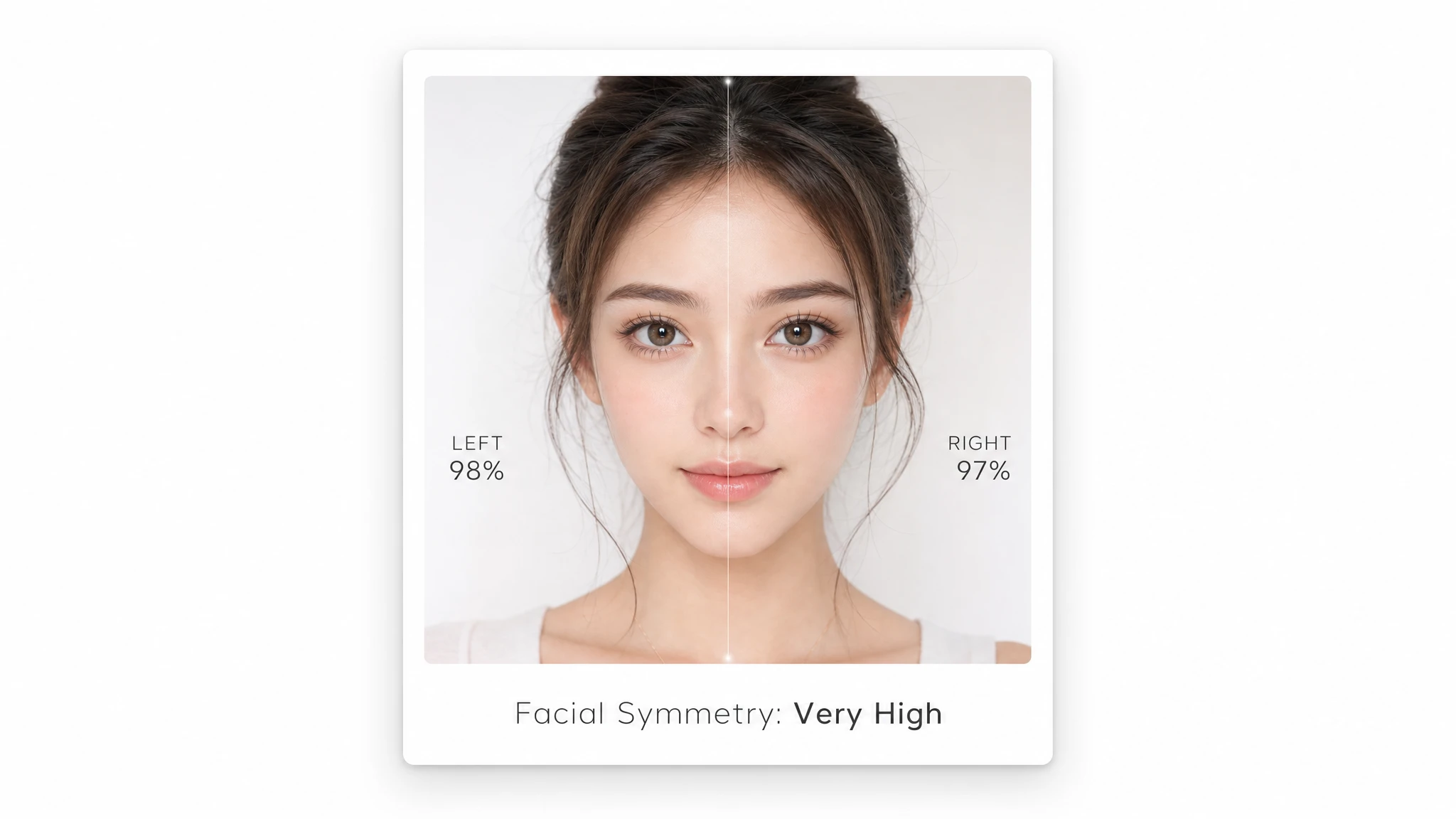
- A face symmetry test compares the positions of corresponding features—such as the eyes, brows, mouth corners, cheeks, and jaw—around a facial midline.
- To maximize the effectiveness of a face symmetry test, take a picture using a level camera from roughly 5 ft (1.5 m) away. Don't use your wide-angle lens, and don't bring the camera closer, because any misalignment of the camera relative to the center of the face can visually distort your proportions.
What Is Facial Symmetry?
Facial symmetry dictates how different — or similar — the left and right parts of a face are around its center. If the face were perfectly symmetrical, the positions and contours on one side would perfectly mirror those on the other. Perfect symmetry almost never happens in nature, so most real faces do not work that way. In people, eyebrows, eye openings, and jaw contours often differ slightly from side to side, and these differences often get progressively bigger with age, result from posture, or develop through daily habits.
In a study of 321 healthy young adults, researchers placed 42 landmarks on standardized frontal photographs and found mild asymmetry in almost everyone who took the test.
Note: Symmetry is different from face shape. Face shape describes the overall outline and proportions of the face, while symmetry compares corresponding points on the left and right. If you're also curious about your face outline, use our guide to find your face shape.
How an AI Face Symmetry Test Works
We've established that faces are rarely perfectly symmetrical. But how asymmetrical are we talking? Facial symmetry is often associated with attractiveness (although it's far from the only, or even the most important, factor in attractiveness), so people started measuring facial symmetry — including with the use of AI tools. We at Overchat AI have developed such a tool to help you measure your facial symmetry. Here's how it works.
In our AI photo-based facial symmetry test, the AI first maps out over 40 facial landmarks. These are reference points at locations such as the eye corners, brow edges, sides of the nose, mouth corners, cheekbones, and jaw. The AI then estimates a vertical midline, pairs landmarks from opposite sides, and compares their height, angle, distance from the center, or relative position. Those measurements become a facial symmetry score.
| Test component | What it compares |
|---|
| Facial midline | Nose and chin center relative to the face |
| Eyes and brows | Paired height, spacing, and angle |
| Nose and mouth | Side-to-side position and mouth-corner alignment |
| Cheeks and jaw | Left-right outline and angle |
How to Use the Overchat AI Face Symmetry Test
The Overchat AI Face Symmetry Test takes one photo and analyzes your facial symmetry based on a map of more than 40 facial landmarks across the eyes, brows, nose, mouth, cheekbones, and jawline. Here's how to use it:
- Open the test and upload your photo.
- Start the analysis and wait for it to process.
- Read the overall symmetry score out of 10.
- Check the feature-by-feature feedback to see which paired regions contributed to the result.
In the breakdown, you'll find more detailed information about what contributed to the total score.
And here's how to interpret your Overchat AI facial symmetry score:
| Overchat AI Face Symmetry Score | How to Read It |
|---|
| Below 7/10 | Poor facial symmetry |
| 7/10 | Average facial symmetry |
| 8–9/10 | High facial symmetry |
| 10/10 | Almost perfect left-right alignment in the submitted image |
If you get a score at the lower end of this scale, don't be discouraged, as perceived facial symmetry is often the result of your hairstyle or grooming, not a bone-level defect. Even if your face really is less symmetrical, it doesn't mean it's unattractive. You can also easily correct the impression through how you wear your hair, beard, or mustache.
How to Make the Face Symmetry Test More Accurate
An AI face symmetry test is more sensitive to the quality of the input image than most other tools because perspective distortion resulting from the camera lens can easily distort facial proportions (objects that are closer to the camera appear larger). To avoid messing with the score, use the following setup:
- Move the camera away from your face. Place it around 5 ft (1.5 m) away when possible, then crop the image. A JAMA Facial Plastic Surgery projection study estimated that a photo taken from 12 in (30 cm) makes the nose appear about 29–30% larger than under an orthographic projection. At 5 ft, the modeled difference was effectively gone.
- Put the lens near eye level. A timer or stand helps you avoid holding the phone close.
- Face the camera directly. Keep your head level, with no turn toward either shoulder and no sideways tilt. Check that both ears are similarly visible if your hairstyle allows it.
- Use even light. Face a window or use soft light from the front. A hard shadow on one cheek can change the detected outline or make one eye appear more recessed.
- Relax your expression. Do not smile or press your lips together — both actions move the mouth and cheeks.
- Clear the landmarks. Move hair, hands, and accessories away from the face. Remove glasses, especially if the frames cover the eyes or brows.
If this is difficult to replicate, find a place away from direct light. For example, stand next to a white wall directly to the side of a window, where the light becomes diffused and the shadows soften, and ask a friend to take a headshot using your phone's portrait mode.
FAQ
Quick answers to the most common questions about face symmetry tests and scores.
Why can the same face get a different score?
A symmetry score can change even when your face has not changed because the test also captures the effects of the camera and the moment. For example, a small turn makes one side appear narrower. A sideways tilt changes the apparent height of the eyes, brows, mouth corners, and jaw, affecting several parts of the result at once. This is especially evident at selfie distances, where the center of the face is closer to the lens than the ears and jaw, changing visible proportions. Camera testing has found measurable midface distortion at short distances, including with smartphones (PubMed). More distance reduces perspective noise.
Is facial symmetry the same as attractiveness?
No — at least, not entirely. Symmetry can affect how faces are perceived, but it does not produce a complete judgment of appearance. In experiments using manipulated or blended faces, participants have sometimes preferred more symmetrical versions (University of Western Australia research record). A newer analysis of natural faces, however, found no significant correlation between symmetry and attractiveness for male or female faces in that dataset (Scientific Reports).
If you want to dive deeper into the topic of attractiveness, read about the PSL scale or rate your face with Overchat AI's Rate My Face tool.
What is a good face symmetry score?
On the Overchat AI face symmetry test, 7/10 or higher is good symmetry, and 8–9/10 is high symmetry.
Is anyone's face 100% symmetrical?
No. Perfect left-right symmetry almost never happens in real human faces. A 10/10 Overchat result means almost perfect alignment in that submitted image, not that every part of the face is geometrically identical.
Why does my selfie look more asymmetrical than the mirror?
The mirror reverses the view you know best, while a saved photo may be unmirrored. A close selfie also introduces perspective distortion. Use a timer and move the camera farther away before comparing the two views.
Is my uploaded photo private?
Yes. At Overchat AI, we process images securely, and your photo is visible only to you and is automatically deleted after processing.
Bottom Line
A face symmetry test can show how paired features align in one photograph. When you are ready, run the Overchat AI Face Symmetry Test and compare the result with one or two carefully matched retakes. Or if you want to take it a step further and level up your looks in general, our looksmaxing AI tools can analyze your attractiveness as a whole and give you a detailed glow-up plan with specific advice and a timeline.