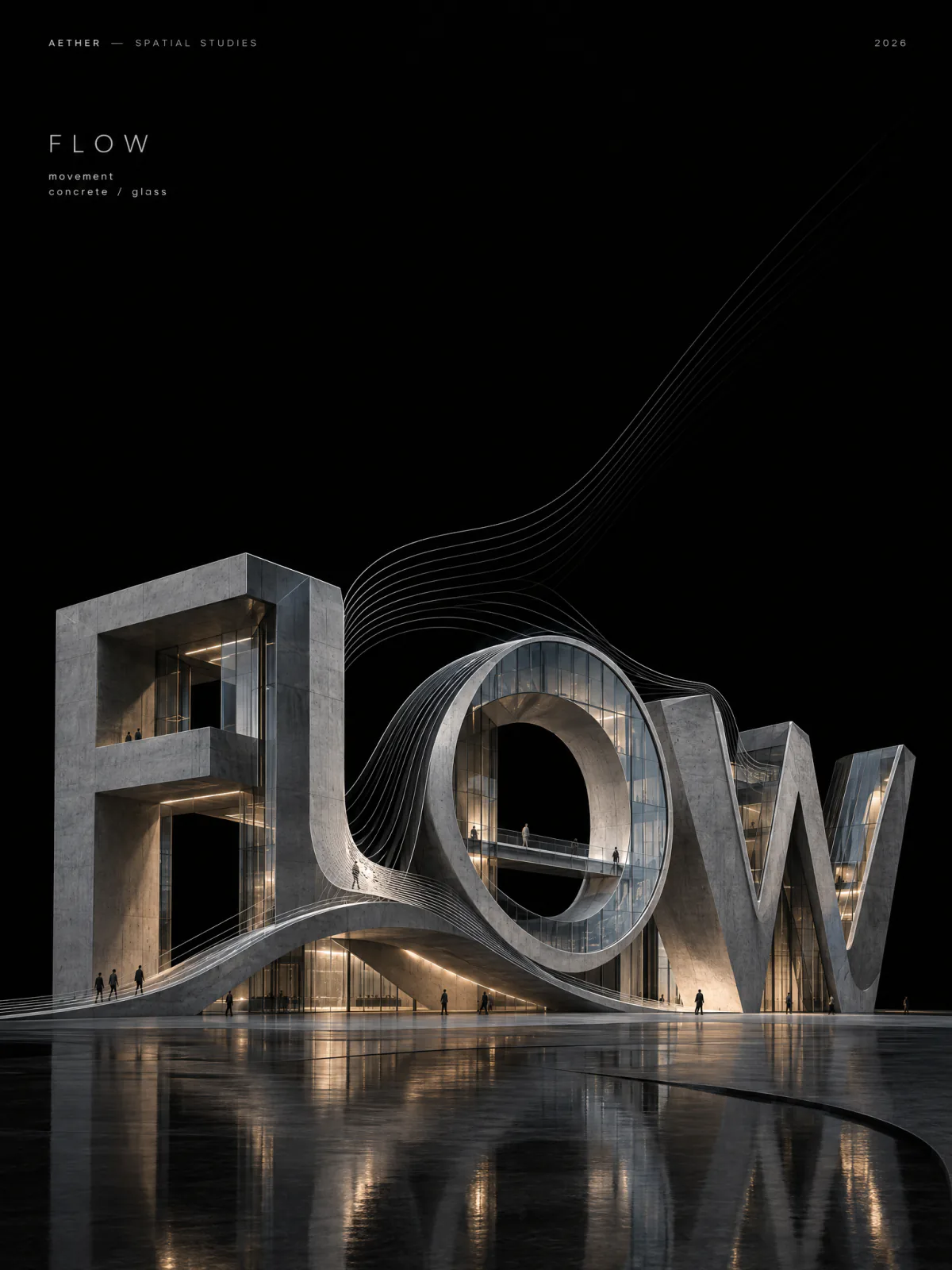
FLOW in concrete and glass

[Word]: FLOW [Concept]: movement [Mode]: Growth [Materials]: concrete / glass [Lines]: flow field [Format]: 3:4 vertical Create a high-end experimental architectural poster where typography becomes architecture itself. Make "FLOW" the main spatial structure, built from real architectural materials rather than placed over a photo or rendered as floating 3D text. Use one construction logic — Growth: letters grow into walls, ramps, corridors, façades, and structural forms. The architecture itself should feel sculptural and visually striking, with strong massing, curves, voids, light, and refined material transitions. Use realistic perspective, material thickness, joints, reflections, and tiny human figures for scale. Add fine parametric lines derived from real letter edges, structural joints, paths, light boundaries, or surface curvature. Let them evolve naturally: structure → abstraction → deformation → dissolution. Keep the lines thin, gray-white, non-glowing, with one concentrated Line Event before they gradually fade into the black space. Use a deep matte-black field with generous negative space. Keep colors restrained: graphite, concrete gray, metal silver, glass tones, plus a subtle warm-light accent. Use minimal micro typography like an architectural research archive. Only show: "AETHER — SPATIAL STUDIES" "FLOW" "movement" "concrete / glass" "2026" Final result: sculptural, spatial, minimal, experimental, and highly designed. Avoid floating 3D text, random decorative lines, cyberpunk effects, UI graphics, extra text, page numbers, logos, and watermarks.