Kling 3.0 Is Amazing: The Best AI Video Generator Yet?
Last Updated:
2026-09-26
Kling 3.0 Is Amazing: The Best AI Video Generator Yet?
Kuaishou officially launched Kling 3.0 on February 4, 2026, and within days it was being called the most significant leap in AI video generation this year.
This isn't just an incremental refresh. Compared to Kling 2.6, the number three version introduces:
Native 4K output
Clips up to 15 seconds long
Reference videos
Sound and lip sync in five languages
And all of this is wrapped into a multimodal architecture Kuaishou calls the AI Director paradigm. So, what exactly is Kling 3.0, and is it worth switching to?
In this article, we'll cover:
What makes Kling 3.0 fundamentally different from Kling 2.6?
How the new AI Director and multi-shot storyboarding work
Whether it's worth choosing over Sora 2 and Veo 3.1
Kling 3.0 is Kuaishou's third-gen AI video model (launched February 4, 2026), built on a unified Multi-modal Visual Language framework that handles image, video, and audio generation in a single architecture instead of chaining separate tools.
Major upgrades over Kling 2.6: duration 10s → 15s, resolution 1080p → native 4K (not upscaled), frame rate 48 → 60 FPS, plus 3 new lip-sync languages.
The headline feature is the AI Director — generate up to 6 shots within a single 15-second clip, each with its own duration, shot size, camera perspective, and narrative, while the model maintains spatial continuity automatically.
Omni Native Audio adds Japanese, Korean, and Spanish support plus environmental soundscapes that match the visual scene.
Visual quality jumps come from native 4K rendering, Visual Chain-of-Thought reasoning through scenes, better physics (water, fabric, anatomy), and text rendering on par with top image generators.
vs Sora 2: beats it on resolution and frame rate. vs Veo 3.1: beats it on duration, storyboarding, and lip-sync language coverage.
Tradeoff: generation is slow — 5-second clips take ~2 minutes, full 15-second multi-shot storyboards take 5+ minutes.
Available via Overchat AI, klingai.com, iOS/Android apps, and developer APIs.
Introduction
If you’re wondering what Kling 3.0 is — it’s the third-generation AI video model from developer Kuaishou, a Chinese AI company. It can generate videos from text, images, and other videos (references).
It’s built using a new multimodal training framework that the company calls Multi-modal Visual Language (MVL). The biggest innovation is this: most AI video generators chain separate tools for image generation, video animation, and audio synthesis. Kling 3.0, on the other hand, processes everything through a single architecture. This unlocks better efficiency and world-knowledge. Ultimately, it creates better footage.
Kling has grown into one of the most widely used AI video platforms globally: over 60 million creators have used the platform, generating more than 600 million videos since launch.
Kling 3.0 Features
Here's a summary of the key Kling 3.0 specifications:
Feature
Specification
Generation modes
Text-to-video, Image-to-video, Reference-to-video
Max resolution
Native 4K
Frame rate
Up to 60 FPS
Max duration
15 seconds
Native audio
Yes
Lip-sync languages
Chinese, English, Japanese, Korean, Spanish
Multi-shot control
Up to 6 distinct shots per generation
How does Kling 3 compare to Kling 2.6?
Duration is up from 10 to 15 seconds
Resolution is up from 1080p to native 4K
Frame rate is up from 48 to 60 FPS
Lip-sync adds 3 new languages
But the numbers only tell part of the story. Here’s what you need to know about new Kling 3.0 features in detail:
AI Director Paradigm
Previous AI video tools — including Kling 2.6 — treated each clip as an isolated generation.
What this means in practice is that you'd create one clip, then another, then try to stitch them together in post-production to create continuity from frame to frame. Things like last-frame-to-video workflows helped create longer AI videos, but still involved a lot of manual work — if you wanted to add many camera cuts, at least.
Kling 3.0 replaces this approach with what Kuaishou calls the AI Director. Essentially, with Kling 3.0, you can generate up to 6 shots within a single 15-second clip. For each shot, you can specify:
Duration
Shot size (close-up, medium, wide)
Camera perspective and movement
Narrative content
The model maintains spatial continuity out of the box — meaning that all action will continue in the same location and characters will stay consistent, and even relationships of elements to each other within the frame won’t change.
This is absolutely huge for AI video filmmaking — where you’d previously had to generate 5–6 separate clips, now a single prompt cycle gives you an edited sequence with cuts.
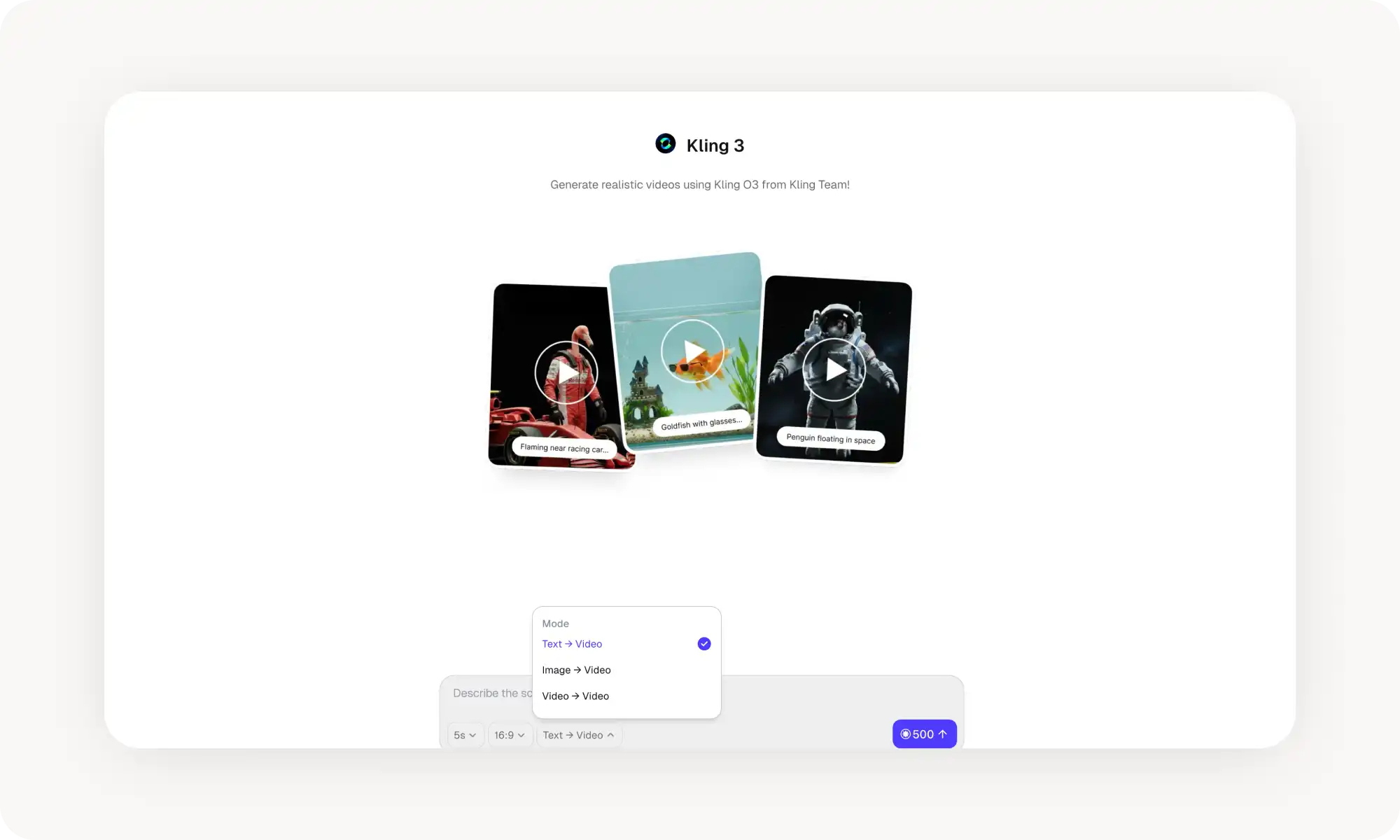
Are you wondering what’s the best way to try Kling 3.0 to see the director mode in action? Get started with King — as well as Sora 2 and latest Google Veo models — by creating an account in Overchat AI, an all-in-one AI platform for video and image creation.
Native Audio
Kling 2.6 was the first Kling model to generate synchronized audio and video in a single pass. Kling 3.0 builds on this with what Kuaishou calls "Omni Native Audio." They've added new languages: Japanese, Korean, and Spanish. Environmental soundscapes are also new: the audio engine generates ambient sounds that match the visual environment.
Huge Visual Quality Jump
Kling 3.0 improves on the visual quality in several way — together they compound into a true generational leap:
Native 4K. Yes — this is not upscaled. It’s native 4K, which means perfect detail at the pixel level.
Visual Chain-of-Thought (vCoT). Similar to how large language models reason through logic steps before generating text, Kling 3.0 reasons through scenes. This greatly improves realism.
Better physics. The model handles flowing water, fabric movement, and human anatomy much better than Kling 2.6.
Text rendering. Kling 3.0 can render text as well as the best AI image generation models.
Kling 2.6 vs Other models
Let’s see how Kling 2.6 compares with other AI video models.
Feature
Kling 3.0
OpenAI Sora 2
Google Veo 3.1
Max Resolution
Native 4K
1080p
Upscaled 4K
Max Duration
15 seconds
20–25 seconds
8 seconds
Max Frame Rate
60 FPS
30 FPS
24 FPS
Native Audio
Yes
Yes
Yes
Lip-sync Languages
5
English
English
Motion Control
Yes
No
No
Where to Access Kling 3.0?
Overchat AI provides an easy way to get started with Kling 3.0 — in Overchat, you can switch between generators in one interface — and compare their output directly.
You can also access Kling 3.0 through:
Kling's web app at klingai[.]com
Dedicated iOS and Android apps from Kuaishou
API providers for developers building custom applications
Frequently Asked Questions (FAQ)
What is Kling 3.0?
Kling 3.0 is the latest AI video generation model from Kuaishou, launched February 4, 2026. It's built on a unified multimodal framework that generates synchronized video and audio in a single pass. The platform supports text-to-video, image-to-video, multi-shot storyboarding, and reference-based generation at up to native 4K resolution, 60 FPS, and 15 seconds duration.
How long does it take to generate a Kling 3.0 video?
This depends on the resolution and duration that you choose, but as a reference point, a 5-second clip usually renders in about two minutes, while a full 15-second multi-shot storyboard at high resolution can take over 5 minutes. Yes, this is pretty slow as far as the best AI video generator tools go, but the quality is worth the wait.
Conclusion
Kling 3.0 is the world’s first AI-powered directing system. Here are the most important takeaways:
Kling 3.0 launched February 4, 2026 — it’s the best model in the Kling family at the time of writing
It supports native 4K at 60 FPS and outputs up to 15-second clips
You can get up to 6 cuts per a single prompts
WHen adding a cut, Kling remembers the state of the world and how objects relate to one another
Motion control from Kling 2.6 carries over with improvements
Kling 3.0 beats Sora 2 on resolution and frame rate
Kiing 3.0 beats Veo 3.1 on duration, storyboarding, and lip-sync languages
If you’re looking for the best AI video generator in 2026, I haven’t tested anything better than Kling 3.0 so far. There have been plenty of new model releases over the past few months, but most of them made me think, “Okay, that’s cool.” Kling 3.0 is an instant wow moment. It lets you create things that weren’t possible before, at least, not without custom workflows or editing. And I can’t wait to see what people create with it.