How Accurate Is Rate My Face? The Science of Facial Attractiveness
How AI rates your face: 478 landmarks, 13 feature scores, and what research on symmetry, averageness and proportions says about attractiveness.


Contents
Can AI really tell how attractive a face is? Face-rating tools promise to analyze facial symmetry, proportions, jawline, eyes, and other features to give you a score. But how accurate are these ratings, really?
Researchers have spent decades studying what people find attractive in faces. Some characteristics, including facial symmetry, averageness, and certain facial proportions, are consistently associated with attractiveness ratings. This means facial attractiveness isn't purely subjective: measurable facial characteristics can help explain and predict how people perceive attractiveness.
With modern AI, these insights can be applied to facial analysis, turning established principles of facial perception into practical tools that assess facial features and proportions. So, how reliable are AI face ratings, what does the science behind them tell us, and what makes a good facial attractiveness test? Let's take a closer look.
Can Facial Attractiveness Be Measured Scientifically?
Beauty is often called subjective, yet it's one of the most studied topics in face perception research. Across decades of studies, four characteristics have repeatedly been associated with good looks:
- Facial symmetry
- Facial averageness
- Facial proportions
- Sexual dimorphism
A review by Gillian Rhodes, published in Annual Review of Psychology, examined the evidence for symmetry, averageness, and sexual dimorphism. All three characteristics were associated with facial attractiveness across multiple studies, including research involving different cultures. So attractiveness isn't just a matter of taste. Measurable characteristics consistently influence how faces are perceived, which makes it possible to study them and build models that estimate facial attractiveness.
What Makes a Face Attractive? The Science Behind Beauty Standards
Researchers have found that certain features tend to contribute more to how beautiful we perceive a face to be. These are the same features AI face-rating tools measure.
1. Facial symmetry
People tend to prefer faces in which the left and right sides of the face are symmetrical. We can compare the position of the eyes, cheekbones, nostrils, and other facial landmarks on both sides to see how symmetrical a face is. Greater symmetry has often been associated with higher attractiveness ratings. A 2021 study, for example, found that symmetrical faces look more attractive partly because they look more normal.

2. Facial averageness
In facial perception research, scientists often create average faces by combining images of multiple people. They then compare these composite faces with individual faces to see how facial features closer to the average affect attractiveness ratings.
Several experiments have found that faces closer to these averages tend to be rated as more attractive. In a study involving Chinese and Japanese participants, researchers manipulated facial averageness. Faces made more average generally received higher attractiveness ratings, while those made less average received lower ratings. So facial averageness consistently influences how people perceive attractiveness, across cultures too.
3. Facial proportions
Facial proportions describe how different parts of the face relate to one another. Researchers look at:
- The ratio between facial height and width
- The width of the jaw relative to the cheekbones
- The distance between the eyes
- The relative length of the upper, middle, and lower facial thirds
- The proportions of the nose and lips
Some proportions have been linked to attractiveness in scientific studies. In a 2010 study, female faces looked most attractive when the distance between the eyes and the mouth was about 36% of face length and the distance between the eyes was about 46% of face width. Those turned out to be the proportions of an average face.

4. Feminine and masculine facial characteristics
Faces that lean more feminine in women are often perceived as more attractive, while in men, more masculine faces are often rated as more attractive. What makes a face more feminine or masculine is the shape of the jaw, brow structure, facial width, cheekbones, and more.
How Does AI Rate Your Face?
This is where things get interesting: the facial characteristics we've discussed aren't just theoretical concepts. Modern AI can actually analyze them.
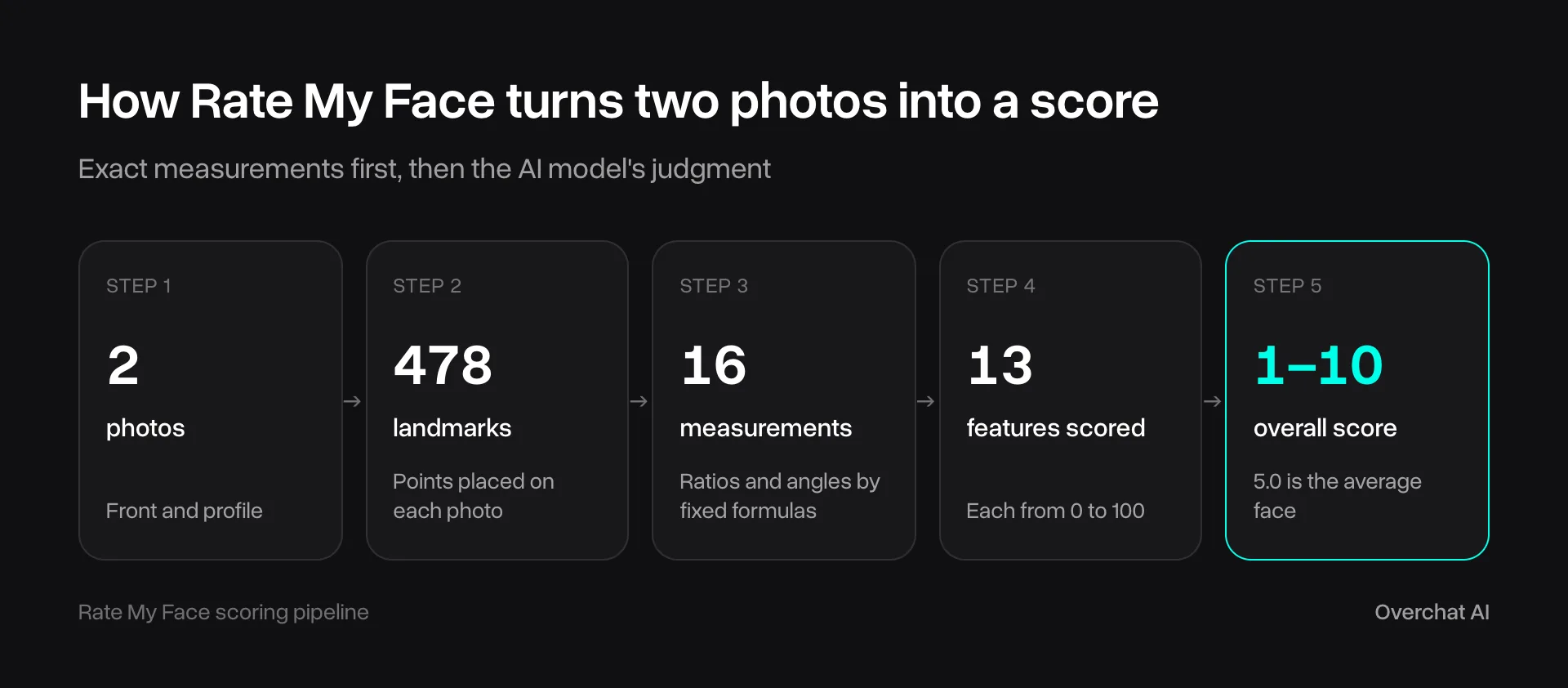
Here's what happens when you upload your photos to Rate My Face on Overchat AI:
- You upload two photos: one from the front and one in profile. The profile shows what a front photo can't, like the angle of the nose and how far the chin projects.
- The AI maps your face. A landmark detection model places 478 points on each photo: the corners of the eyes, the tip of the nose, the edges of the lips, the jawline, and so on.
- The tool measures your proportions. From those points, it calculates symmetry, facial thirds, eye spacing, the jaw-to-cheekbone ratio, nose angles, and more, using fixed formulas. The same points always give the same numbers.
- An AI model scores each feature. It receives both photos and all the measurements and rates 13 features, including the eyes, jawline, lips, and skin, from 0 to 100.
- You get an overall score. The model judges the face as a whole and places it on a scale from 1 to 10, where 5.0 is the average face.
That's the difference from simply asking a chatbot to rate a selfie. A general AI model estimates distances and angles by eye, so its answer can change from one try to the next. Rate My Face gives the model exact measurements first, so every feature score can be traced back to the numbers behind it.
You can try Overchat AI Rate My Face to get your own facial analysis, or explore the AI Attractiveness Test for another way to evaluate your appearance.

How Accurate Is an AI Face Rating?
AI face ratings measure facial characteristics precisely and give consistent results. To understand what a score tells you, it helps to answer three questions.
1. Can AI measure facial proportions accurately?
Yes. Facial landmark detection lets AI find key points on a face, such as the corners of the eyes and the edges of the jaw, and calculate geometric measurements from them.

Using the same landmarks and formulas, measurements can be calculated consistently. For example, the ratio between jaw width and cheekbone width can be measured using the coordinates of those facial landmarks. The same approach works for any single measurement:
2. Can AI predict how people will rate your face?
Yes, for people in general. Research suggests that people share some preferences when judging facial attractiveness. This makes it possible to develop models that predict average attractiveness ratings based on facial characteristics. AI models trained or designed to recognize these patterns can estimate how people might generally perceive a face. Personal taste is a separate story.
A study of individual aesthetic preferences found substantial differences between people in how they judged faces. Although participants showed broad agreement about which faces were generally more or less attractive, their individual preferences were shaped largely by environmental factors and personal experiences. In other words, AI predicts how people in general see your face. Whether one particular person likes it comes down to their own taste.
3. Is a face score objectively correct?
A face score isn't a physical quantity like height or temperature. It's a structured assessment built on measurable facial characteristics and patterns in human perception. The overall score also depends on how the model weights those characteristics. Rate My Face, for example, weights features differently for women and men:
| Faces | What matters most after overall harmony |
|---|---|
| Female | Midface, eyes, skin, nose, lips, face shape |
| Male | Jaw, cheekbones, chin, masculinity |
A 7.5 out of 10 doesn't mean that a face is objectively 75% beautiful. It doesn't mean 75% of people would find someone attractive, either. On the Rate My Face scale, 5.0 is the average face, and half of people score below it. A 7.5 means your face sits well above the typical one.

A good face-rating tool gives you more than a number. It shows your facial proportions, how each feature contributes to the overall score, and which features stand out.
What Does the Science Say About Beauty Standards?
Scientific research shows that some facial characteristics are consistently associated with attractiveness. At the same time, it helps explain why beauty standards aren't as simple as a set of ideal proportions.
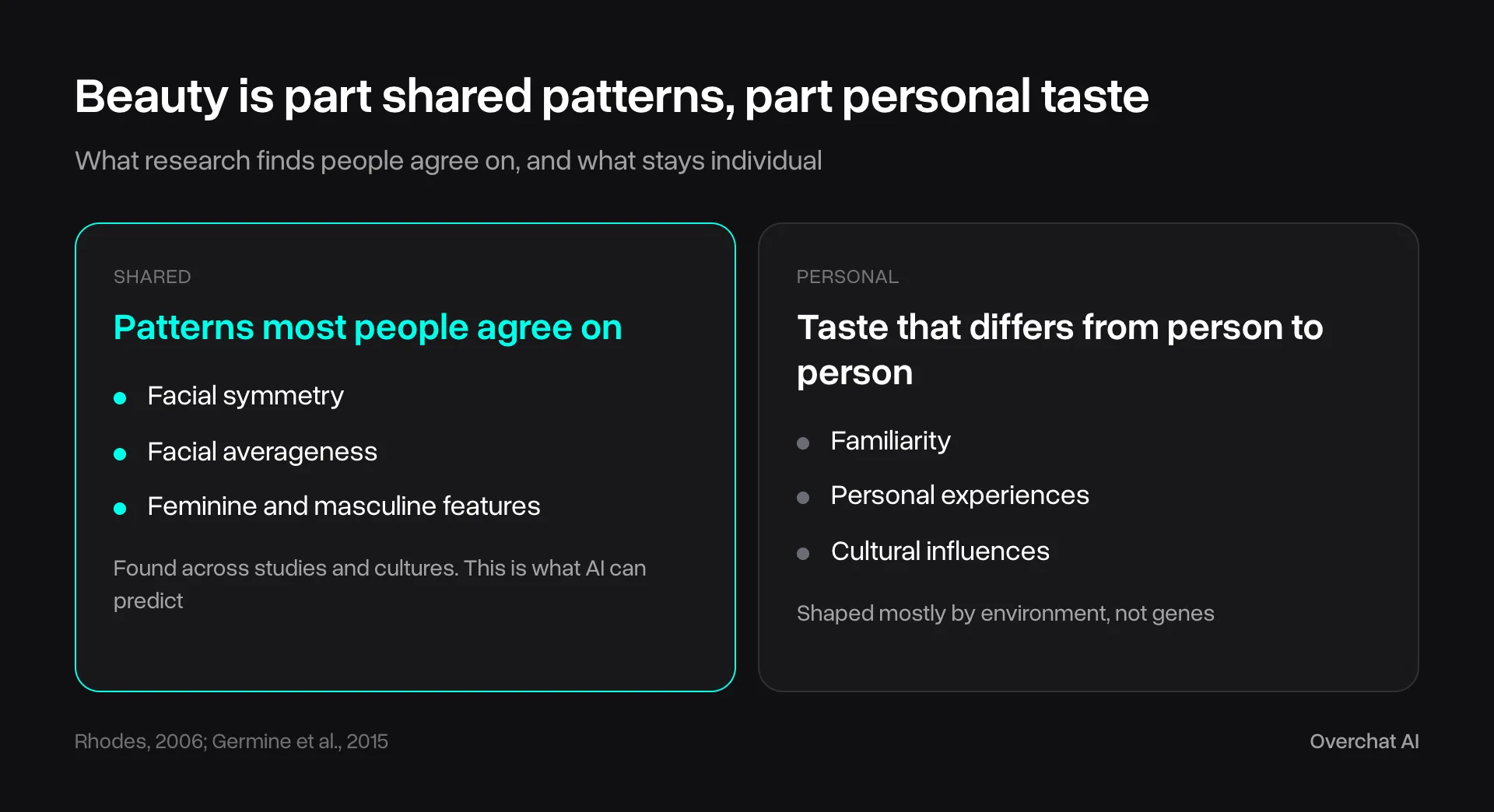
Beauty preferences are partly shared
Studies across different cultures have found common patterns in attractiveness judgments, including preferences related to facial averageness and certain facial characteristics. So some aspects of facial attractiveness are shared by people from very different backgrounds.
Individual preferences still matter
Shared preferences don't eliminate personal taste. People can agree on broad patterns and still disagree about individual faces. Factors that contribute to how people perceive attractiveness include:
- Familiarity
- Personal experiences
- Cultural influences
Beauty standards aren't universal formulas
The ideal proportions often discussed online, like the golden ratio, are usually oversimplifications of research. Facial symmetry, proportions, and averages are useful variables to study, but no single ratio can define an attractive face in every context. Science identifies trends, and AI applies them to facial analysis without forcing every face into one universal template.
What Our Data Says About Facial Proportions
Academic studies aren't the only way to explore facial characteristics. Large-scale facial analysis can also provide insight into how commonly discussed facial proportions occur in real-world images.
In our analysis of 158,716 face scans, we checked how often faces fell within several commonly cited ideal facial proportion ranges.
These idealized proportions turned out to be rare. Only 2.5% of faces fell within the rule-of-fifths range. The ideal facial width-to-height ratio matched 3.4% of women and 1.4% of men, and the textbook nose–forehead angle matched 0.7% of women and 1.5% of men.

This highlights the difference between mathematical ideals and the facial proportions people actually have. Popular beauty standards based on idealized ratios describe relatively uncommon facial proportions, rather than a template that most people naturally follow.
It also shows why facial analysis should consider multiple characteristics. A face can differ from a specific ideal ratio while still having features that contribute positively to an overall attractiveness assessment.
Frequently Asked Questions
Short answers to the questions people ask most about AI face ratings.
Rate My Face measures your facial geometry from 478 landmarks and scores 13 features against patterns found in facial attractiveness research. The same photos always give the same measurements. For the best result, upload a sharp, well-lit front photo and a clear profile.
Both measurable patterns and subjective preferences play a role. Research has identified facial characteristics associated with attractiveness across different studies and populations, but individual preferences also vary considerably.
Facial symmetry is often associated with attractiveness, but it isn't the only factor. Research suggests that symmetry interacts with other characteristics, including overall facial structure and perceived normality.
No. The golden ratio is often used in discussions of facial proportions, but there isn't sufficient evidence to establish it as a universal formula for attractiveness. Facial beauty involves multiple characteristics and individual preferences.
Differences in lighting, camera distance, perspective, head position, facial expression, and image quality can affect facial measurements and AI visual assessments. Different photos may therefore produce different ratings.
Yes, in the way most people mean it. AI estimates how people in general are likely to rate your face, based on your facial proportions and features.
Yes. AI face-rating tools are a quick way to explore your facial characteristics, understand your proportions, and see which features stand out.
Final Thoughts
AI face-rating tools combine facial measurements and visual assessment to estimate attractiveness. Their methods draw on research into facial proportions, symmetry, averageness, and the way people perceive faces.
Beauty has no single universal formula, but it isn't random either. Scientific research and AI facial analysis show the patterns behind it.
An AI score turns those patterns into something you can use: a clear view of your facial features, your proportions, and how a model reads your appearance.