
In this article we're taking a look at the five best AI outfit rater tools, along with their pros, cons, and pricing.
In this article we're taking a look at the five best AI outfit rater tools, along with their pros, cons, and pricing.
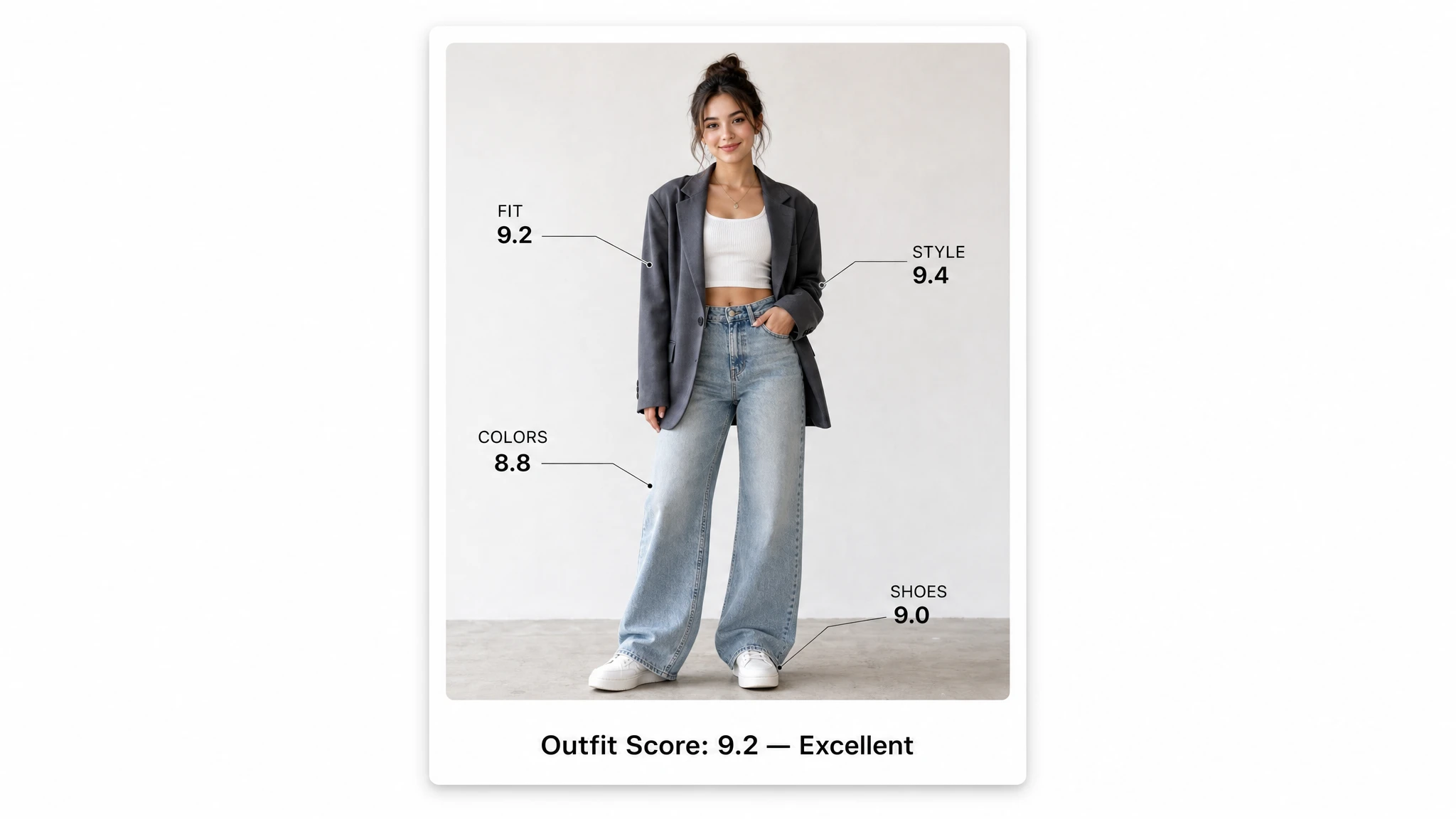
To summarize:
Full disclosure: we built the Overchat AI Outfit Rater. For this comparison, though, we’ve made a deliberate effort to stay unbiased. We’ll explain how the technology works and look fairly at the pros and cons of each option — including our own.
As the creators of one of these tools, we also have some firsthand insight into how AI outfit raters work behind the scenes, so we’ll cover that in more detail throughout the article.
An AI outfit rater is a web tool or mobile app that analyzes a photo of an outfit and returns a score, usually from 1–10 or 1–100, taking into account the fit, colors, shoes, accessories, and the overall impression the outfit gives off.
Curiously, outfit raters aren't that new. Researchers were already training AI models to judge clothing in the mid-2010s. There's a 2016 study where the authors trained a multimodal system on 195,000 outfits collected from Polyvore and created a neural “outfit grader.” But those older systems worked mainly with catalog images of separate garments — nothing like the AI-powered tools we have today.
Over time, AI outfit raters became associated with looksmaxing, where the community of clothing, grooming, and personal growth enthusiasts has found a home. There, these tools occupy a niche alongside face raters, facial-symmetry tests, and broader appearance analyzers.
An AI outfit rater analyzes a photograph of an outfit using a computer-vision or multimodal AI model and generates an assessment based on visible features of the clothing.
There is no universal method for rating outfits, but in most cases the system first processes the uploaded image and infers information about visible elements of the outfit like:
If the tool features a prompt box where you can enter instructions, you can give the AI some pointers about what the outfit is intended for. Dressing well is highly contextual, and the same combination of clothes might be assessed differently depending on whether it is intended for a job interview, a wedding, or a stroll to the local bodega on the corner late at night.
In many AI outfit-rating tools, the score is generated by the AI model rather than calculated from an objective mathematical measurement of style.
A service can instruct a multimodal model to examine an image according to predefined criteria and return ratings in a particular format. For example, it might request an overall score out of 10 together with separate scores for color coordination, fit, footwear, and accessories.
The application may then display those outputs directly or convert them into a visual report.
This means that a score such as 8/10 does not represent an 80% probability that an outfit is “good.” It is better understood as the model's assessment under the criteria and instructions chosen by the developer.
Overchat AI Outfit Rater uses an image-generation model to produce the final assessment.
The uploaded photograph is sent to GPT Image 2 with specially crafted instructions that teach the model how to generate a score covering Style, Fit, Colors, Shoes, and Accessories. When creating the Overchat AI outfit rater, we used the expertise we accumulated while building AI looksmaxing and AI face-rating tools to make the result honest and avoid excessive flattery, which AI tools often default to.
As with other generative AI outfit assessments, these ratings should therefore be treated as subjective AI-generated style feedback rather than objective measurements or professional fashion advice.
In our opinion, an AI outfit rater is most useful when it provides actionable feedback. It's good to know where your outfit sits on a 1–10 scale, but what are you going to do with that number, especially if it comes back low without concrete instructions on how to fix it? With that in mind, we think that the following features contribute to making a useful AI outfit rater:
In practice, the value of an AI outfit rater depends less on the score itself than on whether the explanation helps the user understand what could be changed and why.
Now that we've covered what outfit raters are and how they work, let's cover each of the top 5 AI outfit raters we've selected in more detail:
| AI outfit rater | Platform | Score format | Free use | Monthly plan | Annual plan |
|---|---|---|---|---|---|
| Overchat AI | Web | 0–10 | Free rating | $14.99 | $49.99 |
| Slay or Nay | iOS | 0–10 | 1 check/day | — | $69.99/year |
| GRWM – StyleUp AI | iOS, Android | 1–100 | Free download | $4.99/month | $44.99/year |
| Proper Fit | Web | Written analysis | 3 checks | $14.99/month | $149.99/year |
| VibePalette | iOS | 0–10 | 3-day trial | $8/month | $48/year |
Overchat AI Outfit Rater is a web-based tool that converts an outfit photo into a visual rating scorecard. The finished card includes an overall score out of 10 and a short stylist verdict.
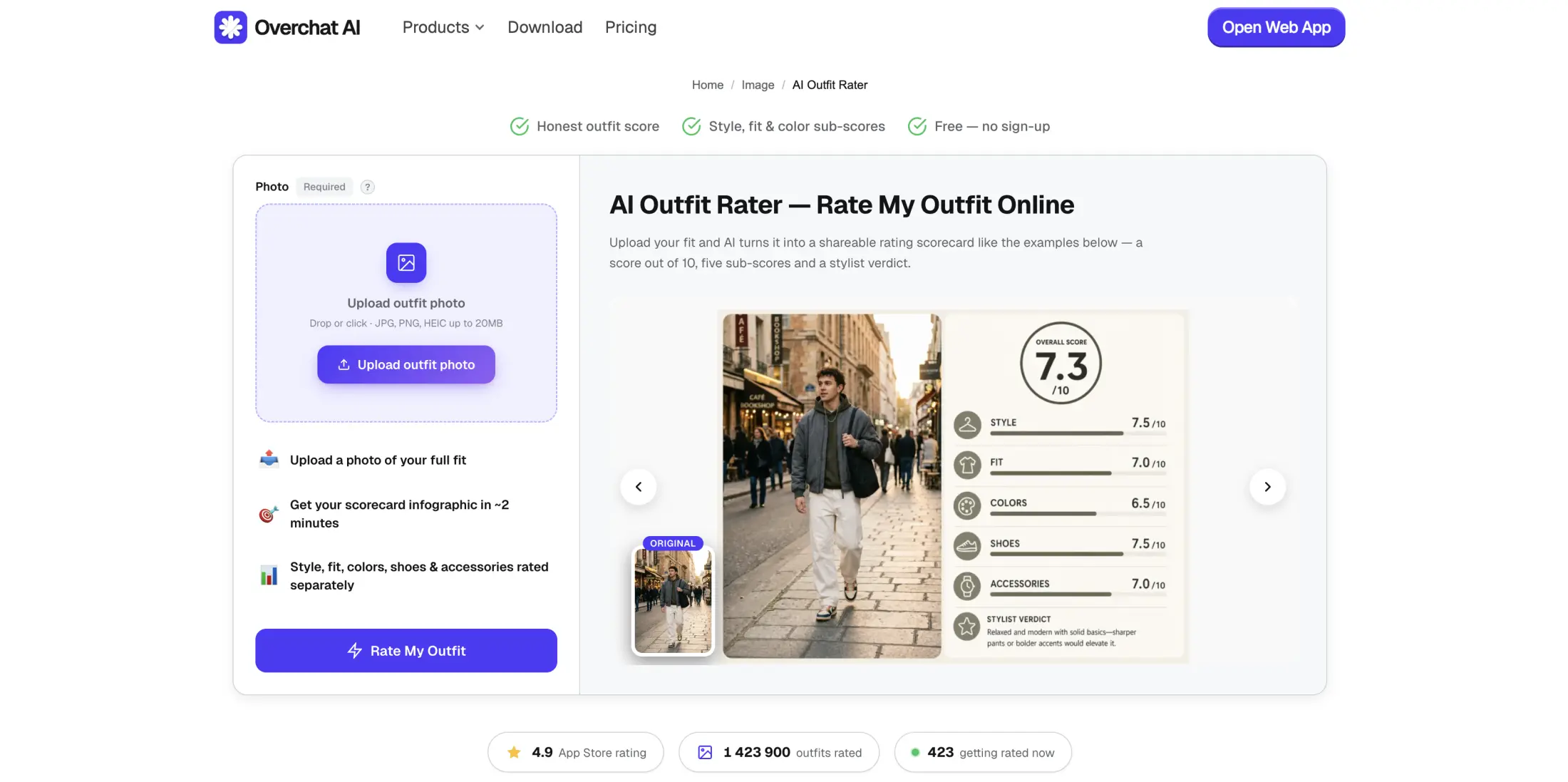
The scorecard rates five parts of the outfit separately:
The five-part layout makes the result easy to read and useful for comparing two versions of the same look. The scorecard is also designed to be downloaded or shared, and the page estimates about two minutes for a result.
Overchat AI is an all-in-one AI app rather than a standalone fashion product. The company reports more than 350,000 active users and has 150+ specialized creative and text tools, so you can keep working with a photo in the same platform after rating the outfit.
Price: Free for a limited time, then $14.99/month or $49.99/year
Pros:
✅ Gives an overall score and five sub-scores
✅ Creates a polished, downloadable scorecard
✅ Works in a browser with no app to install
Slay or Nay is an iPhone outfit-rating app that gives a score from 0 to 10.
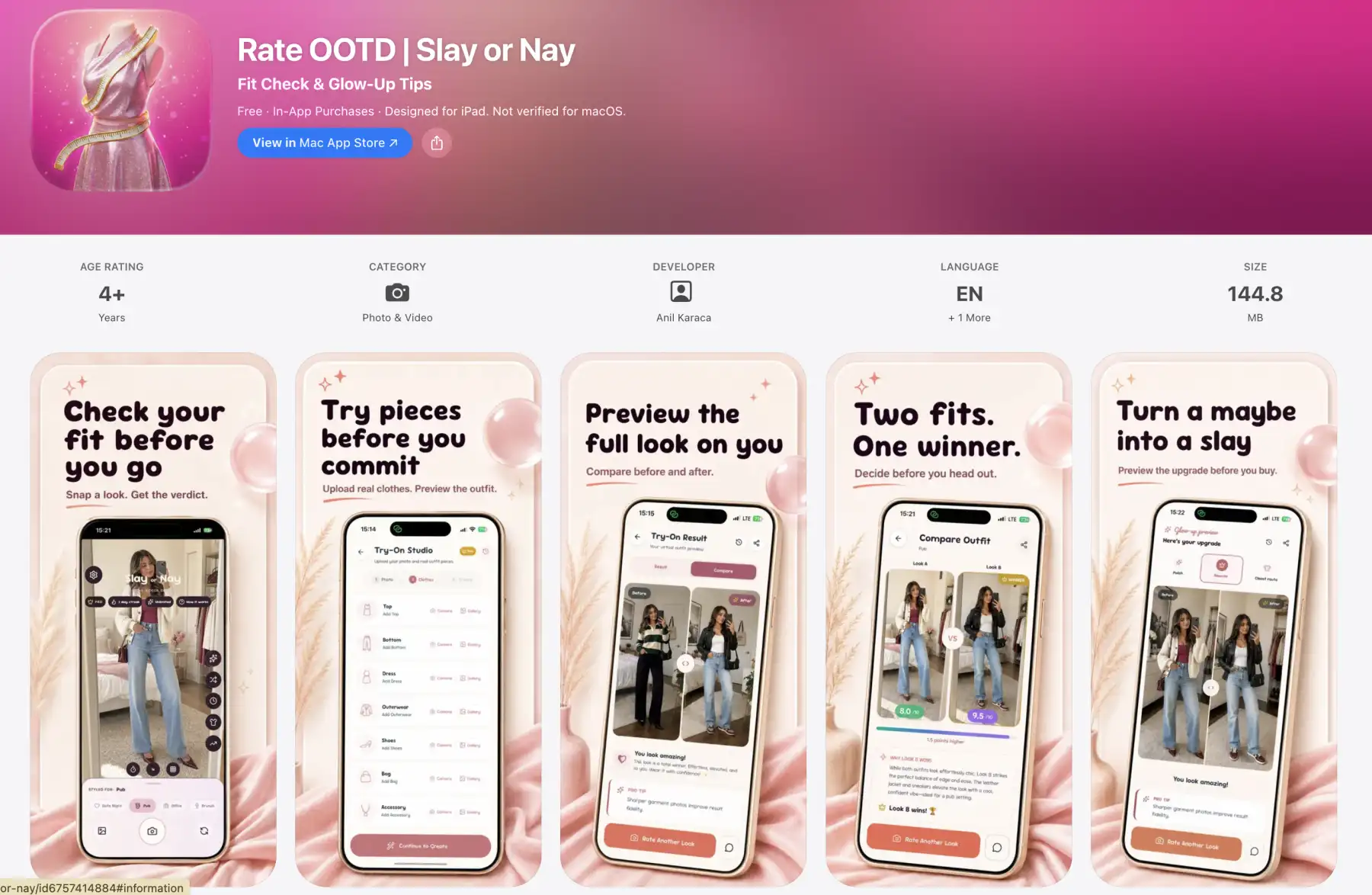
Before the check, you can choose an occasion and one of three feedback tones:
Slay or Nay uses the occasion and tone to give its model more context than a photo alone.
Slay or Nay is unusually broad for a new outfit rater. It can compare two looks and create a share card, while an optional Style DNA profile adds seasonal color analysis. Slay or Nay says its current AI processing uses Google Gemini; original photos are processed transiently, and derived analysis may be cached for up to 30 days.
Slay or Nay's free tier includes one outfit check and one comparison per day. Credits pay for full reports and other extras, while the subscription removes most limits.
Price: $4.99/week or $69.99/year
Pros:
✅ Adds occasion context before scoring
✅ Compares two outfits side by side
✅ Keeps the basic score visible on the free tier
Cons:
❌ Available on iOS only, with Android still listed as coming soon
❌ Credits and subscription limits make the pricing harder to follow
GRWM – StyleUp AI is an iPhone and Android app that rates an outfit from 1 to 100. The app was previously listed as StyleUp AI, which is still the name used on its website and Google Play listing.
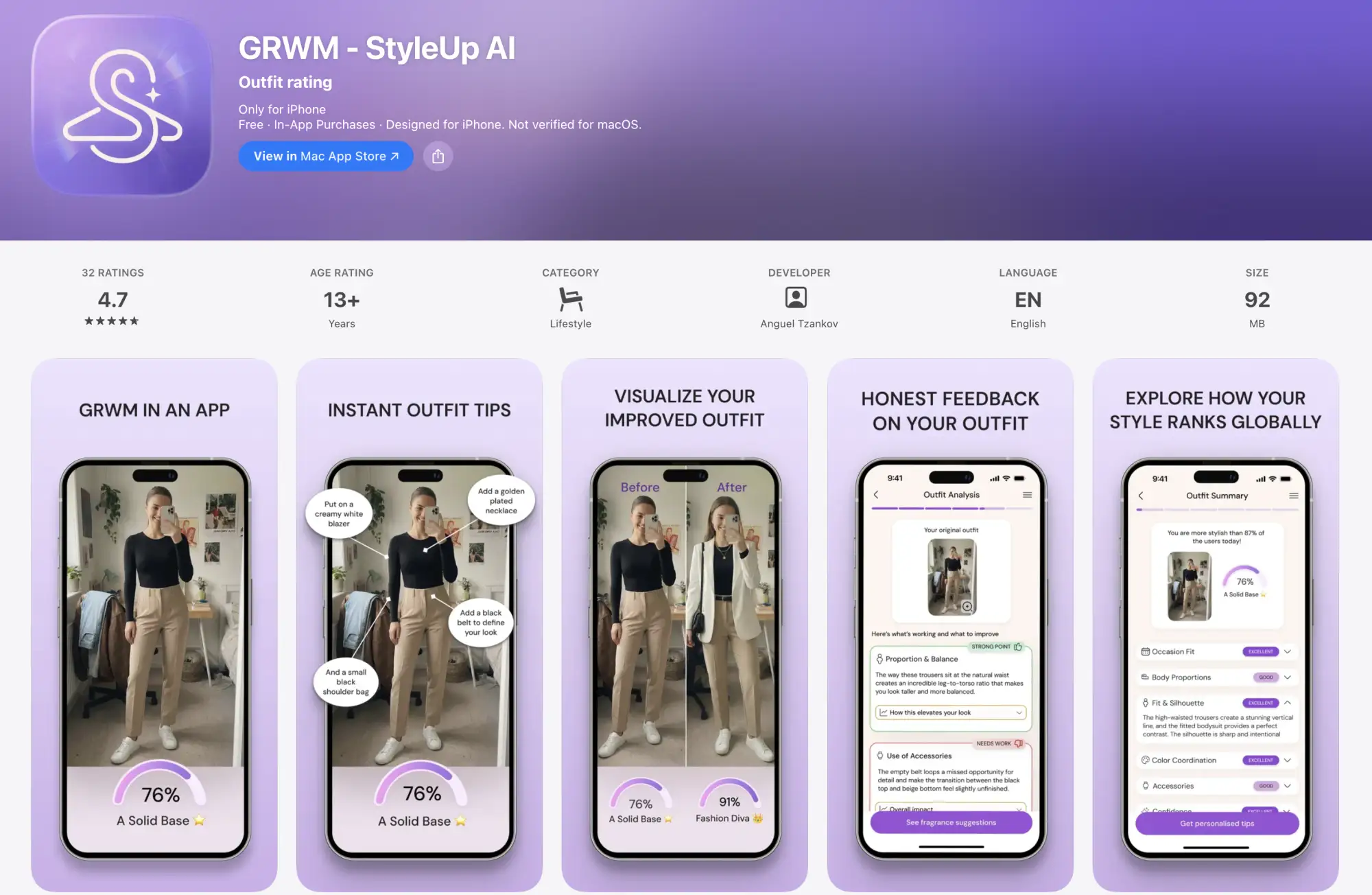
Developer Anguel Tzankov has kept the product deliberately light: upload a photo, then read the score with its suggested changes. The app can recommend items to improve the look and has an optional roast mode for less serious feedback. At the time of writing, the US App Store shows a 4.7 rating from 32 reviews.
Price: $4.99/month or $44.99/year
Pros:
✅ The 1–100 scale gives more granularity than a 10-point score
✅ Suggestions include items that could improve the outfit
✅ Available on both iOS and Android
Cons:
❌ No browser version
❌ A high-precision number can imply more certainty than a subjective style opinion deserves
Proper Fit is a web-based AI style assistant built around seasonal color analysis. It starts by assigning one of 12 color palettes, then uses that profile when it reviews an outfit.
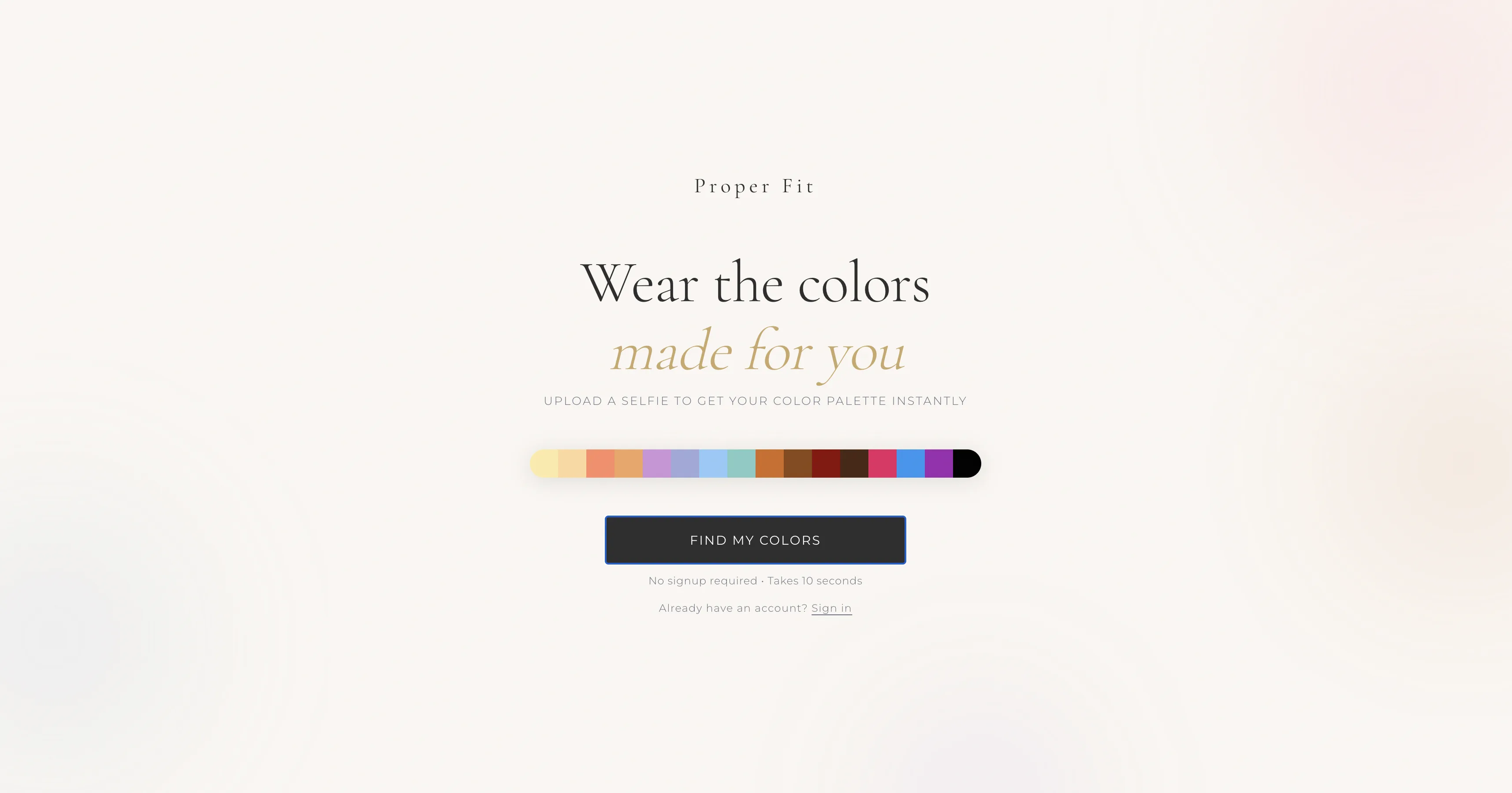
Proper Fit accepts outfit photos in three formats:
You can also paste a product page before buying something and ask whether the item works with your palette. This makes the tool more useful for wardrobe planning, although it adds setup before the first outfit check.
Proper Fit's free plan includes three outfit checks. The Premium plan adds unlimited checks and product-link analysis, while Pro adds occasion guidance and a chat that knows your saved style profile.
Price: Premium costs $14.99/month or $149.99/year; Pro costs $29.99/month or $299.99/year
Pros:
✅ Connects outfit feedback to a 12-season color profile
✅ Can review a shopping link before you order an item
✅ Works on the web
Cons:
❌ You need to complete the color-palette setup first
❌ The paid plans cost much more than the other outfit raters in this list
VibePalette is an iPhone outfit scorer made by developer Jangsan Jeon.
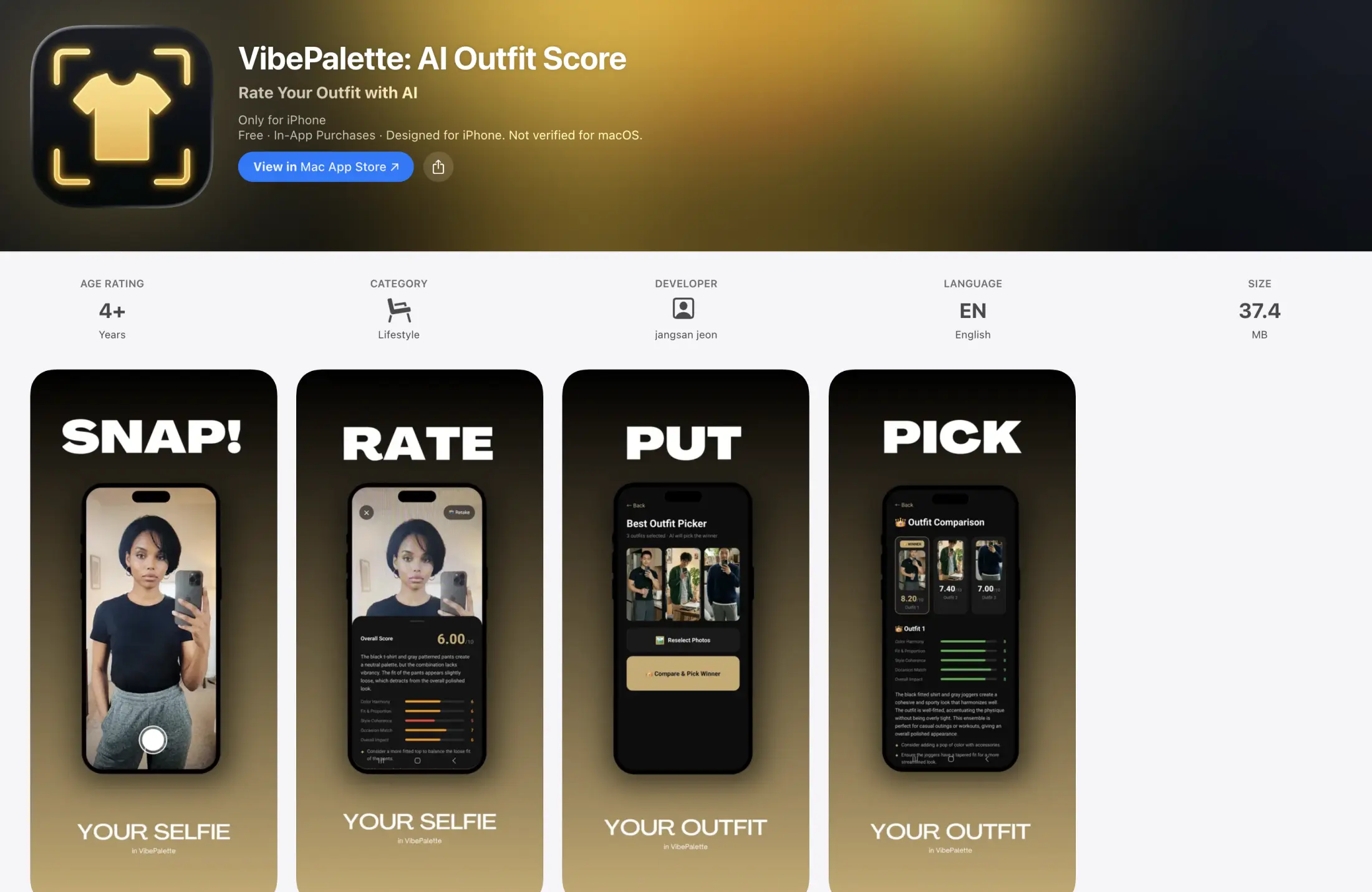
It gives a score out of 10 and breaks the result into five categories:
VibePalette also accepts two or three outfit photos and picks a winner, which is useful in a fitting room or before an event. The app launched in 2026 and is still new enough that the US App Store doesn't show a public ratings average.
Price: $8/month or $48/year after a three-day free trial
Pros:
✅ Compares up to three outfits in one decision
✅ Explains the score across five named categories
✅ Annual pricing is lower than most dedicated styling subscriptions
Cons:
❌ Available on iPhone only
❌ The three-day trial is the only free-use option listed
Quick answers to the most common questions about AI outfit raters.
Yes. An AI outfit rater can analyze a photo of your outfit and return a score, category ratings, and styling suggestions based on what is visible in the image.
For better results, use a clear, well-lit photo that shows the full outfit, including footwear and accessories. The model can only assess details that are visible in the photograph.
Yes. Some AI outfit-rating tools offer free ratings or limited free use. Overchat AI Outfit Rater, for example, is free and unlimited, but only for a limited time.
AI outfit ratings can be useful for identifying visible styling issues, such as color combinations, proportions, footwear choices, or how well different pieces appear to work together. However, there is no universal or objective scoring system for fashion. Different models may rate the same outfit differently, and the result can also be influenced by the photo, prompt, and scoring criteria used by the service. For that reason, an AI outfit score is better treated as style feedback rather than an objective measurement of how good an outfit is.
Yes, absolutely. AI outfit raters can be used to compare two outfits, although the comparison method depends on the service. Some tools can evaluate multiple images in a single request. With others, you can rate each outfit separately and compare the overall score, category scores, and recommendations.
It depends on the service. There is no single photo-retention policy shared by all AI outfit raters. Overchat AI, for example, automatically deletes your photographs after processing. Because outfit photos can include your face, home, or other identifying details, check the service's privacy policy and image-retention terms before uploading a photograph.
At the end of the day, we'd like to leave you with this: every tool on this list returns an outfit score, but that doesn't change the fact that fashion is highly subjective. If you disagree with the AI result, who are we to tell you that you don't dress well? As long as your clothes make you comfortable and you feel cool in them, that's the most important thing. But if you do want a second opinion based on fashion norms and current trends, with advice on how to develop your personal style and where your outfit sits on that sort of generalized spectrum, that's when you'll find these tools the most useful. Happy outfit rating!


