Claude Watermark: What It Is and How to Remove It from Text
Last Updated:
2026-09-26
Claude Watermark: What It Is and How to Remove It from Text
Anthropic introduced machine-readable marking for new Claude models on August 2, 2026. Now, Claude models that launched on or after that date embed an invisible watermark into their text, allowing AI checkers to detect copy generated by Claude with 100% accuracy. Anthropic is adding watermarks to older models separately. This Claude AI watermark is invisible to the naked eye, but it survives copying and light editing.
In this guide, you'll learn how the Claude watermark works, which outputs can contain it, why deleting a few words is not enough to remove it, and how to get rid of it with the Overchat AI Claude Watermark Remover.
The Claude text watermark is an imperceptible, machine-readable signal embedded by supported Claude models.
It is carried by the text itself. Copying the response into a document, email, or CMS does not remove it.
A detected mark indicates that Claude may have processed the text. It does not prove that Claude wrote the original ideas or draft.
Overchat AI removes common invisible Unicode characters and substantially rewrites wording and sentence structure.
Anthropic has not yet published its complete detection specification, so no third-party remover can verify removal against Anthropic's private detector.
What is the Claude watermark?
The Claude watermark is an invisible signal embedded in text produced by supported Claude models. Anthropic introduced marking as part of its commitments under the European Union's Code of Practice on Transparency of AI-Generated Content. Article 50(2) of the EU AI Act requires providers of systems that generate synthetic text, audio, images, or video to mark outputs in a machine-readable format when technically feasible.
Anthropic describes two separate marking methods:
Embedded text watermarks for generated text.
Signed provenance metadata for supported files such as SVG, PNG, and JPG. The file metadata follows the C2PA provenance standard.
In this article, we're talking about the embedded text watermark.
According to Anthropic's documentation, the watermark doesn't visibly change the response and doesn't affect response quality.
Instead, it's a statistical probability that is integrated into the text and spread across the entire copy, added token by token as the model generates the output.
Anthropic says that light editing can't erase it and, according to early tests, which are confirmed by our own internal testing at Overchat AI, the watermark starts becoming invisible once about 70% of the original text no longer remains in the paraphrased piece.
Which Claude outputs contain a watermark?
Anthropic says Claude models launched on or after August 2, 2026 watermark their outputs, and the company will add watermarks to older models with updates. All Claude models that watermark text now add these marks regardless of how you interact with the model:
Claude on the web or in an app.
Claude Platform and API responses.
Claude Code, Claude Cowork, and Claude Tag.
Supported Claude models accessed through AWS, Google Cloud, or Microsoft Foundry.
Other products that return output from a supported Claude model.
So yes — this means that even when you generate text with Claude in Overchat AI, that watermark will be embedded into the copy.
Also, despite being a feature added to comply with European regulation, Claude watermarks are rolled out in all geographies, not just in Europe.
How does the Claude watermark work?
We've already briefly covered that, but let's discuss this topic in more detail.
According to Anthropic, the watermark is embedded directly in generated text, but the company has not yet published its complete technical specification or public detection method — and likely will not, in order to complicate reverse engineering. So, we'll have to use our imagination and knowledge of watermarking in general to describe how it works.
Usually, statistical language-model watermarking works during token selection, and it's likely that Claude uses this kind of system.
A language model normally assigns probabilities to many possible next tokens. A watermarking system can use a secret rule to favor one subset of plausible tokens over another. Each individual choice reads naturally, but a sufficiently long passage contains a measurable distribution that a detector with the corresponding key can test.
The signal (in other words, the watermark) thus gets spread across many choices throughout the copy. This has several practical consequences:
Copying and pasting preserves the same words and therefore preserves the signal.
Changing punctuation or replacing a few words may leave enough of the original pattern for detection.
Short passages are harder to classify because they provide fewer token choices to measure.
Heavy editing, paraphrasing, translation, or mixing the passage with other writing can weaken the signal.
Anthropic's own documentation reflects these limits. It says a detected mark means content may have been processed by Claude.
Claude watermark vs. hidden Unicode characters
Invisible Unicode characters are a separate issue. Text copied between editors can contain characters that occupy no visible space or behave differently from ordinary spaces and punctuation. Common examples include:
Character
Code point
Typical role
Zero-width space
U+200B
Invisible break opportunity
Zero-width non-joiner
U+200C
Prevents character joining in some scripts
Zero-width joiner
U+200D
Controls character joining and emoji sequences
Word joiner
U+2060
Prevents a line break without showing a glyph
Byte order mark
U+FEFF
Encoding marker that can remain inside copied text
Soft hyphen
U+00AD
Optional line-break hyphen
Left-to-right mark
U+200E
Controls text direction
Right-to-left mark
U+200F
Controls text direction
Non-breaking space
U+00A0
Visible as spacing but different from an ordinary space
Removing these characters is useful for clean text handling, but it does not by itself remove a statistical pattern encoded by Claude in word choice.
Why remove the Claude watermark?
There are legitimate reasons to remove a processing mark before publishing or delivering text.
Prevent a processing mark from being mistaken for authorship
For example, if you create a piece of writing and then use Claude only for proofreading, light editing, or translation, it will still add the watermark, and your work can be mistakenly perceived as unoriginal, despite it being 100% human-written. Removing the mark after a substantive human review can reduce the chance that a processing signal is treated as proof that Claude authored the work.
Keep an internal editing workflow private
People who work at agencies or as freelancers use lots of tools to create and deliver quality results, and these tools often involve some kind of generative AI. Despite that, some clients believe that the use of AI by itself is a sign of low effort, even though that's often not the case at all. But at the end of the day, it's easier to keep the workflow private than to persuade them otherwise.
Restore a consistent house style
Watermark removal requires broader rewriting than a character cleanup. This provides an opportunity to correct repetitive transitions, generic assistant phrasing, long dash-heavy sentences, and other wording that does not match the publisher's style guide.
How Overchat AI removes the Claude watermark
The Overchat AI tool uses a two-part cleanup process:
1. Invisible character cleanup
Before rewriting begins, the tool removes zero-width spaces and joiners, the word joiner, byte order marks, soft hyphens, and bidirectional text marks. Non-breaking spaces are converted to regular spaces.
This pass removes character-level artifacts that can remain hidden in copied text.
2. Structural rewrite
The cleaned text is sent through a model-assisted rewrite that uses a model from the GPT family to create a deep paraphrase, changing the necessary 70% or more of the original text. The rewrite is instructed to:
Preserve the meaning, facts, tone, language, and approximate length.
Change word choice throughout the passage.
Restructure sentences rather than perform isolated synonym substitutions.
Keep names, numbers, dates, and defined terms unchanged.
Preserve paragraphs and lists where they are present.
Return only the rewritten text without an introduction or explanation.
This stage changes the sequence of token choices that carries a statistical watermark. It also reduces recognizable default-assistant phrasing.
How to remove a Claude watermark with Overchat AI
The Claude Watermark Remover runs in the browser and does not require an account. One pass accepts between 40 and 6,000 characters.
Step 1 — Open the tool
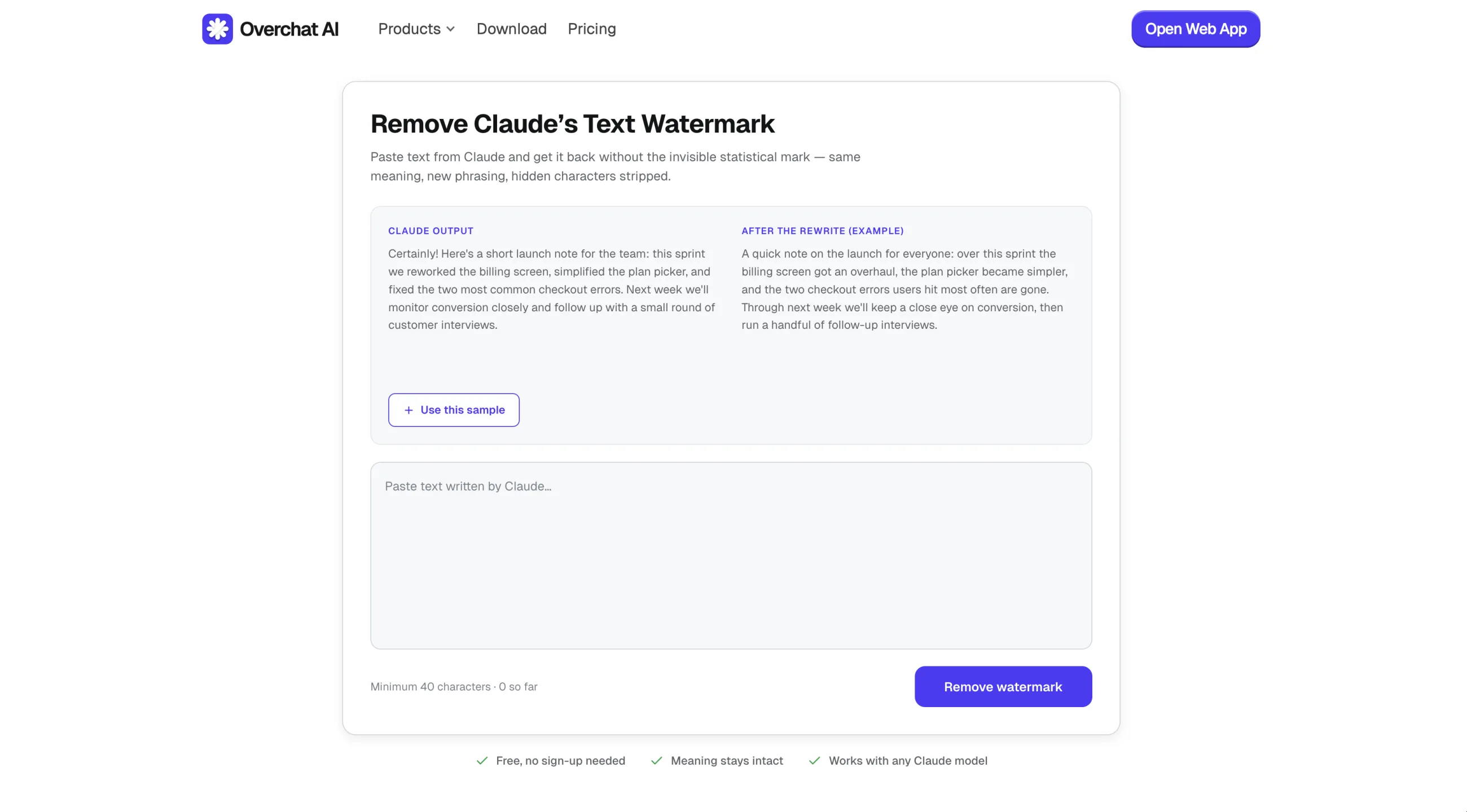
Open the remover and locate the Claude output field. The page includes a sample passage and a worked rewrite, which can be loaded with Use this sample.
The Claude Watermark Remover before any text is entered
Step 2 — Paste the Claude text
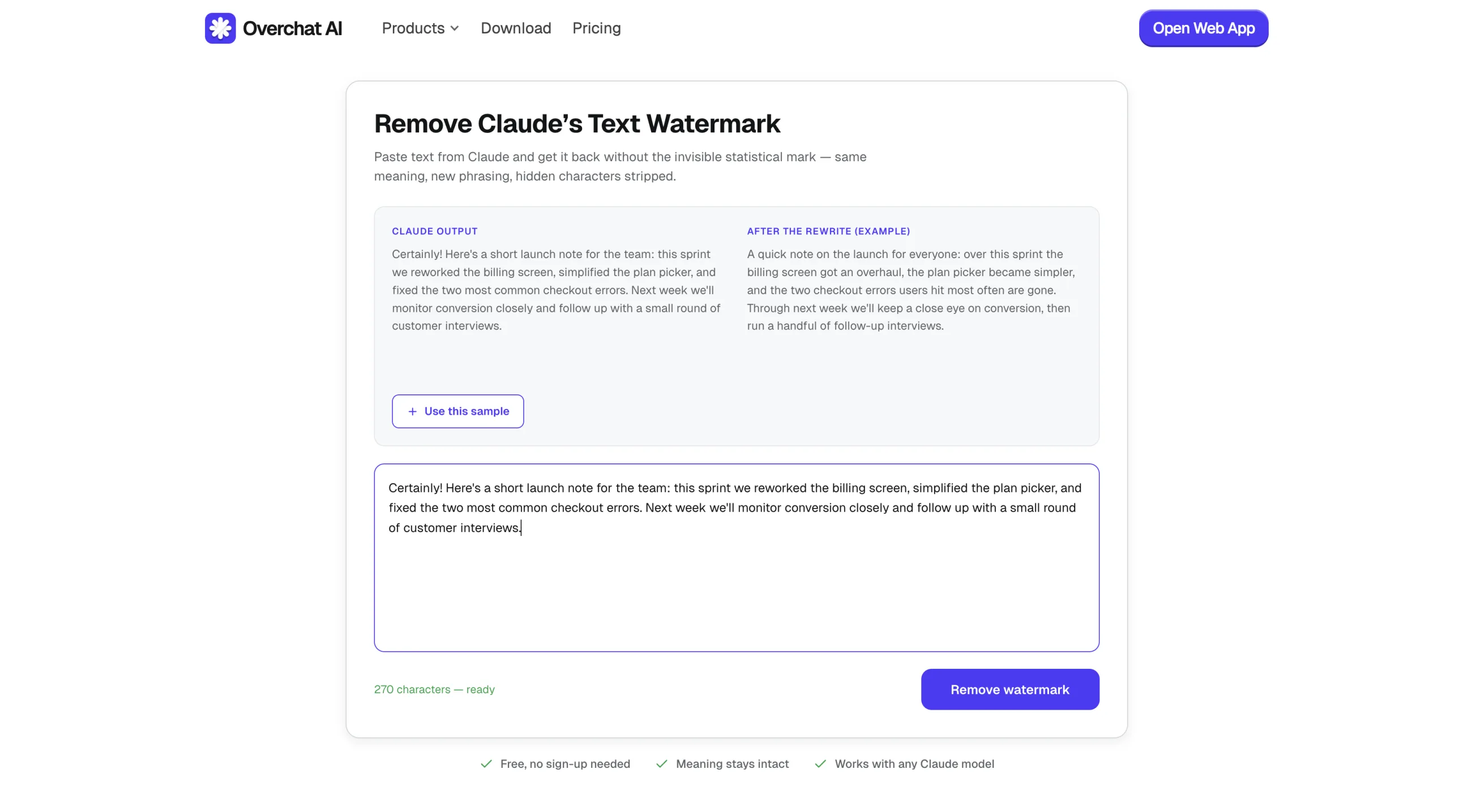
Paste the response copied from Claude, Claude Code, an API result, or another document. The counter below the field shows the character count and confirms when the minimum length has been reached.
For long documents, divide the text at paragraph or section boundaries and process each part separately. Keeping complete sections together gives the rewriter enough context to preserve terminology and tone.
A 270-character sample loaded and ready to process
Step 3 — Select Remove watermark
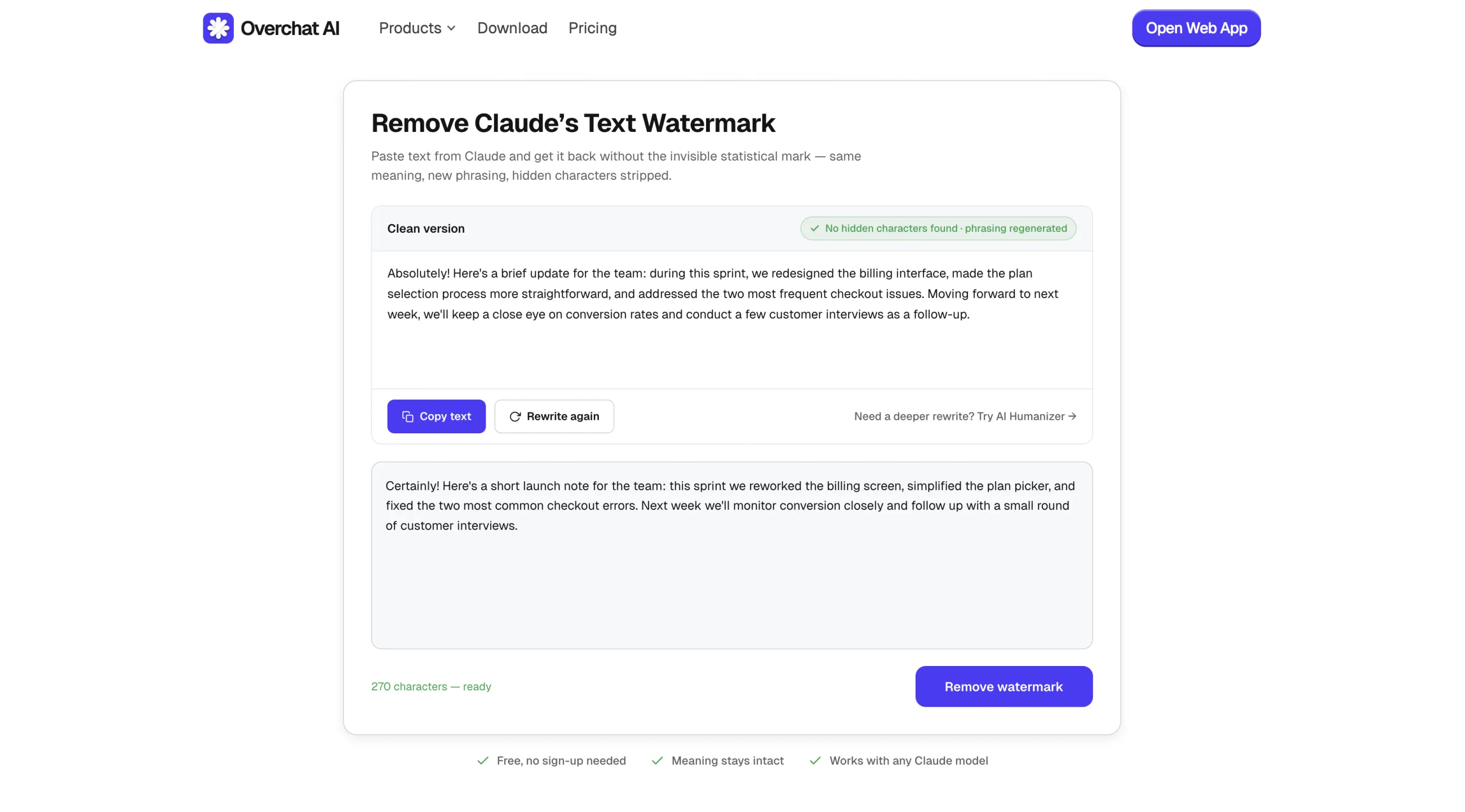
Select Remove watermark and wait for the rewritten version to appear. The result is streamed into the Clean version panel.
In the verified walkthrough shown below, the input did not contain any of the Unicode characters checked by the tool. The interface therefore reported “No hidden characters found · phrasing regenerated.” The wording and sentence structure still changed because the statistical signal cannot be addressed by character deletion alone.
The rewritten clean version with the status message and copy controls
Step 4 — Review and copy the result
Read the complete result before using it. Check names, numbers, dates, quotations, technical terms, and claims against the source text. Model-assisted rewriting can introduce an error even when it is instructed to preserve facts.
Select Copy text when the result is ready. Use Rewrite again if the first version is too close to the original or does not match the intended voice. For a larger stylistic change, the page also links to the Overchat AI Humanizer.
Frequently asked questions
Quick answers to common questions about the Claude watermark and how removal works.
Does copying Claude text remove the watermark?
No. Anthropic says the embedded watermark travels with the text when it is copied and pasted. Moving the passage into Google Docs, Microsoft Word, an email, or a CMS preserves the words that carry the signal.
Can I remove the watermark by deleting invisible characters?
Not completely. Deleting zero-width and other hidden Unicode characters cleans character-level artifacts. A statistical watermark embedded in token or word choices requires substantial rewriting.
Does light editing remove the Claude watermark?
It may weaken part of the signal, but Anthropic says the mark can persist through some editing. Changing a heading, punctuation, or a few synonyms is less effective than restructuring sentences and regenerating wording throughout the passage.
Does a Claude watermark prove that Claude wrote the text?
No. Anthropic explicitly notes that Claude may have proofread, translated, summarized, reformatted, or converted material created elsewhere. Detection is a processing signal, not a complete authorship record.
Does the absence of a watermark prove that a person wrote the text?
No. The text may come from a model that did not support marking, may be too short to test reliably, or may have been translated, paraphrased, or mixed with other writing.
Is the Overchat AI Claude Watermark Remover free?
Yes. The browser tool is free and does not require sign-up. Each run accepts 40 to 6,000 characters.
Will the remover preserve formatting?
It is instructed to preserve paragraph and list structure. Complex document formatting, tracked changes, footnotes, tables, and styles are not part of the plain-text input, so they must be restored in the destination document.
Can I use the remover for academic or regulated work?
Only if doing so complies with the applicable rules. Watermark removal does not override an academic integrity policy, a disclosure rule, a client requirement, or a legal obligation. Keep source records and disclose AI assistance where required.