Does Claude watermark its text?
Anthropic announced its Claude text watermarking system in August 2026 as part of its work to comply with the EU AI Act and the EU Code of Practice on Transparency of AI-Generated Content. The company says future Claude models will generate watermarked text, while watermarking for models released before August 2, 2026 is being added separately during a transition period.
Claude’s watermark is invisible to the naked eye, but it is there. Anthropic says nothing is added to the text, but that the watermark influences how the model makes certain word-selection decisions during generation. Over a long piece of text, this creates a statistical pattern that Claude watermark detectors can see.
The Claude watermark is applied regardless of where you're accessing Claude from or what the origin of your account is.
How does the Claude text watermark work?
Claude generates text by repeatedly choosing the next token from several possible candidates. Many parts of natural language allow more than one equally appropriate choice, giving the model some freedom over which word comes next.
Claude’s watermark takes advantage of this mechanic to hide a statistical pattern in the text. Anthropic says its implementation is based on the SynthID-Text approach published by Google DeepMind, with a secret key influencing the source of randomness used when Claude selects between acceptable alternatives.
A detector can examine enough of those choices and estimate the likelihood that Claude contributed to the text. Because of this, the watermark survives copy-and-pasting.
This works better the longer a piece of writing is, because long texts contain more token-selection decisions that can carry the watermark.
Does Claude Watermark Visibly Change the Text?
Anthropic says that it doesn't. The system doesn't rely on Claude choosing strange synonyms or unnatural constructions, so without detection, you'd never be able to tell if a piece of text was watermarked or wasn't — it just reads like standard Claude-generated copy. Anthropic tested this internally and found no meaningful effect on content, creativity, or readability.
Hidden Characters in Claude Text Can Also Help Identify Generated Copy
Claude is known to leave behind other AI fingerprints:
- Zero-width spaces
- unusual Unicode whitespace
- non-breaking spaces, soft hyphens
- formatting attributes
are sometimes added by the editor and can remain in text copied between websites and editors.
Those characters are directly inspectable because they’re part of the underlying text data. A scanner can identify their Unicode code points or reveal HTML attributes that aren’t obvious when you read the rendered text.
However, this is different from the new Claude watermark — the watermark added in August 2026 does not use hidden characters. Removing a zero-width character or replacing a non-breaking space therefore doesn’t remove or verify Anthropic’s watermark.
Can Punctuation or Writing Style Prove That Text Came From Claude?
Partially yes, although it's more difficult to use these signals to specifically attribute text to Claude; they're more useful if you need to identify whether text was AI-generated by some model or written by a human.
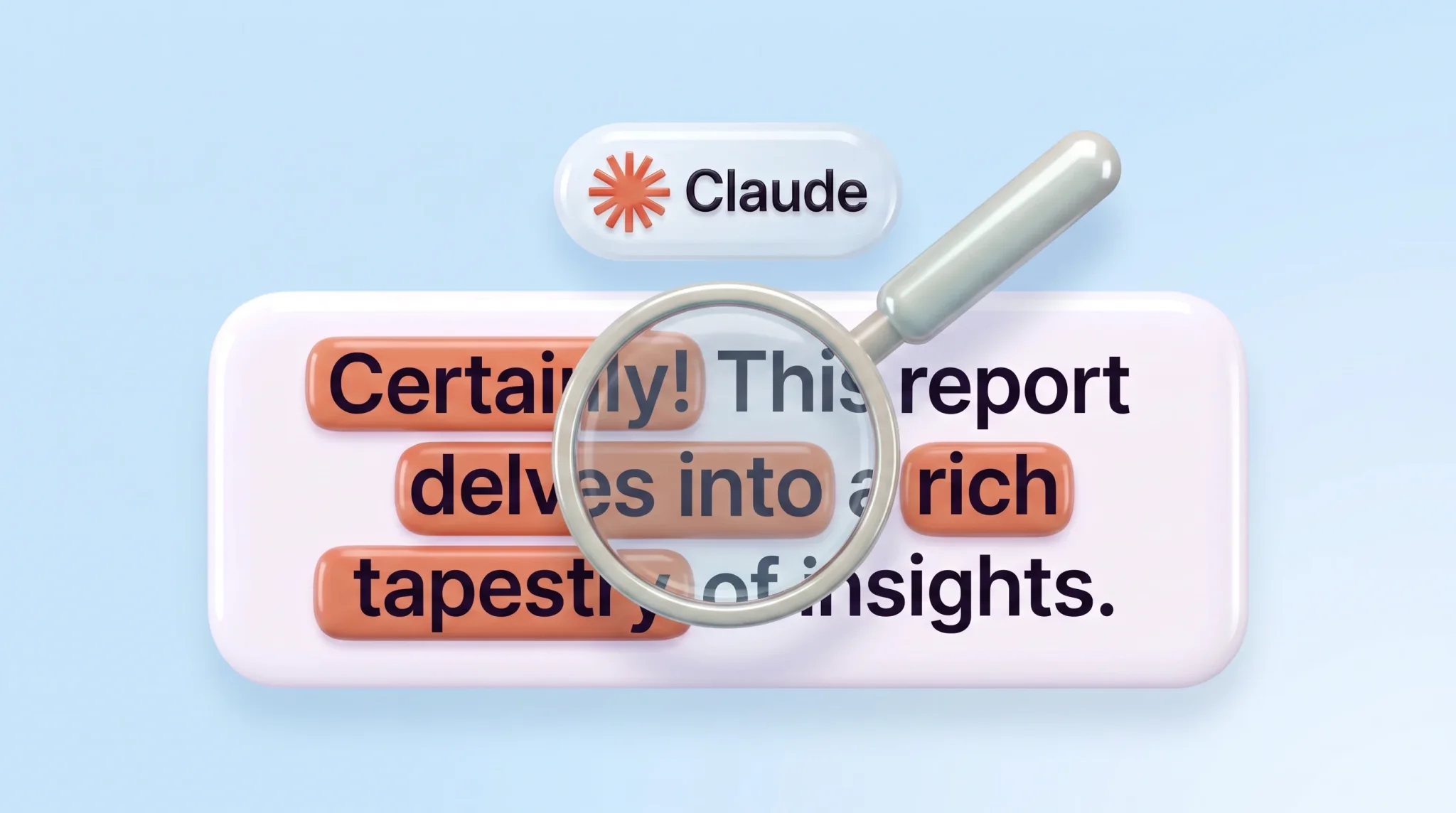
When models generate text, they tend to overuse em dashes, repeated three-part lists, polished transitions, particular sentence constructions, and other recognizable patterns — Claude is no exception.
False positives also happen, because human writers can use the same punctuation and constructions, while Claude can produce text without them.
In short, style-based systems search for linguistic “tells,” whereas Claude watermark verification relies on the statistical signal created during generation.
How reliable is Claude watermark detection?
Claude watermark detection is the most reliable way we've ever had to tell if a text came from Claude, given that the text is long enough.
The accuracy falls a little when the text doesn't have enough tokens for the statistical signal to accumulate, or when it's very factual in nature, because the model has fewer opportunities to choose between identical synonyms: when only one word, number, technical term, or factual answer is correct, changing token selection for watermarking purposes could damage accuracy.
Code is also difficult to watermark in this manner, because many tokens have to be exact, but the watermark can be effectively added to comments, for example.
Does Claude Watermark Text It Proofreads?
If you're only using Claude for light editing, you're generally safe. In such cases, Claude chooses only a small proportion of the final words, which is not enough to embed the statistical signature.
However, if you let Claude rewrite the text significantly, changing more than 50% of the original, for example, then it will have enough opportunities to add the watermark.
Does copying or editing Claude text remove the watermark?
If you copy Claude-generated text into Word, Google Docs, email, a CMS, or another plain-text editor, it won't change the sequence of words carrying a statistical watermark, so the answer is no — the Claude watermark will survive copy-and-pasting.
Anthropic says light editing probably won’t completely remove a watermark either, and that you need to change at least 70% of the words to completely eliminate it, effectively doing a full rewrite.
Do Translations Carry the Claude Watermark?
Yes — if you let Claude translate the text, even a human-written original, it will choose the words of the translated output, so the newly generated translation will carry its own watermark.
How to Detect Claude-Generated Text?
The easiest way to check any text is to run it through the free Claude Watermark Detector. Paste your copy, and the tool analyzes your text and tells you how likely it is that Claude generated the text.
A positive Claude watermark result indicates that Claude was likely involved in producing the text. The longer the sample you paste, the more token-selection decisions the detector can examine and the more confident the verdict — a few paragraphs are usually enough for a reliable read.
Because the watermark survives copy-and-pasting and light editing, the detector works on text taken from anywhere: Word or Google Docs files, emails, CMS drafts, and student submissions alike.
Frequently asked questions
Quick answers to the most common questions about the Claude text watermark:
Can you detect whether text was written by Claude?
Yes. Anthropic’s statistical watermark makes Claude-generated text detectable: a verified watermark means Claude was almost certainly involved in producing the text. Formatting artifacts and stylistic patterns add further supporting evidence on top of the watermark signal.
Does Claude add invisible characters to its answers?
Anthropic says its official text watermark contains no hidden characters. Invisible Unicode characters found in copied text are separate formatting or text-processing artifacts.
Can a Claude watermark detector identify the user who generated the text?
No. Anthropic says its watermark contains no information identifying a person, organization, account, or individual Claude conversation.
Does Claude watermark code?
Yes, wherever several token choices are equally valid. Pure code provides fewer such choices than prose, but comments, docstrings, and the text around the code still carry the watermark.
Does Claude watermark translated text?
Yes, when Claude generates the translation. Claude selects the words in the translated output, giving its watermarking system opportunities to embed the statistical pattern.
Can a Claude watermark produce a false positive?
False positives are rare. The statistical pattern the detector looks for is extremely unlikely to appear by chance in human-written text, and the longer the sample, the more reliable the verdict — a confirmed watermark is a strong signal that Claude produced the text.
Bottom Line
Claude text is no longer anonymous — if before you could generally use a detector to tell if text came from an AI model with some degree of reliability, now Claude adds an indisputable statistical signature that's very difficult to get rid of. Checking if text came from Claude takes a few seconds with the Claude Watermark Detector. Here are the key facts to remember:
- Since August 2026, Claude models watermark all the text they generate, as part of Anthropic's compliance with the EU AI Act.
- The watermark is a statistical pattern hidden in Claude's word choices, based on Google DeepMind's SynthID-Text approach — it uses no hidden characters and doesn't visibly change the text.
- It survives copy-and-pasting and light editing; removing it takes changing at least 70% of the words, effectively a full rewrite.
- The longer the text, the more reliable the detection — a few paragraphs are usually enough.
- Translations generated by Claude carry their own watermark; light proofreading doesn't add one.
- The watermark identifies Claude's involvement, not you: it contains no information about the person, account, or conversation behind the text.