What Is an AI Aggregator? How Multi-Model Platforms Work (and the Best Ones in 2026)
Last Updated:
2026-09-17
What Is an AI Aggregator? How Multi-Model Platforms Work (and the Best Ones in 2026)
What if you could access all of the best AI models, image generators, and video generators in a single place, for the cost of just one ChatGPT AI subscription? With AI aggregators, you can. But what are these platforms, how do they work, and are they legit? We're answering all of that in this article.
Want to read about which all-in-one AI platform is best? Check out our guide to the best all-in-one AI platforms.
An AI aggregator is an online platform that brings multiple AI models together on a single website or app. Usually, these platforms provide access to all models from major providers (GPT, Claude, Gemini, Grok), as well as image and video-generation tools. For example, Overchat AI is an AI aggregator with over 150 tools and models, many of which are free, while full access is available for $14.99/month or $49.99/year.
AI aggregators connect to different providers via APIs — and allow you to chat with the same models that power websites like Claude and ChatGPT, while often offering specialized tools like AI writing assistants or ChatPDF apps that make it more convenient to solve specific tasks with AI.
Most aggregators include video and image generation capabilities — while a platform like Claude only offers text generation, through online aggregators you can access the same Claude models, but also dedicated video generators like Grok Imagine 1.5 and image generators like GPT Image 2.
AI aggregators can save you money — compared to paying for multiple AI subscriptions, which usually cost from $20/month each, AI aggregators typically cost below $20/month, while giving you the same core capabilities.
AI aggregators are legit — they access first-party models through official APIs and give you access to those models via their own interface. Do note, however, that some first-party features like Claude's editable artifacts can be missing from AI aggregators.
Overchat AI is the best AI aggregator — it offers multi-model chat with over 150+ image, video, audio, and document tools on one platform for as little as $14.99/month, which is cheaper than a single ChatGPT Plus subscription.
What is an AI aggregator?
An AI aggregator is a platform that connects to multiple AI models and lets you use them all from one account. Instead of holding separate subscriptions to ChatGPT, Claude, and Gemini, you log into one app, pick the model you want, and pay a single bill. The aggregator handles the connections to each provider in the background.
The word covers two different kinds of product. Developer aggregators like OpenRouter are API gateways: a programmer sends one API call and the gateway routes it to whichever model the code names, which is useful for building apps but not something you'd open in a browser. Consumer aggregators are the apps this guide is about — Overchat AI, Poe, Monica, and others — which wrap those same model connections in a chat interface you can use without writing code.
The chat-only aggregators stop at text models. A growing group, led by Overchat AI, also aggregates image, video, and voice generation, so the platform covers the models behind ChatGPT and Claude alongside the models behind Midjourney and Sora. That breadth is the main thing separating a basic aggregator from one that replaces an entire stack of subscriptions.
How do AI aggregators work?
An AI aggregator works by calling each model through its provider's official API and presenting the results in one shared interface. The model you talk to is the same one the native app uses — the aggregator changes how you reach it, not what it is. Four parts make that possible.
First party AI APIs
Every major AI provider exposes their models not only through an online chat app (like ChatGPT), but also through an API (OpenAI Developer's Platform) — a way for another application or website to connect to the model. This is so that other people can create AI-powered apps using the provider's models. This is how you get apps that weren't developed by the OpenAI team, but are powered by OpenAI's models.
Unlike first-party AI model developers like OpenAI or xAI, who have teams of AI researchers and developers creating new AI models, AI aggregators don't actually build the models themselves. Instead, they hire specialists who create beautiful frontends that expose access to the models developed by OpenAI to everyone else — much like ChatGPT or Grok chat does.
In other words:
xAI has a team of researchers who work on the actual model weights for the upcoming Grok 5. Let's call it the team A.
xAI also has a team of people working on the interface for Grok Chat. That's a team B.
An AI aggregator doesn't have the team A; instead, they only have the team B and pour all the resources into creating the best possible experience for the end users, focusing on design, usability, and providing a convenient way to chat with multiple AI models in one place.
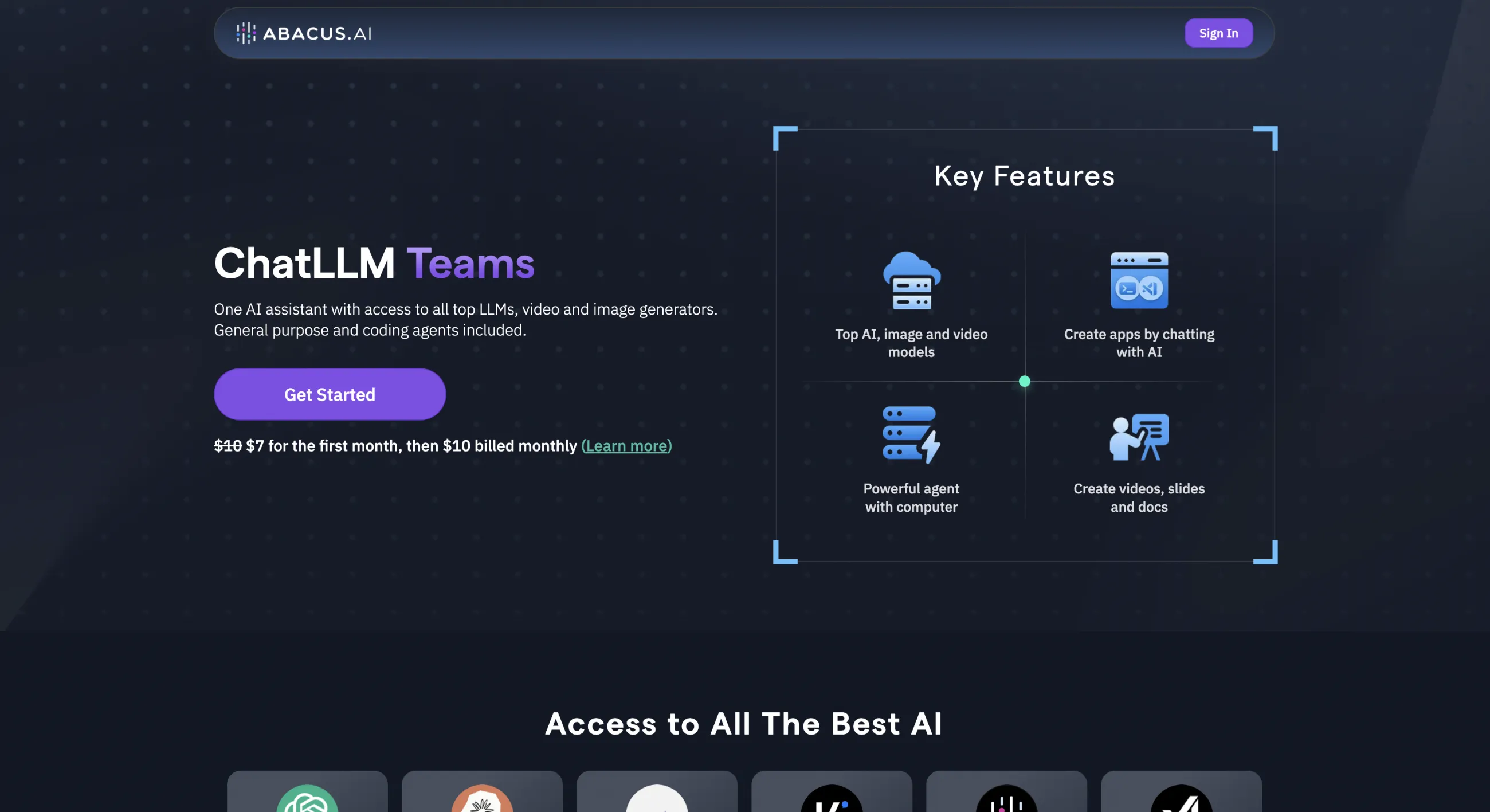
The API-first nature of the AI industry also explains why aggregators can expand quickly. When a provider launches a new model and makes it available through its API, aggregators can often integrate it within days rather than months. Platforms such as Abacus.AI publicly state that new model releases are typically added within 24–48 hours, allowing users to access the latest models without subscribing to multiple services.
The interface
Everything users interact with—including chat history, file uploads, project organization, prompt libraries, team workspaces, image generation tools, and model switching—is the interface layer — and it actually has nothing to do with the AI model itself — it is responsible for sending information from the user (your prompt) and receiving and displaying information generated by the model (the response). Things like:
How the overall website or app is designed to feel and function
How your media generation history is shown in the gallery
How search results are displayed
How the model's thinking block is shown
How to find the correct tool for your specific job
As a result, users are often choosing between interfaces as much as they are choosing between models.
Model routing
Model routing is the process of directing a request to a specific AI model — and a feature that is unique to AI aggregators.
There's this idea that specific models are better at specific things. For example, Claude is one of the best AI models for coding, while Kimi K2.7 is one of the best models for writing.
Since AI aggregators can access all of these models, they can send your request to the model that's best suited to the specific task. In Overchat AI, for example, this happens automatically, as the platform has intelligent AI-powered routing, where a lightweight and ultra-fast AI model analyses your requests and selects the best model for the job (this feature can be disabled if you don't want it). Of course, there's also manual routing, where you select a model from the dropdown menu.
For example, a routing system might:
Send coding tasks to a model optimized for software development.
Route document analysis to a model with a larger context window.
Use a lower-cost model for simple questions.
Switch to a faster model during periods of heavy demand.
For users, routing is one of the biggest practical advantages of an AI aggregator. Instead of managing multiple subscriptions and switching between applications, a single interface can distribute work across several AI providers.
Tokens, credits, and the economics of AI aggregators
Tokens are small units of text that models process as input and generate as output. A longer prompt, a larger document, or a more detailed response consumes more tokens and therefore costs more to generate.
Aggregators purchase API access from model providers and then package those costs into their own pricing systems. Most use credits, points, message allowances, or subscription tiers that abstract away the underlying token accounting.
The business model is straightforward: the aggregator pays the provider for API usage, adds a small margin, and bundles multiple models into a single product.
For users, the benefit is convenience. Rather than maintaining separate accounts, payment methods, and billing dashboards across multiple AI providers, one subscription can unlock access to dozens of models.
What can you do with an AI aggregator?
As a rule of thumb, AI aggregators allow you to complete a broader selection of tasks with AI as compared to first-party AI apps. In 2026, there's a plethora of specialized AI models. There are:
Models for editing videos with text
Models for restyling images
Upscaling models
Background removing models
Image recognition models
Sound generation models
Sound to text converters
The list goes on.
ChatGPT does offer image generation and text generation, but they don't really offer a way to professionally remove a background from an image, or merge two images into one, or to create music — for that, you'd have to find a different tool like ElevenLabs or Suno. And pay their subscription, too.
AI aggregators, on the other hand, attempt to include as many specialized tools as possible, in addition to basic text and image generation. The table below breaks down the major AI categories available within Overchat AI and the types of tools included in each.
Category
What it does
Example tools
Models behind it
Chat
Talk to and switch between frontier text models
Ask AI, Free AI Chat
GPT-5.5, Claude Opus 4.8, Gemini 3.5, Grok 4.2, DeepSeek 4
Text
Draft and rewrite long-form copy
AI Writer, AI Paraphraser, AI Humanizer, AI Translator
GPT-5.5, Claude, Gemini
Image
Generate and edit images from text or a photo
AI Image Generator, AI Photo Editor, AI Cartoonizer, AI Headshot Generator
AI Voice Generator, AI Voice Cloning, AI Music Generator
Dedicated audio models
Docs
Read and summarize files
ChatPDF, PDF Summarizer, AI Contract Reviewer
GPT-5.5, Claude
Math
Solve and explain problems step by step
Math Solver, Physics Solver, Photo Solver
Reasoning models
The point of putting all of this behind one login is the workflows it opens up that separate apps cannot. Three are common among professional users:
Compare models on the same prompt. Send one question to GPT and Claude, read both answers, and keep the better one — useful when you don't know in advance which model handles a task best.
Route each task to the strongest model. Use Claude for long-form writing, GPT for reasoning, and Gemini for multimodal work, all without leaving the platform or paying three bills.
Chain across modalities. On a cross-modal platform you can generate an image, send it straight into an image-to-video tool to animate it, then upscale the result — a chain that would otherwise mean three separate subscriptions and three rounds of downloading and re-uploading.
What are the best AI aggregators in 2026?
The aggregators below cover the range of the market, from cross-modal platforms to chat-only multi-model tools. The table compares them at a glance; the sections after it go deeper on each, with the facts that actually separate them.
Aggregator
Models
Modalities
Price
Standout
Overchat AI
GPT-5.5, Claude Opus 4.8, Gemini 3.5, Grok, Nano Banana Pro, Sora 2, Veo 3.1 + more
Chat, image, video, audio, docs
$14.99/mo or $49.99/yr
100+ tools across every modality
Poe
GPT, Claude, Gemini, DeepSeek, ElevenLabs
Chat (text, some image/audio)
$4.99–$249.99/mo
Compute-points model marketplace
Monica AI
GPT, Claude, Gemini
Chat, writing
~$9.90–$19.90/mo
Browser sidebar on every page
Abacus.AI
GPT-5.5, Claude Opus 4.7, Gemini 3.1, Grok + 20 more
Chat, image/video, agents
$10/user/mo
DeepAgent agentic layer
GlobalGPT
GPT, Claude, Gemini + 100 more incl. Midjourney, Sora, Runway
Chat, image, video
$11.90/mo
Breadth of creative models
Magai
50+ frontier models
Chat, image
€10–€60/mo
Built for marketing teams
Mammouth AI
GPT, Claude, Gemini, LLaMA, DeepSeek
Chat, image, audio
€10/mo
Flat-rate multimodal access
1. Overchat AI
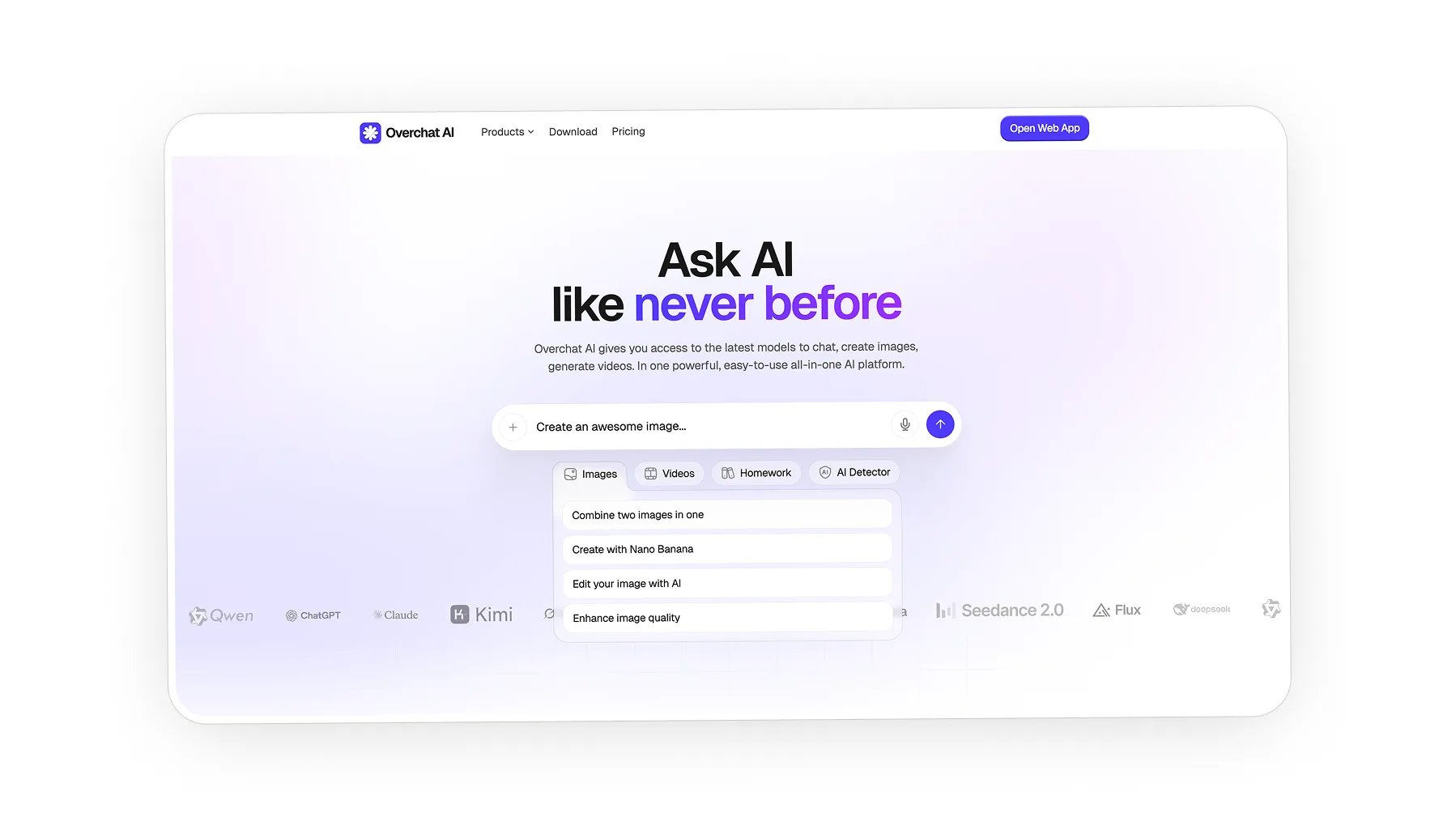
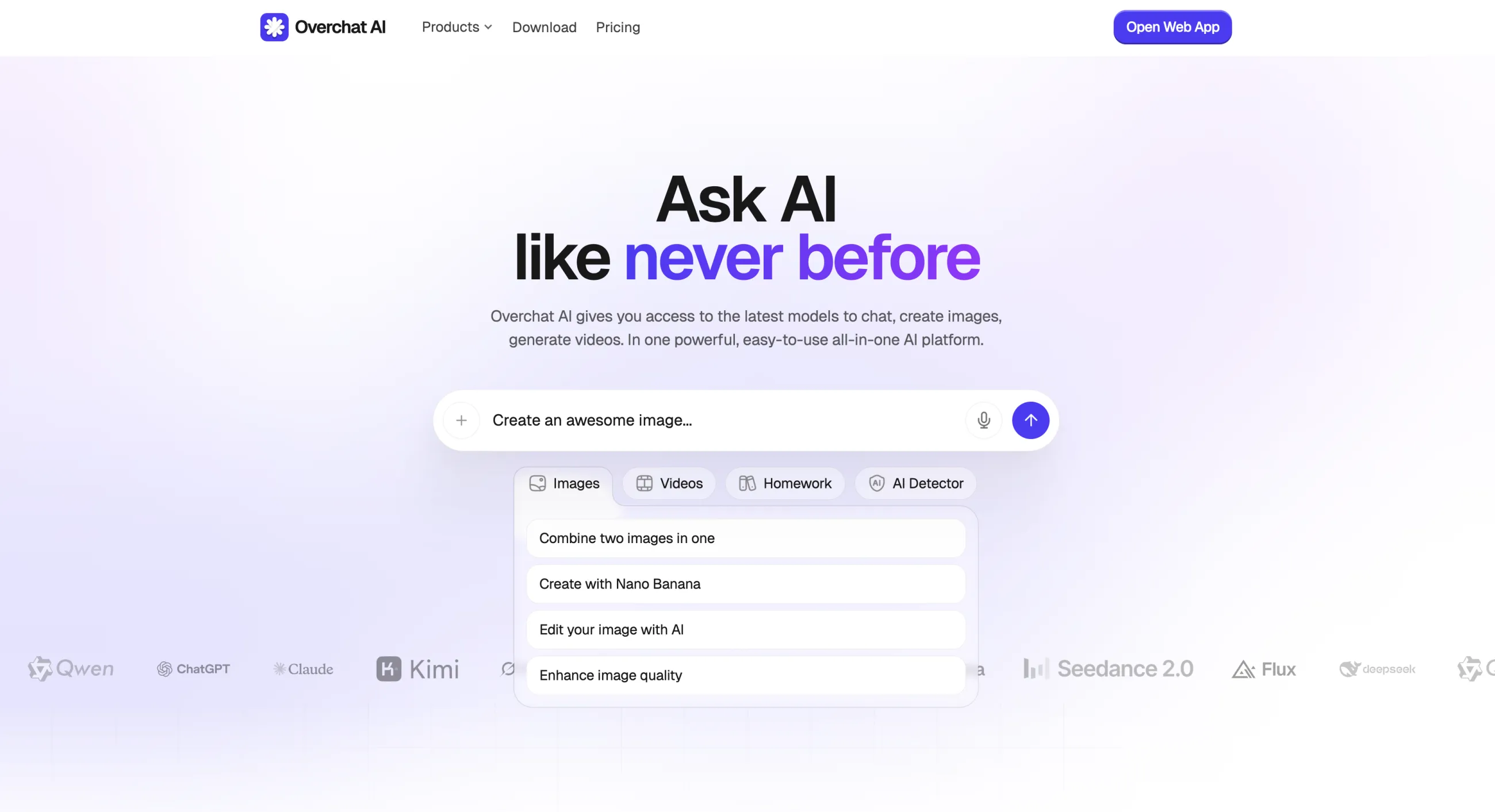
Overchat AI is an all-in-one AI platform that aggregates frontier text models alongside more than 150 image, video, audio, document, and math tools. It has over 350,000 users.
Overchat AI aggregates frontier text models alongside 150+ creative tools.
While most aggregators cover only chat, Overchat AI spans text, image, video, and audio generation, drawing on the same frontier models as the standalone apps in each category:
Modality
Models available
Text and chat
GPT-5.5, Claude Opus 4.8, Gemini 3.5, Grok 4.2, DeepSeek 4
Overchat AI is available on three platforms: a web app, an iOS app, and an Android app. It offers hundreds of specialized tools across multiple categories, and the team behind Overchat AI created specialized interfaces for each tool, making it easy and straightforward to use.
For example, just taking image tools, here's what you can do on the platform:
Tool
What it does
AI Image Generator
Creates images from a text prompt
AI Photo Editor
Edits an existing photo from a text instruction
AI Background Remover
Cuts the subject out from its background
AI Image Upscaler
Increases resolution without losing detail
AI Headshot Generator
Turns a selfie into a professional headshot
AI Old Photo Restoration
Repairs and sharpens damaged old photos
AI Image Combiner
Merges two images into one
Virtual Clothes Try-on
Shows a person wearing a different outfit
AI Product Photography
Generates studio-style product shots
AI Logo Generator
Creates logos from a description
You can also generate videos:
Tool
What it does
AI Video Generator
Creates video from a text prompt
Image to Video AI
Animates a still image into a clip
Face Swap Video
Replaces a face across a video
AI Video Upscaler
Raises the resolution of a clip
AI Video Extender
Lengthens an existing clip
Video Background Remover
Removes or replaces a video background
YouTube Summarizer
Summarizes a YouTube video from its link
And generate music:
Tool
What it does
AI Voice Generator
Converts text to spoken audio
AI Voice Cloning
Reproduces a specific voice from a sample
AI Music Generator
Generates music from a prompt
AI Vocal Remover
Strips vocals from a track
Audio to Text Converter
Transcribes audio into text
ChatPDF
Answers questions about an uploaded PDF
PDF Summarizer
Summarizes a long document
AI Contract Reviewer
Flags key terms in a contract
All of the above costs less than one ChatGPT Plus subscription.
Price: $14.99/month or $49.99/year
Pros:
✅ Covers chat, image, video, audio, and documents in one plan
✅ Runs current frontier models across every modality
✅ Output flows tool-to-tool through the My Media library
✅ Flat price with no per-model points to track
Cons:
❌ So many tools that the catalog takes time to learn
2. Poe
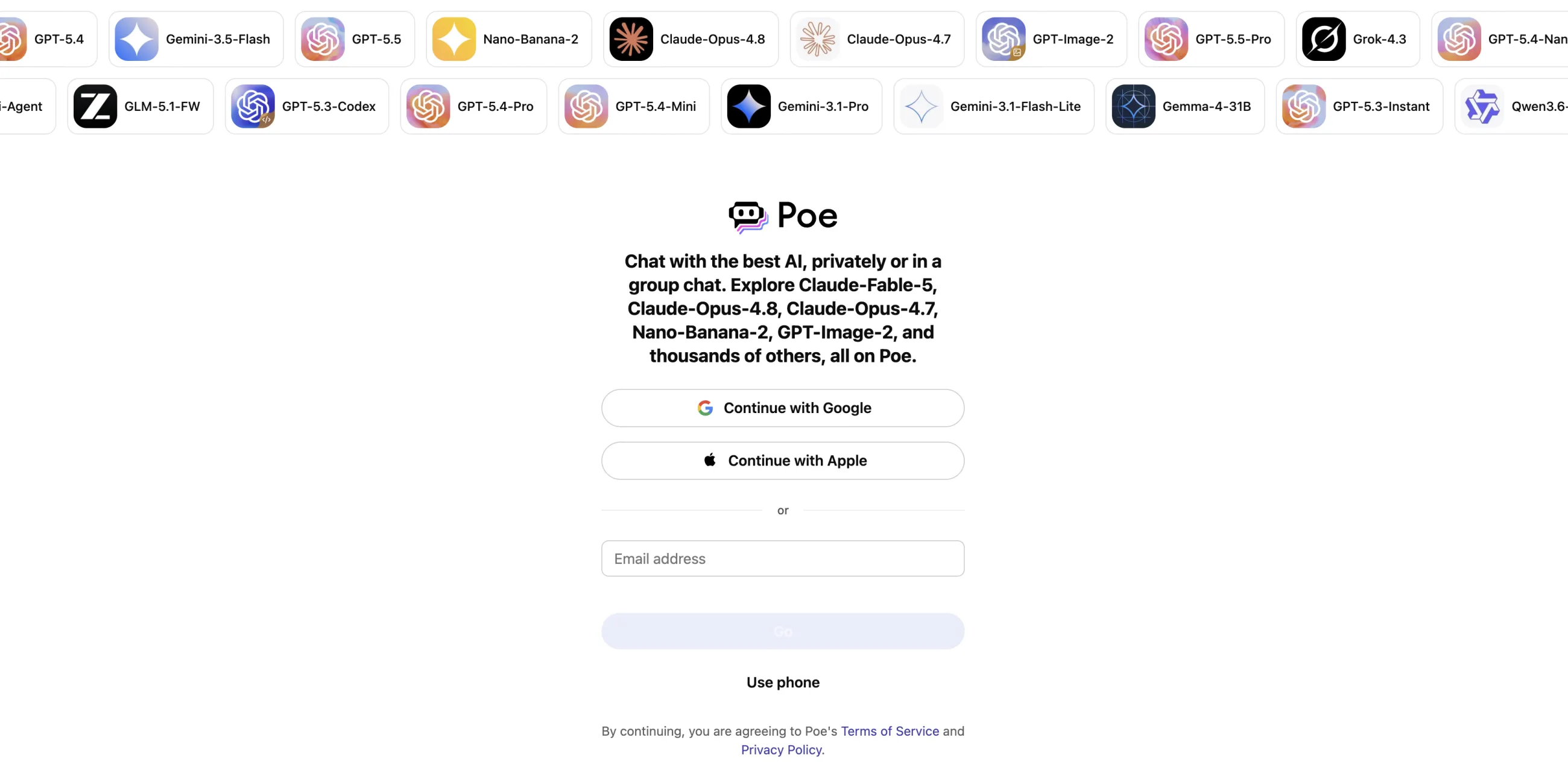
Poe is a multi-model AI chat platform built by Quora and launched in 2023. It works as a marketplace of bots, each running a different model, and it was one of the first consumer products to put GPT, Claude, and Gemini behind a single login.
Poe runs each model as a points-priced bot in a single marketplace.
In Poe, every model costs a set number of points per message. A free tier is available, and the paid plans are priced by how many points they include each month.
Price:
Monthly points
Price (billed annually, may depend on the region)
10,000/day
$4.50/mo ($54/yr)
660,000/mo
$18/mo ($218/yr)
1.65M/mo
$45/mo ($545/yr)
3.3M/mo
$91/mo ($1,089/yr)
8.25M/mo
$227/mo ($2,723/yr)
Pros:
✅ Large catalog of models and community bots
✅ Free daily allowance to test models
✅ Backed by Quora, so it's stable and well-funded
Cons:
❌ Centered on chat, with limited image and video depth
What is the best Poe alternative?
Overchat AI is the best Poe alternative for users who want access to over 150 creative tools. Poe's focus is on text generation and user-created bots, while Overchat AI offers text-generation and mini-apps for creating images and videos with AI, that are professionally developed by the Overchat AI team.
3. Monica AI
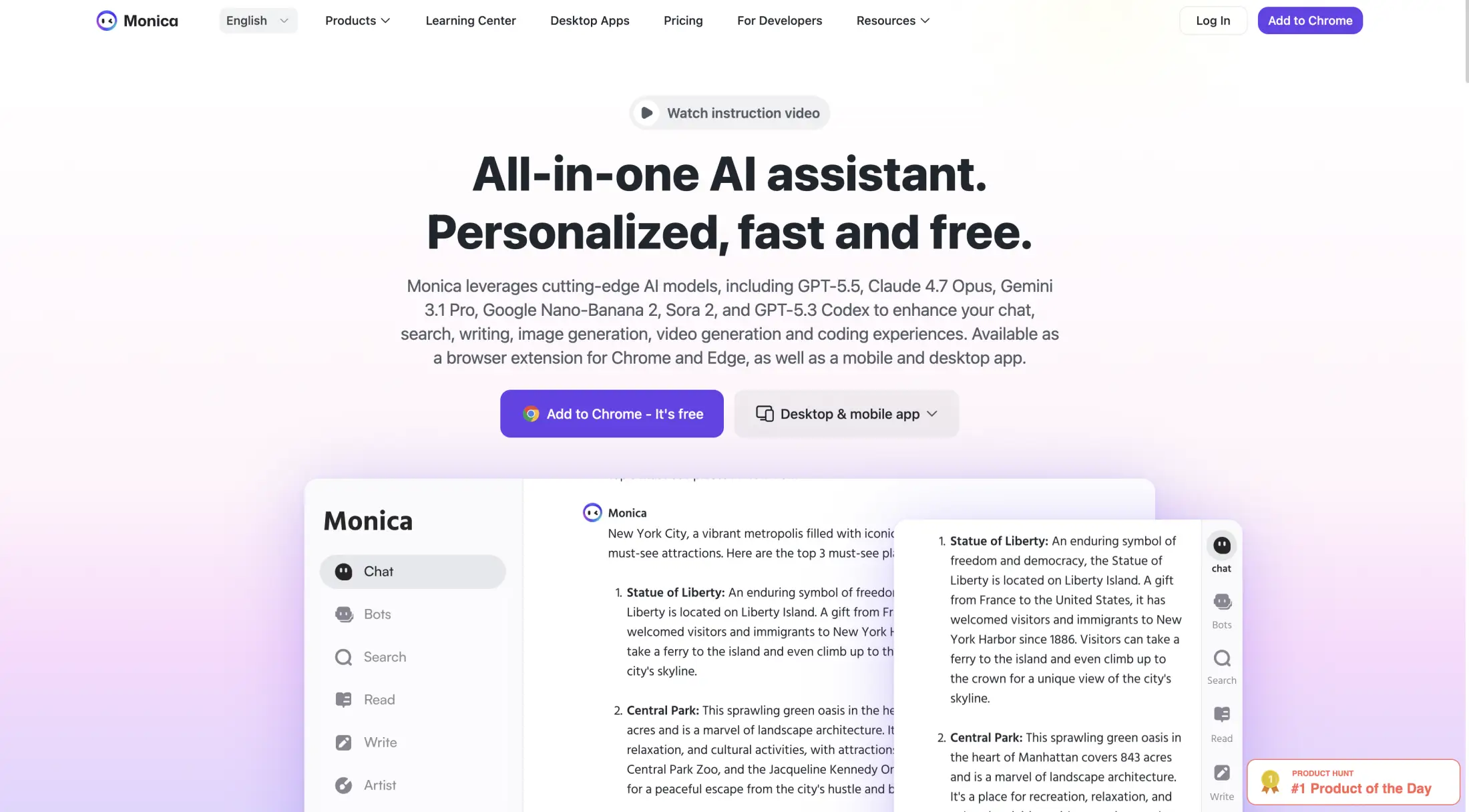
Monica AI is most famous for their multi-model assistant that lives as a browser sidebar or a Chrome or Edge extension, although they also run a dedicated website and mobile apps. It was founded in 2023 by Butterfly Effect and has grown to over 10 million users, with backing from Tencent at a reported valuation near $100 million.
Monica AI runs as a browser sidebar across web apps like Gmail and Notion.
Monica runs GPT-5, Claude 4.5 Sonnet, Gemini 3 Pro, and other models, and it embeds directly into web apps like Gmail, Notion, and WordPress. Its tools span more than chat:
Capability
What it does
Multi-model chat
Talk to GPT, Claude, and Gemini without switching tabs
Web page summarizer
Summarizes any page or YouTube video from the sidebar
Translator
Translates pages and text across 120+ languages
Writing tools
Rewrite, paraphrase, humanize, and AI-text detection
Chat with files
Asks questions about uploaded PDFs and images
Image and video generation
Generates images and short video in-app
Code tools
Writes and debugs code in SQL, Python, and other languages
Custom bots
Build no-code AI bots for support or Q&A
Price:
Plan
Cost
Free
$0 (40 queries/day)
Pro
$9.90/month
Pro+
$19.90/month
Unlimited
$39.90/month
Pros:
✅ Sidebar works on any web page
✅ Fast for summarizing and rewriting in place
✅ Large, established user base
Cons:
❌ Credit system meters heavier models
What is the best Monica AI alternative?
Overchat AI is one of the best Monica AI alternatives for anyone who needs image and video generation alongside chat and writing.
4. Abacus.AI
Abacus.AI is an AI platform founded by Bindu Reddy and Arvind Sundararajan. Its consumer product, ChatLLM, is a multi-model workspace, and it sits alongside DeepAgent, an agentic layer that runs multi-step tasks like building dashboards and automations. The mix of chat and agents is what sets it apart from a plain aggregator.
Abacus.AI pairs multi-model chat with the DeepAgent agentic layer.
ChatLLM gives access to GPT-5.5, Claude Opus 4.7, Gemini 3.1 Pro, Grok 4.2, and more than 20 other models, and the team adds new ones within 24 to 48 hours of release. Pricing runs for $10 per user per month, with a $20 Pro tier that unlocks 30,000 credits and stronger reasoning models.
Price: $10/user/month, or $20/month for the Pro tier
Pros:
✅ New models added within 24–48 hours of release
✅ DeepAgent handles multi-step automated tasks
✅ Flat per-user pricing
Cons:
❌ Interface aimed at power users, steeper to learn
❌ Creative generation is secondary to chat and agents
5. GlobalGPT
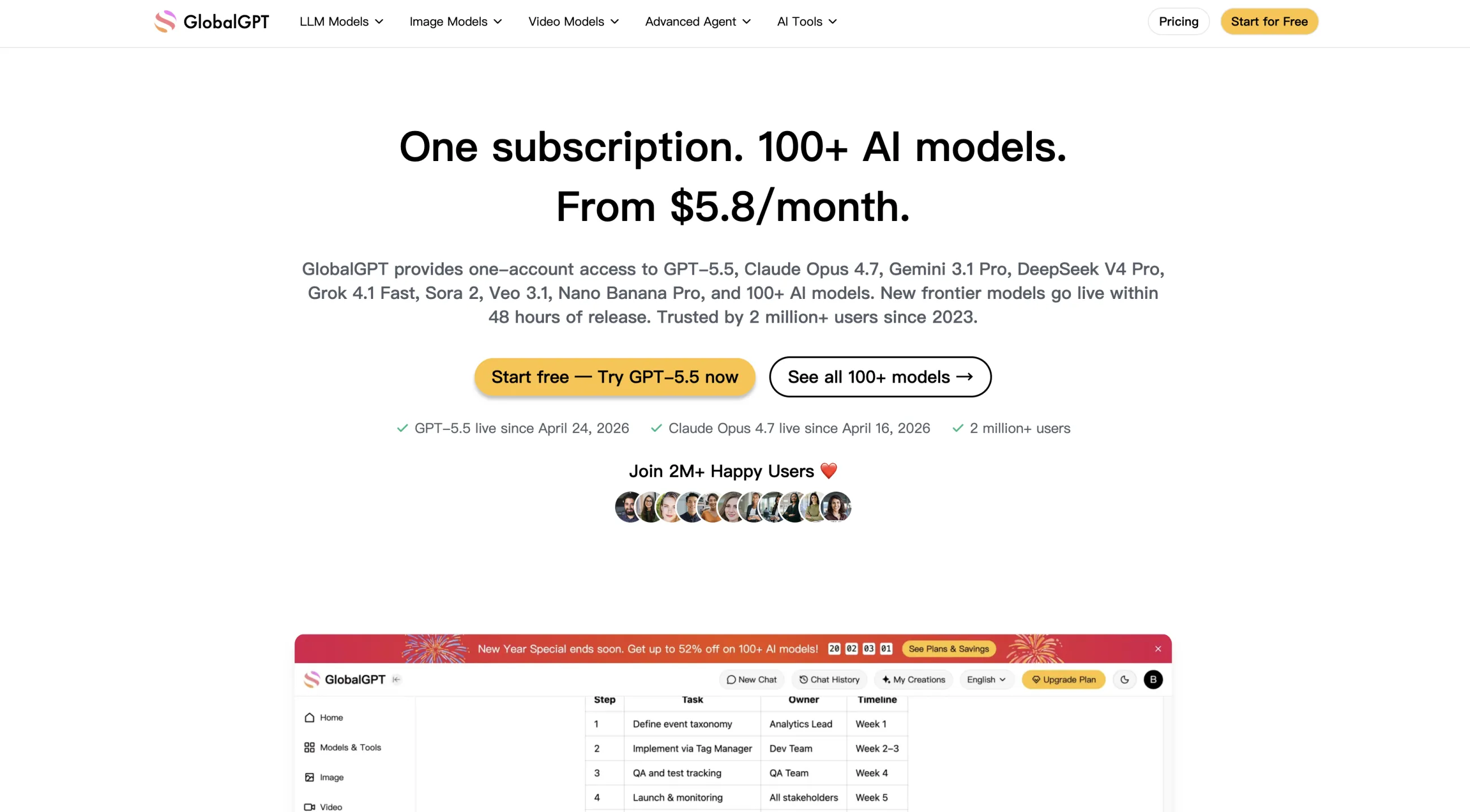
GlobalGPT is a multi-model AI aggregator launched in 2023 by Future Share LLC. It provides access to more than 100 models across text, image, and video in one subscription, with side-by-side model comparison inside a conversation.
GlobalGPT bundles 100+ text, image, and video models in one subscription.
Its model lineup is one of the widest in the category:
Type
Models
Text
GPT-5.5, Claude Opus 4.7, Gemini 3.1 Pro, Grok 4.3, DeepSeek V4 Pro, Kimi K2.6, Llama 4
Sora 2, Veo 3.1, Kling 3.0, Seedance 2.0, Runway Gen-4 Turbo, Luma Ray 2
Beyond chat and generation, it includes:
ChatPDF with a 200K-token context window
Deep Research that pulls from 50+ sources
Perplexity integration for web search
An image editor and audio generation tools
Pricing runs across three tiers, billed monthly or annually:
Plan
Monthly
Annual
Annual credits
Basic
$11.90
$5.80/mo
144,000
Pro
$19.90
$10.80/mo
240,000
Unlimited
$49.90
$25.00/mo
624,000
Pros:
✅ Over 100 models, including premium video engines like Sora and Runway
✅ Side-by-side model comparison in one conversation
✅ Cheapest tier undercuts a single ChatGPT Plus plan
Cons:
❌ Credit allowances cap heavy generation use
❌ Large model menu takes time to navigate
6. Magai
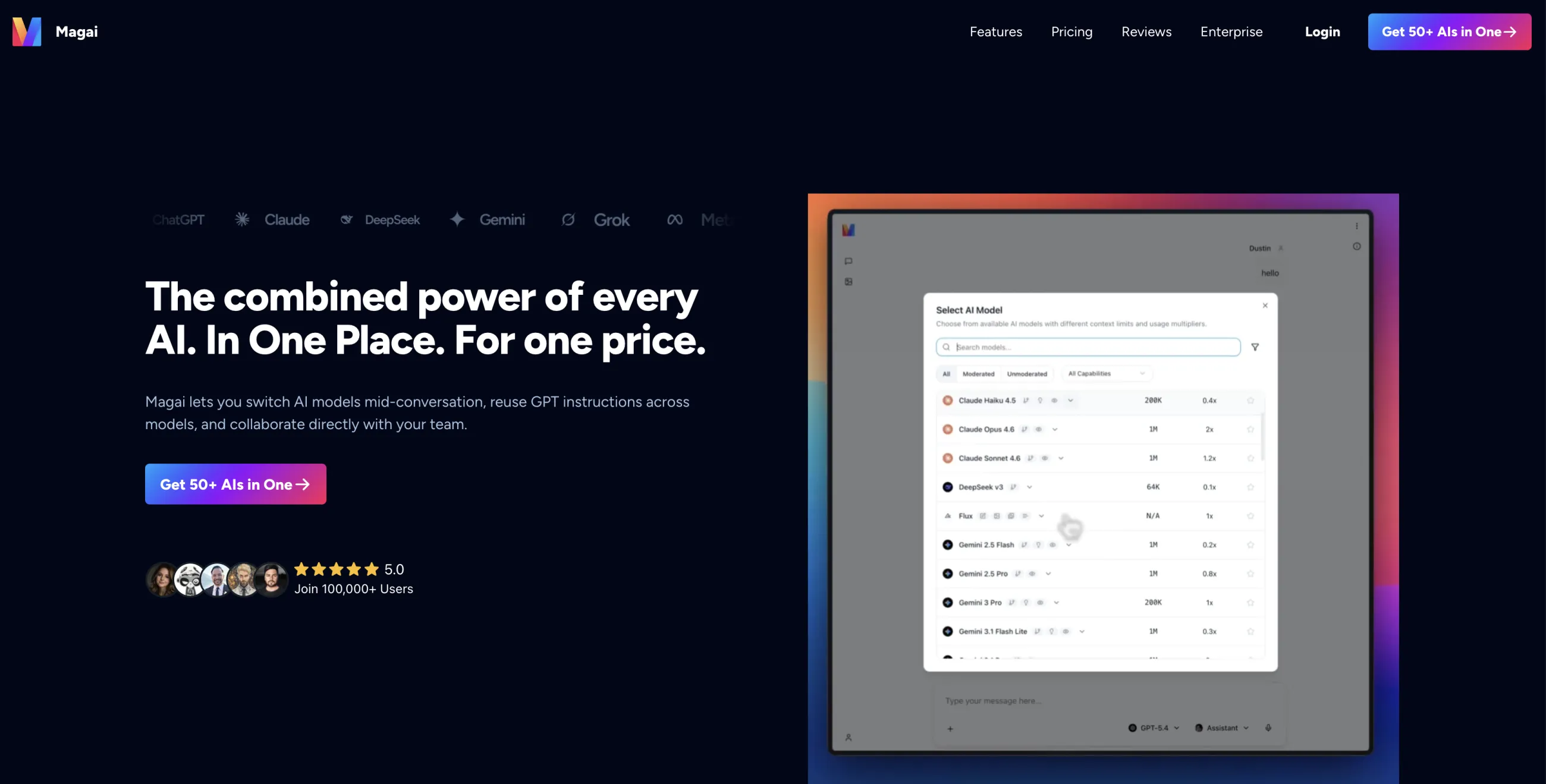
Magai is a multi-model AI platform aimed at marketers and content teams, founded by digital marketing veteran Dustin Stout. It crossed $1 million in annual recurring revenue in 2026. It offers access to 50-plus frontier models for both chat and image generation, with workspace features like folders and saved prompts geared toward teams producing content at volume. Pricing runs from €10 to €60 a month depending on usage and seats.
Magai gives content teams 50+ models with folders and saved prompts.
Price: €10–€60/month
Pros:
✅ Organized for marketing and content workflows
✅ 50+ models with team workspace features
Cons:
❌ Priced per usage tier, climbs for heavy teams
❌ Narrower modality range than full cross-modal platforms
7. Mammouth AI
Mammouth AI is a French multi-model aggregator founded in Paris in 2024 by Luc Bouvattier and Martial Garchery. It provides access to text, image, and video models in one subscription, with a one-click reprompting feature that re-runs the same prompt through a different model.
Mammouth AI bundles text, image, and video models at a flat €10 entry price.
It covers the major model families across each modality:
Sora 2, Veo 3.1 Lite, Kling 2.5 Turbo, Grok Imagine
Pricing is tiered by how many premium images and how much document text each plan allows:
Plan
Price
Premium images
Document limit
Starter
€10/month
40
10,000 characters
Standard
€20/month
200
300,000 characters
Expert
€60/month
1,000
Higher usage
All tiers include unlimited text messages under a fair-use policy, document and image analysis, voice chat, and web search. As a French company, Mammouth states it is GDPR-compliant and does not train models on user content.
Pros:
✅ Covers text, image, and video models
✅ One-click reprompting to compare models
✅ GDPR-compliant with no training on user data
Cons:
❌ Premium image counts are capped per tier
❌ Smaller tool catalog than the cross-modal leaders
AI aggregator vs separate subscriptions: which is cheaper?
An AI aggregator is cheaper than separate subscriptions — especially if you plan to use multiple AI models from different developers. For example, consider the table below:
You subscribe to
Monthly
Per year
ChatGPT Plus + Claude Pro
$40.00
$480.00
+ Google AI Pro (3 apps)
$59.99
$719.88
+ Perplexity Pro (4 apps)
$79.99
$959.88
Overchat AI (one plan)
$14.99
$49.99
Here is what you save by switching from each stack to Overchat AI's annual plan:
Replacing
Their yearly cost
Overchat AI yearly
You save
2 apps (ChatGPT + Claude)
$480.00
$49.99
$430.01
3 apps (+ Gemini)
$719.88
$49.99
$669.89
4 apps (+ Perplexity)
$959.88
$49.99
$909.89
These numbers count only the chat apps. If you also want to make images with Midjourney Pro, which costs $60/month, then this adds another $720 a year, which Overchat AI saves you, as it already includes comparably powerful image generation models.
FAQ
The most common questions about AI aggregators, answered.
Are AI aggregators legit?
Yes, the established AI aggregators are legitimate. They connect to models through the providers' official paid APIs, so the GPT or Claude response you get is the real model running on the lab's own infrastructure. The catch worth knowing is billing: most meter usage in credits or points, and heavier models drain a balance faster, so check whether a tool charges a flat rate or per-model points before subscribing.
Do you get the same models on an aggregator as on ChatGPT Plus?
You get the same underlying model. A GPT response inside an aggregator runs on the same OpenAI model as one inside ChatGPT Plus, because both reach it through OpenAI's API. What can differ is the wrapper — ChatGPT's app has first-party features like cross-session memory that an aggregator only matches if it builds its own version. The answer quality is the same; the surrounding features may not be.
What is the best AI aggregator?
Overchat AI is the best AI aggregator for most people because it aggregates more than chat. It runs GPT-5.5, Claude Opus 4.8, and Gemini 3.5 for text, then adds over 100 image, video, audio, and document tools, so one $14.99/month plan replaces a text aggregator and several creative apps at once. Poe and Monica are strong if you only need multi-model chat.
Is one AI subscription cheaper than separate ones?
One aggregator subscription is cheaper than separate ones whenever you use more than a single AI app. Running ChatGPT Plus and Claude Pro together costs $480 a year, while Overchat AI's annual plan is $49.99 and covers those models plus image and video generation. The savings grow with every app you would otherwise stack.
Do AI aggregators store your data?
AI aggregators handle your prompts to route them to the right model, and their data practices vary, so retention and privacy policies are worth reading before you sign up. Look for clear statements on how long prompts are kept and whether they're used for training. Treat any platform's handling of sensitive or confidential information the same way you would treat sending it to the native app.
Verdict: the best AI aggregator
For most people, Overchat AI is the best AI aggregator. It runs the same frontier text models as the chat-only tools (GPT-5.5, Claude Opus 4.8, Gemini 3.5) and also features image, video, and voice generation, so one $14.99/month plan covers work that would otherwise require subscribing to multiple platforms and paying potentially hundreds of dollars every month — all for just $14.99.
And if you're interested to learn more about what all-in-one tools are, see our guide to the best all-in-one AI platforms.