
Which AI image generation model is the best if you want to create AI art? To answer this question, we've tested 7 models and compared how well they tackle various creative styles.
Which AI image generation model is the best if you want to create AI art? To answer this question, we've tested 7 models and compared how well they tackle various creative styles.
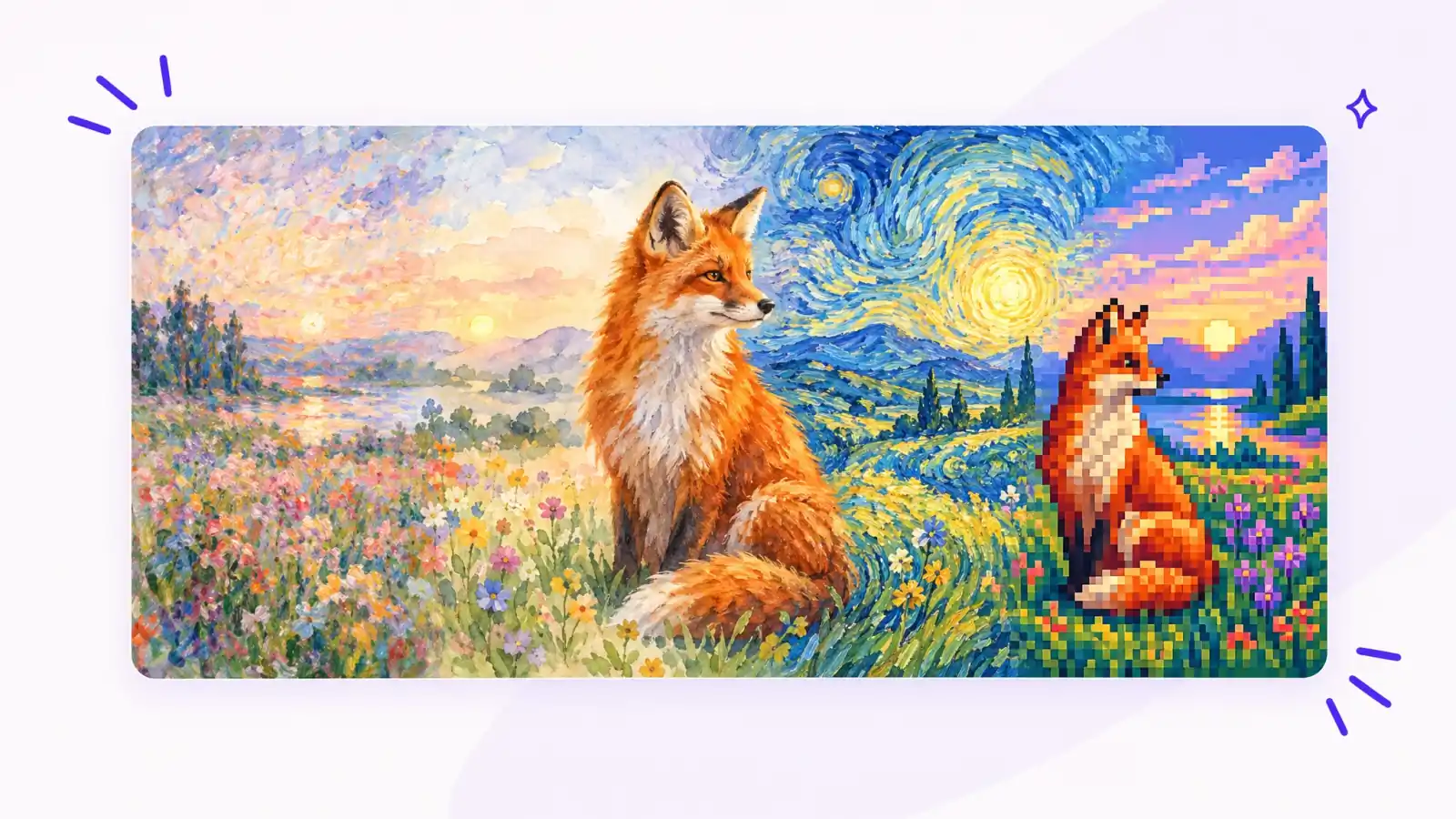
For consistency we provided each model with 8 of the same prompts and generated images in a square 1:1 format.
The first four prompts test art styles. Two of them generate an image from text:
The first prompt asks for a children's book character painted in watercolor. It is long and detailed, so it tests how many instructions a model can follow at once, from the character's proportions to the plain forest background:
Create a children’s book illustration introducing a main character.
Character:
A young, storybook-style hero inspired by a little forest outlaw,
wearing a simple green hooded tunic, soft brown boots, and a small belt pouch.
The character has a kind expression, gentle eyes, and a brave but warm demeanor.
Carries a small wooden bow used only for helping, never harming.
Theme:
The character protects and rescues small forest animals like squirrels, birds, and rabbits.
Style:
Children’s book illustration, hand-painted watercolor look,
soft outlines, warm earthy colors, whimsical and friendly.
Proportions suitable for picture books (slightly oversized head, expressive face).
Constraints:
- Original character (no copyrighted characters)
- No text
- No watermarks
- Plain forest background to clearly showcase the character
Source: OpenAI Cookbook
In the noir comic panel, the model has to work in black-and-white ink and write a caption exactly as it is given, which also tests how well it renders text:
A single comic book panel in a gritty, noir art style with high-contrast black and white inks. In the foreground, a detective in a trench coat stands under a flickering streetlamp, rain soaking his shoulders. In the background, the neon sign of a desolate bar reflects in a puddle. A caption box at the top reads "The city was a tough place to keep secrets." The lighting is harsh, creating a dramatic, somber mood. Landscape.
Source: Google Developers Blog
The other two restyle a photo. For these, each model received a photo of a street in Chongqing at night and a photo of a ginger cat:
To restyle the night street, the model has to repaint the whole photo with Van Gogh's swirling brushstrokes and keep every building and car in its place:
Transform the provided photograph of a modern city street at night into the artistic style of Vincent van Gogh's 'Starry Night'. Preserve the original composition of buildings and cars, but render all elements with swirling, impasto brushstrokes and a dramatic palette of deep blues and bright yellows.
Source: Google Developers Blog
Finally, we have the cat prompt, which turns it into a 16-bit game character. The model has to come up with the entire game level as well:
Recreate this cat as a 16-bit video game character, and place the character in a level of a 2D 16-bit platform video game.
Source: Google
The other four prompts test how well a model reproduces the style of a famous artist:
Monet:
a painting of a fox sitting in a field at sunrise in the style of Claude Monet
Source: OpenAI
Vermeer:
a painting in the style of Vermeer of a large fluffy Irish wolfhound enjoying a pint of beer in a traditional pub
Source: Zapier
The next prompt mixes two artists, Greg Rutkowski and Thomas Kinkade. Greg Rutkowski is a Polish digital artist, and in 2022, MIT Technology Review reported that his name had been used in about 93,000 Stable Diffusion prompts, far more often than the names of Picasso or Leonardo da Vinci:
A beautiful painting of a singular lighthouse, shining its light across a tumultuous sea of blood by greg rutkowski and thomas kinkade, Trending on artstation.
Source: Disco Diffusion
The last prompt asks for a wave and Mount Fuji in the style of Katsushika Hokusai, which tests whether a model creates a new image or copies his best-known print, The Great Wave off Kanagawa:
A powerful ocean wave with Mount Fuji in the background, in the style of Katsushika Hokusai.
Source: Tensor.art
We compared the following models, listed from best to worst in the table below:
| Rank | Model | Developer | Result | Credits per image on the Pro plan |
|---|---|---|---|---|
| 1 | GPT Image 2.5 Flare | OpenAI | Authentic results in every style | 25 |
| 2 | Seedream 5 Pro | ByteDance | Close to GPT Image 2.5, turns paintings into clean illustrations | 40 |
| 3 | Nano Banana 2.1 | Consistent, but stops halfway in restyles | 100 | |
| 4 | Grok Imagine Image 2 | xAI | Too much detail for simple styles | 65 |
| 5 | Nano Banana Pro | No better than Nano Banana 2.1, forges signatures | 150 | |
| 6 | Qwen Image 2 | Alibaba | Unpredictable, some results are a mess | 25 |
| 7 | Flux 2 Max | Black Forest Labs | The most primitive results, blocked one prompt | 30 |
All of these models are available in the Overchat AI image generator, our all-in-one AI app, so you can test them on your own prompts there.
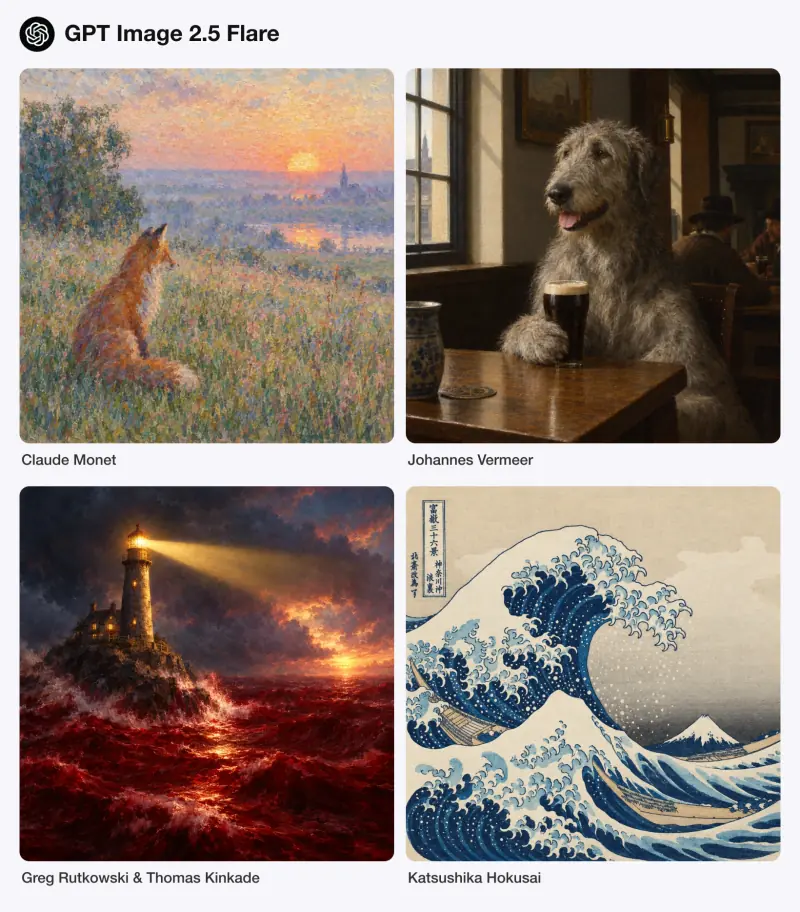
GPT Image 2.5 Flare by OpenAI produced the best results in the test: every style looks authentic.
The watercolor illustration has the texture of real paint, the noir panel has the exact caption from the prompt, and in the Van Gogh restyle, both the buildings and the sky are painted with swirling brushstrokes, and the composition of the photo stays the same. The pixel art scene is a complete game level, although it borrows elements from Super Mario, such as the question block and the Goomba.

GPT Image 2.5 Flare is also the only model that painted the main subject in the same style as the rest of the image. The Monet fox dissolves into the field in the same short broken brushstrokes as the grass and the sky, as Monet painted his figures, and the lighthouse stands in a sea that is really red. The Vermeer scene has the soft daylight from a side window that Vermeer used in his interiors. Like every other model, GPT Image 2.5 copied The Great Wave off Kanagawa for the Hokusai prompt, including the Japanese inscription.
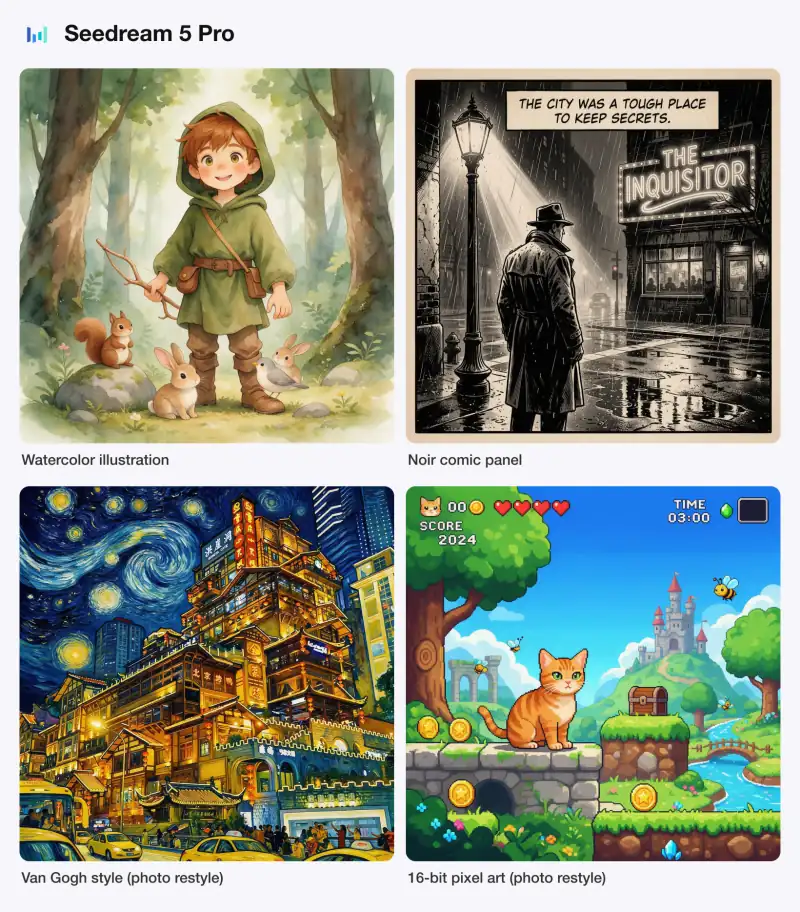
Seedream 5 Pro by ByteDance produced results close to the level of GPT Image 2.5, and in most styles, which of the two is better is a matter of taste.
The watercolor illustration is strong, and the pixel art level is the most detailed in the test, with a castle, coins and a full game interface. The Van Gogh restyle is where the model fell short: the swirls are there, but the paint is smooth and flat, without the thick impasto brushstrokes the prompt asks for. In the noir panel, the model added a neon sign with a name it made up, "The Inquisitor".
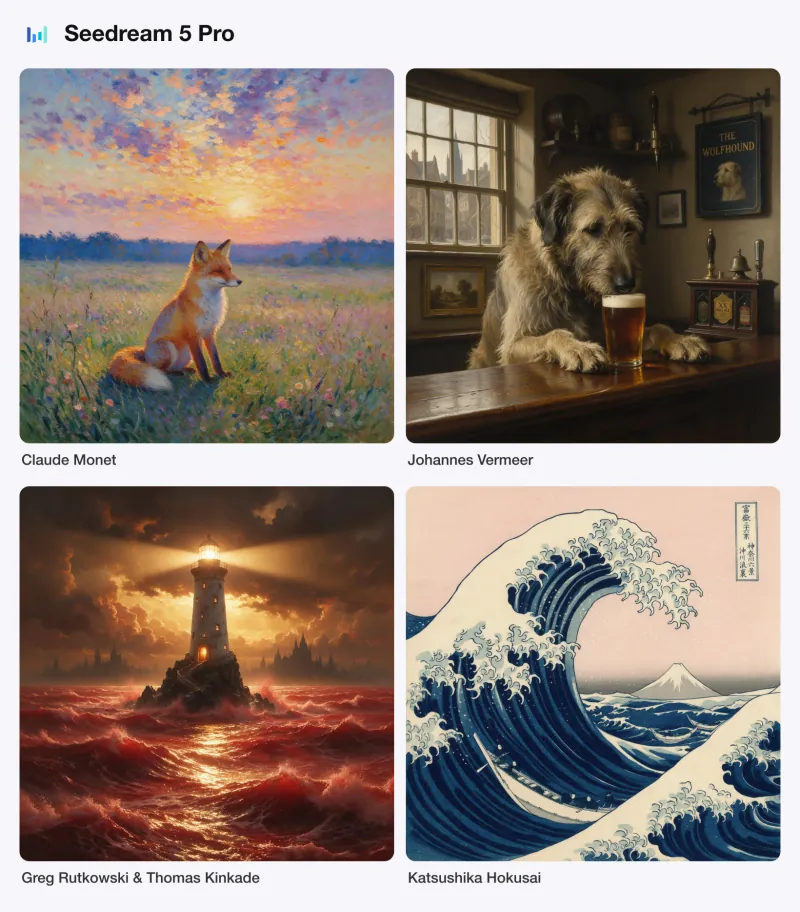
The artist styles show the same pattern. In the Monet painting, the sky is painted in loose impressionist strokes, but the fox is drawn sharp and detailed, as in a wildlife illustration, so the subject and the background look like two different paintings. The Vermeer scene turned into an English pub with a sign that reads "The Wolfhound", a modern detail that has nothing to do with Vermeer's 17th-century Delft interiors. The Hokusai print copies The Great Wave and adds a pink sky that the original doesn't have.
Nano Banana 2.1 by Google produced solid results in every style, with no complete failures, but it often stops halfway when it has to transform an image.
The clearest example is the Van Gogh restyle. The sky is painted with swirls, but the buildings, the lights and the crowd stay almost the same as in the photo, so the result looks like a photo with a painted sky. The other styles are better: the watercolor illustration is light, with a lot of white paper, and the pixel art cat walks along the same wall as in the original photo, so the game level still looks like the cat's real surroundings.

The Vermeer painting is the closest to Vermeer in the test: the dog sits on a bench at a table in a dim Dutch interior lit by a window. The Monet painting misses the style: it is a realistic landscape with a detailed fox, closer to a modern plein-air study than to Monet's broken color.

Grok Imagine Image 2 by xAI adds a lot of detail even where the style calls for less, and simple styles suffer the most from it.
The pixel art cat is the clearest example: it is drawn with so many pixels and shades that it loses the simple look of a 16-bit sprite and reads as a detailed digital painting, and the level behind it borrows the question block from Super Mario. The watercolor illustration looks like a dense picture book page with no white paper left. In the Van Gogh restyle, the model failed the task: only the sky changed, and the buildings stayed a photo.
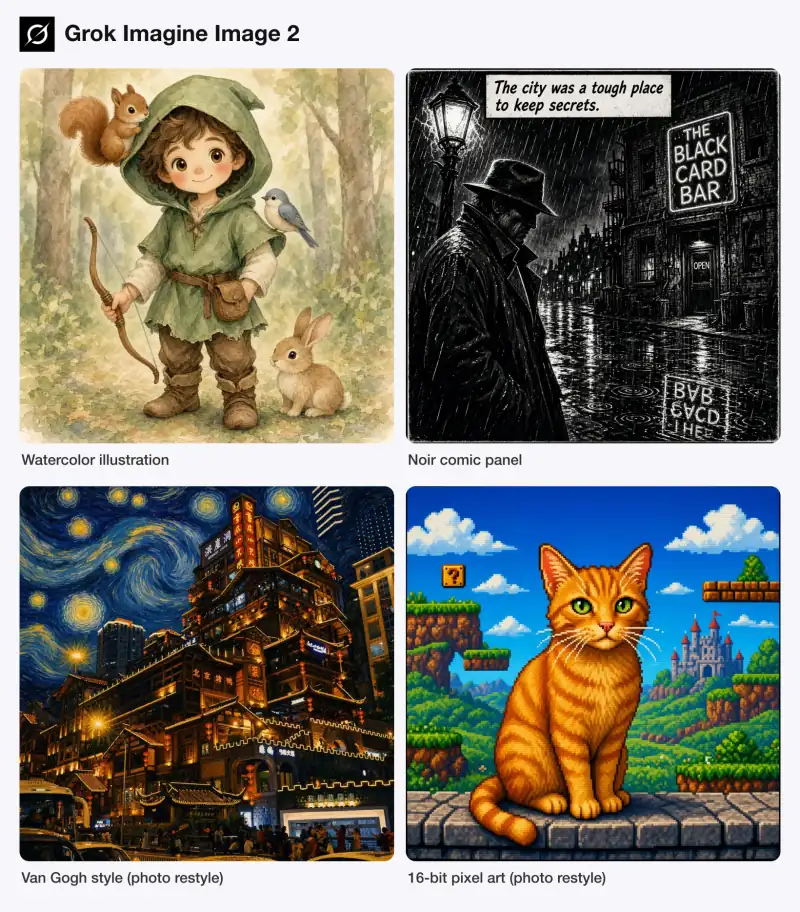
The detail works in Grok's favor only in the lighthouse painting, the most detailed in the test, because Greg Rutkowski's fantasy art is detailed too. The Monet painting is a generic oil painting with thick strokes and a sharply drawn fox, with nothing specific to Monet. The Hokusai print has an error none of the other models made: there are two Mount Fujis in it, one behind the other.

Nano Banana Pro by Google produced good results, but they aren't better than those of Nano Banana 2.1, and an image costs 150 credits, compared with 100 for Nano Banana 2.1. For art, there is little reason to pay more for it.
In the style tests, Nano Banana Pro did better than Nano Banana 2.1 in exactly one place: the Van Gogh restyle is painted completely, including the taxis from the original photo. The pixel art cat keeps the look of the cat from the photo. The noir panel has the exact caption, but also a sign with a name the model made up, "The Blue Dahlia", which appears in the image twice, on the wall and in the puddle.

In the artist styles, Nano Banana Pro borrows motifs from the artists' famous paintings: the Monet field has poppies and haystacks, and the Vermeer pub has a map and a lute on the wall, as in Vermeer's interiors. The brushwork doesn't follow: the fox and the dog are painted with the same smooth realism, so the paintings look like Monet and Vermeer only by their props. The bigger problem is that the model forges signatures. It signed the Monet painting and wrote "Rutkowski & Kinkade" in the corner of the lighthouse painting, so the fake signature has to be removed before an image like this is used anywhere. The sea in the lighthouse painting is dark maroon with no sense of blood.

Qwen Image 2 by Alibaba produced good results in some styles and a complete mess in others, so you can't predict what you will get.
The Van Gogh restyle is one of the best in the test, with strong swirling brushstrokes over the whole photo. The pixel art restyle is the worst: the model turned only the cat into pixels and left the blurred background of the original photo, with no game level at all, so the result looks like a sticker pasted onto a photo. In the noir panel, the model ignored the black-and-white inks from the prompt and added red and blue neon.
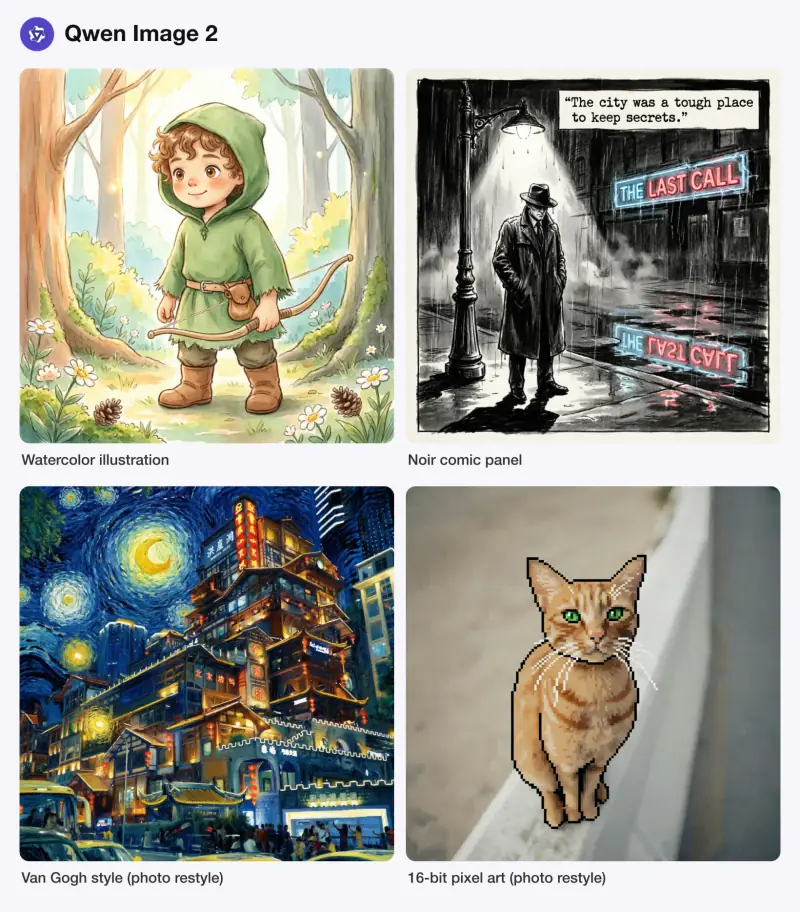
In the artist styles, Qwen Image 2 painted everything in its own manner. The Monet and Vermeer images look like the same oversaturated digital painting with glossy fur and no brushwork of either artist, and the Vermeer pub is lit by candles and a fireplace, the opposite of the cool daylight from a window that Vermeer is known for. In the lighthouse painting, the sea is dark with only a few red patches, although the prompt asks for a sea of blood.

Flux 2 Max by Black Forest Labs produced the most primitive results in the test: the images follow the prompts, but with the least detail and the weakest sense of the style.
The watercolor illustration is flat and simple, closer to a children's app than to a hand-painted book. The pixel art level is almost empty: a small sprite stands on two platforms against a plain sky. The Van Gogh restyle has muted, dark colors with none of the deep blues and bright yellows the prompt asks for. The only strong image is the noir panel, with clean comic inks and the correct caption.

Flux 2 Max is also the only model that refused a prompt: its content filter blocked the lighthouse prompt twice, most likely because of the words "sea of blood", although the other 6 models generated it without problems. The Hokusai print ignored the square format and came out as a narrow vertical print with white margins. The Vermeer painting looks like a 19th-century genre scene with a dog, and the Monet painting is signed with a fake signature, like the images from Nano Banana Pro.

The best AI art generator in 2026 is GPT Image 2.5 Flare by OpenAI. In our test of 7 image models, it was the only model that reproduced all 8 styles authentically, including the brushwork of Monet and Van Gogh. Seedream 5 Pro by ByteDance is the closest alternative, and Nano Banana 2.1 by Google produced the most consistent results among the other models.
Yes, AI image models can generate art in the style of a specific artist when the prompt names the artist. Models learn styles from the images in their training data, so artists with many well-known works, such as Monet or Hokusai, are reproduced best. How close the result is depends on the model: in our test, GPT Image 2.5 Flare came closest to each artist's manner, and Qwen Image 2 turned the Monet and Vermeer prompts into the same glossy digital painting. Famous artworks also limit the result: every model copied The Great Wave off Kanagawa almost exactly when asked for Hokusai's style.
Yes, AI image editing models can turn a photo into a painting. The photo is uploaded together with a prompt that names the style, and the model redraws the image in that style and keeps its composition. Not every model redraws the whole photo: in our test, GPT Image 2.5 Flare and Nano Banana Pro painted the entire night street in the Van Gogh style, and Grok Imagine Image 2 and Nano Banana 2.1 changed mainly the sky.
GPT Image 2.5 Flare, Nano Banana Pro and Grok Imagine Image 2 are the best AI art generators for text in images: in our test, they wrote the comic caption exactly as it was given in the prompt. Seedream 5 Pro, Nano Banana 2.1 and Flux 2 Max wrote the caption without errors but in capital letters, and Qwen Image 2 added quotation marks around it.
Yes, most AI art generators have a free plan with a daily limit:
Open-source models such as FLUX have no limits when you run them on your own computer, but they need a powerful graphics card.


