We thought it'd be interesting to compare GPT Image 2.5 and Seedream 5 Pro in head-to-head tests — both are flagship image generation models, from OpenAI and ByteDance respectively, and both advertise particular strengths in creative visuals and image editing accuracy.
We put those claims to the test and found that GPT Image 2.5 was more reliable, while Seedream 5 Pro showed surprisingly strong artistic taste. As for which model was better overall, we'll let you decide.
Both models received the same prompt, reference images, and requested aspect ratio for every test. We used GPT Image 2.5 Flare at high quality and Seedream 5 Pro at its corresponding high-resolution setting.
The benchmark covers five kinds of work:
Photo editing and identity preservation
Multi-reference composition
Sequential editing
Style and technique control
Typography, presentation design, UI, and concept art
We judged prompt accuracy, subject consistency, text correctness, composition, and overall finish.
Photo editing
Dressing a corgi as a firefighter
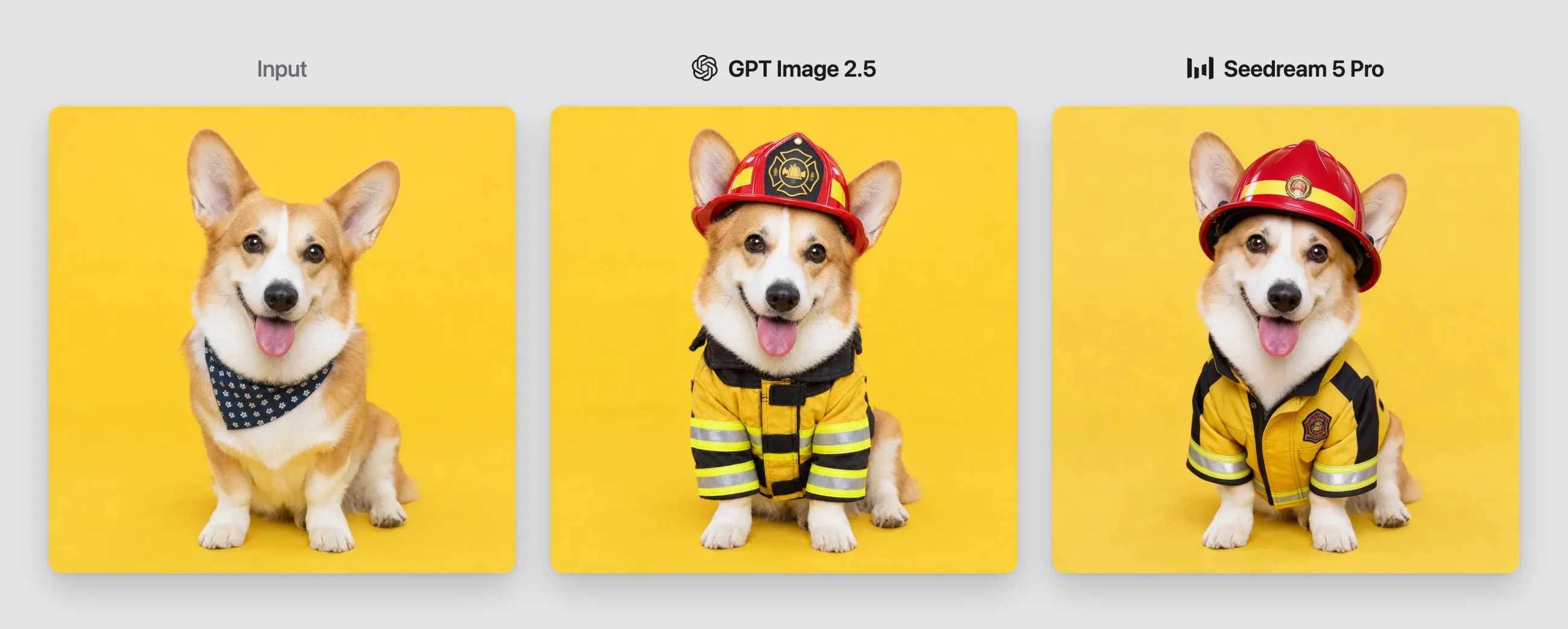
The first edit asked each model to dress the corgi in a yellow-and-black turnout jacket:
The same corgi dressed as a firefighter by both models
GPT Image 2.5 perhaps stays a little closer to the source photograph, and it created a more realistic and detailed uniform, but which model won this test is a matter of personal taste. In our opinion, it's GPT Image.
Winner: GPT Image 2.5
Turning a kitchen selfie into a professional headshot
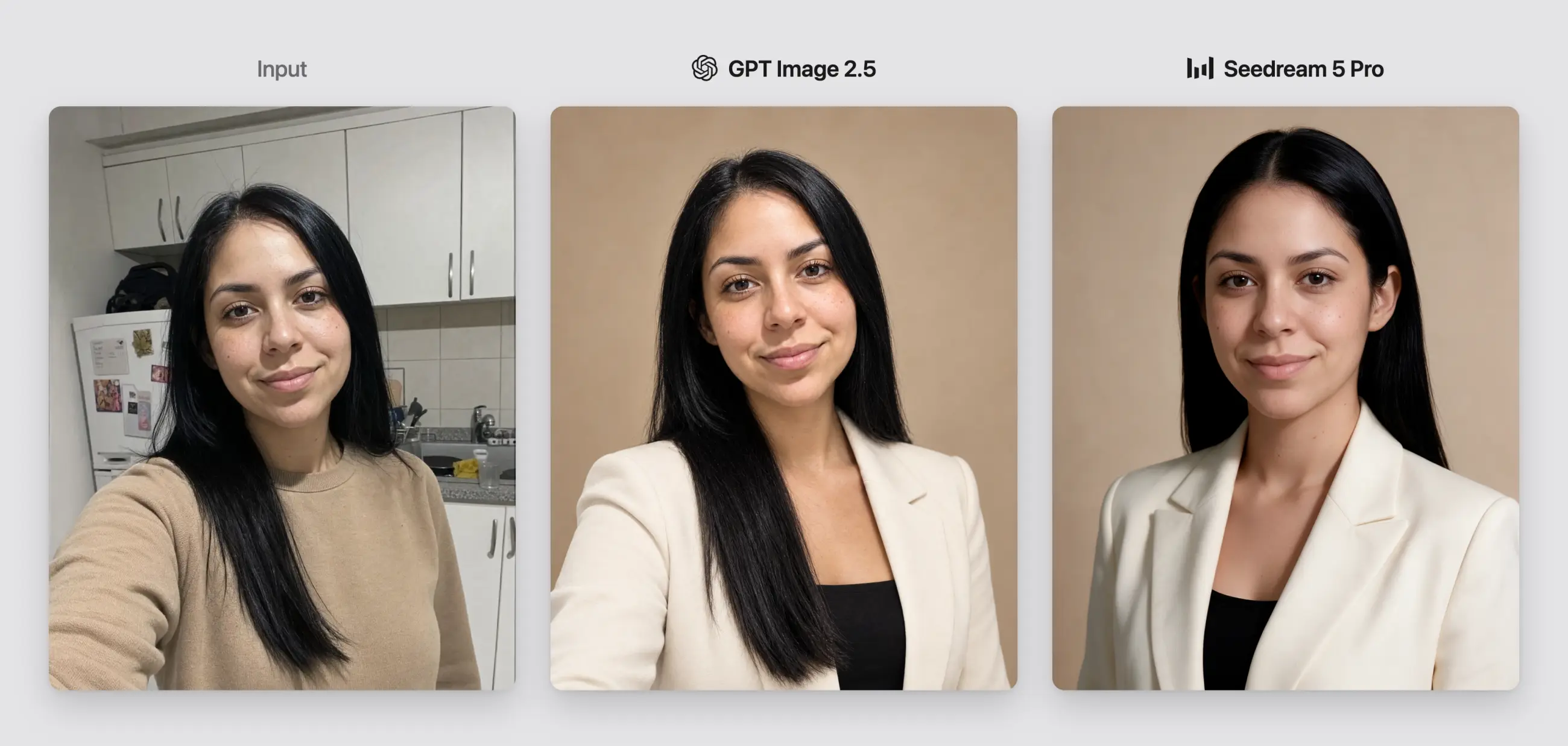
We then gave both models an AI-generated candid selfie of a woman and asked them to turn it into a professional headshot.
A casual selfie converted into a professional headshot
GPT Image 2.5 actually failed the test, as it didn't reposition the woman and kept sharp shadows on her face, while Seedream correctly reposed the subject and added soft studio lighting. Which portrait do you prefer?
Winner: Seedream 5 Pro
Combining three people in a ski chalet
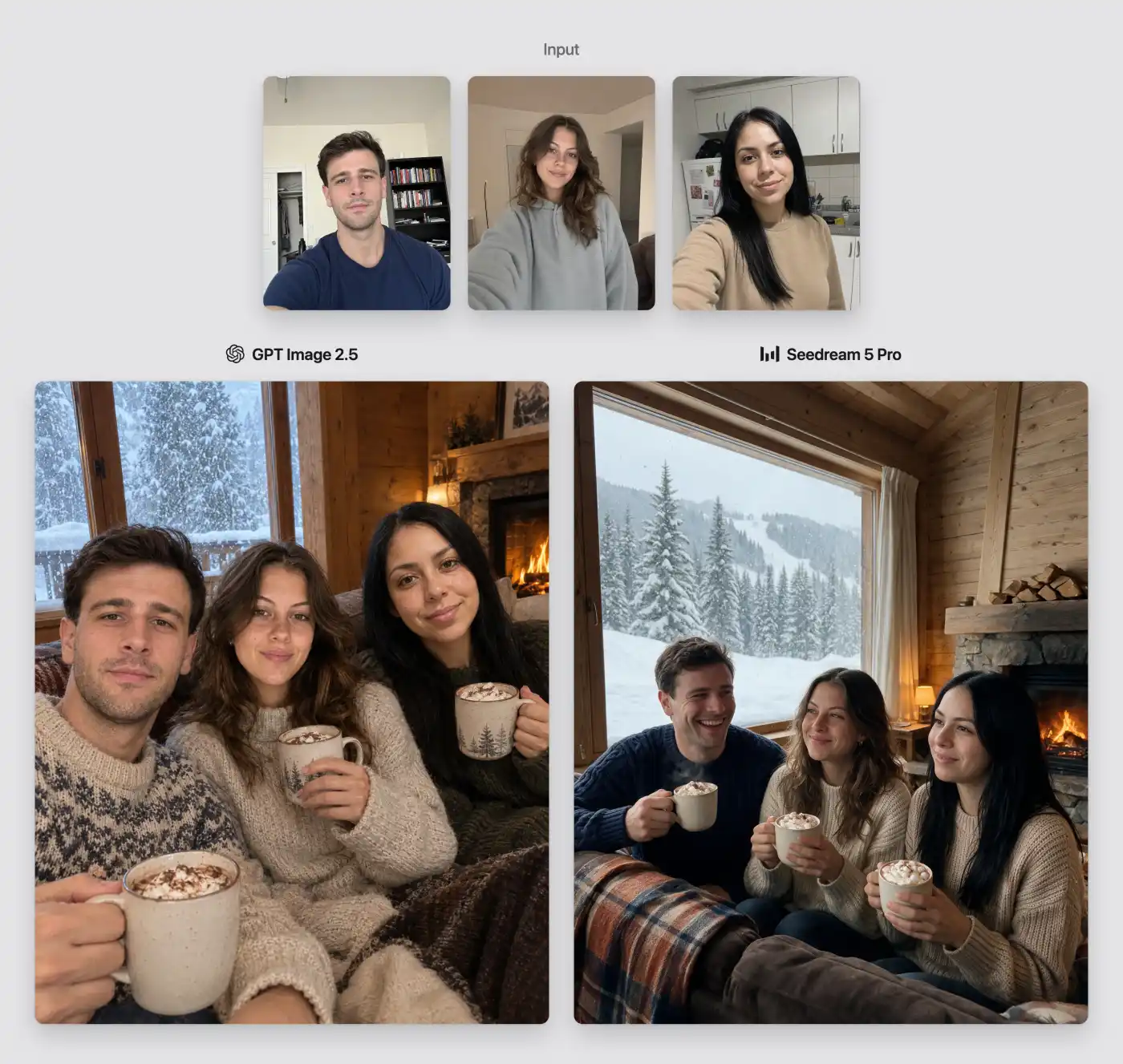
For the multi-reference test, the models received three separate selfies and we asked them to place all three people on a sofa in a wooden chalet.
Three separate people combined into one candid chalet photograph
You can perhaps see the difference in tuning here: Seedream created a more polished, magazine-style shot, while GPT Image 2.5 created a more candid photograph, as if the group had been photographed by a friend. The background is also more realistic, with another cabin visible through the window — we didn't ask for that detail specifically. It's interesting how Seedream 5 Pro went for a polished look, whereas GPT Image 2.5 produced something more believable, and we prefer it.
Winner: GPT Image 2.5
Multi-step editing
Changing an outfit, then moving the subject to Tokyo
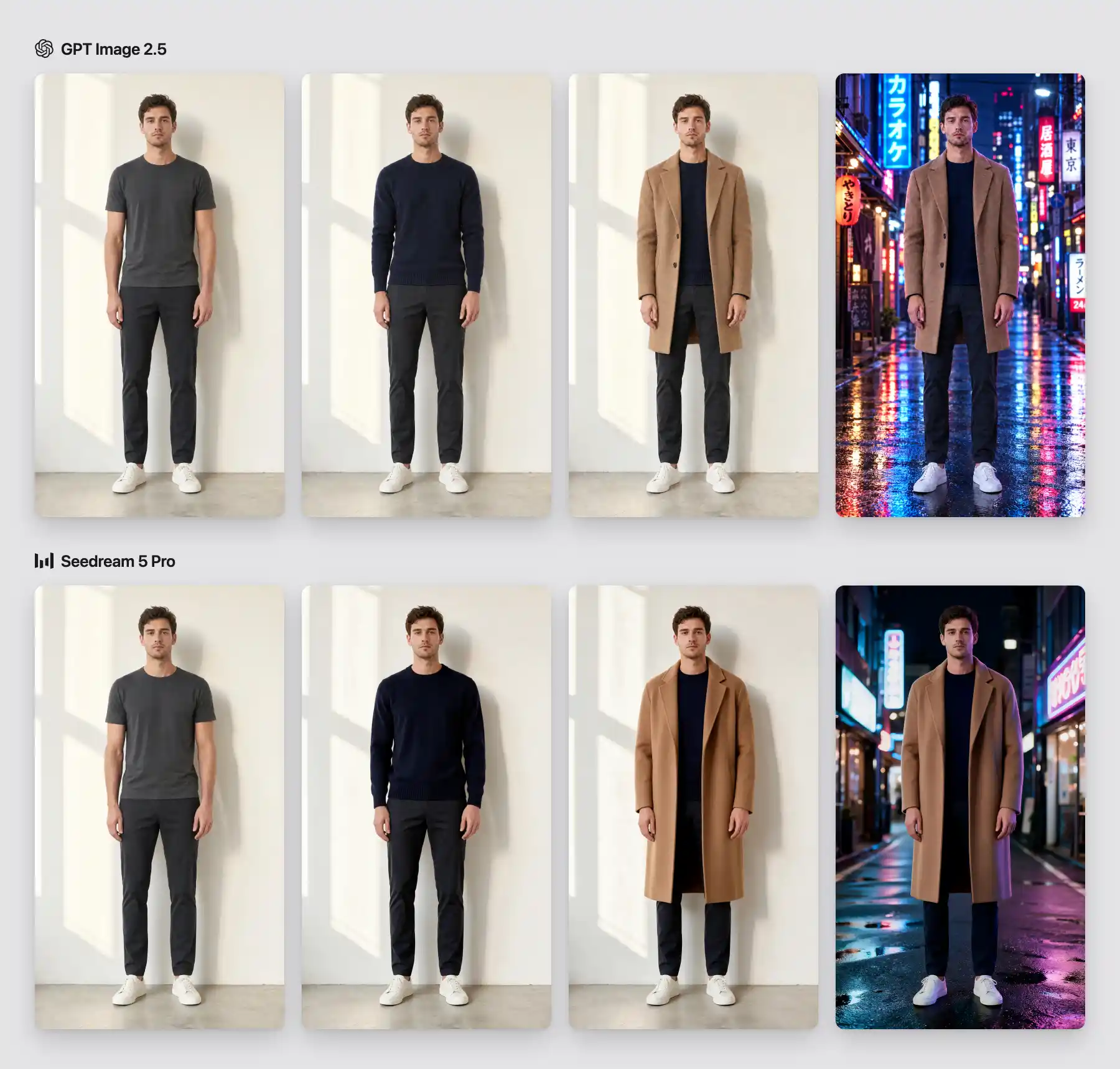
This three-stage chain began with a full-body studio photograph. First, the T-shirt became a navy wool sweater. Next, the model added an open camel overcoat. Finally, the plain studio was replaced by a neon-lit Tokyo side street at night. The face, pose, trousers, sneakers, and outfit from the previous step were meant to remain stable.
A three-stage clothing and background edit chain
Both models complete every requested edit, but GPT Image 2.5 accumulates less drift. The subject's stance, proportions, hair, and clothing remain nearly fixed through all four frames. Seedream is consistent at first, then changes the jeans color more visibly when it introduces the coat. GPT also integrates the blue and magenta street light into the final portrait more convincingly, as well as adding more textures and micro-detail all around.
Winner: GPT Image 2.5
Changing three tulips to seven, then adding exact text
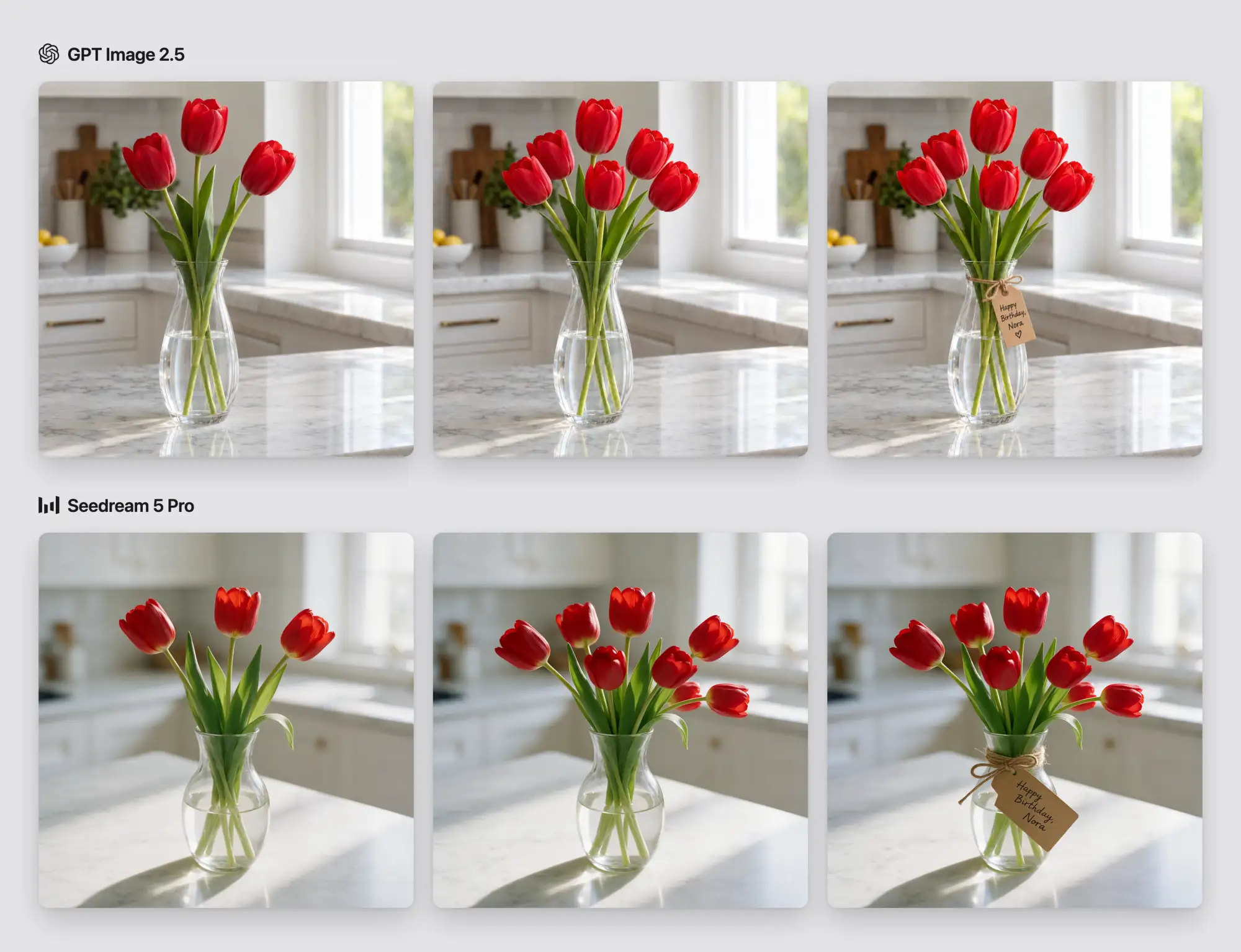
This test covers counting, local edits, and typography. We asked each model to first generate a clear vase with exactly three red tulips, then change the bouquet to seven, and finally add a kraft-paper tag reading “Happy Birthday, Nora.”
Three tulips changed to seven, followed by a personalized gift tag
Seedream 5 Pro added an extra tulip — producing eight instead of seven — which gives GPT Image 2.5 an automatic win in this test.
Winner: GPT Image 2.5
Style control
One lighthouse in four visual styles
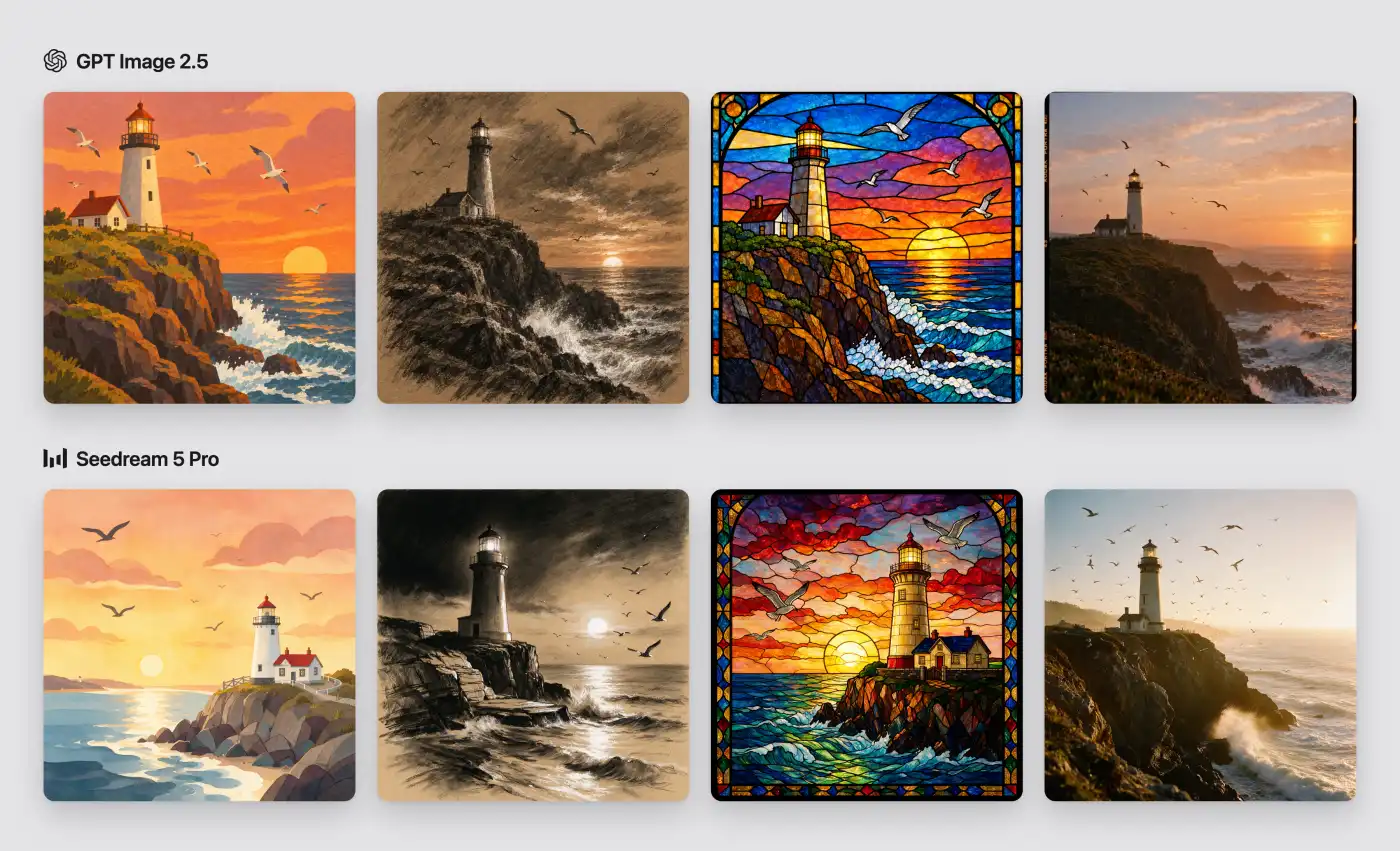
We rendered the same lighthouse scene as a children's picture-book illustration, an expressive charcoal drawing, a stained-glass window, and a 35mm film photograph.
The same lighthouse translated into four distinct visual styles
Both models show strong separation and beautiful artistic imagery. GPT Image 2.5 perhaps created a more believable 35mm film look, but Seedream uses strong contrast that makes its images really pop. Which one you prefer comes down to personal preference and the artistic style you're going for.
Winner: Tie
Recreating four famous artistic styles
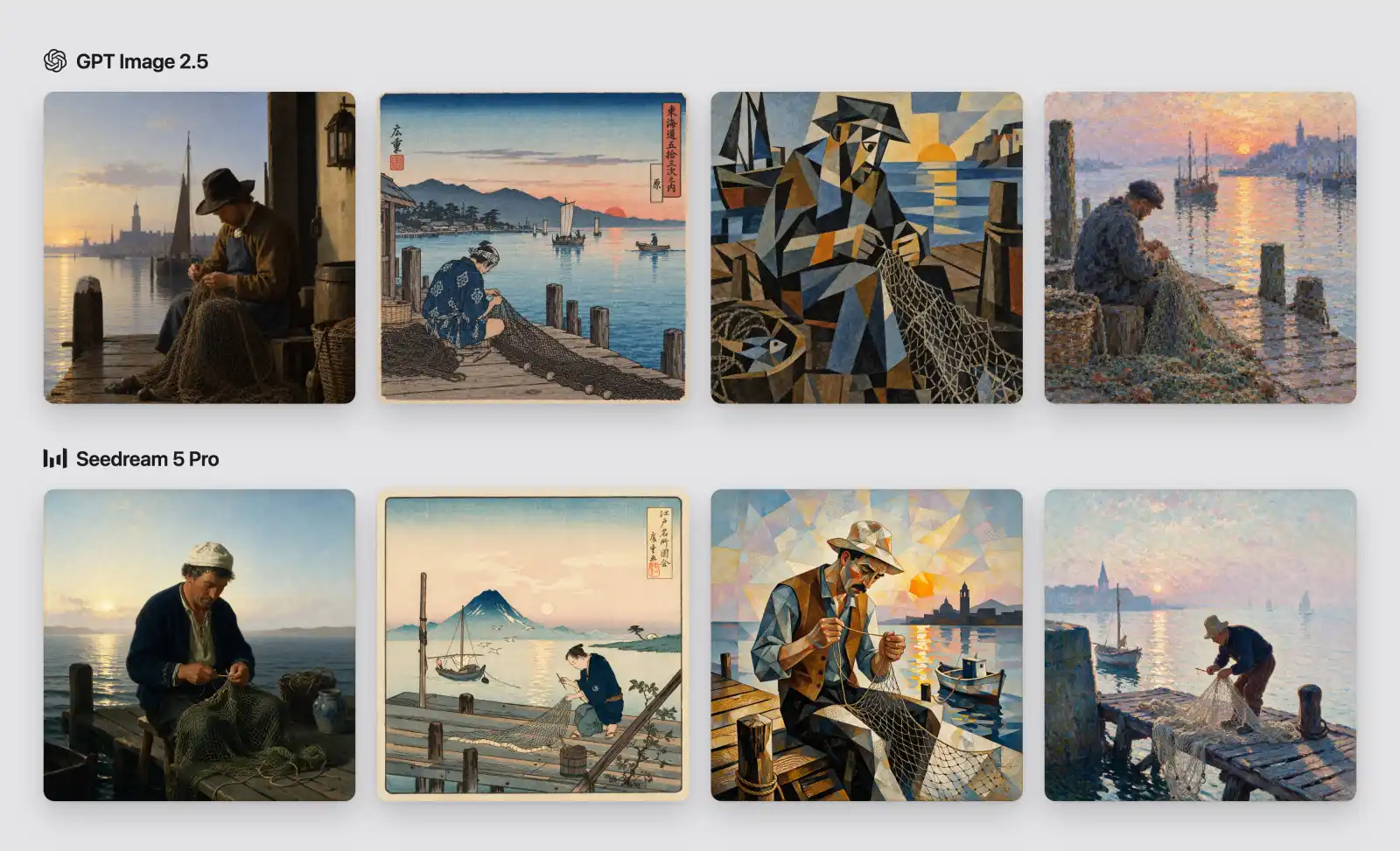
We asked GPT Image and Seedream to "paint" a fisherman mending a net on a wooden pier at dawn in the styles of Johannes Vermeer, Utagawa Hiroshige, Pablo Picasso's Cubism, and Claude Monet.
A fisherman at dawn interpreted through four historical art traditions
In this case, GPT Image 2.5 completely blew Seedream 5 Pro out of the water. While ByteDance's model integrated certain aspects of each style into its images, GPT Image 2.5 captured each iconic style completely. Without context, you'd be forgiven for thinking you're looking at an original artwork.
Winner: GPT Image 2.5
One still life in four rendering techniques
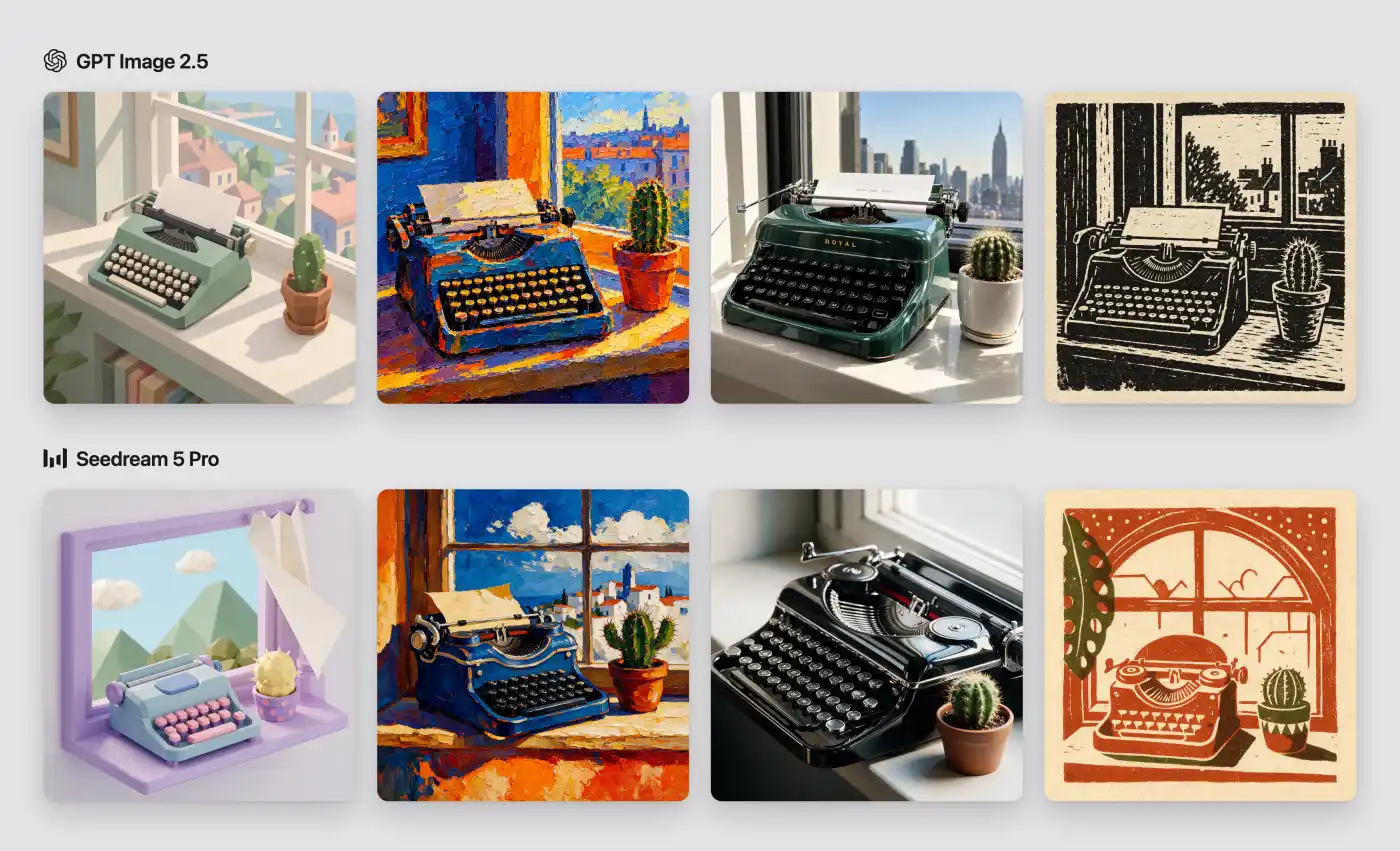
To test technique, we asked the models to generate a vintage typewriter and a small cactus in four styles: low-poly 3D, thick impasto, glossy editorial product photography, and a two-color linocut.
A typewriter still life rendered as 3D, impasto, photography, and linocut
GPT Image 2.5 interprets the material instructions more literally. The impasto has visible palette-knife relief, the product photograph gives the typewriter believable enamel and chrome, and the linocut has convincing carved marks and ink loss.
Winner: GPT Image 2.5
Text and information design
A café chalkboard with exact menu copy
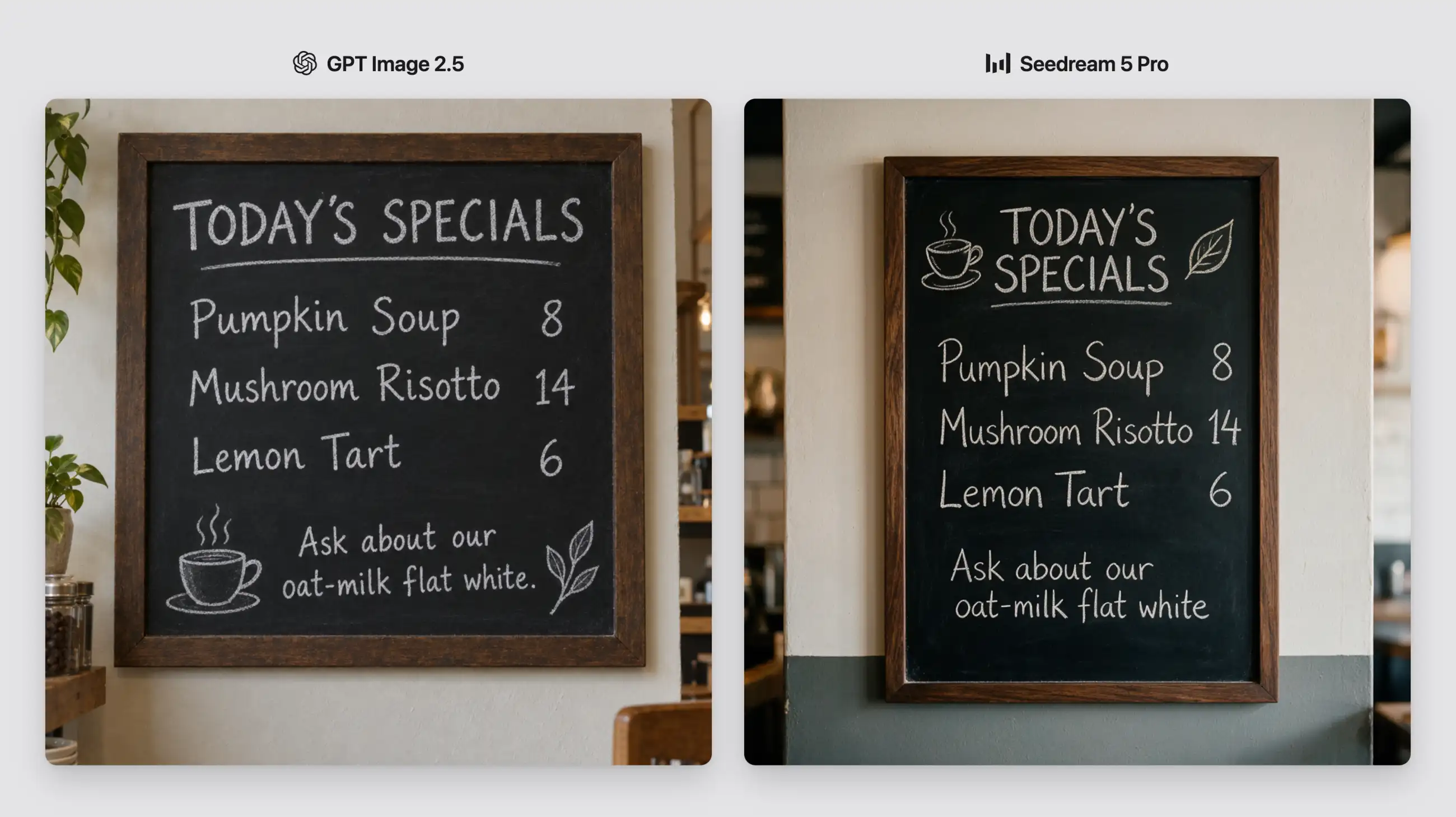
The chalkboard had to contain five exact lines, including three dishes with prices and the sentence “Ask about our oat-milk flat white.”
A hand-lettered café menu with five required lines of text
Both outputs are clean. Every word, price, apostrophe, and hyphen is present and readable.
Winner: Tie
A four-step photosynthesis slide
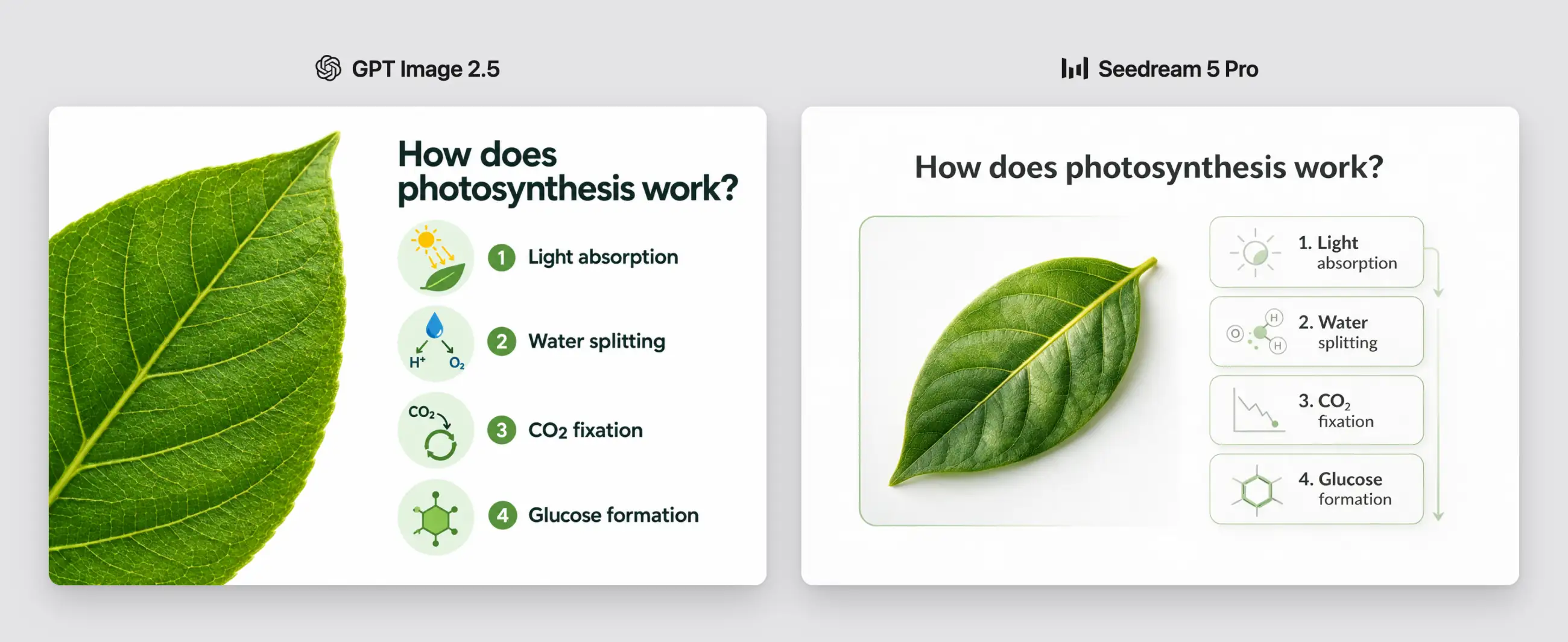
The presentation brief called for a large leaf, a white background, and four ordered steps: light absorption, water splitting, CO2 fixation, and glucose formation.
A four-step explainer slide about photosynthesis
The more you look at the results from this test, the more you realize that there's a generational leap between these two models, at least when it comes to pitch decks and presentations. First, the decision to crop the leaf at the corner and show it only partially on the slide is unusual for AI-generated imagery. Second, the actual infographics are much more descriptive. Finally, the texture of the leaf is far more realistic.
Winner: GPT Image 2.5
Six labeled European luggage tags
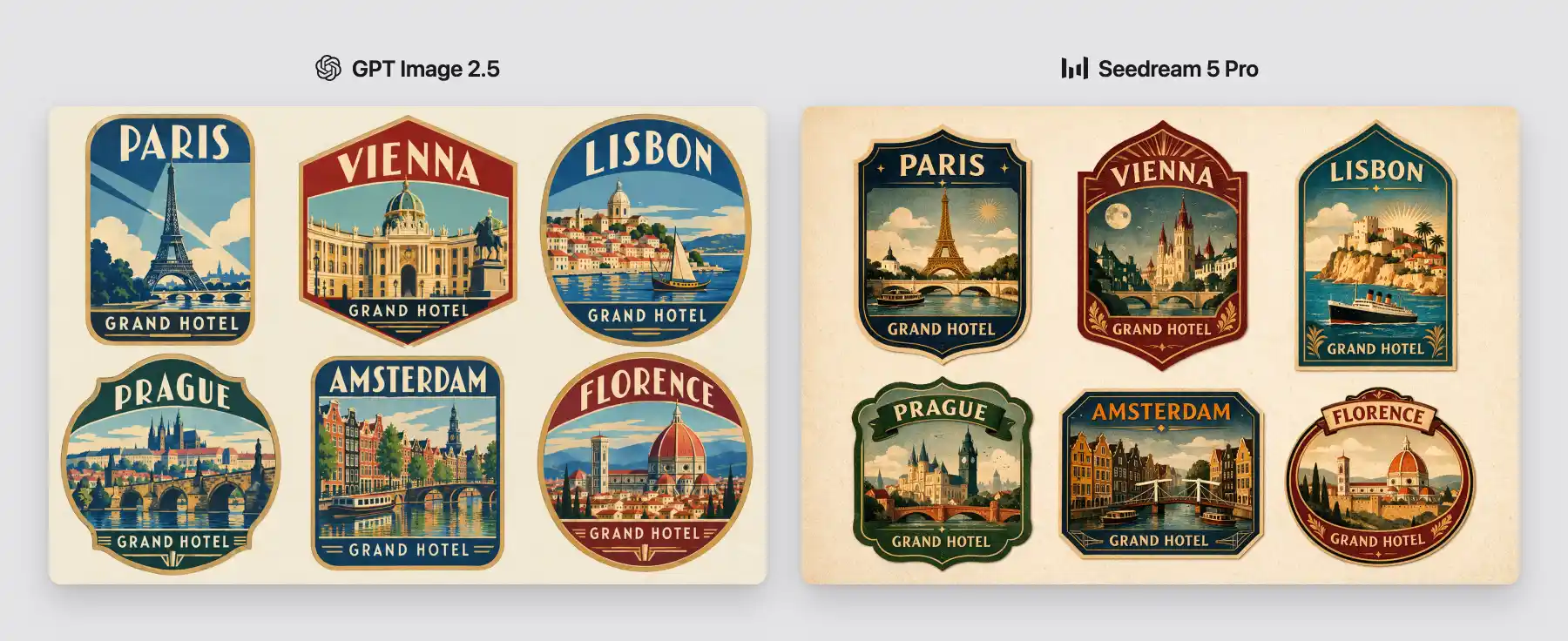
This test requested six 1920s-style luggage labels in a 3-by-2 grid. Each needed a different shape, one of six city names, and the words “GRAND HOTEL.”
Vintage luggage labels for Paris, Vienna, Lisbon, Prague, Amsterdam, and Florence
Both models render all twelve required text elements correctly and keep the grid orderly. Seedream offers more variety in label silhouettes and ornament. GPT Image 2.5 is stronger on place-specific imagery: the Eiffel Tower, Vienna's imperial architecture, Prague's bridge and skyline, Amsterdam's canal houses, and Florence's cathedral are immediately identifiable.
Winner: GPT Image 2.5
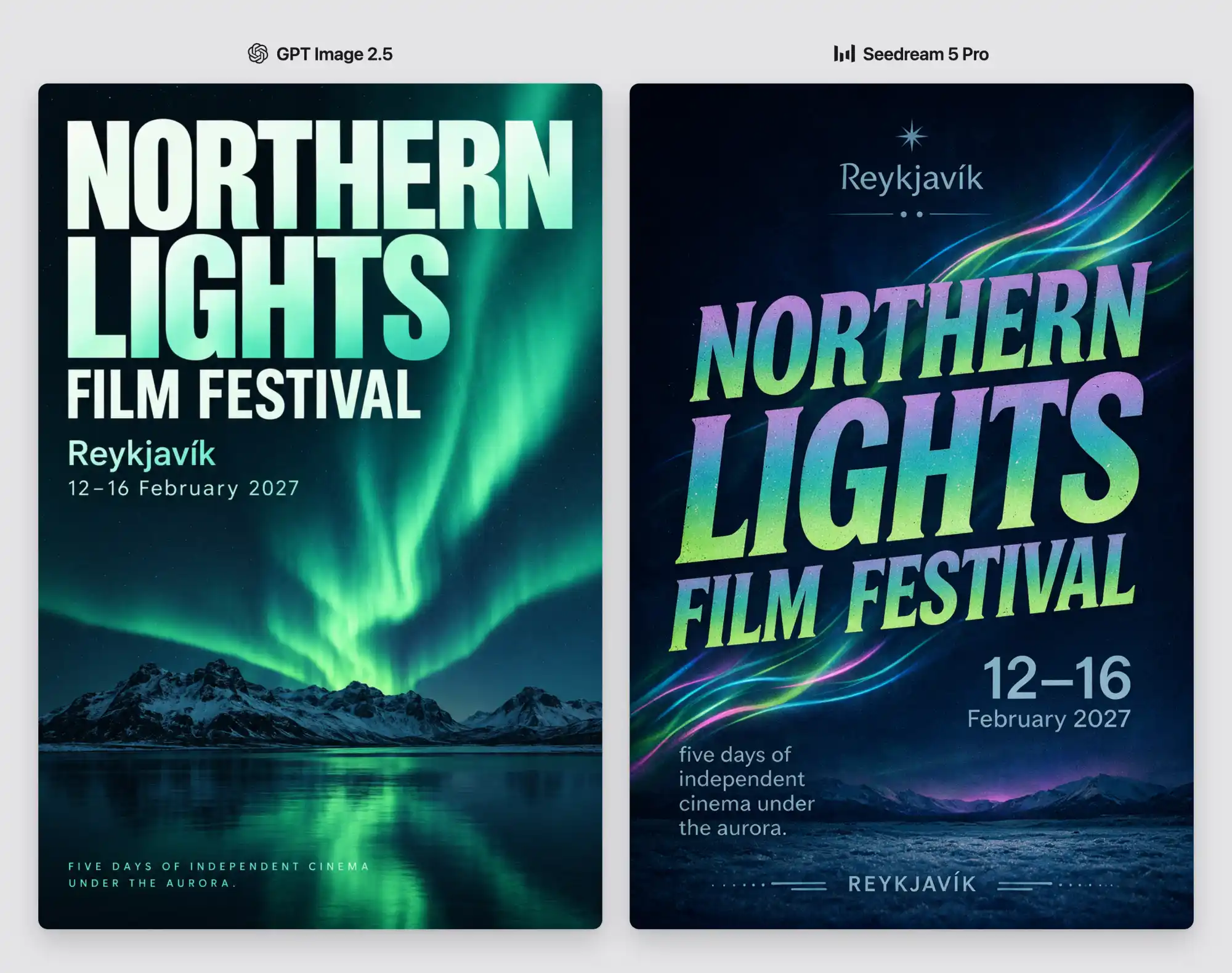
A typographic Northern Lights film-festival poster
For this poster we supplied the event name, Reykjavík, the dates, and one line of supporting copy, then left the hierarchy, type pairing, and palette to the models.
Two typographic poster directions for the same film festival
GPT Image 2.5 went for a realistic take, while Seedream chose a stylized approach. GPT Image 2.5's image has a cleaner composition and typography, but we feel that Seedream captures the theme better, so in this case, we'd give it the edge.
Winner: Seedream 5 Pro
Interface and web design
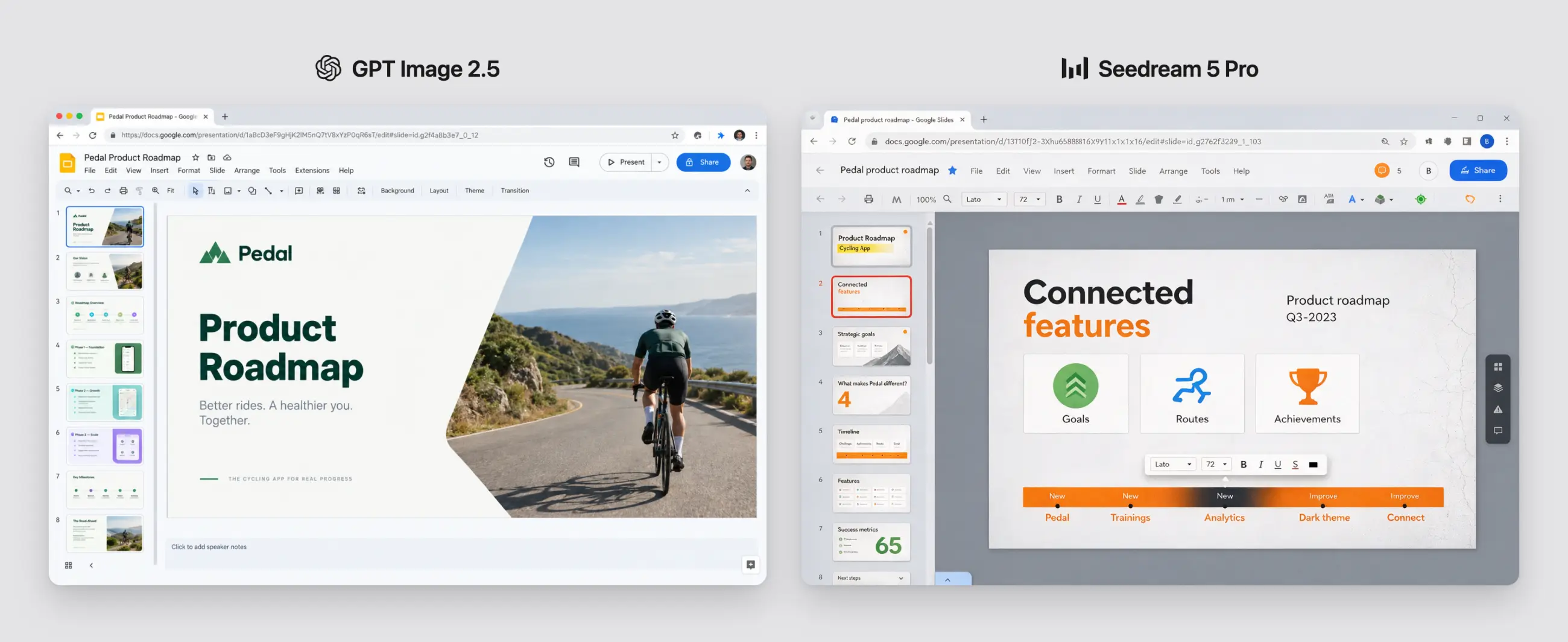
An eight-slide product roadmap in Google Slides
The prompt asked for a believable desktop Chrome screenshot of Google Slides editing an eight-slide roadmap deck for a cycling app called Pedal. The browser chrome, toolbar, filmstrip, and selected slide all needed to read correctly.
An eight-slide cycling-app roadmap shown inside Google Slides
GPT Image 2.5 recreates the application one-to-one, while Seedream merely approximates the interface. You can also see that when asked to create slides within Slides, Seedream's complexity drops considerably, while each slide in the GPT version is fully rendered and full of detail.
Winner: GPT Image 2.5
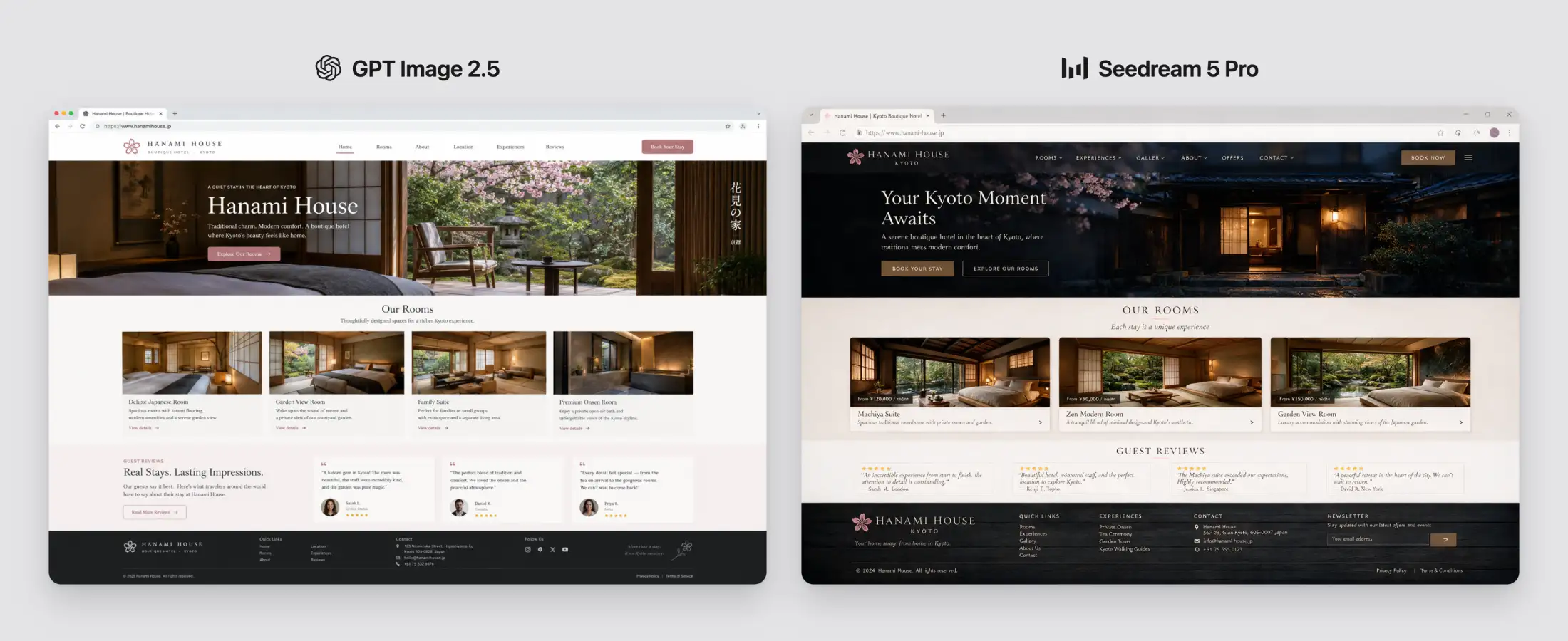
A boutique-hotel homepage
We then asked the models to create a desktop homepage design for Hanami House in Kyoto, including navigation, a hero, room cards, guest reviews, and a footer.
Two complete homepage concepts for a fictional Kyoto boutique hotel
GPT Image 2.5 created a believable website — you could actually take this design into Figma and turn it into a usable site. Seedream introduced more visual elements — too many, perhaps — along with illegible fonts.
Winner: GPT Image 2.5
Concept art
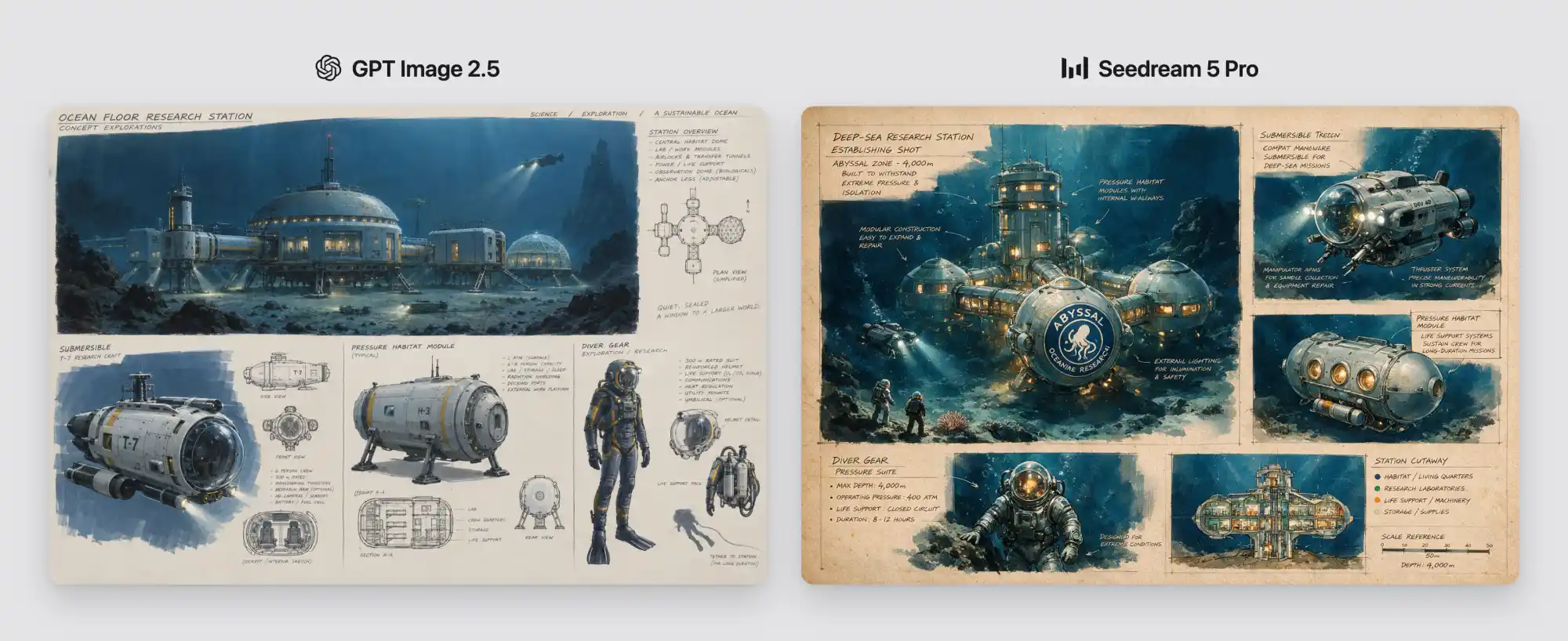
A deep-sea research station design sheet
In the final test, we asked each model to create a wide concept-art spread inspired by Ralph McQuarrie's industrial-design work. The subject was an ocean-floor research station.
Industrial-design studies for a deep-sea research station
We've previously tested GPT Image 2.5 against GPT Image 2 and noted a massive improvement in concept-art quality. It's the same story here. GPT Image 2.5 created a much more interesting, detailed, and believable concept for both the main station and the various props. Seedream is more colorful, but on closer inspection, the design doesn't make much sense — it's form over function.
Winner: GPT Image 2.5
Final verdict
Across 15 tests, GPT Image 2.5 won 11 rounds, Seedream 5 Pro won two, and two ended in ties.
Model
Wins
Best at
GPT Image 2.5
11
Identity preservation, controlled edits, style fidelity, presentation and interface design, concept art
Seedream 5 Pro
2
Studio-style portrait restaging and bold poster art direction
Tie
2
Broad style control and exact short-form text
The clearest difference is not one isolated capability but consistency across very different tasks. GPT Image 2.5 won the photo-composition test, both multi-step edits, the historical-style and rendering-technique rounds, the information slide, the luggage labels, both interface tests, and the concept-art spread. It was more likely to preserve structure, add meaningful detail, and produce an image that still made sense under close inspection.
Seedream 5 Pro still produced two clear wins. It did a better job of transforming the casual selfie into a deliberately posed, softly lit studio portrait, and its more stylized Northern Lights poster captured the festival theme better. The lighthouse set and chalkboard menu ended in ties, showing that Seedream remains competitive when the task rewards visual punch or straightforward text rendering.
The speed gap reinforces the overall result. In our 28 measured generations, GPT Image 2.5 Flare averaged 25 seconds versus 72 seconds for Seedream 5 Pro. Individual requests will vary with queue load, image size, and task complexity, but GPT Image 2.5 was consistently faster in this run and made repeated iteration much easier.
Taken as a whole, this was a decisive result for GPT Image 2.5. It was both faster and more dependable, and its advantage became most visible in tasks that combined several constraints at once. Seedream 5 Pro can still be the better creative choice for a specific aesthetic direction, but GPT Image 2.5 is the stronger all-round model in this comparison.