We tested FLUX 3 Max against Seedance 2.5 and FLUX 3
Last Updated:
2026-10-21
We tested FLUX 3 Max against Seedance 2.5 and FLUX 3
Fal and Black Forest Labs collabed to create a new video model — FLUX 3 Max. It's an improved version of FLUX 3 that generates 10-second clips in about 12 seconds, solving one of the biggest problems of AI video generation — seemingly endless waiting times (it's 22 times faster than Seedance 2.5).
But were there compromises to achieve that speed? We've put the new model to the test across all of its generation modes, so let's find out.
FLUX 3 Max is a video model made by fal Research, the research team of the AI platform fal, together with Black Forest Labs.
What's unique for this release is that the model was post-trained by fal, a multi-model provider specializing in AI APIs, to improve motion and prompt following. The team also optimized how the model runs to make generation faster.
Here are some of the main specs for the new release:
Feature
FLUX 3 Max
Modes
Text-to-video, image-to-video, keyframes-to-video
Video length
5–20 seconds
Resolution
720p, 1080p with upscaling
Aspect ratios
21:9, 2:1, 16:9, 4:3, 1:1, 3:4, 9:16
Sound
Generated with the video, can be turned off
In image-to-video mode, you can also add a last frame, and in keyframes mode, the model takes up to 10 images and places each one at a set point in the video.
There's also a reasoning setting: on high, the model spends more time working out the prompt before it starts generating, which makes generation slower.
FLUX 3 Max benchmarks
On Artificial Analysis, an independent company that ranks video models by blind votes, FLUX 3 Max scored 1,139 points — the same as Seedance 2.5, in the preliminary image-to-video results published at launch.
Here's how it stacks up against other models:
Model
Elo, image-to-video
MiniMax H3
1,141
FLUX 3 Max
1,139
Seedance 2.5
1,139
Gemini Omni Flash 1.1
1,134
Wan 3.0
1,127
FLUX 3
1,089
What this basically means is that in blind testing, when multiple versions of the same video were shown, people chose FLUX 3 Max almost as much as MiniMax H3 and Seedance 2.5, basically putting it into the top-3 best AI video models.
The two-point gap between MiniMax H3 and FLUX 3 Max is within the margin of error, so we can basically say that these three models share first place.
For reference, the base FLUX 3 is 50 points lower, so post-training definitely changed the model a lot.
But the biggest, most impressive difference is speed — FLUX 3 Max literally generates videos as fast as some other models generate images. It feels like magic — after typing the prompt, there's barely any waiting, which makes iterating on video ideas feel so much better.
But what about numbers? Well, the table below shows how long different models take to generate a 10-second 16:9 clip at 720p, so judge for yourself:
Model
Generation time
FLUX 3 Max
12.45 s
Gemini Omni Flash 1.1
47.37 s
MiniMax H3
83.26 s
FLUX 3
126.44 s
Wan 3.0
180.16 s
Seedance 2.5
277.80 s
Yes — it's a generational leap in speed, at least according to fal's benchmark. But does it hold up? Well, kind of.
We tested FLUX 3 Max
We generated a 10-second 720p clip with sound in text-to-video, image-to-video, and keyframes modes.
A caveat right away — we couldn't replicate the 12-second generation time. In our experience, the model took between 19 and 27 seconds to generate the clips. Granted, this is still very impressive, but almost twice as long as in the official benchmark. In the real world your results will probably be closer to this.
Text-to-video
In the text-to-video mode, FLUX 3 Max generates the whole clip from a description.
For this test, we took a boat chase prompt from fal's collection of Seedance 2.5 prompts:
A low chase camera skimming a hand's width above the water in a narrow canal at dusk, two wooden longtail boats running flat out between stilt houses with laundry strung overhead. The lead boat carries one woman at the tiller in a soaked linen shirt, the second is two lengths back and closing, its long-shaft propeller throwing a rooster tail that lights up orange in the last of the sun. She looks back once, then flattens herself along the gunwale as a low concrete footbridge comes up, and her boat goes under it with about thirty centimeters of clearance. The pursuing driver ducks too late, has to haul off into the pilings, and his boat slews, catches, and keeps coming. The camera stays locked at water level tracking parallel and never rises above the gunwale line, one continuous shot with no cuts. Anamorphic, hard low sun flaring off the wake, deep shadow under the houses, heavy grain. Two unmuffled engines at full throttle, water slamming both hulls, wood hitting concrete, birds coming off the roofline, no score.
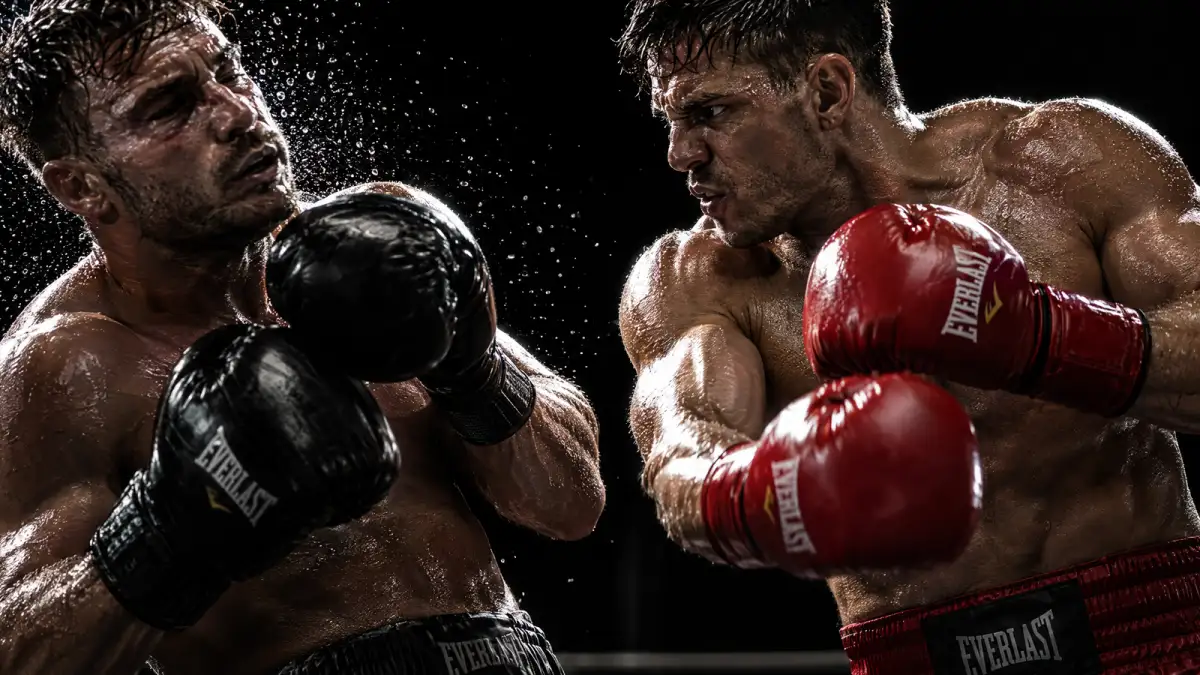
Close up shot inside a boxing ring. Two boxers at close range, the boxer in red gloves loading a right hook toward the jaw of the other boxer. Lit by hard white point light, rim light, high contrast, sweat beads and sweat particles flying, glowing edges along muscles. Pure black background. Extreme contrast, deep crushed blacks, high-end styalized sports commercial, shot on 80mm.
And here's the prompt we used to generate the video:
Fast boxing exchange in real time. The red-glove right hook lands on the jaw, speed ramp into extreme slow motion on impact, cheek ripple, sweat spray frozen in the air, camera slowly arcs around. Then it snaps back to real speed, he stumbles into the ropes. Hard white point light, rim light, pure black background. Sound: gloves and crowd roar, muffled heartbeat in the slow motion, crowd roar slams back in.
And here's the resulting video:
Keyframes
In keyframes mode, you can give FLUX 3 Max the frames the video has to pass through, and the model fills in the motion between them. The model can currently take up to 10 frames.
We used the following prompt:
FPV drone shot following the mountain biker. He drops in off the top of the red sandstone ridge and rides the steep spine down at full speed, the bike bucking over loose rock, then launches off a small rock lip and lands hard on the dusty trail below, his rear wheel sliding out in a burst of red dust. The drone dives after him and stays a few meters behind him the whole way, one continuous shot. Sound: wind roaring past the drone, tires skidding on loose rock, the thud of the landing.
And here's the result:
FLUX 3 Max vs Seedance 2.5 vs FLUX 3
Given that FLUX 3 Max is so much faster, the real question is whether it can keep up with the best models on quality.
We compared FLUX 3 Max with Seedance 2.5, which shares first place with it on the Artificial Analysis leaderboard, and with FLUX 3, the model it's built on. All three got the same text prompt and the same settings: 16:9, 720p, sound on. All three ran through fal, and we kept the first video from each model.
We didn't write these prompts ourselves. The car chase is from fal's collection of Seedance 2.5 prompts, so Seedance 2.5 plays on its home field here, and the parkour jump is from Clipia's comparison of Seedance 2.0, Kling 3.0 and Veo 3.1.
Test
FLUX 3 Max
Seedance 2.5
FLUX 3
Car chase
Every stage, but starts on a flat level
Every stage, closest to the prompt
No crash at the end
Rooftop parkour
Jump, roll and run on
Highest jump, roll in a cloud of dust
Long run-up, jump at the very end
In the videos below, FLUX 3 Max is on the left, Seedance 2.5 in the middle and FLUX 3 on the right. The side-by-side videos have no sound.
Car chase
A car chase is hard for video models because the two cars and the camera all move at once, and the scene has to stay consistent through several story beats. In this prompt, there are three: the cars race down the spiral ramp of a parking garage, the pursuit car pulls level, and when the sedan brakes, the pursuit car hits the wall. The camera rides low next to the sedan and then switches to a wide shot to catch the crash.
The prompt:
Stage 1: Level six of a concrete multi-storey car park at night, empty, lit by sodium strips with every third one dead. A black sedan comes around the ramp at speed with its headlights off, and a white pursuit car follows one beat later with its lights on full. Ends with both cars committed to the same descending spiral, the sedan half a turn ahead. Stage 2: They take three continuous turns of the spiral. The sedan's rear tires break traction on every corner and the car runs wide, touching the outer wall twice and leaving paint on it. The pursuit car cuts the inside line and closes to one car length. Tire smoke and concrete dust hang in the ramp behind them. Ends with the two cars level with each other entering the next turn. Stage 3: The sedan brakes hard mid-corner. The pursuit car goes past on the outside and hits the wall square. The sedan reverses out of the corner and takes the down ramp alone. Ends on the wrecked pursuit car steaming against the wall with one headlight still burning, and the sedan's taillights dropping out of frame down the ramp. Camera: mounted low and outside the sedan's rear quarter through stages one and two, then whipping to a locked wide on the corner to catch the impact in stage three. Look: anamorphic, sodium orange against bare concrete, headlights raking a low ceiling, smeared highlights on the light strips, heavy grain. Audio: two engines echoing hard off concrete, tires howling on painted floor, one long scrape of metal along wall, the impact, then an idling engine and dripping. No score.
The resulting videos:
Seedance 2.5 followed the prompt most closely. The cars go down the spiral ramp with the camera next to the sedan, then the shot switches to a wide view of the corner, and the pursuit car ends up against the wall with a crumpled hood and steam coming off it.
FLUX 3 Max starts the chase on an open, flat level instead of the spiral, but after that it gets every stage: the sedan scrapes the wall, the white car crashes, and the video ends on the wreck with one headlight still burning.
FLUX 3 kept the low camera next to the sedan and left scrape marks on the wall, but it skipped the crash, and its video ends with both cars driving on in a wide shot.
Rooftop parkour
Gymnastics and parkour have long been one of the hardest tests for AI video. In this prompt, a freerunner sprints across a roof, jumps a 4-meter gap to the next building and lands in a roll, while a drone follows from behind.
The prompt:
High-energy tracking shot of a freerunner in a red jacket performing a massive precision jump between two rooftops at sunset. Camera mounted on a drone follows from behind in real-time speed. The athlete sprints, plants their foot on the ledge, launches across a 4-meter gap, arms windmilling, and lands in a roll on the opposite rooftop. The red jacket flaps violently in the wind. City skyline glowing orange and magenta behind. Dust and gravel scatter on impact. Raw, powerful, athletic. No slow motion.
Seedance 2.5 made the most spectacular video: a high jump against the sunset sky with the arms windmilling and the jacket flapping, then a roll on landing in a burst of dust.
FLUX 3 Max kept the drone behind the runner, who clears the gap, lands in a roll, then gets up and keeps running, but the movement is somewhat cartoonish.
FLUX 3 spends most of the video on the run-up, so the jump and the roll only come in the last two seconds.
How fast is FLUX 3 Max, really?
In our tests, FLUX 3 Max generates videos about 10 times faster than Seedance 2.5 and about 4 times faster than FLUX 3, which is very impressive:
Test
FLUX 3 Max
Seedance 2.5
FLUX 3
Car chase, 12 s
31 s
296 s
117 s
Rooftop parkour, 10 s
23 s
243 s
87 s
In practice, this changes how you work with the model. While Seedance 2.5 makes one video, FLUX 3 Max can make about ten versions of the same scene, and you can pick the one where the jump or the crash came out best.
How to use FLUX 3 Max in Overchat AI
FLUX 3 Max is available in Overchat AI's video generator. To generate a video:
Open the video generator and choose Flux 3 Max in the Model list.
Set the duration (5 or 10 seconds in Overchat AI), the resolution and the aspect ratio.
Type your prompt and press Generate.
FAQ
What is FLUX 3 Max?
FLUX 3 Max is a video generation model from fal and Black Forest Labs, built on FLUX 3. It makes 5- to 20-second videos with sound from a text prompt, from an image or from up to 10 keyframes, at 720p with optional upscaling to 1080p.
When was FLUX 3 Max released?
fal released FLUX 3 Max on October 19, 2026. This is the first version of the model, and fal plans to keep training it.
How much does FLUX 3 Max cost?
On fal, FLUX 3 Max costs $0.17 per second of 720p video and $0.29 per second of 1080p video, so a 10-second 720p video costs $1.70. Until November 7, 2026, fal sells it at a 75% discount, for $0.0425 per second at 720p. In Overchat AI, a 5-second 720p video costs 900 credits and a 10-second one costs 1,800 credits. The Pro plan costs $14.99 a month and gives 8,000 credits.
Is FLUX 3 Max better than Seedance 2.5?
FLUX 3 Max and Seedance 2.5 both score 1,139 points on the Artificial Analysis image-to-video leaderboard and share first place with MiniMax H3, whose 1,141 points are within the margin of error. In our test, Seedance 2.5 followed the car chase prompt more closely and made the more spectacular parkour jump, while FLUX 3 Max generated both videos about 10 times faster.
Where can I use FLUX 3 Max?
FLUX 3 Max is available through the fal API and in apps such as Krea, Venice and Overchat AI.