GPT Image 2 had taken the #1 spot across every category on the Image Arena leaderboard within 12 hours of release — by the widest margin the board has ever seen of +242 Elo points, making it, by community vote, the best AI image generator.
For two months prior, that title had belonged to Google's Nano Banana 2 — so in the article we’ll compare them head to head to figure out what GPT Image 2 does, why it beats Nano Banana 2 by such a wide margin, and which model you should pick for your own projects. Examples included. Spoiler alert — it’s not even close.
GPT Image 2 is OpenAI's newest image generation model, released 21 April 2026. It replaces GPT Image 1.5.
Meanwhile, Nano Banana 2 (officially Gemini 3.1 Flash Image) is Google's best image generator.
GPT Image 2.0 beats Nano Banana by quite a margin: On the Artificial Analysis Image Arena, GPT Image 2 scores 1,512 Elo on text-to-image vs Nano Banana’s 1,271.
GPT Image 2 wins on text rendering (~99% character accuracy), UI/layout precision, and multi-image consistency.
Subjectively, GPT Image generates richer, more detailed, and more interesting images, in our opinion.
Technically, both models are very close: they both support 4K output and multilingual text, as well as reasoning and web-search.
What Is GPT Image 2?
GPT Image 2 is OpenAI's latest image generation model, released on 21 April 2026. Internally it's called gpt-image-2, and in ChatGPT it powers the new ChatGPT Images 2.0 product. Here’s everything that’s new about the model:
Best-in-class text rendering. GPT Image 2 achieves roughly 99% character-level accuracy in Latin and non-Latin scripts including Japanese, Korean, Chinese, Hindi, and Bengali. The model can render entire pages of accurate text (examples coming in later)
Two generation modes. Instant mode generates standard images, taking roughly 3 seconds, while the Thinking mode adds reasoning — the model plans composition, counts objects, checks constraints, and can even search the web mid-generation for reference material.
4K resolution. You can now generate images in 4096×4096.
Updated world knowledge. The cutoff date is December 2025, so references to recent events, products, and public figures are handled competently without hallucinated details.
Unique architecture. Unlike most image generation models, which use diffusion, GPT Image 2 uses an autoregressive approach within a GPT-style neural network. This is important for text rendering because autoregressive models understand the semantic structure of text, rather than treating it as pixel patterns. This explains the high level of text rendering accuracy achieved here.
What Is Nano Banana 2?
Nano Banana 2 is Google's current image generation flagship that came out on 26 February 2026 and succeeded the viral original Nano Banana model. Technically, it’s called Gemini 3.1 Flash Image.
Three generation modes. Fast, Thinking, and Pro. Pro takes around 20–30 seconds per image, while Fast is closer to 20.
Up to 4K resolution. Flexible output from 512px up to 4K in multiple aspect ratios.
Real-world knowledge via Google Search. The model pulls from real-time web search during generation, so prompts referencing specific places, products, or public figures get accurate visual reference without guesswork.
Character consistency. Holds consistency for up to 5 characters in a single workflow, with fidelity on up to 14 characters across multi-reference prompts.
GPT Image 2 vs Nano Banana 2
The table below compares the two models at a glance.
Feature
GPT Image 2
Nano Banana 2
Developer
OpenAI
Google
Released on
21 April 2026
26 February 2026
Arena Elo text-to-image score
1,512
1,271
Max resolution
4K (4096×4096)
4K
Generation speed
~3 seconds
~20–30 seconds
Modes
Instant, Thinking
Fast, Thinking, Pro
Multi-image consistency
Up to 10 panels per prompt
Up to 5 characters / 14 fidelity
Multilingual text
Yes
Yes
Web search during generation
Yes
Yes
Architecture
Autoregressive
Diffusion
With that ouf of the way, let’s see how both models perform head to head on the same prompts.
Coffee infographic
Prompt: Infographic poster themed "How a Cup of Coffee Reaches You". Style: High-end information design with educational and commercial visual appeal, clear layout with path arrows, data boxes, icons, simple illustrations, and modular cards. Color scheme: coffee brown, milk white, ink black, copper accents. Must include: 01 Planting (elevation 1200–2200m, temperature 18–24°C, harvest season), 02 Processing (sun-dried, washed, honey process), 03 Roasting (light = brighter, medium = balanced, dark = richer), 04 Grinding (pour-over = coarse, espresso = fine, cold brew = medium-coarse), 05 Extraction (ratio, temperature, time all affect flavor), flavor keywords (floral/citrus/nutty/caramel/chocolate/smoky). Must look like a high-quality display board, not a classroom slide.
GPT Image 2 made a very rich layout with detailed illustrations and in-depth explanation.
Nano Banana 2, in contrast, retired something that’s relatively amateurish in terms of the layout and doesn’t go as in-depth — there’s also just less information on the screen.
If you’ve thought the coffer infographic was impressive, this one takes it to another level. The prompt we used is very-very-very short, and the topic is very dense. GPT Image 2.0 handles it beautifully — put its output into a textbook and nobody will be able to tell it’s not a professionally made infographic. Nano Banana 2, on the other hand… No comment.
Travel poster
Prompt: A striking Spring 2026 city poster for Boston with an elegant celebratory mood and a bold contemporary design. On a clean off-white textured background with large areas of negative space, a miniature single sculler rows across the lower right corner of the image on a narrow ribbon of reflective water. The wake from the oar sweeps upward in a dynamic calligraphic curve, gradually transforming into the Charles River and then into a dreamlike hand-painted panorama of Boston. Inside this flowing river-shaped composition are iconic Boston elements: the Back Bay skyline, Beacon Hill brownstones, Acorn Street, Boston Public Garden, Swan Boats, Zakim Bridge, Fenway-inspired details, historic brick architecture, harbor ferries, and the city's waterfront atmosphere. Soft morning fog, golden spring light, subtle festive accents in crimson and gold, rich detail, layered depth, sophisticated city-poster aesthetics, fresh and refined, visually powerful.
GPT Image 2 produced a very interesting S-curve composition that reads immediately, and it’s not cookie-cuter at all. The landmarks are specific and recognisable (Washington statue in the Common, the CITGO sign above Fenway, the Boston Tea Party Ships & Museum, the Zakim Bridge). Nano Banana 2 produced a pleasant watercolor but missed most of the specifics. Half the canvas is also empty negative space that reads more like a draft than a finished poster.
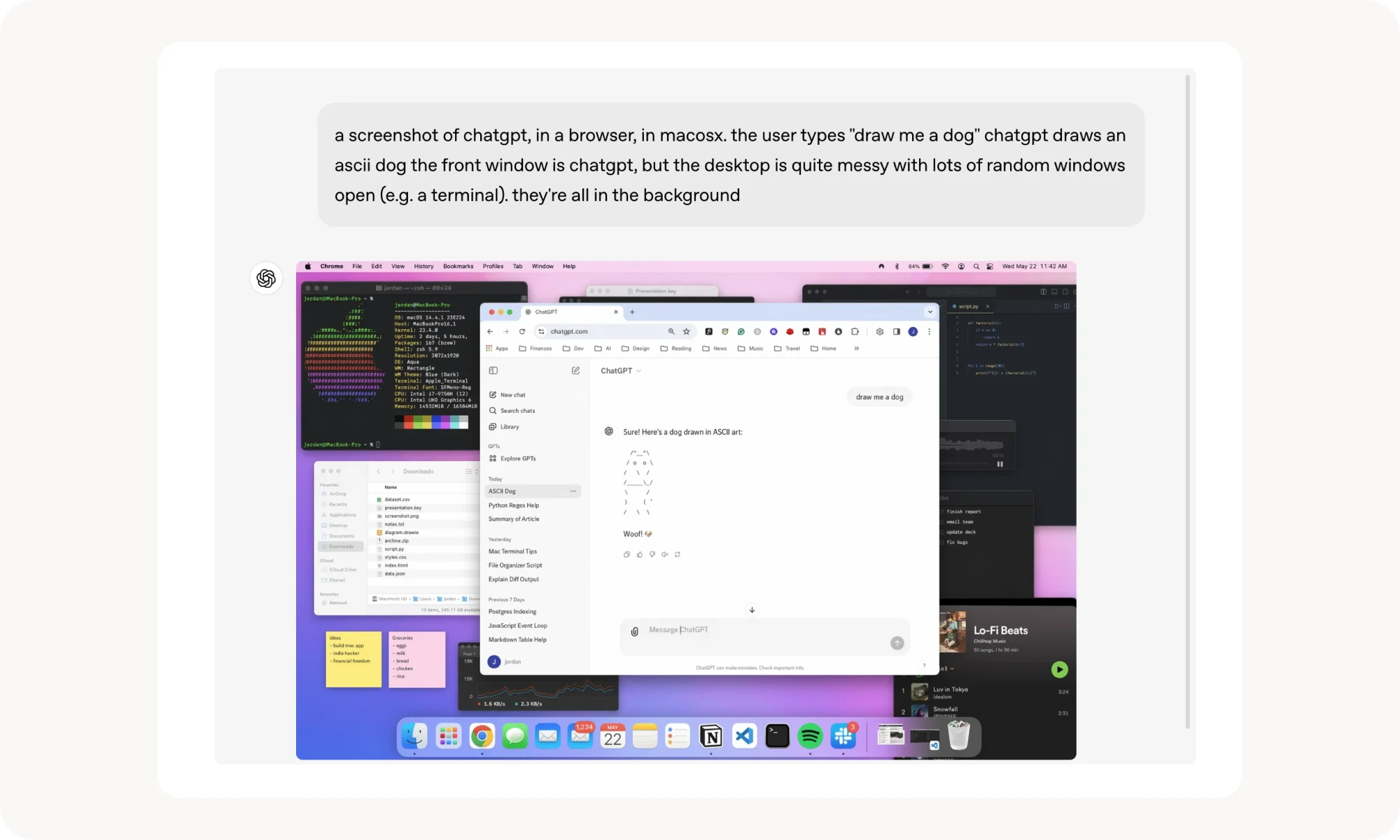
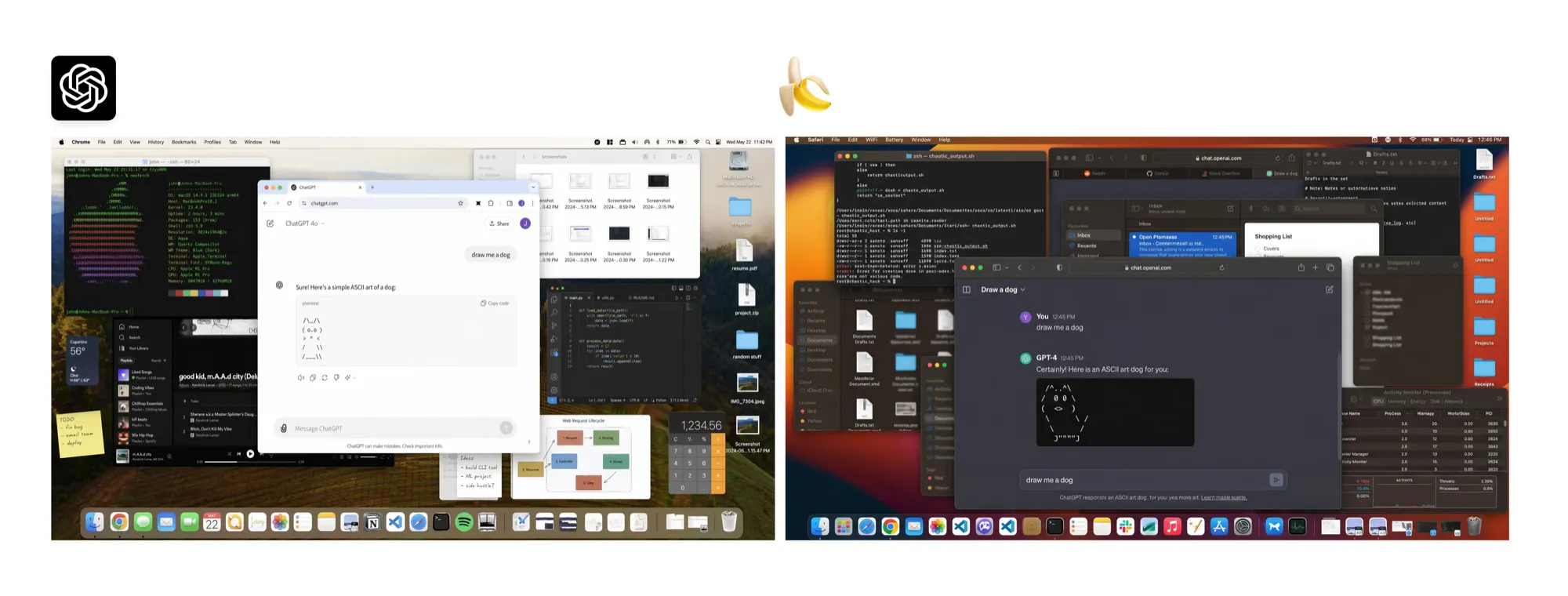
macOS desktop screenshot with ChatGPT
Prompt: a screenshot of chatgpt, in a browser, in macosx. the user types "draw me a dog" chatgpt draws an ascii dog the front window is chatgpt, but the desktop is quite messy with lots of random windows open (e.g. a terminal). they're all in the background
This one looks really close at first, but if you look at the details the UI elements of different apps are more realistic in the GPT Image version, and all text is legible and realistic, while some of the text Nano Banana 2 added in the background is gibberish or made up of scribbles, rather than real letters.
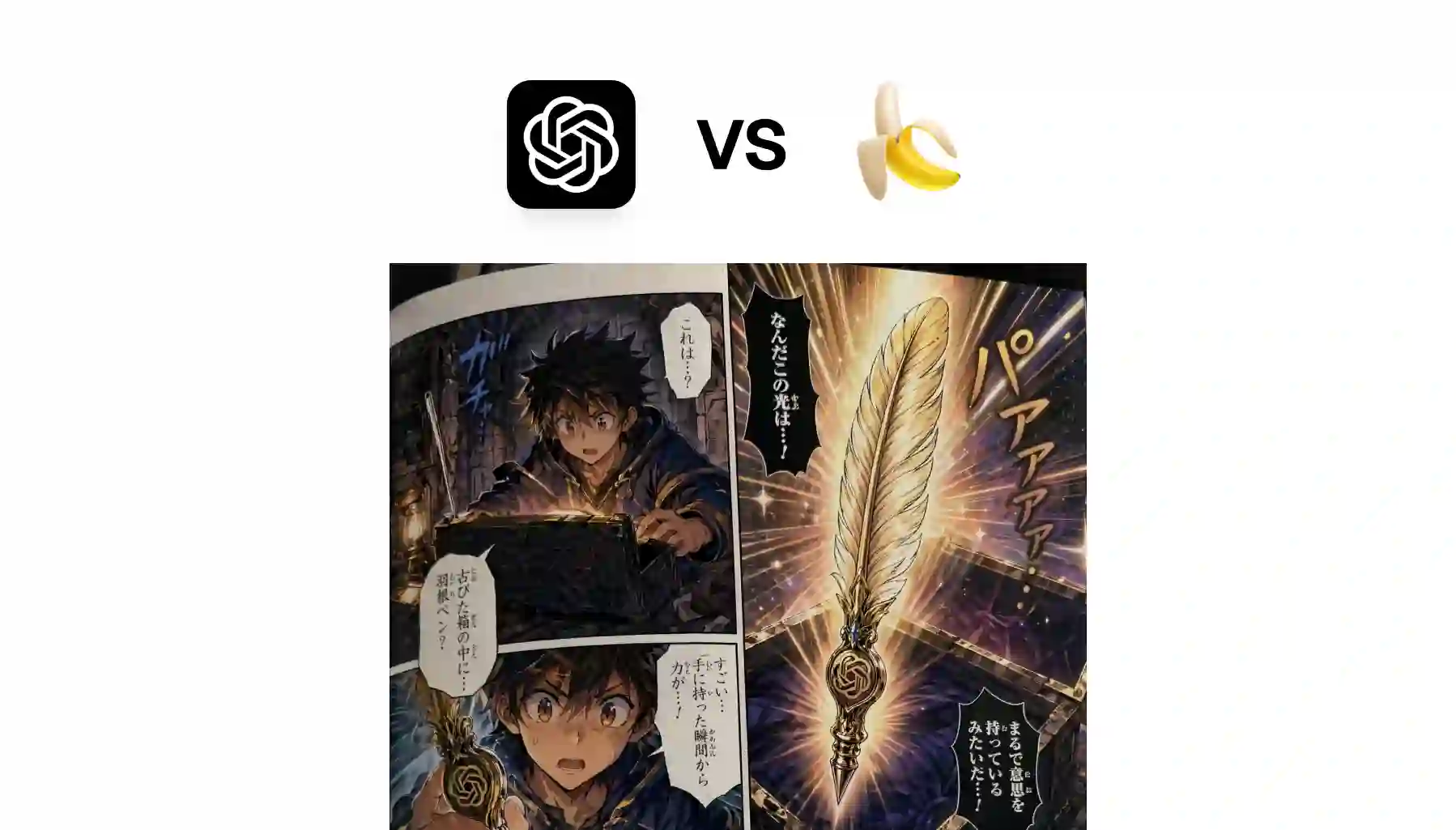
Manga page with in-panel Japanese text
Prompt: Make a sample page of a colorized Japanese shonen adventure manga. The page should vividly depict our main character found a magical quill. The name of the quill is called the Quill of GPT Image. Make it dramatic. The magical quill has strong power sealed inside it. Additional instructions: Aspect ratio: Portrait 1440x2560. The pen should have an {{OpenAI}} logo on it. The language throughout the manga should be Japanese. Think carefully first to make this a good story with good split of manga panels. The page should appear as a photo of a physical page, not a digital page.
We’re really starting to see GPT Image 2 outperform Nano Banana 2 here. Its style replication is s[ot on. Nano Banana 2 produced something manga-adjacent, but it’s not really Manga.
35mm film portrait on the coast
Prompt: A photorealistic candid travel scene of a person standing at a coastal roadside turnout on an overcast morning, shot on 35mm film. Natural imperfect framing, visible grain, ambient light, muted colors, wind in clothing and hair, cinematic realism, and the feeling of a lived-in documentary photograph.
Direct-flash night portrait, early 2000s
Prompt: A photorealistic snapshot portrait of two friends outside a venue at night, shot on a compact point-and-shoot camera with direct flash. Close subject distance, crisp foreground detail, deep shadow falloff, slightly raw spontaneous energy, nightlife atmosphere, and the unmistakable look of an early-2000s flash photograph.
GPT Image 2 really nailed the era's visual style and the image’s texture is photo-real, while Nano Banana 2 does look a little digital to us.
FAQ
Which is better, GPT Image 2 vs Nano Banana 2?
Comparing image generation models is always subjective, but on balance, GPT Image 2 is better than Nano Banana 2 — it leads in text rendering, realism, world knowledge, and generation speed while offering broadly the same feature set. In fact, it’s hard to name exactly what Nano Banana 2 does better.
Where can I try GPT Image 2 without a ChatGPT subscription?
GPT Image 2 is available on Overchat AI without needing a ChatGPT Plus, Pro, or Business subscription.
What makes GPT Image 2 text rendering so accurate?
The answer is autoregressive architecture — diffusion-based models treat text as pixels, but GPT Image 2 understands it semantically.
Which model offers the fastest generation speed?
GPT Image 2 in Instant mode generates images in roughly 3 seconds, making it much faster than Nano Banana 2 at 30–40 seconds in Pro mode and around 20 in Fast mode.
Bottom Line
GPT Image 2 feels like the biggest jump in AI image quality we’ve seen in a long time — probably since the original Nano Banana model. Nano Banana 2 is still really strong, mind you, but there’s a new leader in image generation right now, and OpenAI clearly holds the top spot. Generate with GPT Image 2 on Overchat AI.
Key Takeaways:
GPT Image 2 launched 21 April 2026 and took #1 on every Image Arena leaderboard by the widest margin ever recorded.
It beats Nano Banana 2 on photorealism, generation speed, and text rendering accuracy.
GPT Image 2's autoregressive architecture is the underlying reason it handles typography so well, specifically



.webp)
.webp)
.webp)
.webp)
.webp)
.webp)
.webp)