


Detector de código AI online gratuito

Cole qualquer trecho de código e descubra instantaneamente se ele foi escrito pelo ChatGPT, Copilot ou outra IA.

No sign-up required · Free to try
AI Code Detector

Paste code to analyze

Click anywhere or paste your code

AI Code Detector

Analyzing your code…

This usually takes a few seconds

Vocabulary analysis Waiting
Syntax patterns Waiting
Code structure Waiting
AI Code Detector
Analysis Complete
0% AI written
0%
How AI-like the word choices and phrasing are
Vocabulary
0%
Patterns in code formatting and syntax usage
Syntax patterns
0%
Overall code organization and architecture patterns
Code structure
90%+ accuracy
500K+ scans performed
10K+ developers

Detecte código gerado por IA com o melhor detector de código de IA

De acordo com alguns relatórios on-line, o código gerado por IA já representa cerca de 25 a 30% dos envios de código nas empresas da Fortune 500, e espera-se que essa participação cresça. Além disso, algumas empresas já gere 100% do código usando IA.

It’s becoming increasingly important to distinguish human-written code from AI-generated code for security, accountability, and transparency. That’s why, at Overchat AI, we've built this free AI code detector. It’s powered by a fine-tuned language model, achieves 90%+ detection accuracy, and supports the most popular programming langauges.

If you’re unsure whether a piece of code was written by a human or generated by AI, paste it into the tool and let it analyze it.

Principais benefícios do verificador de código Overchat AI

Overchat's AI code detector helps teams verify the origin of any code snippet in seconds — whether it was written by a developer or generated by ChatGPT, Claude, GitHub Copilot, Gemini, or another LLM. Paste code in Python, JavaScript, TypeScript, Java, C++, Go, Rust, PHP, or any of 15 supported languages and get a probability score, a per-segment breakdown, and an explanation of the patterns that triggered the result. Unlike generic AI text checkers, Overchat is tuned specifically for source code — so it flags AI patterns that plain-text detectors miss, without punishing clean, well-formatted human code.

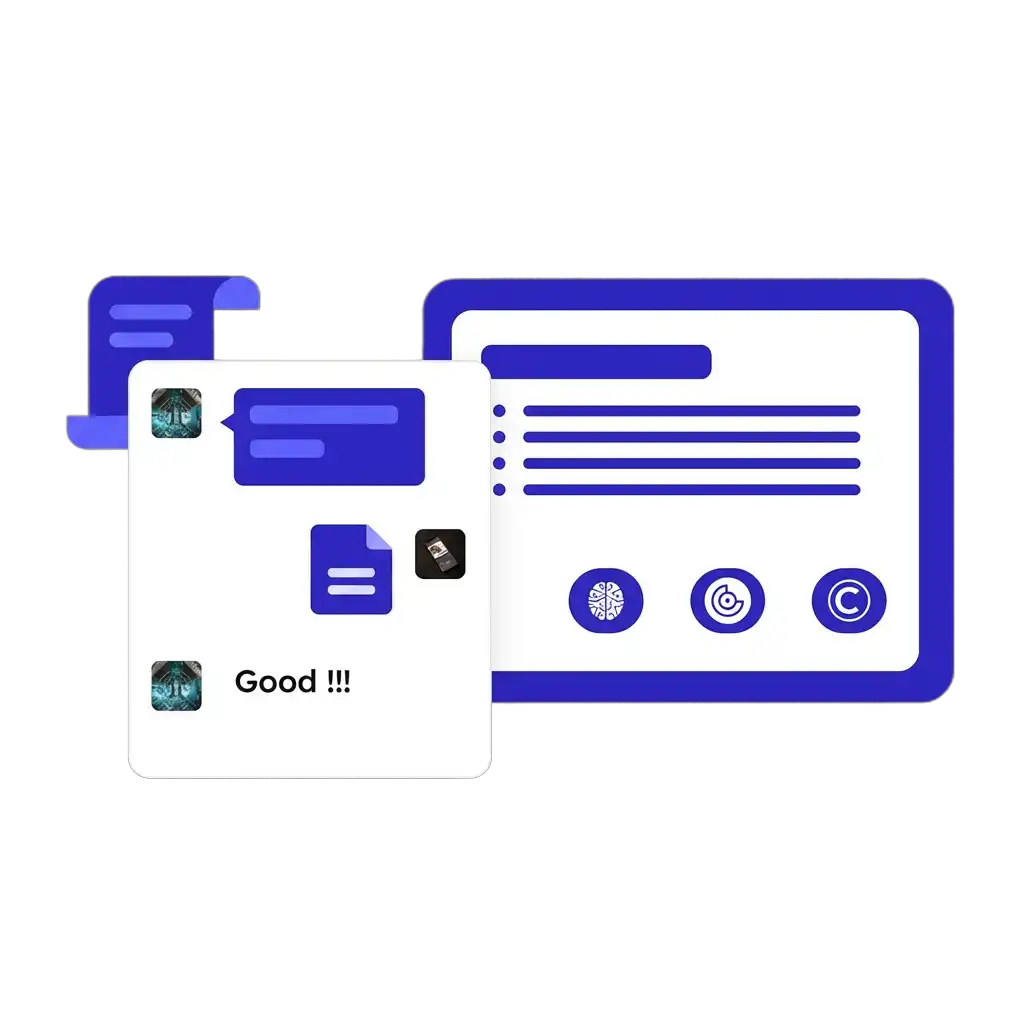
Ilustração minimalista da interface de usuário mostrando a interface de bate-papo e documento com IA do Overchat, com cartões em camadas, balões de mensagens e ícones simplificados em azul e branco, representando comunicação e geração de conteúdo com inteligência artificial.

Precisão de 99%

Nosso detector de código ChatGPT AI foi treinado em milhões de amostras de código para distinguir o código escrito por humanos do código gerado pela IA.

Fácil de usar

Para começar, basta colar seu código no campo de entrada, selecionar o idioma e clicar em analisar.

🌐

15 linguagens de programação

Essa ferramenta é compatível com Python, JavaScript, Java, C++, Go, Rust, TypeScript e muito mais. Veja a lista completa abaixo.

How to Use Overchat AI Code Detector

1.

Paste your code

Drop any snippet into the input field — up to several thousand lines. No sign-up, no file upload required. Your code is never stored or used for training.

2.

Select the language

Choose from Python, JavaScript, TypeScript, Java, C++, Go, Rust, PHP, and more. Language-specific detection improves accuracy — the tool applies different pattern models for strictly-typed languages like Rust and dynamic ones like Python.

3.

Review the results

Click Check your code and get a probability score within seconds, showing whether the snippet was likely written by ChatGPT, Claude, Copilot, Gemini, or a human. The breakdown highlights exactly which segments triggered the AI flag — naming patterns, comment density, or structural repetition — so you can verify the result yourself.

Try Code Detector
The Overchat AI code detector shows a low probability AI score of 29%.

Supported Languages

Python

Python

JavaScript

JavaScript

TypeScript

TypeScript

Java

Java

C++

C++

C#

C# icon

Go

Go icon

Rust

Rust icon

Ruby

Ruby icon

PHP

PHP icon

Swift

Swift logo

SQL

HTML

CSS

And more...

CASOS DE USO

Identifique a IA, independentemente da ferramenta

💼

Revise o código freelance

Execute os envios por meio de nosso verificador de código de IA para verificar se o trabalho não foi apenas copiado e colado do ChatGPT.

🎓

Revise o trabalho do aluno

Verifique as tarefas de programação dos alunos e garanta que as inscrições reflitam aprendizado e esforço genuínos.

🔍

Revise o código ao contratar

Analise as tarefas para levar para casa e verifique se o código foi criado pelo candidato, não por uma IA.

🔗

Verifique o código-fonte aberto

Mantenha a qualidade em seu projeto de código aberto examinando solicitações de pull e identificando contribuições geradas pela IA.

🐍

Revise projetos em Python

Nosso detector de IA de código Python é ajustado para os padrões de estilo e criação exclusivos do Python.

👥

Audite o código da sua equipe

Verifique o código em toda a equipe para entender quanta assistência de IA está sendo usada.

Pronto para verificar seu código?

Junte-se a milhares de desenvolvedores, educadores e equipes que já usam a IA do Overchat.

Experimente agora

Are AI Code Detectors Accurate?

Short answer: yes, but with nuance. Modern AI code detectors — including Overchat's — reach up to 99% accuracy on longer snippets (50+ lines) in well-represented languages like Python, JavaScript, and Java. On shorter code (under 10–20 lines) or less common languages like Rust or Swift, accuracy drops to around 85–90% because short code gives too few distinguishing patterns.

This is why any responsible detector returns a probability score, not a yes/no verdict.

False positives do happen. Clean, well-formatted code written by senior developers — consistent naming, thorough comments, idiomatic patterns — can look statistically similar to AI output. Conversely, skilled prompting can make ChatGPT or Claude produce code that mimics human quirks. No detector, ours included, should be the sole basis for accusing someone of using AI. Overchat addresses this by highlighting the specific segments that triggered the flag — naming conventions, comment density, structural repetition — so you can verify the decision yourself instead of trusting a black-box score.

The right way to use an AI code detector is as a signal, not a verdict.

Treat it like a spam filter or a plagiarism checker: it surfaces candidates for review, and a human makes the final call. For high-stakes decisions — hiring, grading, contractor reviews — combine the detection score with a follow-up conversation: ask the person to explain their logic, walk through a specific decision in the code, or extend a small piece live. A developer who wrote the code can always explain why; a copy-paste user usually can't.

How Does Our AI Code Detector Work?

Overchat's detector combines advanced language models with code-specific pattern analysis to determine whether a snippet was likely generated by ChatGPT, Claude, Copilot, Gemini — or written by a human.

When you paste a snippet and click Check your code, the detection pipeline runs four steps:

1. Language detection and tokenization. The code is parsed using a language-specific tokenizer so variables, comments, strings, and structural elements are classified correctly — not treated as plain text.
2. Semantic analysis. The parsed code is passed through a language model capable of reading source code, which evaluates meaning, style, and structural patterns — not just surface-level formatting.
3. Pattern scoring. Each dimension — naming conventions, comment density, error-handling style, structural repetition, idiomatic clarity — is scored against the fingerprints major AI models leave and typical human code for that language.
4. Probability output. The system returns a probability score with a per-segment breakdown, so you can see exactly which parts of the code triggered the AI signal.

This code-aware approach is why Overchat outperforms general-purpose AI text detectors on programming content — because our tool analyzes the code the same way a human reviewer would.

Can AI Code Detection Be Fooled?

Short answer: yes, but it's harder than most people think — and the common tricks leave traces of their own. Here's what  happens when someone tries to bypass an AI code detector.

Minor edits rarely work. Renaming variables, tweaking indentation, or sprinkling in a few comments doesn't remove the structural patterns the detector looks for — control flow, error-handling style, how functions are composed, how data moves between them. These fingerprints survive surface-level edits.

Obfuscation breaks functionality. Heavy renaming, stripping comments, or running code through a minifier can lower an AI score, but it also makes the code harder to read, maintain, or review — which defeats the purpose of submitting "clean" work. In a hiring or code-review context, obfuscated code is itself a red flag.

AI code humanizers have limits. Tools that claim to humanize AI-generated code usually rephrase comments and rename variables. They don't restructure logic, so the underlying patterns still read as AI-generated. Humanizers also tend to introduce subtle bugs, which is its own signal that the submitter didn't write the code themselves.

Mixing AI and human code is the hardest case. When someone generates code with AI and then rewrites parts of it by hand, detection becomes a judgment call. That's why Overchat returns per-segment breakdowns rather than a single verdict — so you can see which specific parts look AI-generated and ask the submitter to walk through them.

In short, no detector is 100% bypass-proof, and we don't claim otherwise. But in real-world hiring, academic, and code-review settings, most bypass attempts either fail outright or produce code that's suspicious for other reasons.

PERGUNTAS FREQUENTES

O que é um detector de código de IA e como ele funciona?

Nossa ferramenta funciona com todos os vídeos públicos do YouTube, incluindo vídeos regulares, vídeos curtos do YouTube, gravações de transmissões ao vivo, podcasts, tutoriais, palestras e muito mais. Qualquer vídeo com um URL válido do YouTube pode ser resumido, independentemente da duração ou do idioma.

Como usar o detector de código Overchat AI?

Ele funciona de forma semelhante a um detector de IA de texto. Basta colar seu trecho de código no campo de entrada acima e clicar em Analisar. A ferramenta escaneará o código e retornará um detalhamento junto com uma pontuação de IA. O uso é gratuito e não requer uma conta.

Isso é gratuito para usar?

Sim, a responsabilidade é fundamental para o desenvolvimento responsável da IA, e queremos apoiar isso. É por isso que a ferramenta é de uso gratuito e permanecerá assim enquanto pudermos suportá-la. Atualmente, o uso é ilimitado, embora possamos introduzir limites no futuro, dependendo do volume de envio.

Can an AI detector identify code from ChatGPT, Claude, Copilot, and Gemini?

Yes. Overchat's detector is trained on code generated by ChatGPT (GPT-4, GPT-4o, GPT-5), Claude (Sonnet, Opus), GitHub Copilot, Gemini, and DeepSeek. It recognizes the distinct fingerprints each model leaves — verbose docstrings from ChatGPT, defensive error-handling from Claude, compact idioms from Copilot — and flags them even when the code has been lightly edited by a human.

Which programming languages does the AI code checker support?

Overchat AI supports 15+ languages: Python, JavaScript, TypeScript, Java, C++, C#, Go, Rust, Ruby, PHP, Swift, SQL, HTML, CSS, and Shell/Bash. Each language uses a dedicated detection model tuned for its syntax and idioms — so a Python script is judged against Python patterns, not generic code heuristics. Accuracy is highest for Python, JavaScript, and Java, where training data is most abundant.

How accurate is the AI code detector?

On average, our AI code detector is 90%+ accurate, but accuracy depends on language and snippet length. On snippets over 50 lines of Python, JavaScript, or Java, the detector reaches up to 99% accuracy. On short fragments (under 10 lines) or less common languages, accuracy can drop, because there are fewer distinguishing patterns. We recommend pasting at least 20 lines for a reliable result.

Can the detector give false positives on human-written code?

Yes — any AI detector can. Clean, well-formatted human code (especially from senior developers following strict style guides) can share patterns with AI output: consistent naming, thorough comments, modern syntax. That's why Overchat returns a probability rather than a binary verdict, and highlights the specific segments that triggered the flag so you can verify the call yourself. Treat the score as a signal, not a final judgment.

What makes code look AI-generated vs human-written?

AI-generated code tends to have verbose variable names, unusually consistent formatting, redundant comments explaining obvious logic, textbook-perfect error handling, and few "shortcuts" or idiomatic quirks. Human code more often contains abbreviations, inconsistent spacing, TODO comments, commented-out fragments, and creative but imperfect solutions. Overchat measures these dimensions and weighs them per language.

Can I use Overchat to check student code or freelance submissions?

Yes. Educators use the detector to verify take-home programming assignments; engineering managers use it to review code from freelancers and contractors; hiring teams check technical interview submissions. Always combine the score with a follow-up conversation — ask the candidate to explain their logic — before making a final decision.

Sobre Overchat AI

A IA do Overchat traz para você o poder dos principais modelos de IA do mundo: ChatGPT, Claude, Gemini, Mistral e muito mais.

Interface de IA Overchat

Explore mais ferramentas de IA

Do blog