O Que É a DeepSeek AI — E Como Ela Se Compara ao ChatGPT?
Last Updated:
2026-09-08
O Que É a DeepSeek AI — E Como Ela Se Compara ao ChatGPT?
Se você está se perguntando o que é a DeepSeek AI, a resposta é bem simples. A DeepSeek AI é um laboratório de pesquisa em IA chinês que desenvolve grandes modelos de linguagem. A empresa lançou vários modelos no fim de 2024 e no início de 2025 que competem diretamente com o GPT-4 da OpenAI e o Claude da Anthropic, mas por uma fração do custo de operação.
A linha de modelos da DeepSeek AI inclui o DeepSeek V3.2 (o principal modelo de conversação) e o DeepSeek R1 (o modelo focado em raciocínio que mostra seu processo de pensamento). Eles ganharam destaque porque seus modelos têm desempenho comparável ao de alternativas muito mais caras nos benchmarks.
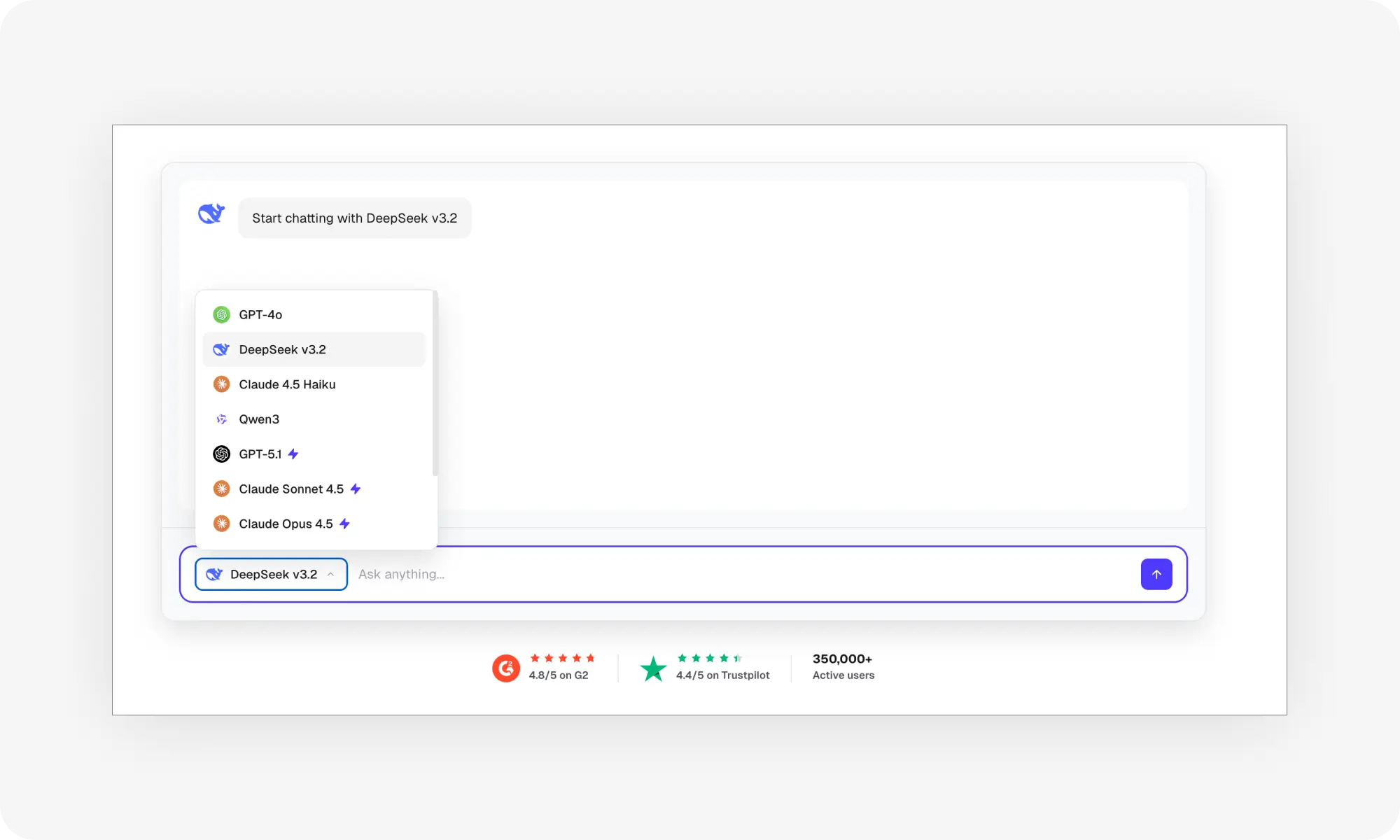
A DeepSeek disponibiliza seus modelos pelo DeepSeek chat no próprio site, por meio de acesso via API e através de plataformas de terceiros que integram a tecnologia. Você também pode conversar com a DeepSeek na Overchat AI.
A DeepSeek pertence à High-Flyer Capital Management, um fundo de hedge quantitativo chinês sediado em Hangzhou.
Ao contrário da maioria das gigantes de tecnologia chinesas, a DeepSeek lança modelos de peso aberto que pesquisadores podem baixar e rodar localmente, disponíveis no Hugging Face.
O DeepSeek R1 é um modelo de raciocínio que mostra todo o seu processo de pensamento antes de responder — especialmente útil para tarefas de matemática, programação e lógica, em que você precisa verificar o trabalho da IA.
O DeepSeek V4 (lançado em abril de 2026) é o carro-chefe atual — um modelo Mixture-of-Experts com janela de contexto de 1 milhão de tokens e profundidade de raciocínio configurável. Disponível nas versões V4-Pro (1,6 trilhão de parâmetros, 49 bilhões ativos) e V4-Flash (284 bilhões de parâmetros, 13 bilhões ativos).
O DeepSeek V3.2 continua sendo o principal modelo do dia a dia na maioria das integrações (incluindo a Overchat AI) — rápido, barato e com janela de contexto de 128 mil tokens.
Opções de acesso: de graça pela Overchat AI sem cadastro, pela API da DeepSeek (formato compatível com o da OpenAI) ou localmente, se você tiver o hardware (mais de 80 GB de VRAM para o modelo completo).
Em comparação ao GPT-5.2: o GPT-5.2 leva vantagem em entrada e saída multimodais (a DeepSeek é só de texto), no polimento da escrita e nas integrações de ecossistema. A DeepSeek vence em custo, peso aberto, execução local e (com o V4) tamanho da janela de contexto.
Linha de modelos: o V4 como novo carro-chefe, o V3.2 para uso cotidiano com Sparse Attention para eficiência em contextos longos, o R1 para raciocínio visível passo a passo, além de variantes especializadas como o DeepSeek-Prover para matemática formal.
Panorama geral: a DeepSeek treinou o V3 por cerca de US$ 6 milhões em computação — uma fração dos centenas de milhões da OpenAI —, provando que uma IA competitiva não exige orçamentos gigantescos.
Quem É a Dona da DeepSeek AI
A DeepSeek pertence à High-Flyer Capital Management, um fundo de hedge quantitativo sediado em Hangzhou, na China. O fundador do fundo, Liang Wenfeng, criou a DeepSeek como uma divisão de pesquisa em IA.
A empresa opera de forma relativamente independente em relação às típicas empresas de IA chinesas. Elas lançam seus modelos com peso aberto, o que significa que pesquisadores e desenvolvedores podem baixá-los e rodá-los localmente. A maioria das gigantes de tecnologia chinesas, como Baidu ou Alibaba, mantém seus modelos proprietários.
Essa abordagem aberta tornou a DeepSeek popular na comunidade de desenvolvedores. Você encontra os modelos deles no Hugging Face e pode rodá-los no seu próprio hardware, se tiver os recursos necessários.
Recursos da DeepSeek AI
Raciocínio Profundo
O DeepSeek R1 — e o mais recente V4 no modo "thinking" — mostram o processo de pensamento do modelo antes de dar uma resposta. Quando você faz uma pergunta, o modelo gera um "rastro de raciocínio", em que você o vê resolvendo o problema passo a passo.
Por exemplo, se você pedir para ele resolver um problema de matemática, vai vê-lo montar as equações, conferir o trabalho, identificar erros e revisar a abordagem — tudo visível na saída antes de ele apresentar a resposta final. Esse raciocínio em cadeia de pensamento (chain-of-thought) facilita identificar onde o modelo pode estar errado e ajuda a depurar problemas complexos.
Esse recurso é especialmente útil em tarefas de programação, matemática e raciocínio lógico, nas quais você precisa verificar o trabalho da IA.
Geração de Código
Tanto o DeepSeek V3.2 quanto o mais novo V4 lidam com várias linguagens de programação, incluindo Python, JavaScript, C++ e Java. Eles conseguem escrever funções completas, depurar código existente e refatorar implementações confusas.
Os modelos foram treinados em um grande corpus de código e conseguem entender o contexto entre diferentes arquivos. Se você estiver trabalhando em um projeto, pode passar vários arquivos para eles, e eles manterão a consistência com a sua base de código existente. O V4, em particular, se beneficia da janela de contexto de 1 milhão de tokens — grande o bastante para caber uma base de código de porte médio inteira em um único prompt.
Janela de Contexto Longa
O DeepSeek V3.2 processa até 128.000 tokens em uma única conversa — cerca de 90.000 palavras ou aproximadamente 300 páginas de texto. O DeepSeek V4 amplia isso de forma drástica, chegando a 1 milhão de tokens, no mesmo nível das maiores janelas de contexto dos modelos fechados de ponta. Você pode enviar bases de código inteiras, documentos longos ou vários artigos de pesquisa e fazer perguntas sobre todos eles de uma vez.
Processamento Multilíngue
O modelo lida especialmente bem com chinês e inglês, já que foi treinado intensamente nas duas línguas. Ele também oferece suporte a japonês, coreano, espanhol, francês, alemão e outros idiomas importantes.
Como Usar a DeepSeek AI
Você pode acessar a DeepSeek por vários caminhos, dependendo do que precisa.
Se você é desenvolvedor, também pode usar a API da DeepSeek gerando chaves de API pelo painel deles. A API segue o formato da OpenAI, então, se você já integrou o ChatGPT antes, pode trocar pelos endpoints da DeepSeek com pouquíssimas mudanças de código.
Para usuários avançados, é possível baixar os pesos do modelo e rodar a DeepSeek localmente. Isso exige um hardware robusto (várias GPUs com pelo menos 80 GB de VRAM para o modelo completo), mas dá a você controle e privacidade totais.
Preços da DeepSeek AI
A DeepSeek sai mais em conta do que a maioria dos concorrentes. O plano gratuito dá acesso completo aos dois modelos do DeepSeek chat pelo site deles.
Existem limites de uso, mas, para um uso casual, você não vai esbarrar neles. A maioria das pessoas consegue usar a DeepSeek sem pagar nada, a menos que pretenda usar a API, que é paga.
Dito isso, a API da DeepSeek também custa bem menos em comparação com o ChatGPT ou o Claude. A tabela abaixo compara os preços de API entre os modelos mais populares:
Modelo
Entrada (por 1M de tokens)
Saída (por 1M de tokens)
DeepSeek V3.2
US$ 0,28
US$ 0,39
DeepSeek R1
US$ 0,55
US$ 2,19
GPT-5.2
US$ 1,75
US$ 14,00
Gemini 3 Pro
US$ 2,00
US$ 12,00
Claude Opus 4.5
US$ 5,00
US$ 25,00
O DeepSeek V3.2 é drasticamente mais barato do que os modelos concorrentes. Ele custa 6x menos que o GPT-5.2, 7x menos que o Gemini 3 Pro e 18x menos que o Claude Opus 4.5 nos tokens de entrada. Os tokens de saída mostram economia semelhante.
Até o DeepSeek R1 (o modelo de raciocínio) custa 3x menos que o GPT-5.2 e 6x menos que o Gemini 3 Pro. Um milhão de tokens equivale a cerca de 750.000 palavras. A menos que você processe quantidades enormes de texto todos os dias, os custos se mantêm baixos.
DeepSeek vs ChatGPT
A tabela abaixo mostra como o DeepSeek V3.2 e o R1 se comparam ao ChatGPT nos benchmarks atuais. O DeepSeek V4 foi lançado em abril de 2026 e, de modo geral, fecha a distância para a família GPT-5 nos benchmarks de raciocínio — os números de terceiros ainda estão sendo publicados em meados de 2026, então mostramos aqui os valores do V3.2/R1 e discutimos o V4 de forma qualitativa.
Benchmark
DeepSeek V3.2
DeepSeek R1
GPT-5.2 Thinking
AIME 2025 (Matemática)
96,0%
87,5%
100%
GPQA Diamond (Ciências)
59,1%
81,0%
92,4%
SWE-bench Verified (Programação)
73,1%
57,6%
80,0%
ARC-AGI-2 (Raciocínio Abstrato)
—
—
52,9%
Principais Diferenças:
A janela de contexto depende do modelo da DeepSeek. O GPT-5.2 tem uma janela de contexto de 400.000 tokens. O DeepSeek V3.2 fica em 128.000 tokens (menor que a do GPT-5.2), mas o DeepSeek V4 salta para 1 milhão de tokens — mais que o dobro do GPT-5.2 e no mesmo nível das maiores janelas dos modelos fechados.
O GPT-5.2 oferece suporte a entradas e saídas multimodais (imagens, tarefas de visão). O DeepSeek V3.2 e o R1 são apenas de texto. Se você precisa de análise de imagens, o GPT-5.2 é obrigatório.
O peso aberto da DeepSeek significa que você pode rodá-la localmente se a privacidade dos dados for importante ou se você quiser fazer fine-tuning do modelo. O GPT-5.2 só roda nos servidores da OpenAI.
O estilo de escrita do GPT-5.2 tende a soar mais natural. Ele foi muito otimizado para experiências de chat voltadas ao consumidor.
O ChatGPT tem mais integrações de terceiros, maior reconhecimento de marca e um ecossistema mais amplo. A DeepSeek está crescendo rápido entre desenvolvedores que priorizam eficiência de custo e a flexibilidade do código aberto.
Os Modelos da DeepSeek Explicados
DeepSeek V4 (V4-Pro e V4-Flash)
Lançado em abril de 2026, o V4 é o carro-chefe atual da DeepSeek e o maior salto desde o V3. Ele vem em dois tamanhos: V4-Pro (1,6 trilhão de parâmetros no total, 49 bilhões ativos) e V4-Flash (284 bilhões no total, 13 bilhões ativos). Os dois são modelos Mixture-of-Experts com janela de contexto de 1 milhão de tokens.
A grande mudança de arquitetura é uma nova Hybrid Attention Architecture, que combina Compressed Sparse Attention e Heavily Compressed Attention, permitindo que o V4-Pro use apenas cerca de 27% da computação e 10% da memória que o V3.2 precisava para a mesma carga de 1 milhão de tokens. O V4 também introduz profundidade de raciocínio configurável — os desenvolvedores podem ajustar o nível de esforço de pensamento por requisição.
Os dois modelos V4 são de peso aberto e estão disponíveis no Hugging Face. Use o V4-Pro quando quiser qualidade máxima em tarefas difíceis ou precisar processar documentos enormes; use o V4-Flash quando a velocidade e o custo importarem mais que o desempenho bruto.
DeepSeek V3.2
Este ainda é o modelo cavalo de batalha em muitas integrações (incluindo a Overchat AI). Ele é otimizado para conversas, escrever código simples e analisar texto. Esta versão inclui o DeepSeek Sparse Attention (DSA), que reduz drasticamente os custos no processamento de contextos longos. Use-o para tarefas do dia a dia em que você precisa de desempenho confiável sem mostrar o processo de pensamento — e em que a estrutura maior do V4 não é necessária.
DeepSeek R1
Este é o modelo de raciocínio original, lançado no início de 2025. Ele mostra sua cadeia de pensamento e é especializado na resolução de problemas complexos. Quando você faz uma pergunta, vê o modelo resolvendo o problema passo a passo antes de dar a resposta final. Use-o quando precisar verificar a lógica da IA ou resolver problemas técnicos difíceis, como matemática, programação competitiva ou depuração complexa.
DeepSeek V3.2-Speciale (histórico)
Uma variante de alta computação por tempo limitado do V3.2, otimizada para desempenho máximo em benchmarks de elite. Ela alcançou resultados no nível de medalha de ouro nas competições IMO, IOI e ICPC e ficou disponível até 15 de dezembro de 2025. Ela não é mais um endpoint ativo, mas seus resultados foram o que provou que a arquitetura por trás do V3.2 conseguia igualar os modelos fechados de ponta em tarefas difíceis de raciocínio — abrindo caminho para o V4.
Conclusão
Principais conclusões:
A DeepSeek é um modelo de IA de peso aberto, semelhante ao GPT da OpenAI.
A empresa pertence à High-Flyer Capital Management, um fundo de hedge quantitativo chinês.
O DeepSeek V3.2 custa cerca de 6 a 36 vezes mais barato do que o GPT-5.2 para usar pela API deles, dependendo da variante.
O DeepSeek V3.2 obteve 96,0% nos benchmarks de matemática AIME 2025, igualando o desempenho do GPT-5.2 por uma fração do custo.
Os principais modelos são o V4 (o novo carro-chefe, com contexto de 1 milhão de tokens), o V3.2 para uso cotidiano barato e o R1 para tarefas de raciocínio que mostram o processo de pensamento do modelo.
A DeepSeek provou que modelos de IA competitivos não exigem orçamentos gigantescos. Eles construíram o V3 por cerca de US$ 6 milhões em custos de computação — enquanto isso, a OpenAI gasta centenas de milhões para treinar seus modelos.
Essa eficiência vem de melhores técnicas de treinamento e de melhorias arquiteturais inteligentes.
Para os usuários, isso significa mais opções. Você não fica preso a provedores de API caros se precisar de recursos poderosos de IA. O peso aberto significa que você pode modificar e personalizar o modelo para necessidades específicas.